Explaining The Abrahamic Obsession With Anti-Racism And Anti-Nationalism

No-one virtue signals harder than Abrahamists bragging about how anti-racist they are. Some have argued that this reflects a deep-seated guilt complex – the Abrahamist’s attempt to atone before a wrathful deity. This essay will argue that the Abrahamist rejects race and nation for the same reason they reject family: because Abrahamism is an inherently unnatural mentality that perverts all thought and all morality.

For all their disagreements, the followers of the various Abrahamic cults can agree on one thing: cult comes before kin.

For the Christian, this is simply following Jesus’s threat from Matthew 10:37: “Anyone who loves his father or mother more than Me is not worthy of Me; anyone who loves his son or daughter more than Me is not worthy of Me.” Here Jesus, like any other cult leader, rejects those who will not reject their own family in favour of him.

This sentiment is harmonious with the sentiment that, for Christians, there is neither Jew nor Greek, for all are one in Rabbi Yeshua. The Christian abandons his ties to the natural world in order to earn the grace of his universalist god. Yahweh and his prophet Rabbi Yeshua are not pleased by those who maintain the natural consciousness of family, nation or race. All are to be subjugated to cult consciousness.

Muhammad, for his part, is recorded as having preached that “​All mankind is from Adam and Eve, an Arab has no superiority over a non-Arab, nor a non-Arab has any superiority over an Arab; also a white has no superiority over black, nor a black has any superiority over white except by piety and good action.” Here, “piety and good action” means, of course, submission to Islam.

This has led some to state that “The religion of Islam forbids racism and racial inequality.” Certainly, the Muslims of the Barbary slave trade were not white supremacists. Like the Christians, Muslims are happy to admit that they consider people who share their cult, but not their race, to be of greater importance than those who share their race but not their cult.

This is why both Christians and Muslim immigrants to the West are constantly screaming about racism. In destroying the national consciousness of their host nations, they achieve the Abrahamic objective of destroying all competing power structures. It’s also why Christians credit all of the achievements of whites to Christianity, but blame all of the crimes of Christianity on whites.

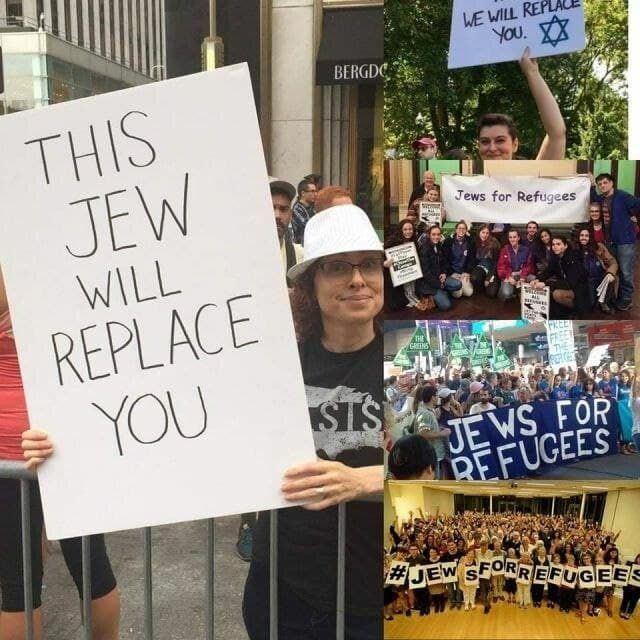
It’s more complicated for Jews. Being both religion and race, Jews lack the self-destructive, self-righteous masochism of Christians and Muslims. But, like their Abrahamic brethren, they still do everything they can to destroy family consciousness, national consciousness and race consciousness. This is why organisations that lobby to increase refugee quotas are often full of Jews.

Marxists, who are realistically just a secular form of Abrahamist, are little different. They seek to destroy familial, national and race consciousness for the same reason as the other Abrahamists – because those are competing loyalties. The Marxist puts his ideology above his kin, just as the religious Abrahamist puts his cult above his kin. Also like the other Abrahamisms, Marxist ideology is universal, which manifests as globalism in secular space.

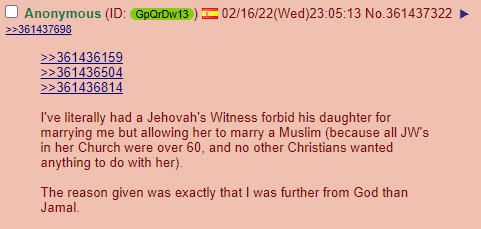
For the Abrahamist, religious or secular, creed comes before kin, always. In fact, it goes much further. The more you can reject your own kin, the more righteous and holy you are. The highest moral achievement of the Abrahamist is to completely sever ties with one’s blood family and race. Yahweh is a jealous god, and all other loyalties must be abandoned. It must be all Yahweh, all the time.

Highest of all in the Abrahamic moral hierarchy is the one who can impassively watch on as their nation or race is destroyed, or who can even assist in that destruction. To resist the destruction of one’s own kin, in the Abrahamic mindset, is to cling to the material world, and is therefore a spiritual failure. The person who identifies with their blood family and race is the equivalent of the devil worshipper.

Someone indifferent to the destruction of their family, nation or race, on the other hand, can be said to have transcended petty material concerns and become something truly holy. If you can sit back indifferent while your family, nation or race is destoyed and replaced, you have truly achieved divine status.

Like everything else Adharmic, this mentality is an unbalanced phenomenon that goes against natural law, and therefore will not exist forever. The balanced Dharmic view suggests that one’s yin energies might come from one’s physical incarnation, and that one’s yang energies might come from one’s spiritual incarnation, and therefore that the two must be kept in balance.

The mentally ill person says No to life, sacrificing the physical as if it was something evil. They do not play their role as a being trying to overcome challenges for the sake of entertaining the gods. Rather, they withdraw, and neglect their physical, recreational, social and even their survival needs.

The mentally healthy person says Yes to life, and exults in the niche that they inherited from their forebears. They set aspirations, and then strive to achieve them, overcoming the challenges that they encounter. They understand that the material world is not something to cower away from, but is rather the stage on which the play of life takes place.

This doesn’t mean that saying Yes to life requires indulging in all of the cruelties of the natural world.

It means finding the correct balance between spiritual and material concerns. The Elementalist suggestion is to live one’s life to the fullest, but in the knowledge that the material world is not the fundamental basis of reality. The material world is one Great Fractal dreamed up by God for the purpose of entertainment, and the most important thing is to correctly play one’s role within it, whatever that might be.

The Abrahamist fails to understand this need for balance, choosing instead to virtue signal their moral superiority to the material world, which they reject in favour of a promised land in the afterlife. This is a fundamentally unhealthy and unnatural attitude that only leads to great suffering.

*

If you enjoyed reading this essay/article, you can get a compilation of the Best VJMP Essays and Articles from 2021 from Amazon for Kindle or Amazon for CreateSpace (for international readers), or TradeMe (for Kiwis). A compilation of the Best VJMP Essays and Articles of 2019, the Best VJMP Essays and Articles of 2018 and the Best VJMP Essays and Articles of 2017 are also available.

*

If you would like to support our work in other ways, subscribe to our SubscribeStar fund, or make a donation to our Paypal! Even better, buy any one of our books!
Arriving At The Beginning

Much of what we call ‘waking up’ or ‘enlightenment’ is really just about our finally becoming comfortable with living paradox, which is to say living as paradox.

Our usual modality is to live through the screen of the mind with its beliefs, judgments and preconceptions. Awakening isn’t really a choice so much as it is a conscious recognition of that which is happening regardless. What is it that is finally real? Who is this one to whom we attribute all of these thoughts, experiences and memories?

These are answers you will not find in any book.

When you awaken to the truth of who you are, you aren’t in a state of knowing or unknowing, rather you are in a state of authenticity. This becomes self-evident, because no further question emerges. Even calling it a state does not adequately pull together the breadth of awareness that transcends all states.

It isn’t something new that you come across. It is always immediately available as the closest truth of who you are. It can’t be an object of knowledge. There isn’t a separate someone to figure it out, and there really isn’t anything to figure out.

Our various traditions have played a part in advertising awakening as some kind of permanent removal from the challenges of earthly existence, in which we are removed to some distant heaven or nirvana in a perfected state. The trouble with this view is that our freedom is very intimately linked with our authentic engagement with this moment, wherever it is that we happen to find ourselves. In one sense, our ground of being is so ordinary we do not see it and we therefore completely take it for granted.

We have also inherited a notion of someone who as awakened to their true nature as being someone who has ‘arrived’ on a spiritual level, which is really another extension of the dream state.

These people can easily become attributed with all kinds of projected virtues and assumptions. This invariably leads to much confusion and disillusionment.

It is intoxicating to the ego to imagine that people have crossed over the threshold in this way, and the allure that we too could also achieve this, on the implicit condition that we follow instructions carefully and repeat the program step by step. In other words, if we act and behave just right, we will get it. Can you think of any other field of human life this condition has been promoted?

This is a remarkably dangerous misunderstanding. Everyone has seen the effects of this in our world. We worship those we think have made it, and this attitude filters down into every facet of life until our entire worldview and life structure is dictated by the insatiable need to arrive. The big ways are easier to see, but what about the small ways in which we give away our freedom?

For example, allowing others to decide when we are happy or upset, or placing our sense of worth in the eyes of others – as though we even knew what they were seeing!

This is all a very elaborate, coherent, and above all convincing illusion, and it is one we have all bought into at some point. Some of us continue to pay the subscription to this worldview, while others among us have grown to see it as flimsy and untenable, but are not really quite sure what could replace it as a foundation.

This brings us to awakening to yourself as awareness, which is simply the withdrawal of identity from the pervasive illusions of the mind-ego, and quite literally, coming to your senses.

This withdrawal from illusion is actually easy in principle. You simply stop investing your energy in what you recognise to be illusory. The mechanism is quite simple, only it requires a lot of honesty which is usually leveraged upon the total dissatisfaction with the consensus of illusory beliefs which form the status quo.

The difficulty comes from the tendency to withdraw from illusion being quite painful, at least initially. It can very often lead to pain in the same way that recovering from a foolish investment can be painful, because often there is a great degree of investment by way of time, money and resources.

When there is only who you truly are, then what will end is the mind’s fascination with the mythologised ‘other’ which is always frustratingly just out of your reach. Your hunger for spiritual attainment will naturally retire, and you will accommodate no opinion of yourself – yours nor anyone elses, because you will know that in the final analysis, none of this touches who you truly are.

This is not a theory, but an experiential transition. Be forewarned – you will not gain anything. In fact, you will lose your fictional world, and you will know your place humbly amongst your brothers and sisters. The only part of you that desires reconnection with what is real is the only part of you that is real.

We are so hungry for the imagined reality of this success that we will often bargain away nearly anything in the transaction, including our honesty, our integrity, our happiness and well-being.

People are often quite prepared to allow themselves to be brainwashed by whoever they have delegated authority to on the condition that they will be allowed to partake in their share of glory.

The discovery of who you are is the termination of the primary identity pursuit, and the ending of the persistent denial of one’s own inherent freedom and worth. Awakening is the end of existential insanity.

Fortunately, you never need to worry about trying to figure out who you truly are. All you need to do is to stop energizing every thought and movement away from your natural state, and witness that which is right in front of you. Your arrival at the beginning is simultaneously to comprehend the nature of the end. This unspeakable depth of experience is what is hinted at in the symbol of the ouroboros, the serpent eternally swallowing his own tail.

It is one thing to believe that there is neither beginning nor ending, but another thing entirely to bring forth that truth within your experience. This is the sacred invitation to living paradox. You must eventually come to arrive at the point that you always were. How could you do otherwise? What else is there worth doing? All that it requires is the complete willingness to forfeit every idea of who and what you are – just for one moment.

*

Simon P Murphy is a Nelson-based esotericist and philosopher, and author of His Master’s Wretched Organ, a brilliant collection of weird fiction stories.

*

If you enjoyed reading this essay/article, you can get a compilation of the Best VJMP Essays and Articles from 2021 from Amazon for Kindle or Amazon for CreateSpace (for international readers), or TradeMe (for Kiwis). A compilation of the Best VJMP Essays and Articles of 2019, the Best VJMP Essays and Articles of 2018 and the Best VJMP Essays and Articles of 2017 are also available.

*

If you would like to support our work in other ways, subscribe to our SubscribeStar fund, or make a donation to our Paypal! Even better, buy any one of our books!
If You Want An Alliance To Work, Leave Out The Christofascists

Suggestions did the rounds again this week that the minority parties unite under one banner. This has been a perennial suggestion since my first time in the Aotearoa Legalise Cannabis Party in 2007. Now, as then, egos prevented the suggestion from getting anywhere. One thing would make forming an alliance to get over the 5% threshold much easier: leave out the Christofascists.

Ironically, the most recent suggestion to unite was made by Brian Tamaki. But few are willing to work alongside Tamaki on account of his toxic reputation. Tamaki is a classic example of a Christofascist, Christofascism being “the political direction of all attempts to place Christ at the center of social life and history.”

Tamaki, like his fellows Elliot Ikilei and Leighton Baker, wants to use the State to smash people he hates: drug users, homosexuals and prostitutes being the usual targets. The Christian fascist logic is that these people shouldn’t be tolerated. Like other fascists, the Christofascist has a massively overflated opinion of their own moral judgment.

Christian fascists don’t work well with others. Combining the ruthlessness of the authoritarian right with the arrogance of the authoritarian centre, these fascists are everything politics shouldn’t be: narcissistic, pompous fanatics who literally believe they’re appointed by God to rule over the rest of us.

Few others are as obnoxious as the Christofascist. Like their Abrahamic counterparts the jihadists, the Christofascist exists in a perpetual state of war against all outsiders. This puts him in a mindset of antagonistic, spiteful aggression, exemplified by their rejection of cannabis law reform.

As was observed at the Wellington protests earlier this year, co-operating with Christian fascists is extremely difficult. Not only do they want to hog the stage and the PA system, but they have no respect for other points of view, are happy to negotiate on behalf of everyone else without getting their consent for it, and are willing to jump in at the last minute to steal the limelight.

This level of arrogance is not as great as the arrogance that launched the Inquisition or murdered Hypatia, but it’s getting up there. It’s an arrogance that can only be submitted to, not co-operated with. So the proposal of this essay is that we don’t co-operate with them, i.e. we leave the Christofascists to form their own party and let the true freedom movement unite under a separate banner.

This arrangement would leave New Conservative, Advance NZ, ONE Party, Vision NZ and any Brian Tamaki, Elliot Ikilei or Leighton Baker-related vehicles to form their own Christofascist party. This party could then have the policy of banning all drugs, homosexuality, prostitution, music, dancing and levity. They can even freely propose to again make it legal to rape your wife.

The non-Christofascist parties outside of Parliament won 138,455 votes in 2020, or some 4.9% of the total (New Zealand First 75,021, or 2.6%; The Opportunities Party 43,449, or 1.5%; Aotearoa Legalise Cannabis Party 13,329, or 0.5%; NZ Outdoors Party 3,256, or 0.1%; Sustainable NZ Party 1,880, or 0.1%; Social Credit 1,520, or 0.1%). If these parties would combine under one non-Christofascist banner, they could seriously challenge the 5% threshold.

Possibly this would have to be a Winston Peters-led movement in order to get enough votes, and he might reason that he has a better chance by himself with New Zealand First (which is fair, considering that he’s been in Parliament with them before). Some might not think favourably of Peters, but he has one quality that contrasts him with the Establishment – he’s a nationalist.

An anti-Establishment, anti-Christofascist alliance would inevitably be nationalist in character. As such, it’s fitting for Winston Peters and his party to be at the centre of it. This might make it hard to integrate The Opportunities Party, who are led by – of all things – a foreign ex-Goldman Sachs banker. But integration of the others would not be too difficult.

The Aotearoa Legalise Cannabis Party is already nationalist in the sense that the vast majority of their voters are New Zealand-born, and very few of their voters are immigrants. An alliance that explicitly rejected the War on Drugs could easily win the support of ALCP voters, and this would suit a nationalist vehicle, as the War on Drugs was an imported foreign concept from the beginning.

The Outdoors Party, Sustainable NZ and Social Credit have several quality candidates in (among others) Sue Grey, Vernon Tava, Chris Leitch and Amanda Vickers. If candidates like these could ally with the high-IQ Kiwis in The Opportunities Party (like Dr. Ben Peters), with a token representative from the ALCP, and under the paternal guidance of Winston Peters for one last crusade against the Establishment, they could do well.

*

If you enjoyed reading this essay/article, you can get a compilation of the Best VJMP Essays and Articles from 2021 from Amazon for Kindle or Amazon for CreateSpace (for international readers), or TradeMe (for Kiwis). A compilation of the Best VJMP Essays and Articles of 2020, the Best VJMP Essays and Articles of 2019, the Best VJMP Essays and Articles of 2018 and the Best VJMP Essays and Articles of 2017 are also available.

*

If you would like to support our work in other ways, subscribe to our SubscribeStar fund, or make a donation to our Paypal! Even better, buy any one of our books!

Why The Government Lets Violent Criminals Run Rampant

Many were stunned by the news this week that Daniel Havili, who killed Fau Vake with a coward’s punch in Auckland, was sentenced to a mere 33 months’ imprisonment. Havili will, in all likelihood, be released after serving a little over a year. Considering the historical severity of sentences for killing people, this is very close to getting away scot free.

This incredibly light touch comes in the wake of other soft sentences for violent assaults. In one notorious recent case, Mongrel Mob chapter president Terry Berryman was sentenced to 23 months’ imprisonment for an 18-man gang home invasion that stomped on a man’s head in front of his children. Most of the gang members involved were not prosecuted.

This has prompted many to ask: why such light sentences for such barbaric crimes?

These sentences seem incongruous with the fact that cannabis growers such as Harley Brown get a similar amount of time in prison for growing medicinal cannabis. Brown was sentenced to 27 months’ imprisonment for a piddling amount of cannabis – at most $100,000 worth. This is for an “offence” that not even 51% of the New Zealand population believes should be an offence.

Other working-class whites, like Philip Arps, don’t even have to grow cannabis. Arps was sentenced to 21 months’ imprisonment for sharing the Christchurch mosque shooting video.

So why do violent criminals almost get a free ride from the courts, when peaceful people get smashed? Why would sharing a video attract a similar sentence to a gang leader doing a home invasion in which children are subjected to the sight of their father getting his head stomped?

The answer lies in understanding the motivations, intentions and aspirations of the ruling class.

Everyone who knows anything about psychology knows that violent criminals cheer at such weak sentences as the ones listed above. For professional criminals, arrests and prison time are just part of the cost of doing business. The lighter the sentencing, the lower the expenses. Therefore, the lighter the sentencing, the more crime pays.

These weak sentences mean that criminals can freely intimidate other people with threats of violence, knowing that the judicial consequences will be minimal. When sentences are as weak as they are in the West today, violent criminals get to reign in terror over the vulnerable (usually working-class) communities in which they reside. Even if the Police deal to them, they’ll be out again soon enough, and in most cases barely inconvenienced.

This end result – widespread terror – is not accidental. It is, in fact, the entire goal of having a justice system in which violent criminals are left to run rampant. In a state of terror, both individuals and populations are unusually willing to forfeit their rights, needs and desires. As such, it’s easier to rule over a terrorised population than a free one.

The Government allows violent criminals to run rampant in New Zealand for one simple reason: to terrorise the rest of us into submission.

VJM Publishing wrote in a previous article why the Government lets in terrorists like the New Lynn supermarket stabber Ahamed Samsudeen. The reason is the same. They let violent criminals run loose for the same reason that they let terrorists run loose: to maximise the degree of fear the average person feels.

Widespread fear makes the population submissive, and is necessary for any authoritarian government to maintain control. Without the fear, the population would rise up against authoritarianism and overthrow it. The fear beats them down and makes them suspicious of their neighbours and workmates, so that no-one organises any resistance.

The control system has many ways of spreading fear through the populace – the foremost of which is the mainstream media – but violent criminals serve this purpose as well as terrorists do.

The surge of adrenaline people get from seeing a patched gang member in public, and the adrenaline fatigue that inevitably follows it, primes people’s minds to submit. Engendering this submission, as George Orwell showed us, is the end goal of all political action and is the ultimate aspiration of the control system.

*

If you enjoyed reading this essay/article, you can get a compilation of the Best VJMP Essays and Articles from 2021 from Amazon for Kindle or Amazon for CreateSpace (for international readers), or TradeMe (for Kiwis). A compilation of the Best VJMP Essays and Articles of 2020, the Best VJMP Essays and Articles of 2019, the Best VJMP Essays and Articles of 2018 and the Best VJMP Essays and Articles of 2017 are also available.

*

If you would like to support our work in other ways, subscribe to our SubscribeStar fund, or make a donation to our Paypal! Even better, buy any one of our books!