
The Seven Alchemical Ages Of Man

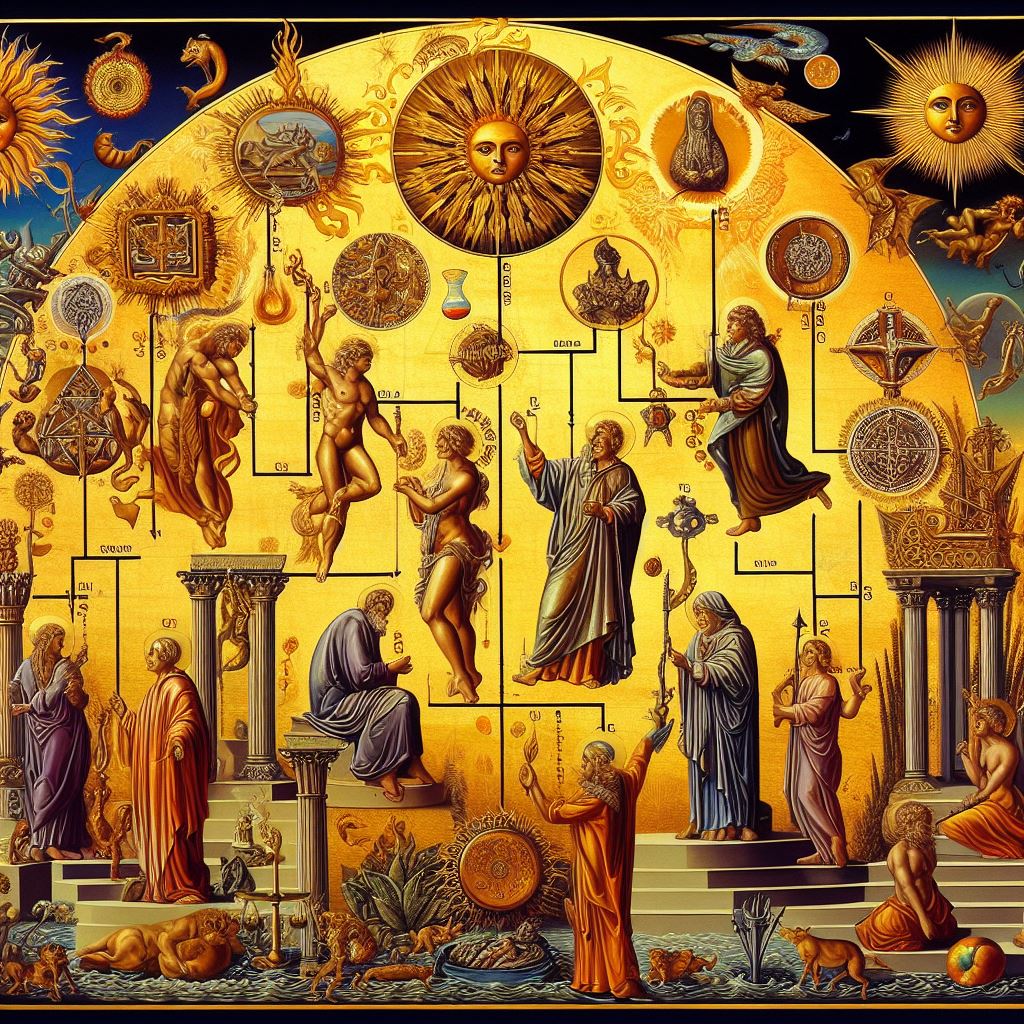
In the same way that the Mithraic Ladder consists of seven steps, so too can the life of a human being. From an alchemical perspective, the human life can be divided into seven distinct stages, each with its own metal and patron gods. These seven ages of man constitute a life ideally lived.

The first age, from zero to 12, is analogous to lead. At this level, base survival is the most important concern of all. Children aged between zero and 12 have to learn not to fall off cliffs, not to run out in front of traffic, not to provoke dangerous animals/people, not to eat poison or to stick a fork in an electrical socket.

This is the realm of Saturn. Being in the realm of Saturn, things are very serious. There is no room for levity when you’re trying to teach a child not to get hit by a bus. Historically speaking, most people died in the first 12 years of life, mostly from childhood diseases. Thus there is a connection between Saturn and the Grim Reaper.

From 12 to 24, the relevant alchemical metal is tin. This is the realm of Jupiter, where joy is the natural state. This second alchemical age is achieved by anyone who survives the age of Saturn, i.e. the age of basic physical survival. No longer being concerned with death or dying, teenagers become primarily concerned with overcoming boredom.

All play and all games occur under the auspices of Jupiter, whose jovial nature embodies the frequency of recreation. Tin is brighter than lead; this represents the overcoming of the saturnine seriousness of the first age and the transmutation of dullness into brightness.

The years 24 to 36 are spent under the auspices of Mars, the god of iron. These years are when a man masters fighting and martial prowess. The peak fighting ability of most men will be during this age. Usually a man learns how to fight as an individual at the beginning of the age of iron. By the end of the age of iron, he could lead a century of men into battle.

Iron can carry a sharper edge than any other metal, hence it represents the basic masculine action of dividing. For millennia, an iron sword was the very emblem of strength and virility. Successful transmutation of tin into iron means that a man learns how to impose order upon the material world. Being able to impose order, he is now a warrior.

Venus rules the years from 36 to 48. Here the relevant metal is copper, representing romance and lovemaking. Having proven himself on the battlefield, here the alchemist has to prove himself with the trophy of battle: a woman. Hence the peak sexual market value of a man who has lived well is between these two ages (the less well one lives, the earlier one peaks).

Copper is both softer and more colourful than iron. This represents the age when man realises there is more to life than battle. Here he must soften because he must engage with his children instead of foes on a battlefield. So he softens, becomes funnier and less serious. Transmutation of iron to copper is about the change from warrior to family man.

From the years 48 to 60 man labours under Athena, the goddess of civic participation. Having raised his children so that they have successfully survived the gauntlet of lead in the first alchemical age, a man moves beyond his family and moves into a position of social power. Silver is more brilliant than copper, representing man’s broadening of focus from family to society.

Plato wrote in Republic that a man is ready for a political life at age 50. By the fifth alchemical age a man should have exhibited enough mastery over his life so far that other people want to be like him. He is not yet capable of radiating divinity but, under the auspices of silver, he can reflect it (as does the Moon). As such he can play a role bringing people together.

Between 60 and 72 a man is in the realm of mercury. Mercury is also the name of the god of the sixth alchemical age. Silver is transmuted to mercury by a process of quickening, in other words, through the entry of the divine into the material world. This is a minor form of illumination compared to the seventh age, but it’s powerful enough to have major effects.

This is the age of greatest temporal power. At the completion of the age of mercury a man might be an emperor with control over all the known world. Compared to a man of silver, a man of mercury has more gravitas and inspires more awe. Some might even consider him a demigod.

From age 72 to age 84 – or until the end of life – a man is in the realm of gold. Here he ought to fashion himself after Apollo, who represents perfection and illumination. In this age a man ought to learn how to radiate divine truth. Learning to do this is the secret of transmuting mercury into gold.

Ideally, a man reaching this stage would retire from all material concerns and focus entirely on readying himself for death. Temporal power has little appeal to those in God’s waiting room. Those who can grow old and die with grace and dignity can be said to have apotheosised, as Socrates did. Dying with the highest possible frequency brings the best chance of taking one’s place among the gods after death.

The example given in this article is idealistic. The actual life of any given alchemist will not progress this smoothly. Aspects of all seven ages are present in every age, and so a person can work the frequency of any stage at any time.

*

For more of VJM’s ideas, see his work on other platforms!
For even more of VJM’s ideas, buy one of his books!

*

If you enjoyed reading this essay/article, you can get a compilation of the Best VJMP Essays and Articles from 2021 from Amazon as a Kindle ebook or paperback. Compilations of the Best VJMP Essays and Articles of 2020, the Best VJMP Essays and Articles of 2019, the Best VJMP Essays and Articles of 2018 and the Best VJMP Essays and Articles of 2017 are also available.

*

If you would like to support our work in other ways, subscribe to our SubscribeStar fund, or make a donation to our Paypal! Even better, buy any one of our books!
Old Poverty vs. New Poverty

There is a popular distinction between Old Money and New Money.

Old Money is what everyone is familiar with. It’s what you have when you’re a prince or an aristocrat. It’s when you grow up learning how to manage an estate, rather than learning skills to trade for a wage. Old Money is when you have a pedigree. Most of your ancestors did well and most of your family are doing well. There are monuments/parks/buildings/roads named after your relations.

New Money is what you have when your parents escaped from the working class. Maybe one started a business and got rich, maybe one became a sports star, maybe one won the lottery. Maybe your parents are old enough that they could escape the working class by studying and working hard. Probably the rest of your family is poor, and you might have a lot of criminal cousins.

A behavioural difference is apparent. New Money is much flashier and ostentatious than Old Money. This is a function of New Money’s underlying insecurity – the inescapable suspicion that they achieved their position through luck, and that it won’t last. Being insecure, New Money is more likely to bully. It lacks grace, dignity, gravitas and the other qualities associated with good breeding.

Old Money is secure. Old Money knows that if it fucks up, some uncle or great-aunt will be there to provide a cushy job for a quick rebound. Even in cases where help from close relatives isn’t enough, it can usually rely on the reputation of the family name to seal a good deal. And if that doesn’t work, Old Money can always rely on the qualities of their breeding to see them through.

When the economy expands, the central struggle is Old Money vs. New Money. This occurs when the descending aristocracy, on the way down, meets the ascending merchantry. This is the same as what George Orwell called the High vs. the Middle. It’s a natural historical division that most people know about.

When the economy contracts, however, you have Old Poverty vs. New Poverty.

For example, I’m Old Poverty. I’m used to being poor. I was raised by a single mother on welfare, and although my grandparents were great people they were always broke. These grandparents brought me up on stories about the Great Depression, and how they learned to “make do”. Many of the stories began with “we didn’t have a…”

Old Poverty makes it easy to live on a Student Allowance or other benefit, as it usually isn’t much less money than you grew up on anyway. You naturally know how to make do when you’ve been raised by grandparents who were also poor. Poverty doesn’t cause as much anxiety when it’s the natural state, so is not resented as much. Actually having money, on the other hand, is seen as a bonus and is not taken for granted.

In coming years, we will see a lot more of a phenomenon that has hitherto been rare: New Poverty. This has never previously existed in any large number because the economy has kept expanding. But in coming decades, as we hit the limits of growth, we will have economic contractions.

New Poverty is when your parents were able to buy a house and raise a family on their wages – and you can’t. It’s when your parents keep asking you when you’re going to give them grandchildren, and you have to keep explaining that the maths doesn’t add up. It’s when you hit 40 and still haven’t paid off your student loan. It’s when you’re constantly asking yourself how things turned out so bad.

New Poverty is different to someone born into money who crashes out through their own bad decisions. New Poverty is when you do everything (or almost everything) right and still end up renting. You study hard, you don’t get a criminal record, you don’t do Class As, and you still find yourself making $60,000 a year and needing a $900,000 mortgage.

It remains to be seen how Western society deals with the phenomenon of widespread New Poverty.

One of the features of New Poverty is that it’s likely to lead to a massive increase in dissent. Not having expected to become poor, many of those falling from the middle class into New Poverty will become resentful about their miserable station. Already there is a widespread incel movement in the West comprised of men who demand the very best.

In the past, the coming of New Poverty portended revolution. Old Poverty can handle being poor, but New Poverty tends to become bitter. So in times when middle-class or upper-middle-class people are cast down into the working class, we can expect them to fight to get back to their original position. Here it’s worth recalling that many revolutionaries started out in the minor aristocracy.

If we don’t get revolution, we might get what Aldous Huxley predicted – a world where everyone is zombified by pharmaceuticals. Maybe the vast masses will be paralysed by a matrix of screen propaganda, prescription pills and long working hours, lacking the energy to revolt against the technologically-empowered ruling class.

*

For more of VJM’s ideas, see his work on other platforms!
For even more of VJM’s ideas, buy one of his books!

*

If you enjoyed reading this essay/article, you can get a compilation of the Best VJMP Essays and Articles from 2021 from Amazon as a Kindle ebook or paperback. Compilations of the Best VJMP Essays and Articles of 2020, the Best VJMP Essays and Articles of 2019, the Best VJMP Essays and Articles of 2018 and the Best VJMP Essays and Articles of 2017 are also available.

*

If you would like to support our work in other ways, subscribe to our SubscribeStar fund, or make a donation to our Paypal! Even better, buy any one of our books!
Why People Are Helping Tom Phillips Hide From The Police

When I was younger, I had a family member in the trade of supplying medicinal cannabis to people with various conditions, including Huntington’s disease. One day the New Zealand Police caught wind of his operation, so they came to his house, arrested him, and chucked him in a cage with rapists and murderers for nine months.

He came out damaged – not physically, but with a transparent case of C-PTSD. Evidently the nine months of constant physical threat caused serious trauma and brain damage. He came out paranoid, aggressive, bullying, abusive and impulsive, seeing threats and dangers everywhere. Another casualty of the War on Drugs.

Shortly afterwards (in 1990), I was watching the television news with some of my family when there was a report about a Police officer who had died falling from a helicopter sling during a cannabis recovery operation. Upon hearing this, my family cheered. Comments about how the only good pig was a dead one were made. A dead Police officer was a dead enemy.

Our family suffered greatly from the law against cannabis, and we are far from the only ones. This century alone, tens of thousands of Kiwi families have been destroyed by cannabis prohibition – destroyed by New Zealand Police officers who mindlessly enforced a cruel and unjust law written by scum politicians.

The net result is that everyone in my family – like tens of thousands of others – hates the Police. We don’t see them as heroes keeping the community safe, but rather as the footsoldiers of tyrannical filth – no different to the enforcers of every other despot.

Upon hearing such things, most mainstream Kiwis react with denial. My family must just be really fucked up, most people conclude. But mainstream Kiwis, secluded from the underbelly of society, don’t understand that there is a large segment of the New Zealand population who hate the Police and consider them the enemy of anyone who wants to live freely in peace.

Many such Kiwis are wondering how “fugitive” Tom Phillips has managed to evade the New Zealand Police for so long. The part of New Zealand in which Phillips is hiding is not so big, the Police have surveillance capacities that most of us couldn’t dream of, and Phillips has been featured on television several times. Why haven’t they got him yet?

Based on the fact that my own family has harboured people on the run from the law, I can make a good guess. In all likelihood, Phillips has an entire community of people looking out for him. They know that the Police are looking for Phillips – and that makes him the good guy, the same way that Sauron hunting for Frodo made Frodo the good guy.

Because law enforcement has always eagerly served tyrants, there have always been communities that served as Underground Railroads, helping to keep the victims of oppression free from “justice”. In principle, there is little fundamental difference between an Underground Railroad hiding escaped slaves from the authorities, and a hypothetical community of social outsiders hiding other people falsely accused of being criminals, whether political dissidents, spiritual sacrament users or Tom Phillips.

I can all but guarantee that there are at least a hundred people who know where Tom Phillips is, and they’re all keeping quiet because they hate the Police, knowing them to be agents of tyranny. Almost certainly those hundred personally know victims of previous human rights abuses carried out by New Zealand law enforcement. These people feel that by defying the Police, who are evil, they are doing good.

Understanding why Tom Phillips has so many supporters is a matter of understanding why the New Zealand political establishment has so many enemies. And this has a simple explanation: the New Zealand political establishment is evil, and has a history of causing suffering to innocent people without moral justification.

There is only one possible solution to this dilemma.

It’s not to reform the Police. The Police will always be the same: unthinking dogs obeying their masters. They’re incapable of being anything else. In practice, the Police are a tool, like an automatic rifle. Used wisely, they’re capable of preventing great harm. Used unwisely, they’re capable of inflicting great harm.

Therefore, our solution is to reform the political class, so that they do the right thing, and do not direct the Police to cause harm. All victimless crimes must be abolished. Those who made crimes out of victimless actions have to be punished. Those who waged the War on Drugs on the New Zealand people have to be tried with treason.

If we want the New Zealand Police to operate in harmony with the population they’re policing, and not as an America-style cudgel of the state with which the population are beaten into submission, then we need a new policing philosophy. Perhaps one in which individual Police officers were empowered to – or perhaps even obliged to – disobey unjust laws. This may be impossible without a New Zealand Constitution.

*

For more of VJM’s ideas, see his work on other platforms! https://linktr.ee/vjmpublishing
For even more of VJM’s ideas, buy one of his books! https://www.amazon.com/author/vincemcleod

*

If you enjoyed reading this essay/article, you can get a compilation of the Best VJMP Essays and Articles from 2021 from Amazon as a Kindle ebook or paperback. Compilations of the Best VJMP Essays and Articles of 2020, the Best VJMP Essays and Articles of 2019, the Best VJMP Essays and Articles of 2018 and the Best VJMP Essays and Articles of 2017 are also available.

*

If you would like to support our work in other ways, subscribe to our SubscribeStar fund, or make a donation to our Paypal! Even better, buy any one of our books!
Correlations With Special Voting Yes In The Euthanasia Referendum

VariableSpecial voting Yes for Euthanasia
Honours degree0.750
Master’s degree0.746
Working in professional, scientific or technical services0.743
Special voting Yes for cannabis0.742
Working as a professional0.700
Voting Greens 20200.697
Bachelor’s degree0.687
Personal income $70,000+0.685
No children0.663
Mean personal income0.654
Working in information media or telecommunications0.623
Following Judaism0.617
Doctorate0.613
Voting The Opportunities Party 20200.602
Working in financial or insurance services0.558
Median personal income0.553
Working in arts or recreation services0.544
Part-time study0.499
Aged 25-290.499
Working in rental, hiring or real estate services0.485
Voting Sustainable NZ 20200.469
Receiving income from interest, dividends, rent, other investments0.462
Aged 30-340.435
Aged 20-240.433
Percentage of electorate overseas-born0.397
Receiving income from self-employment or owning one’s own business0.390
Turnout rate0.366
Following Buddhism0.364
Employed full-time0.349
Own house in family trust0.338
Working in accommodation or food services0.314
Aged 35-390.309
Receiving income from Student Allowance0.298
Asian0.279
Working as a manager0.277
Receiving wage or salary0.275
Following no religion0.274
Aged 40-440.234
Never married0.234
Level 6 diploma0.232
Enrolled in an urban electorate0.220
Aged 45-490.205
Working in public administration or safety0.198
Employed part-time0.194
Voting ACT 20200.174
Voting National 20200.168
Following Hinduism0.165
Personal income $5,000-$10,0000.143
Following Spiritualism or a New Age religion0.136
Enrolled in a North Island electorate0.135
Voting TEA Party 20200.129
European0.125
Personal income $50,000-$70,0000.115
Neither ownership of house nor house in family trust0.113
Working as a clerical or administrative worker0.109
Currently unpartnered0.108
Working in education or training0.094
Following Islam0.086
Level 3 certificate0.070
Aged 50-540.069
Personal income < $5,0000.030
Percentage of voting age population enrolled0.025
Percentage of males in electorate0.019
Full-time study0.013
Working in wholesale trade0.004
One child0.000
Working as a sales worker-0.005
Working in administrative or support services-0.009
Voting Heartland NZ 2020-0.015
Percentage of females in electorate-0.019
Receiving no source of income-0.058
Not studying-0.061
Aged 85+-0.083
Voting Labour 2020-0.092
Aged 55-59-0.103
Married (not separated)-0.107
Currently partnered-0.108
Aged 70-74-0.118
Two children-0.123
Aged 65-69-0.132
Aged 75-79-0.149
Aged 60-64-0.149
Mean age-0.155
Voting NZ Outdoors Party 2020-0.160
Working in mining-0.166
Aged 80-84-0.178
Working in healthcare or social assistance-0.184
Unemployed-0.195
Receiving income from NZ Super or Veteran’s pension-0.210
Voting New Conservative 2020-0.212
Voting Social Credit 2020-0.214
Working in construction-0.214
Voting Maori Party 2020-0.215
Enrolled in a Maori electorate-0.217
Pacific Islander-0.221
Median age-0.221
Voting Vision NZ Party 2020-0.233
Working as a community or personal services worker-0.236
Working in electricity, gas, water or waste services-0.243
Working in retail trade-0.253
Working in other services-0.270
Own or part own house-0.273
Voting New Zealand First 2020-0.275
Voting ONE Party 2020-0.298
Voting Advance NZ 2020-0.308
Voting ALCP 2020-0.312
Following a Maori religion-0.315
Maori-0.322
Receiving income from Supported Living Payment-0.354
Working in agriculture, forestry or fishing-0.367
Receiving income from Sole Parent Support-0.373
Following Christianity-0.394
Not in the labour force-0.394
Percentage of electorate New Zealand-born-0.397
Receiving income from Jobseeker Support-0.398
Divorced/separated/widowed-0.414
Working in transport, postal or warehousing-0.424
Working as a technician or trades worker-0.437
Three children-0.493
Receiving income from ACC or private work insurance-0.521
Personal income $20,000-$30,000-0.527
Personal income $10,000-$20,000-0.537
Level 5 diploma-0.541
Six or more children-0.555
Object to answering how many children-0.561
Level 2 certificate-0.572
Level 1 certificate-0.587
Personal income $30,000-$50,000-0.597
Level 4 certificate-0.597
Working as a machinery operator or driver-0.617
Working as a labourer-0.635
Five children-0.647
Working in manufacturing-0.655
Four children-0.667
No NZQA qualifications-0.727

*

This table is an excerpt from the upcoming 3rd Edition of Understanding New Zealand, by Dan McGlashan and published by VJM Publishing. Understanding New Zealand is the comprehensive guide to the demographics and voting patterns of the New Zealand people.