How the Ruling Class Stays in Power

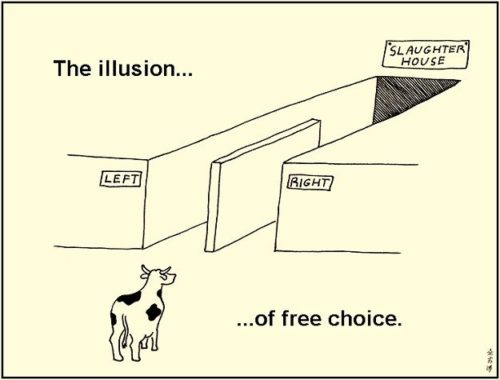
If a person is slapped awake for even the briefest of moments they might come to look around and ask why a parasitic class of politicians wields power of life and death over them despite a total lack of historical evidence that they are wise enough for the responsibility or even intelligent enough to comprehend that it exists.

The truth is that the ruling classes maintain their position in every time and place in the same simple way, and have done so ever since the first chimpanzee established a dominance hierarchy in the primeval jungle: by taking rights away from the people they rule, and then giving some of them back in exchange for submission.

This essay will describe the method of enslavement known as “democracy” – a method that has reached acute levels of sophistication in the modern West.

As described above, the essential pattern is bipartite: first, take rights away from the people; second, promise to give some of those rights back to the people in exchange for their submission.

What’s crucial to understand is that the relationship described here is that of the rulers towards the ruled. Which flavour of political party the rulers use to swindle the rights of the ruled away from them is not relevant, as all political parties are tools of the ruling class.

Any political party is capable of taking rights away and giving rights back, because in a democratic system the masses have submitted to the rulers of that party. All that matters is that more rights are taken away than are given back.

This can be seen when the National Party takes away people’s rights to use medicinal cannabis, but gives them back some of their right to keep the money they have earned.

The Labour and Green Parties, by contrast, will promise to give you your rights to use medicinal cannabis back, but they will take away some of your right to keep the money you have earned.

And both parties will team up to give you back your rights to have sex with people of the same gender as you, but will team up to take away your rights to recreational use of tobacco and alcohol. At least today – it was the other way around 80 years ago and probably will be again in 80 years’ time.

The trick is that as long as both wings of the political machine take away more rights than what they give back, the machine itself can stay in power forever, because there will always be an unjust deficit of rights somewhere and therefore always grounds for a politician to come in and start promising things.

Helen Clark, for example, knew that she could not make any progress on cannabis law reform between 1999 and 2008, because then the Labour Party would not be able to gain votes by promising to look at reforming the medicinal cannabis laws in 2017.

Likewise, Andrew Little in 2017 knows that, if he is to be elected to power, he must make the smallest possible amount of progress on the issue.

This is why he only makes vague mumblings about sorting out medicinal cannabis, but will not under any circumstances discuss the incredible success of the Colorado model, and how adopting it in NZ would save us $400,000,000 per year.

That is something that has to be left to Jacinda Ardern’s Seventh Labour Government in 2035 or so. If the Labour Party gave too many rights back to the people too quickly, they would lose the leverage that they are currently exploiting to stay in power.

Unfortunately, New Zealanders (like voters everywhere) reward this kind of carry-on by continuing to vote for whichever of its number the ruling class puts forward to rule them that electoral cycle.

After all, it doesn’t matter which party a politician claims to represent – as long as they are from the ruling class, nothing will change.

It can confidently be predicted that many New Zealanders will vote for the Green Party this year for the sake of relief from cannabis prohibition, and that little thought will be given to the people who will lose rights under a Labour-Greens Government – namely, taxpayers.

And it can be confidently predicted that the National Party will rely on the outrage of taxpayers to get back into power in 2026.

Likewise, it can be predicted that any rights that Kiwis can claw back from the ruling class regarding the use of cannabis will be outweighed by the loss of rights to access alcohol, tobacco, and other recreational alternatives.

As before; so after – the Hermetic axioms apply to time as well as space.

What’s Mental Damage to You is a Profit Opportunity to Someone Else

Here’s a grim, meathook reality so grim that you might want to sit down for it in case you can’t sit down pain-free for the next week: There is nothing in the whole world as profitable as human suffering. In every time and in every place, human misery offers unparalled opportunity to make dollars.

Understanding this is a matter of understanding some psychology.

A person’s level of motivation to take any given action is a function of the amount of pleasure they expect to gain or the amount of suffering they expect to avoid.

If they come to believe that a previously favoured course of action will lead to a decrease in future pleasure or an increase in future suffering, they will come to change their behaviour.

The psychology of advertising is little more than causing the reader, listener or viewer of the advert to suffer in some way and to then create an association between the product that you are trying to sell and the alleviation of that suffering.

This is done with a simple two-step procedure.

The first is to get the reader to feel bad for some reason. In practice, there are an almost unlimited number of ways that you can make a person feel bad. The really big ticket items, though, are a fear of disease, a fear of low social status and the fear of not being attractive to the opposite sex.

These fears play into the ultimate biological reason why human beings feel fear – namely, when the biological organism calculates, consciously or otherwise, that its potential to maintain or to spread its genes is threatened.

The second is to promote a product as the solution to that feeling bad.

In the case of fear of disease, you can sell medicine and insurance. You can manipulate the target’s fear of germs by exaggerating the prevalence of them to sell cleaning products. You can manipulate the target’s fear of dying by exaggerating the degree of anxiety that a reasonable person ought to feel if they do not have life insurance.

In the case of fear of low social status, you can sell flash cars, expensive clothing, jewellery, houses, golf clubs, yachts and more. Basically anything that appears to compensate for any kind of erectile dysfunction or small penis will attract people who are willing to pay money for it.

In the case of fear of not being attractive to the opposite sex, you can sell just about anything. The use of sex to sell a product is almost universal in advertising. After all, it plays at the fundamental male fear.

The psychologists who conduct advertising campaigns know that the human male – in the vast majority of circumstances – is permanently in a state of subconscious anxiety about his capacity to pass his genes on through a fertile female of his species. This will make him reliably dumb in ways that can be anticipated and profited from.

All the advertiser has to do is to associate the lack of their product with a lack of mating opportunities, and the presence of their product with the presence of mating opportunities. When this is achieved, the male will be willing to pay money for the advertiser’s product in order to alleviate the anxiety the advertiser has created.

It can therefore be seen that the purpose of advertising is literally to make you suffer for money.

This column is no exception. We make a living from telling you when you’ve been lied to – and then selling you what we claim to be the truth. The more we can aggravate your sense of outrage at the lies of politicians, priests and psychiatrists, the more likely you will become to spend money on our books.

Of course, we claim to be doing it out of solidarity, in your own interest – but then so did the priests who burned Giordano Bruno at the stake.

As above; so below – but don’t forget that anyone who is trying to make you suffer is probably not doing it out of sadism but simply for the $$$$$.

The Consequences of Making All Fun Illegal in Nelson

This burnt-out stolen car has sat on the side of Maitai Valley Road for over a week. Actions that lead to the consequences shown above are often the result of boredom

In the words of Doug Stanhope: “Boredom is a disease. Drugs cure it.” This might be a throw-away line from a famously irreverent standup comedian, but it points to a truth that our society lacks the sophistication to debate: boredom causes legitimate human suffering, and this costs money and even lives.

Some psychologists are aware of the consequences of boredom. It’s now believed that boredom literally causes the brain to degenerate, as it requires a certain minimum amount of excitory stimulation to maintain the strength of existing neuron connections.

This is why it seems to actually hurt. The mental pain associated with boredom is the pain of your brain dying from a lack of stimulation, in the same way that a newborn infant neglected by its mother may die of hospitalism from a lack of oxytocin.

It’s not likely that anyone in Nelson will go as far as shooting someone out of sheer boredom, as happened to the unfortunate Chris Lane in Oklahoma. But the more boring this city becomes, the further we move towards forcing people to become violent in order to combat the pain that comes from so many fun things being illegal.

Boredom is a real thing that makes people misbehave. It has been observed in British prisons that boredom leads to misbehaviour.

When there are too many recreational outlets closed off by puritan laws, people naturally come to ignore them and may purposefully break any law just to relieve the boredom

The reason for this ought to be clear by now, especially if the reader knew any juvenile delinquents while growing up. Because boredom is painful, people suffer from it, and as a result of the suffering they become willing to destroy in order to alleviate it.

Almost everyone has done something recklessly stupid at some point because it felt good on account of that it relieved boredom.

Unfortunately, the people making the laws in New Zealand are whores, not psychologists. They have whored themselves out to the pharmaceutical, tobacco and alcohol industries, and these industries have commanded the politicians to make recreational alternatives to their products illegal for the sake of wiping out their competitors.

Neither is the Nelson City Council any better. They have proven themselves utterly incapable of taking care of a single homeless protester outside the Farmers building, so the expectation that they could comprehend an end to the War on Drugs is far too much to ask for.

Nelson, like all provincial New Zealand towns, is not an easy place to live in when a person is aged between 18 and 30 or thereabouts. If you’re a young person and consequently have a high point of homeostasis for excitement, there are not many really good options.

Cannabis is illegal, the drinking culture is violent and disgusting, the hookup culture is vile and depressing, and the control freaks have even taken away the simple pleasure of having a cigarette to relax by making it too expensive to be enjoyable.

Well, this is the price. This is how we end up with burnt-out cars sitting on the side of Maitai Valley Road.

As this column has previously argued, there ought to be cannabis cafes on Bridge Street. Giving the young people of Nelson greater recreational options than booze and television would result in less boredom, which would result in fewer burnt-out cars.

This would necessarily require a change to New Zealand’s cannabis laws, which would have ancillary benefits, not least putting a stop to the current wastage of $400,000,000 of tax money every year.

Perhaps some of the estimated $120,000,000 of Police funding that would be saved from cannabis legalisation could then be used to clean up the mess on the side of Maitai Valley Road, as it has been sitting there for over a week.

Understanding New Zealand: Demographics of European New Zealanders

Possibly the single most striking characteristic of the demographic bloc of Kiwis of European descent is that they are considerably older than average. The correlation between being of European descent and median age was 0.72.

Predictably, then, there is a very strong positive correlation with being of European descent and being on the pension – this was 0.65.

This raises the interesting point that, for all the rhetoric about lazy Maoris sucking unemployment benefits out of the country, there are legions of wealthy white Kiwis getting paid much more than an unemployment benefit in the form of a pension, which is not means tested.

Aside from this, the trends show the general pattern of industriousness among Kiwis of European descent. The sorts of industry that demands a committed and sustained physical effort tends to be stacked with them. The correlation between being of European descent and working in construction was 0.38; with working in agriculture, forestry and fishing it was 0.37; and with mining it was 0.25.

Like the average Maori, the average European New Zealander is born in New Zealand. The correlation between being of European descent and being born in New Zealand is 0.33.

European New Zealanders are also markedly likely to delay reproduction. The correlation between being of European descent and being in a couple without children is a very strong 0.81. This reflects the degree to which Kiwis of European descent have a tendency to live for a number of years together as a couple before committing to having children.

Some might predict, based on that, that the correlation between being of European descent and being a solo parent would be significantly negative. It turns out to be a strongly negative -0.68.

Kiwis of European descent were much more likely than average to be former tobacco smokers. The correlation between the two was a very strong 0.74. This is strong enough to suggest that it is a common cultural experience among Kiwis of European descent to have struggled with tobacco addiction and to have successfully overcome it.

European New Zealanders were the only racial group that had a significant positive correlation with biking to work – this was 0.38. This correlation may not reflect so much the culture of European New Zealanders as the fact that Christchurch is an extremely bicycle-friendly city and is also very European, whereas the opposite is true of Auckland.

They also had a moderately strong positive correlation with working from home, which was 0.58. All of the other races had negative correlations with working from home, which probably reflects the fact that the vast majority of Kiwi farmers and people living in isolated areas are of European descent.

Perhaps fitting the stereotype that white people are never desperately poor, there is an extremely strong negative correlation between being of European descent and being in the income band of Loss or Nil Income, which was -0.84.

There were two separate income bands which had a significant positive correlation with being of European descent.

The first was the $15-25K income band. The correlation between being of European descent and having an income between $15-20K was 0.29, and with having an income between $20-25K it was 0.34.

Probably the reason for this is the large number of young Kiwis of European descent who become students, because a person on a student allowance or loan and maybe working part time will be in this income range.

The second was the $60-100K income band. This is about where people expect the average Kiwi of European descent to end up. The correlation between being of European descent and having an income between $60-70K was 0.32, and with having an income between $70-100K it was 0.29.

Being strongly represented in these high income bands reflects that the average Kiwi of European descent is a bit older and a bit better educated than the average and will therefore have significant career advantages in both seniority and expertise.

Given that, it is not surprising that there is a strong positive correlation between being a manager and being of European descent – this was 0.54. The other occupation that had the strongest positive correlation with being of European descent was technicians and trade workers, which was 0.33.

The strongest negative correlation between being of European descent and working as a particular occupation was with the Maori-dominated machinery operators and drivers, which was -0.31.

There was also a moderately strong correlation of 0.51 with being of European descent and living on the South Island.

Kiwis of European descent are very likely to either own their own homes or to live with their parents still. There was a negative correlation with being of European descent and every band of rent paid, apart from the $150-199 per week student niche, which was 0.01.

Perhaps interestingly, there were no significant correlations between being of European descent and having any of the higher degrees. The closest was with having a doctorate, which was 0.22.

This reflects how the bulk of the population in New Zealand is Kiwis of European descent and subsequently they comprise most of the middle between the high-achieving Asians and the low-achieving Maoris and Pacific Islanders.

*

This article is an excerpt from Understanding New Zealand, by Dan McGlashan, published by VJM Publishing in the winter of 2017.