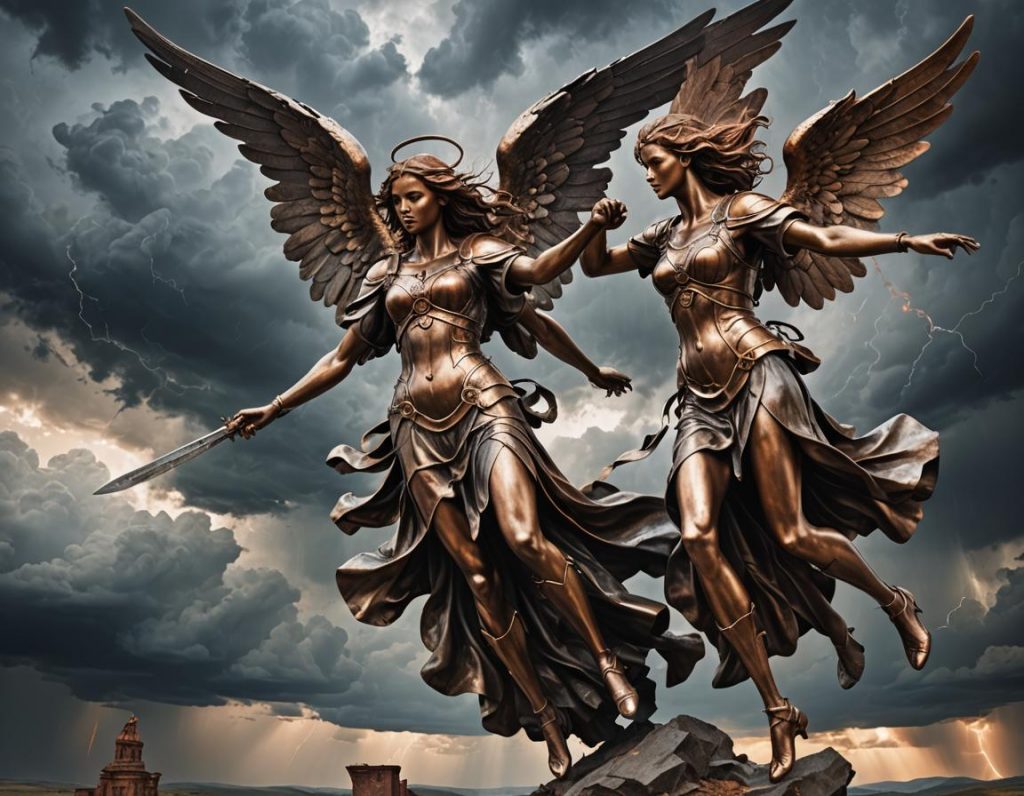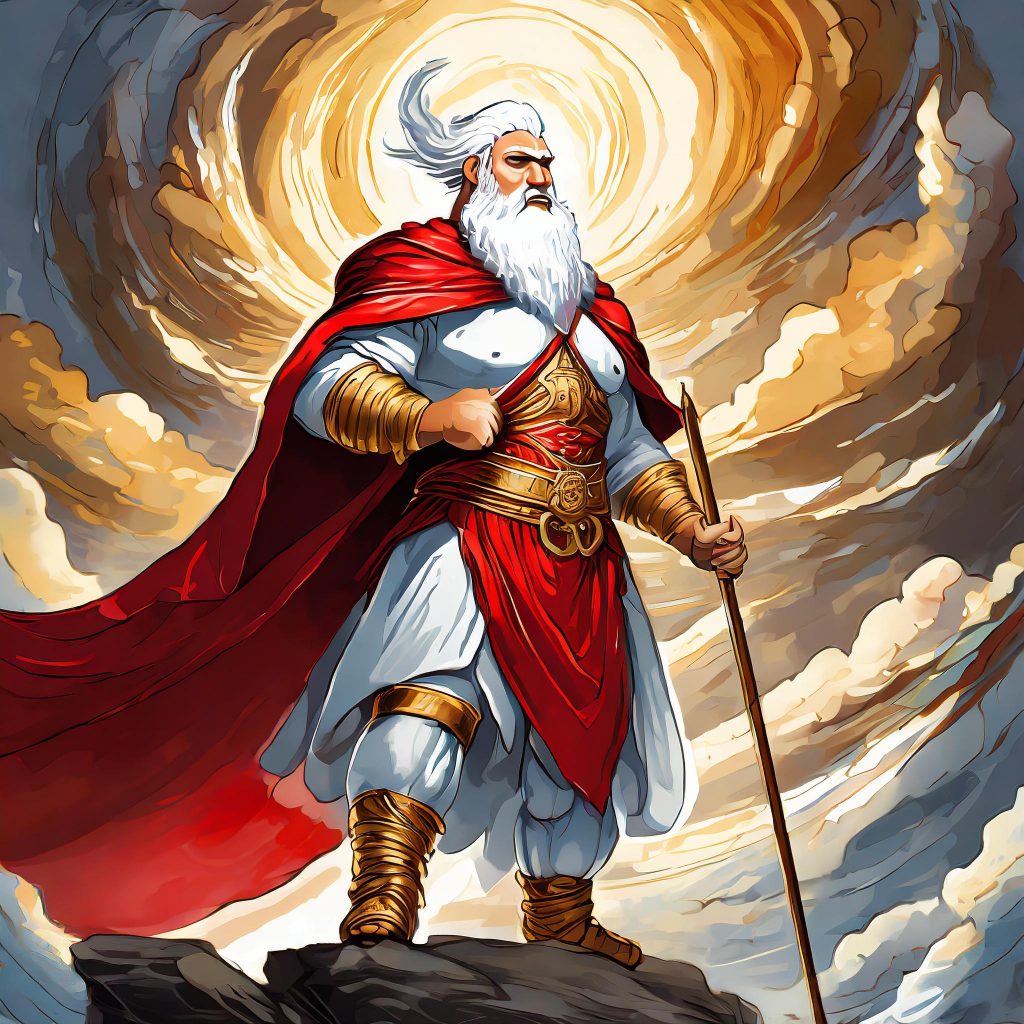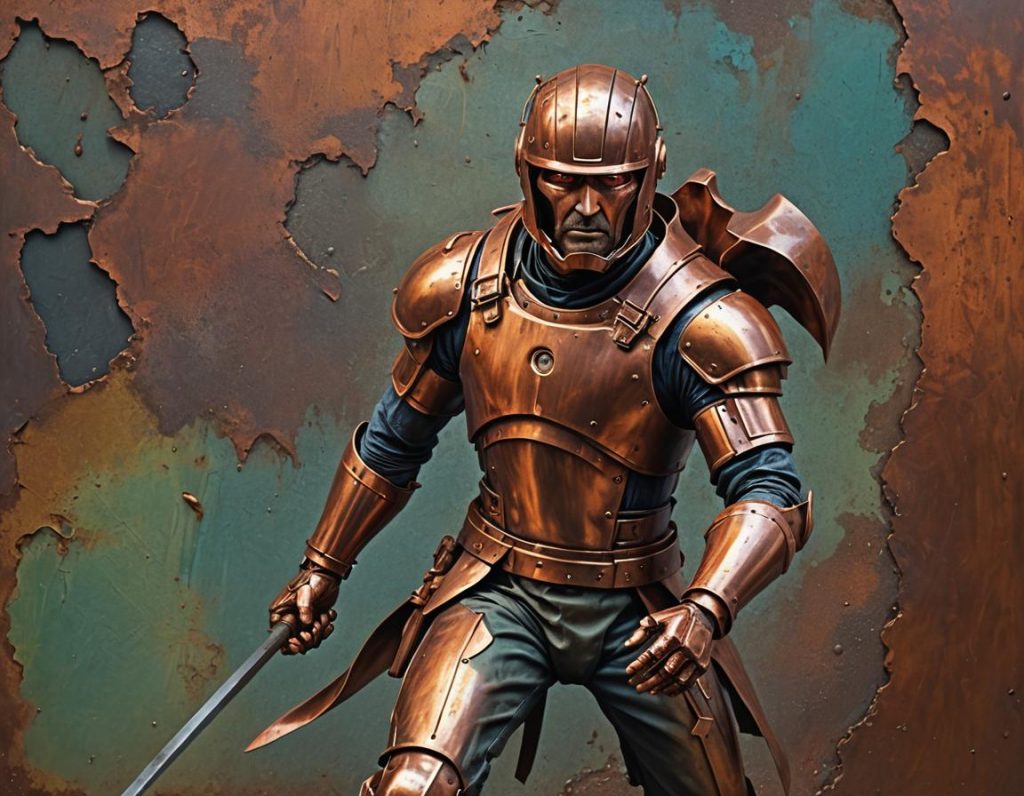
The second transmutation on the path up the Mithraic Ladder is that of tin into iron. The jovial, laid-back energy of tin becomes the martial and grim energy of iron. This second transmutation completes the physical realm, and produces a character who is optimised for war and combat.
As a character enlargens when they transmute from lead into tin, they sharpen as they transmute into iron. This sharpening is the characteristic action of this third level. The character thereby becomes harder and more warlike. The person of iron is, of course, the warrior.
The transmutation of tin into iron begins when a character comes to see recreation and play, characteristic of the second level, as childish. No longer are the frivolities of tin seen as an esacpe from the cruel pressures of survival. A character starts to yearn for more than just recreation. A character aspiring to the realm of iron years to test themselves, to test their strength against opposition.
As such, the attitude of a character transmuting to iron sharpens as well. Iron is the frequency of maximum possible cruelty – but it doesn’t have to be cruel. It’s also the frequency with which a man protects his family. That might involve cruelty, but it can also involve acts of the most extreme physical rectitude. A character might come to learn this rectitude when they first have a family, giving them something to defend.
This stage can involve a character who has lapsed into gluttony getting fit and strong. Getting off the couch, and starting to lift weights, is an example of the sort of transformation that occurs in physical space at this stage. Thus the sharpening can involve pain – the pain of weakness leaving the body (as the US Marines would put it).
Motivation to get stronger comes mostly from the archetypal motivation of the stage of iron, which is honour. If a character comes to feel humiliated and dishonoured on account of being fat and unfit, the reader will easily understand that character’s motivation to become lean and fit instead. If a woman rejects them, or if they can’t climb a set of stairs, or if a child laughs at them, they might develop a powerful desire to get fit.
The transformation of tin into iron occurs primarily within the physical realm, being mostly a matter of sharpening the body. The two classic ways this can be achieved is through conflict against the environment or conflict against other people.
Conflict against the environment can come through means such as climbing a mountain, traversing a desert or sailing a vessel through stormy waters. The same way a blacksmith purifies iron by continually striking it, so can a person purify their body by continually taking one more step up the mountain.
Conflict against other people, in this context, primarily means battle. Many a man of tin has gone into battle with a distant grin, only to harden up quick when the man next to them got a spear through the chest. The deprivations of war will reliably harden a person more than anything.
The typical background of the transmutation of tin into iron is the gym. The fat of tin becomes the iron of muscle through repeated action.
This is especially true if the gym is a martial one. The line in Fight Club goes “A guy who came to Fight Club for the first time, his ass was a wad of cookie dough. After a few weeks, he was carved out of wood.” That line summarises the nature of the transformation of this stage. One puts the drinking vessel away and picks up the rifle.
A character who has transmuted their consciousness into that of iron will look at the pastimes that obsessed them in youth, and see childishness of no importance. Games in which defeat used to upset them now only evoke laughter. If a person can lose a game to a child with complete indifference, they might have passed into the realm of iron.
Although the transmutation of tin into iron is primarily a physical phenomenon, there are mental and spiritual aspects to it. A character that has mastered iron will be much harder to intimidate than one who has not. That character’s physiology will be like iron, in that they will not be nervous in the face of physical danger. They could stand on the edge of a precipice without feeling fear.
The character who has successfully developed a soul of iron will also be more inclined to think about eternity than the characters of lead and tin. To a character of iron, the character of tin seems like a degenerate and the character of lead seems like a wretch. The character of iron is the first on the ascent up the Mithraic Ladder to actually enjoy their life, i.e. not to suffer significantly.
The major mental transformations, however, are still to come, the mental realm being that which lies inbetween iron and silver. A character that completes the transmution into iron might have become an awesome fighter and the master of themselves, but they will only master themselves. Iron is still too low a level to command from. So a successful transmutation into iron will come with a new set of ambitions.
A famous example of this transmutation in popular culture is that of Rocky in Rocky 3. He starts the film fat and out of shape, and ends it super-fit. Another example is that of Conan in Conan the Barbarian. He gets put to work on the slave wheel as a boy, so that by the time he is a man he is exceptionally strong.
When the character of iron feels like they have truly proven their physical courage, they can begin the transmutation to copper.
*
This is an excerpt from Viktor Hellman’s The Alchemy of Character Development, the sixth book in VJM Publishing’s Writing With Psychology series. This book will show you how to use alchemy to create deep, realistic and engaging characters for your creative fiction.
*
If you enjoyed reading this piece, buy a compilation of our best pieces from previous years!
Conventional political understanding is that the left wing is for the working class and the right wing is for the ruling class. But conventional understanding is in the process of being replaced by an alternative politics. In the politics of the 21st Century, the left wing is for browns and blacks. This has raised a number of, until now, unanswered questions.
Perhaps the foremost of those questions is: what is the position of working-class whites in the new paradigm?
The labour movements that formed in the West in the 19th and early 20th Centuries were almost entirely white. They formed in opposition to the capitalist interests that were also almost entirely white. But when globalists won World War Two, and began the mass importation of cheap Third World labour to the West, the white working class were put in a bind.
According to the Marxists, the white working class were obliged to embrace their replacements. The world’s working class were prophecised by Marx to come together across international borders, and so the destruction of national consciousness through mass cheap labour imports was a good thing. The white working class would have to recognise that they and the newcomers were of a shared mission: to destroy the capitalist system.
Working-class whites, however, didn’t feel like they had much in common with the newcomers. For one thing, the vast majority of working-class whites have at least some middle-class people in their extended family. For another, the newcomers usually hated the working-class whites and made that hatred obvious.
This caused working-class white sentiments to split: some embraced working-class culture, some embraced white culture, and others bunked down into an exclusivist working-class white culture that was hostile to outsiders. The net result was the shattering of working-class white solidarity and the neutralisation of working-class whites as a political force.
Today, we see working-class whites, on account of being white, forced to take a back seat to everyone else, even when those others are wealthier. Working-class whites are excluded from racial scholarships just as much as Bill Gates’s kids are. Working-class whites can also be, and often are, excluded from certain jobs under Diversity, Inclusion and Equity initiatives.
Naturally, this has led to immense resentment among working-class whites towards the Western political establishment. This resentment is strongest for those leftists who claim to be fighting for the white working class, but who in reality are fighting for an ideology that doesn’t care at all about working-class whites.
The working-class white question, then, is a way of distinguishing sane leftists from insane wokists.
If a person truly supports the underdog, they will support the working-class whites upon whose backs industrial civilisation was built, and who still bear the majority of the intergenerational trauma incurred through the various wars of the past 100 years: the same working-class whites who are currently getting squeezed out of housing all over the West.
If they are an insane wokist, by contrast, they might consider working-class whites traitors for their refusal to support the globalist revolution. Thus they will not care about the suffering of working-class whites from the mass importation of Third World cheap labour. That suffering is just a means to the end of globalist revolution.
Thus sane leftists can be distinguished from insane ones, simply by asking them what they think about working-class whites.
A leftist might make the argument that some particular racial group is disadvantaged because of colonisation, and therefore deserves special treatment by way of compensation. Very well. But what, then, explains the disadvantage of working-class whites?
If a left-wing politician makes the argument that browns and blacks are disadvantaged by colonisation, but working-class whites, who may be poorer than those browns and blacks, are advantaged by that same colonisation, and therefore are obliged to pay some of the reparations that are due from the whites to the browns and blacks, that politician is the enemy.
Likewise if a politician says that browns and blacks are poor because they have not had a chance yet, but working-class whites are poor because they have had a chance and have already blown it, that politician is the enemy. This is akin to saying that working-class whites are the only truly low-IQ faction of society, and therefore deserve a place at the very bottom of the ladder.
Working-class whites need to realise that, if a left-wing politician doesn’t support working-class whites explicitly, they will not support working-class whites at all. The fact that they are on the left cannot be taken to mean that they implicitly support working-class whites.
The working-class white question is a way for working-class whites to determine if a given leftist is a friend or a foe.
*
If you enjoyed reading this piece, buy a compilation of our best pieces from previous years!
There are many levels at which you know and you don’t know, as well as levels at which you think you know, and think you don’t know. There is no way to systematise or explain these levels, simply because they will be vastly different for each being. I don’t ask anyone to take this on faith. I am far more interested in encouraging your exploration in this direction. What I would like to suggest are some tools with which you can begin to call into question some of the things you think you might know.
Sometimes you have to move in a direction that appears backwards in order to go make what we could call ‘progress’. In true self-inquiry we are always extending a foot out into the darkness, and although the results aren’t always guaranteed, the intention does always count.
In conventional terms, I couldn’t put anything on a piece of paper as ‘truth’. I am really no better positioned than you are. I am however aware of many things I thought I knew, and I am increasingly skeptical of the value these things carry. I have witnessed so many of them dissolve or break away like chunks of sea ice. Sometimes these fragments are never to be seen again, sometimes they occasionally drift back within sight, but never again taking up the same amount of space on the horizon. These are things I relied upon at some point as inviolable facts, what I assumed to be truth itself. What I witness when this kind of inner event happens, whether through inquiry or accident, is that there is an exceptionally fine line between a sense of liberation and horror. The prospect of freedom simultaneously exhilarates and terrifies us.
On the one hand, the sense of teetering over the abyss, looking down into the black unknown is horrifying – but only to one part of the self. That is the part that thinks it knows, that thinks it should understand, that thinks it ought to have some grasp over the management of its inner topography. It turns out that part of us is very minor upon investigation. That part of me, despite being so tiny, has historically been like a finger held up in front of my eyes only an arm’s length away, but has seemed big enough to blot out entire galaxies in the night sky. The tiniest parts of us inside can block out the greater portion of reality, if adequate care and attention is not taken.
To the greater part of me, so witnessed, there is a sense of freedom and liberation as these pieces of knowledge once claimed as firm ground have broken away. It reveals what was always really there, which is not the black abyss we thought would swallow us. There is a space there, alive and whole, that only seems to increase in plenitude with each inner discovery. This is the space in which I know that I don’t know, and it is alive.
Pseudo-Dionysius the Areopagite referred to this state of not-knowing as ‘agnosia’, which is distinct from mere ignorance. In fact, my knowing that I don’t know is the primary condition to be in maximal congruence to this greater reality. It is neither silence nor non-silence, neither darkness nor light, neither everywhere nor nowhere. It is a living state of pure potential. There is nothing behind it; everything is out in front of it.
At our level of being, the coordinates at which it may be located are ‘here’ and ‘now’. For the purposes of having something to refer to it as within human language, it could be called ‘the unmanifest’ or ‘the unborn’. It doesn’t really matter what we choose to call it. We could always call it ‘consciousness’, but I would rather use a term that you are likely to have less immediate familiarity with so that it doesn’t dock in at the port of your intellect carrying with it too much by way of unnecessary cargo.
For reasons suggested earlier, thinking you know anything about this isn’t overly helpful. This includes everything you have ever read about it before, whether religious, scientific, philosophical or spiritual. At the same time, thinking you don’t know anything about it also isn’t especially useful, because you certainly will have had some experience with it, since it is the foundation of your entire inner life. What I find is more useful is de-emphasising your insistence on what you think you do or do not know.
This is what the Zen practitioner Shunryu Suzuki refers to as ‘beginner’s mind’. It then doesn’t really fall within a category of what we ordinarily think of as something we know or don’t know, understand or don’t understand. It is more to do with what we are, with what our direct, unaltered experience is when we aren’t consumed by the common human endeavour of cramming it full of new content, maps, systems, or other frames of reference.
You may have noticed that many people are often extremely bothered by not having anything to talk about. Thinking that you don’t know, but assuming you need to know, creates violent ripples of dissonance in the human mind. Often these people will attempt to remedy this with talking incessantly, or via outsourced mental noise such as reading, radio or television. This is because silence is highly detrimental to this limited sense of self which lives off reams of acquired mental content. It is almost like it can sense an undercurrent of awareness that it has been taken from a space of freedom into a tiny, separate skull cramped full of beliefs and prejudices. Silence is corrosive to this illusion, and it can make people nervous to the point of being physically ill with fear when they don’t have something to occupy their attention.
Lack of self-understanding is the modern disease. It was Blaisé Pascal who correctly observed that the root of modern man’s ills is his inability to sit quietly in a room by himself. This highlights the symptoms of modern man’s materialist syndrome as a being that has either willfully or ignorantly acquired no familiarity with their own soul.
Before I understood that the abyss beneath our claims to knowing wasn’t annihilation, I was extremely terrified of anything that threatened what I had claimed in belief or knowledge. It felt like impending doom to me that the things I thought I knew might be threatened, questioned or even subjected to slight modification. If I came across something that disturbed this sense of knowing, or forced me to modify the way I think, I would spend dutiful hours repairing thoughts, making new connections, reframing, re-routing.
The nature of this activity wasn’t noticed at the time. I just thought I was a bit depressed, or ‘thinking things over’, although what I was really doing was making sure the new disturbances would not affect the total structure of my established worldview – I was in damage control.
If someone had told me at an early age that none of this was necessary, and had I heeded this advice, this would have been like being led to a goldmine. Of course, you cannot be told this, because no-one would ever listen unless they were truly ready to hear – in which case, they would be led there eventually anyway.
True knowledge, which is a term I would hesitate to throw around, does not fall within our usual system of values, because everything we have collectively developed by way of what we have call ‘wisdom’ is something employed instrumentally to in order to get something else beyond it – spiritual wisdom is not like this. It is not what we think we know. It cannot be learned from someone else, it cannot be mooched, it cannot be bought or sold, and it cannot be gifted, inherited or stolen. It is exclusively earned through a combination of experience and direct application of your inner attention. You have to be looking, listening – you have to be interested in how this experience right here deepens and unfolds. Not for some new acquisition, status, or a new set of mental toys, but because you are inherently interested in what is here, and what you are.
A worldview, being a constellation of mental positions about the way we believe things are, isn’t true knowledge in this sense. It is acquired over time, and maybe it is closer to an accurate picture of the way things are relative to others. A worldview represents a high investment of one’s life energy – at least, insofar as a psychological entity is concerned, in its time-bound personhood. The necessary feature of any and every worldview is that it is limited – it portrays an image of reality at the vital cost of its limitlessness.
To the selfless-self discovered beneath the turmoil, this is all neither here nor there. The unborn doesn’t exist in psychological time like our worldview does, it exists here and now. That is what qualifies it as alive rather than being some kind of coral-like accretion running backward throughout personal and human history. No worldview is required to engage in Being, although the false self has zero tolerance for the unborn. You might be surprised at what can and will be discarded without harm to you. I certainly was, and I still am quite routinely. The universe never seems to run out of surprises.
What do you think you know? That might be a good place to start. Chances are, if you think you really know something that isn’t subject to criticism or doubt, then I’m willing to bet that you probably haven’t inquired very far into it. If you think of your beliefs and conclusions as each having a piece of string attached to them, try following the string all the way from one end to the other.
People are generally reluctant to do this, or at the very least unpractised. This is partly because questioning the things you took for granted as true is of such high novelty that there isn’t widely available information about it. Most people will discover that there are strings they are more comfortable to follow than others. There are many strings we absolutely do not want to follow, because part of us recoils in horror at the thought of what we may or may not find at the end.
Fear can actually be your friend in this exercise, because you will learn by your apprehension which conclusions you have set aside as inviolable and sacred. The difference between these beliefs and others you aren’t afraid to investigate is that these are cherished beliefs, probably touching on core beliefs that structurally support your worldview. Can you afford to lose your worldview in the pursuit of truth? Your view of who is right and who is wrong? Who are the blameless, and who are the damned?
Maybe these are all just temporary roles within the play of consciousness, or, maybe this universe has some kind of insubvertible structure. Take a look though, see whether there are strings worth investigating while others can be left trailing into the darkness. The discovery you will be making here is not directly about truth, but your inner relationship to truth. Am I willing to question everything, or do I have a set of rules set aside that make me feel safe, that I choose to never pursue in inquiry, because I already know the answer?
We might begin with some really simple, but big questions, such as: how do you know who or what you think you are? What makes you think that you are who your memories tell you that you are, and is there a difference? If you lost everything you had ever learned or remembered, who would you be? Who would you seem to be, to yourself or to other people? Is there any difference? What do you think you know that cannot be undermined by any reason, any doubt? If there is anything that you have taken on authority, whether philosophical or religious, and how do you know that you have not been knowingly misled by some kind of demon? What can you be sure of? Will you have some answer in the future? Did you once have some answer in the past, which you have now lost?
The goal here isn’t for you to settle upon some profound new answer to worship and hold onto, but to crack open some of your pre-existing assumptions.
Our culture doesn’t generally do a great job of preparing us for this scale of inquiry. Culture is for the most part a topographical map permitting exploration in very limited regions, providing the illusion of limited freedom and reduced options within the prescribed system. There are of course plenty of roadblocks and no-go zones. Some of these directions are so taboo that other people will attempt to repudiate your claims by agreeing in knowing falsehood that you can’t have gone to the places you claim, simply because it is easier for them to believe a lie that preserves the structural integrity of the consensus than it is to embark upon overhauling their own inner realm.
A classic example of this is the person who leaves a religious organisation claiming that they have seen unwholesome things that led them to leave it behind. The cultural response encouraged and supported within the remainder of that group will be some version of “yes, but the devil would try to convince you of that. We, however, are standing firm, because the devil will not succeed in tricking us”.
This effect is everywhere. It isn’t really religious, it is human. It happens in the church, the school cafeteria – it may even happen in killer whale pods, for all we know. We revile the dissenter because they threaten to inform us of something concerning our choices and position that we would really rather not see the light of day. It exposes our foolishness. If our choices that were made in the sleep of ignorance were to become subject to any form of scrutiny, the only possible outcome insofar as ego was concerned would be damage and destruction. If you placed yourself in a position of allowing this damage, you would be forced to repair or even entirely discard what you had invested in for many years.
Of course, some people have no control over this collapse and are forced to act when it comes upon them. When we turn a blind eye, we are allowing cognitive dissonance to win at the expense of truth. Truth has to be at stake, not because anything we believe could be inherently true, but because anything that is formed as belief in darkness is going to be subject to falsehood – even if it just so happened to turn out to be true. You can be wrong by mistake, but you can’t ever be right by mistake – see whether this is true in your own experience.
Again, wisdom or self-knowledge can only come as result of your deliberative inner attention and receptivity. It isn’t mysterious or elusive, but it does ask you to put all that you hold dear to the highest scrutiny.
Truth is not going to arrive as the addition of something new, it is going to consist at a minimum of disempowering the falsehoods that predominate the collective mind. We have found ourselves as humans in a position of needing to urgently assess the collective structures we have agreed to. Unless we allow those structures to fall under the light of examination within ourselves, what hope do we have as a species? What value can we really claim to put on honesty and integrity?
What might you lose if you were to loosen your death-grip on your worldview? What kind of world do we want to leave to our children? And if it doesn’t begin directly with ourselves, in our own inmost world, then where else could it possibly start?
*
Simon P Murphy is a Nelson-based esotericist and philosopher, and author of His Master’s Wretched Organ, an astonishing and surreal collection of weird fiction stories.
*
If you enjoyed reading this piece, buy a compilation of our best pieces from previous years!
The initial stage of the alchemist’s journey is the stage of lead. This is represented by the bottommost step of the Mithraic Ladder. It’s also represented by the colour black. The transmutation of lead into tin is the transmutation of a black metal into a grey one.
In the Roman pantheon, the stage of lead was represented by Saturn, the god who devoured his own offspring. Madness and death are two of the key themes of this lowest stage, which represents the unimproved consciousness. Overcoming madness and death are two of the main ways that a protagonist can transmute lead into tin.
The primary orientation of the stage of lead is survival. The drive for survival naturally creates a hardened, brutal, mirthless sort of person. This is why lead is the lowest level. The survival stage is the same one that all of the other creatures on this planet are born into. The man of lead is, to a major extent, a wild animal still. He might be able to to speak but his frequency is still one of brutality.
Diligence is the primary virtue through which a character at the level of lead can transmute themselves into tin. Through repeated and dedicated application of will, a person can achieve something and thereby overcome the resentment that characterises the level of lead. This repeated application builds the belief that there is something worth working towards in this life. This might only be a small amount of positivity, but it can be enough to get off the bottom of the Mithraic Ladder.
The survival pressures in your story don’t have to come from without. The character of lead can struggle with their own self-destructive impulses. At the lowest level of the Mithraic Ladder, struggles against addiction, self-destruction or suicide are common. That the energies of death flow from the inside as well as the outside is one of the lessons of the level of tin.
It’s not until the survival pressures start to relax that a character can develop above this lowest of the seven stages. A character who starts to pass their survival challenges easily will soon start to become joyful. This transformation into joyousness is the same as transmuting one’s consciousness to the frequency of tin. The joylessness of pure survival is replaced with something higher.
The alchemical process of transmuting lead into tin is a process of enlarging. Hence, the stage of tin is represented by the larger-than-life Zeus. The process of becoming like tin can be represented by enlargement. A skinny, starving man of lead indulges in food and thereby becomes much bigger: so could an author portray this change in caricature.
If a character in your story is met with repeated survival challenges of a similar type, such that after overcoming enough challenges they start to develop a sense of mastery, then that sense of mastery ought to bring joy with it. Being the master of previously terrifying survival challenges ought to bring a sense of playful relief, the essence of the level of tin.
Such a character will also stop taking themselves so seriously. A character at the level of lead will snap and snarl if someone jokes with them, but one at the level of tin will join in with the joking. As joviality is the primary emotion of the character of the level of tin, an ability to banter is indicative of the successful transmution of lead into that soft, light grey metal.
One of the areas in which this transformation will be the most noticable will be social. People tend to avoid the men of lead, because their desperation and suffering is frightening and intimidating. But as a character of lead transmutes their frequency into that of tin, they will find themselves making more friends as they become more approachable.
Someone undergoing the transformation from sullenness into joyfulness can be said to have ‘brightened’. This will be apparent in their aura, not just their face. They will smile when they used to frown. Their gait will appear lighter. Brightening is the fundamental change when lead changes into tin. As tin is brighter than lead, characters of tin will be happier than characters of lead.
In order to brighten, the character has to see the value in joy. They have to learn, whether through their own realisation or simply through experience, that joy and the attainment of joy have inherent value. Through repetitively doing something they enjoy, a character can overcome the pain and trauma of the level of lead and to manifest the joviality of the level of tin through their actions.
The transmutation will be complete when the character can look back on their old self and see something lesser. When they realise that joviality represents a higher level of being than the saturnine wild beast of the level of lead.
Physically, the transmutation from lead into tin can be represented by getting fat. The man of lead is scrawny and lean because he deals with the everyday presence of starvation. The man of tin, by contrast, lives on the level of feasting and merriment. His body can represents that by becoming portly and ruddy-cheeked.
Environmentally, the typical place of the level of tin is the tavern. The journey from the wilderness to the tavern is the archetypal expression of the journey of transmuting spiritual lead into spiritual tin. The unrestrained joy of partying at a tavern is a typical expression of the frequency of the level of tin. The phrase “feast or famine” captures the energies of the levels of tin and lead.
An example of the transmutation of lead into tin would be Benno Furmann’s character Bodo in the film Der Krieger und die Kaiserin. Bodo begins the story traumatised, frightened, angry, and ends it joyous, relaxed and confident. Although tin is still a relatively low level, it’s a lot better place to be than lead is.
*
This is an excerpt from Viktor Hellman’s The Alchemy of Character Development, the sixth book in VJM Publishing’s Writing With Psychology series. This book will show you how to use alchemy to create deep, realistic and engaging characters for your creative fiction.
*
If you enjoyed reading this piece, buy a compilation of our best pieces from previous years!