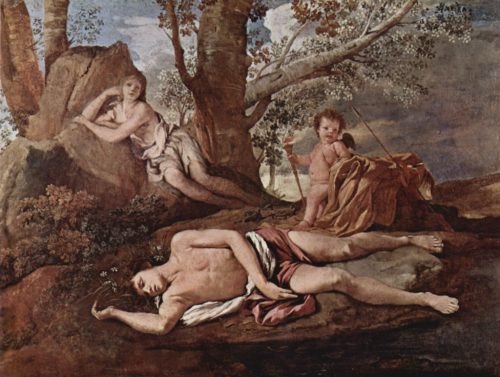
Fellas – It’s (Almost Entirely) A Question Of Demonstrating A Capacity For Resource Acquisition

If you have the health, the strength, the brains or the will to do this, then you can get laid

Countless reams have been written about the question of what women really want. This question has bedevilled great minds going all the way back to antiquity, and not even Sigmund Freud had a clue. Recent advances in evolutionary psychology have given us an answer from a biological perspective – but only for those who dare to read on!

In the animal world from which we have climbed, survival is primarily a matter of meeting metabolic needs. Every creature that lives has a need to eat, because only by eating are most animals capable of acquiring the necessary nutrients to keep breathing, to stay warm, and to have the energy to keep moving and find a breeding partner.

This is why the animal world has been described as “red in tooth and claw”, but there’s more to it than that. Whether a creature eats or dies, and therefore whether its genes are selected for in the next generation, is primarily a question of its capacity for resource acquisition.

Getting laid is all about demonstrating a capacity for resource acquisition. Why? Because this is by far the most accurate way for a female onlooker to determine if your genes are likely to produce offspring that are themselves capable of acquiring resources – in other words, if your genes are likely to produce offspring that can survive.

Whether an individual woman realises it or not, the females of every sexually reproducing species don’t care about anything else – and why would they? Compared to the need to gather resources to meet your metabolic needs, there’s little else that really matters for a sexually reproducing creature.

If one thinks about it, almost all of the qualities that women find attractive in men relate directly to his capacity for resource acquisition, and, by extension, the capacity for resource acquisition of any potential offspring.

There are four major ways that women determine a man’s capacity for resource acquisition, and all four of them correspond directly to major evolutionary challenges in the biological past of the human species (they also correspond to the four alchemical stages of clay, iron, silver and gold).

The first is to be healthy. After all, ill health in animals is often a consequence of not getting enough food, because without enough food it’s difficult to maintain an immune system that can keep the body free of diseases.

Having diseased skin or a rancid body odour will turn a woman off faster than anything, which is why men spend so much time washing and showering before they go into town. Both of those things suggest strongly that the man in question has failed to acquire the necessary resources for maintaining healthy bodily function. In other words, they appear to be dying, and nothing is less sexy than that!

The second major quality is to be tall and strong. Everyone knows that women are attracted to this, but fewer have thought it through to the next stage. Being tall and strong is extremely advantageous to the degree that resource acquisition has historically been dependent on the physical strength of the male in question.

This is apparent when one considers that males spent most of their time in the biological past hunting, which sometimes required hitting animals with sticks and bones or throwing rocks at them, and then carrying the prey back to the rest of the tribe on his shoulders, which are all matters of physical strength.

Arguably even more important is that fact that height and strength correlate very strongly with a male’s position on the social dominance hierarchy, which is the prime determinant of future mating opportunities. The stronger a man is the easier he will be able to defuse threats to himself, to his breeding partner or to their offspring.

The third major quality is to be intelligent. Not everyone appreciates the intense degree to which women are attracted to intelligence in breeding partners, which is probably because most people don’t really understand what intelligence is.

In the biological past, humans were able to acquire resources far more effectively if they were intelligent enough to notice and memorise certain patterns of nature. For instance, the first humans to figure out that large herbivores frequented watering holes were able to ambush those large herbivores, club them to death and thereby feed the entire tribe.

Ancient bushlore contains thousands of little patterns like this, unique to each locale in which they developed, but all with one thing in common – whoever possessed this bushlore was more effectively able to predict when and where the food was going to be.

The fact that intelligence has historically been an extremely important indicator of a man’s capacity to acquire resources can be seen from the manyfold increase in brain capacity in hominids over the past few million years, which is evidence of an extremely strong selective pressure in favour of it.

The fourth major quality is to be brave. This quality relates alchemically to the level of gold. Like the gold it is more subtle than the other qualities, and because of its rarity not quite as obvious.

Bravery relates to resource acquisition in ways like not letting another man take away the food that you have successfully hunted, or not letting the size of an animal scare you away from trying to club it to death. Essentially it’s the quality that allows a man to reduce the fear that makes him weaker and less intelligent.

In the modern world, resource acquisition has basically been reduced to having a job. If you have a job, chances are excellent that you have the capacity to acquire the necessary resources to feed a wife and children until those children are themselves capable of acquiring resources.

This is why being unemployed is extremely unattractive to women. Most women will naturally assume that a man without a job is either too lazy, too weak, too stupid or too cowardly to work or to hold down a job, and all of those four things correlate very poorly with the capacity to acquire resources.

Chris Rock joked about this in a stand-up comedy special, when he said “Fellas! If you lose your job you will lose your woman.” The reason why he had observed this pattern play out in his social circles is because a man losing his job has also lost his capacity for resource acquisition.

The other major quality that a man can possess to demonstrate his capacity for resource acquisition is to own a house. Females of all territorial species intuitively understand that the creature that dominates any given territory naturally controls all the resources within that territory, and so a man that controls a house appeals to very deep and powerful instincts.

Essentially, if a man is unable to get laid he needs to either become better looking, stronger, smarter or braver, because those are the qualities that correlate with a capacity for resource acquisition and are therefore the qualities that woman have evolved to select for in their breeding partners.

The Closer the Election Gets, the More Degraded Political Discourse Becomes

We’re fortunate that no campaigning is allowed on Election Day – if there was, it would just be the candidates throwing feces at each other

There’s a psychological heuristic about the effectiveness of logical arguments compared to emotional ones. In essence, rational arguments weigh more heavily in the long term, often producing permanent changes, but emotional arguments weigh more heavily in the short term, often producing immediate action. This simple rule explains why the quality of political discourse has degraded so sharply in recent weeks, and why it will degrade further in the next two.

This human tendency was demonstrated with a study that examined tooth brushing habits. Two groups listened to two different lectures from dental health professionals. The first lecture used calm, reasonable, logical arguments to explain why people should brush their teeth, the second used fire and brimstone and tried to scare the listeners into doing so.

Although people who heard the first lecture only made a small increase in how regularly they brushed their teeth, the change in behaviour lasted for a long time. This was in stark contrast to the emotional lecture. People who heard this one made a sharp increase in tooth-brushing behaviour immediately after the lecture but, over the long term, this then fell away to much lower levels than the people who had heard the logical arguments in the first lecture.

Our political class and their advisers, highly sophisticated in the art of psychological persuasion, know all of this and are using this knowledge against the plebs right now. The rule they are operating by is: the closer we get to the day of the election, the less effective logical arguments become, and the more effective emotional arguments become.

One year out from an election, there’s no real reason to get emotional. The voters themselves have not yet been whipped into hysteria by the mainstream media, and so any politician that noticeably becomes emotional will look unstable and lose support.

That far out, it’s much better to focus on calm, logical arguments that a potential voter can ruminate over at their leisure before making a solid commitment to a party on the basis of reason. This is because, as with the toothbrush study, this influence will be minor but permanent.

The day before an election, by contrast, is not the time for calm and logical arguments. It doesn’t make psychological sense to aim for a moderate but long-term gain when the election is the next day and the preferences of voters in one year’s time doesn’t count for shit. At this point, it only makes sense to appeal to the heart (and almost always to fear), in the hope that this wave of raw emotion will not have subsided by the next day.

Right now, two weeks out from Election Day, fewer logical arguments are being made. “Let’s Do This!” is not a logical argument, and that is why we have seen expressions of it much more often over the past week. Neither is whipping up fears about being taxed into the poorhouse.

Here the political discourse can already be seen to have degraded, but things will only get worse over the next two weeks as the miserable calculus of persuasion shifts the balance ever-further towards whipping up hysteria and fear.

In two weeks’ time, the discourse will have degraded so far that National supporters will simply be yelling “COMMUNISM!!!”, Labour supporters will be screaming “SOLD DOWN THE RIVER!!!”, New Zealand First supporters will be bellowing “NEOLIBERALISM!!!” and Greens supporters will be shrieking “POO IN THE WATER!!!”

And it will take us three years to get over the shame of how low we all stooped before we can do it again.

Writing The Psychopath

Psychopaths make for fascinating characters in creative writing because they are dangerous, ruthless and unpredictable

The psychopath, sociopath or person with Antisocial Personality Disorder has for centuries been one of the most interesting subjects for creative writers. Something about their nature reliably invokes a sense of horror in the reader – perhaps the ruthlessness, perhaps the callousness, perhaps the deep and smouldering hatred for life. This article looks at how you can believably portray a psychopathic character in your own creative fiction.

It’s important to note that ‘psychopath’ and ‘psychotic’ are two entirely different things. A psychopath is seldom a madman – there is usually a distinct logic and methodology to their actions, even if those actions are considered abhorrent by the majority of people around them.

Psychopaths are primarily characterised by a lack of shame or remorse. Essentially this means that they don’t feel bad about causing suffering to other sentient beings. If they do cause suffering to another person or animal they will rarely accept that they shouldn’t have done so, and even when they do they are never sincere.

A striking lack of remorse after the psychopath did something that harmed someone might be the clue that lets other characters realise that they’re dealing with someone who is a bit different up top. The psychopath might be unaware that they’re supposed to feel remorse (depending on their level of sophistication) and may appear to become confused when another character acts as if remorse would be expected.

Lying is another essential characteristic of the psychopath. From the perspective of the author, this presents an interesting challenge, because the characters that interact with the psychopath are unlikely to realise (at least, not initially) that they are being lied to.

This isn’t just a question of telling a lot of lies. Psychopaths are good at lying as well. They stay cool when telling lies – even if initially disbelieved, and this means that the microsignals that people subconsciously use to detect liars are present less often.

A character who encountered a psychopath might find themselves slowly figuring out that they’re being lied to. They might be so taken in by the glib charm of the psychopath character that they are reluctant to accept that that character has been misleading them, and only by thinking hard about the facts do they realise that something doesn’t add up.

These two traits combine as well, in remorseless lying. The psychopath does not care about the consequences of telling lies, neither when it comes to the suffering caused or the risk of being caught out. The lack of shame means that even if they are caught with indisputable proof that they are lying, they might continue to insist that their accuser must be mistaken, possibly mentally ill, or that they should just “get over it”.

These characteristics might be of more interest to psychological fiction than a psychopath who is just a remorseless killer. Although, if they are a remorseless killer, they no doubt will have developed a fantastic web of lies to divert attention from the fact. Keep in mind that some serial killers were even able to keep their streak of murders a secret from their own wives!

Another personality trait that typifies the psychopath is a constant need for stimulation. It seems that psychopaths do not derive the same satisfaction from everyday activities that non-psychopaths do, and this has leads to an increased incidence of risk-taking behaviours, such as sexual promiscuity, violence and drug use. The psychopath tends to be impulsive, on account of that they don’t have much in the way of inhibitions.

This means that a psychopath character will almost certainly not practice meditation, for example. Neither will they be fond of long walks on the beach, hiking, chess, Test cricket, gardening etc. They wouldn’t be able to sit still for long enough to partake in pastimes such as these.

A history of irresponsibility also characterises the psychopath. It’s common for psychopaths to be incapable of holding down a stable job or relationship because of the need for constant stimulation and because their lies and callous behaviour tends to limit social opportunities. Some other characters in your story might find this history a warning sign.

Another decision that the author will have to make is whether their character is a psychopath or a sociopath. Although both conditions generally fall under the rubric of Antisocial Personality Disorder, there is a distinction in that psychopathy is innate whereas sociopathy is a learned condition from the environment.

Depending on the needs of the story, the character might have been “born bad” or they might have lost their natural empathy as a consequence of massive physical, sexual or psychological abuse. The author will have to decide this once they decide what emotional reaction they want to reader to have, because a character who has had everything good beaten out of them in childhood will be more engaging to some readers, particular those with a higher demand for psychological realism.

Taking these considerations into account when writing a psychopathic character should allow the author to make an accurate portrayal of someone with the condition while avoiding the common cliche of mindless, uncalculating sadism.

*

This article is an excerpt from Writing With The DSM (Writing With Psychology Book 5), edited by Vince McLeod and due for release by VJM Publishing in the summer of 2017/18.

VJMP Reads: Anders Breivik’s Manifesto X

This reading carries on from here.

In this section (c. pages 776-847), titled “A Declaration of Pre-emptive War”, Breivik discusses how “Christian/conservative/nationalist” forces can organise themselves to best resist the coming chaos. Here he is particular about making sure that the work is seen as hypothetical and fictional, apparently for the reason that he is concerned about potential legal consequences from being too explicit.

Here again Breivik demonstrates that he is not a neo-Nazi, at one point by demanding that the national governments of Europe issue a statement in support of Israel against Muslim aggression, at another by calling Hitler a “twisted mass murderer.”

Here also he holds European politicians accountable for every single crime committed by Muslims in Europe, a crime rate that he describes as “an average 1000 atrocities per 100 000 Muslims annually.” The line of reasoning Breivik pursues here is that, without Muslims being in Europe, none of these crimes would ever have happened. This is perhaps the most untenable of all the claims in this document.

Although it’s literally true that none of the crimes committed by Muslims against Europeans would have happened if there were no Muslims in Europe, the absolute numbers of crimes in a particular country is primarily a function of the absolute numbers of people – after all, America manages to maintain an extremely high rate of crime (by developed world standards) with far fewer Muslims than Europe.

Breivik tends to conflate all genuine criticism of European traditions and institutions into the category of the great Marxist/feminist conspiracy against Europe. He does this with the nature of the Church’s influence on European society – here Breivik can not tolerate any criticism of the Church on libertarian or humanist grounds. All criticism of the Church is a Marxist plot to destroy Europe.

The paranoid nature of some of the earlier parts of the document resurfaces when Breivik details a media-led conspiracy to deny the truth about historical Islamic violence. This also misses the mark.

The media doesn’t educate anyone, ever – it sells advertising. Breivik considers it a kind of bias for the media to be silent on, for example, the genocide of Hindus and Buddhists in the Hindu Kush, but that degree of historical detail is reserved for special and academic interests, not for a mainstream media which speaks to a twelve-year old intellect.

There is an eerie foreshadowing of the future when Breivik cites Jefferson as saying “The tree of liberty must be refreshed from time to time with the blood of patriots and tyrants.” Indeed, later on in this section he goes as far as declaring that “The time for dialogue is now over. The time for armed resistance has come.”

The legal measures suggested in this section are those that Breivik appears to believe should be instituted by any genuinely patriotic European front, should any take power. Curiously, one of the policy points allows for the immediate release of all “patriotically-minded” individuals from Western European jails.

Perhaps Breivik himself, incarcerated as he is for life, is counting on such a policy in order to get out of jail himself.

When he writes that “Norway and Sweden are two of the world’s most repressive Marxist regimes,” he echoes a sentiment that is common among Scandinavian conservatives, especially Christian ones. This sentiment is grounded in a disbelief that the conservatives are in a genuine minority. Where majority opinion does not agree (and it’s far from agreeing with Breivik’s demands that all Muslims be deported on pain of execution), this is considered evidence of brainwashing.

Interestingly, Breivik lists all of Communism, Cultural Marxism, Islam and Nazism as “hate ideologies” which must be opposed by any European male who wishes to be accepted into what he hopes might become a renewed European chivalric order.

It’s apparent that anyone who thinks like this in contemporary European society is bound to experience a certain degree of social isolation. This might ultimately help to explain the reasoning that led Breivik to take the actions he did.