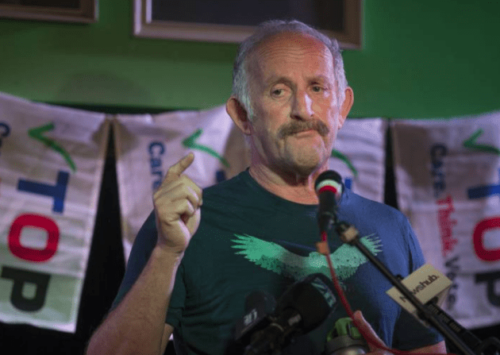
What’s Defective in the Brain of Gareth Morgan?

Most Kiwis have now had occasion to listen to Gareth Morgan and have realised that there’s something missing from his brain

New Zealanders have had a collective experience this year – 97.6% of us have seen Gareth Morgan on television or social media and thought to themselves “There’s something fucking wrong with that guy.” Even by the mediocre, ignorant, bombastic standards of the puffed-up pissants who comprise New Zealand’s political class, Morgan stands out as a particularly vile specimen. This article takes a psychological perspective to examine what might be wrong with the man.

Having a go at someone on the occasion of the sudden death of a beloved pet, as Morgan did upon the death of Jacinda Ardern’s cat this week, is about as worthy of admiration as having a go at someone on the occasion of the death of a grandparent. It’s a really low thing to do, and a person wouldn’t normally think to do it unless something was missing from their brain. After all, many pet owners consider their animal friends a legitimate part of the family.

Imagine if Sam Morgan suddenly died and Jacinda Ardern had a go at Gareth on social media, taunting him on account of the damage Sam did to the environment with frequent international air travel. It would be the most appallingly unprimeministerial conduct ever witnessed in the history of the country. The whole nation would be united in agreement that someone who behaved like that was not fit to run a pub, let alone lead a country, on account of lacking basic compassion.

That this sort of conduct is not beneath Morgan won’t surprise the large numbers of people who have observed him speak and got a creepy vibe from the man, as if he was someone who you wouldn’t leave alone in a room with a pet or a small child.

Probably the reason for this is that Morgan, like most individuals who give other people the creeps, has a very low opinion of the importance of other people. As evidenced by his proposal to buy a section of Awaroa Beach, Morgan considers other people lesser beings, their opinions less worthy, their feelings less valuable.

This is not news to anyone who criticised Morgan’s refugee policy on one of his billions of sponsored FaceBook threads, and was verbally abused as a consequence.

It is cause to believe that Morgan has utterly failed at what a psychologist would call the development of a Theory of Mind – in other words, Morgan has absolutely no idea what’s going on in other people’s heads.

This hypothesis is supported by Morgan’s rude, crude, almost autistic dismissals of other people’s viewpoints. Like most narcissists, Morgan responds firstly with disbelief and rage when people disagree with him, and then when this cools becomes snarky and contemptuous. No effort at creating a common understanding with another person is made – you agree with the truth as divined by Saint Gareth or you are simply subhuman.

No amount of explaining could get it into Morgan’s head that most people are appalled by a tax plan that calls for taxing the family home. For the vast majority of people, their tenure of dwelling is their basic security in life: their castle and their home base. Of course, someone with hundreds of millions who can buy a house with pocket change cannot understand these sentiments, but the telling thing is that Morgan made no effort to – anyone who disagreed was simply a misinformed idiot.

Neither does he seem to have the faintest idea how much joy people get out of cats, and therefore the great anti-depressant effect that cats have on the people that spend time around them. He seems to have completely failed to understand that most cat owners see their cats as fellow beings of a similar order of importance to other people. This is pretty weird, all things considered, because there are very few people who are mentally defective on such issues of empathy.

Probably the main reason for this failure is that Morgan just doesn’t care. Judging by his behaviour on the campaign circuit, other people are, for him, just tools to be used in the achievement of a greater objective.

In other words, Morgan shares a failure to develop a theory of mind with all manner of criminals, psychopaths and dictators, who, like him, are missing the basic empathy that makes people truly human.


Everything is a Matter of “Muh Feels”

It’s common for one side of an argument to demand from the other side a cold, logical, rational reason to justify their position, while at the same time decrying all appeals to emotion as fallacious. The problem with this line of reasoning is that there are no truly objective reasons to make moral judgments about anything. As this essay will investigate, all political motivations are based on emotion.

Usually the person dismissing an argument as emotional is the sort of person who is a bit autistic, perhaps themselves not really in touch with their own emotions. This sort of person has a tendency to dismiss the genuine outrage, horror or disgust of other people as illegitimate motivators. They also have a striking tendency to not realise how emotional their own arguments are.

For instance, on the question of taxation for the sake of paying for social services, many people on the left make the argument that the right are without emotion when it comes to child poverty, mental health services, rape crisis centres and the like. The usual rightist counter to this is to claim that them keeping the maximum amount of their own income is a moral imperative to oppose communism or the likes, and that left-wing “feels” about starving children etc. do not and cannot ever justify the government levying taxation upon people.

What these rightists usually miss when it comes to this line of reasoning are their own emotions that are tied up in the issue.

The government levying taxation upon people is not wrong by dint of some decree from God. It is usually only opposed by those who believe that their personal net return of government services received from this taxation is negative. For these people, a sense of anger arises from feelings of having one’s energy parasitised; a similar sort of anger arises in cases of property theft or gross disrespect.

It can thus be seen that the right wing opposes taxation for emotional reasons. In other words, “muh feels”.

Political questions, when it comes down to it, are all a matter of “muh feels”. Feelings of injustice motivate most of them, and for many people such feelings are unavoidable. After all, the feelings of the population about what is the optimum level of taxation fall along a bell curve with no taxation at one end and full communism at the other, but the actual overall level of taxation must fall on a point on that curve, meaning that many above it will be outraged that it isn’t higher and many below it will be outraged that it isn’t lower.

Even murder fulfills this criteria. After all, what’s wrong with murder other than that it makes us feel bad? If it wasn’t for the fact that a person likely feels terrified when they’re being murdered, or the fact that the people left behind feel bereaved when someone they love is murdered, or the fact that the people in the neighbourhood feel afraid by murders in case they are next, or the fact that other citizens feel disgusted by murder because they consider it a bestial act of brutality, then there would be no reason to even make murder illegal, much less anything else.

Indeed, it could even be argued that, without feels, none of us would be capable of feeling motivated to do anything, and we would simply lie about until we died of metabolic failure.

Although it’s often true that a person does not examine their own emotional impulses and makes political decisions by just lurching from one burst of neurotransmitters to the next, this does not by itself mean that emotional input into decision making is necessarily undesirable, or that a line of reasoning appealing to an emotion is necessarily fallacious.

It could even be that, for a social species, correct decisions cannot be made without some accounting for how people will emotionally react to them. If one drills deep enough, there may not be much more to life than “muh feels”.

Te Reo With Mnemonics: Kitchen Words

Spoon – koko

An old woman spoons cocoa out of a tin and into a cup.

Cup – ipu

A creature shaped like the letter E takes a cup, puts it on the floor and does a poo in it. In the cup is an E poo.

Door – tatau

A man shows off a tattoo on his arm. It is of a door that looks as though it leads to extradimensional places.

Oven – umu

A man tries to wrestle an emu into an oven.

Fork – paoka

A man is eating a casserole with a fork. Another man asks him what he’s eating, and he answers “Pork.”

Knife – naihi

A woman takes a knife and cuts her own knee.

The Maori word for ‘Door’ – tatau – sounds like the English word ‘tattoo’

Kettle – tīkera

(loan) A woman boils a kettle to make a cup of tea that has a carrot in it. The kettle boils the water in which floats the tea carrot.

Frypan – parai

A frypan is stuck to stovetop, so a woman tries to pry it off with a crowbar.

Towel – tāora

A princess is wearing a tiara on her head and nothing but a beach towel around her body.

Plate – pereti

A plate says to a woman “You are very pretty.”

Saucepan – hōpane

Someone knocks the bottom out of a saucepan and affixes it to a basketball backboard, where it serves as the hooping.

Broom – puruma

A puma is cleaning its house with a broom.

*

The above is an excerpt from the upcoming Learn Maori Vocabulary With Mnemonics, by Jeff Ngatai, due to be published by VJM Publishing in the summer of 2017/18.

How to Not Sound Crazy When Talking About Your Psychedelic Experiences

It’s hard to talk about the world beyond to people who aren’t familiar with that range of frequencies

Even though the Internet has led to a sharing of shamanic knowledge completely unprecedented (and impossible) for any other point in the world’s history, it hasn’t filtered down to the mass consciousness yet. Probably it never will – the men of silver and iron and clay cannot be expected to concern themselves with what lies beyond this veil. This essay gives some tips for talking to them about the world beyond without sounding insane.

The most important thing is to have a feel for what the person you are talking to is likely to be able to handle. This means that you have to look for clues from what you already know about them to give hints about what they already believe.

The easiest way to sound crazy is to express a belief that does not accord with consensual reality of the mass consciousness of the people around you. This is true whether you are in meatspace or cyberspace. The lower the intelligence of the person you are speaking to, the less likely it is that they will have challenged any belief widely-held by the people around them.

It is in this will to challenge consensual reality that most people judge sane from insane. All you have to do is to assert that things are not as they are commonly believed to be, and some people will start to consider you crazy. Essentially you only have to contradict the television, or in other cases the radio or FaceBook.

You might start a conversation with a suspected normie by questioning the narrative that you are fed by the network news, or by the broadsheet papers. Even that is enough to sound pretty crazy to most people, who are on the level of “they couldn’t say it if it wasn’t true.” If a person is on this level they are in no way ready to handle the idea that the government has lied to them about psychedelics for the sake of making them easier to control.

A useful tactic here is to point out how the governments and mainstream media of Anglosphere countries colluded to sell the lie that Saddam Hussein had weapons of mass destruction in order to manufacture consent for the Iraq War. It’s possible now, though, that a person remembers those times differently and will choose to remember it in a way that denies this collusion.

It pays to be wary of the fact that most people are materialists, which implies that they believe that the brain generates consciousness, and that upon the death of the physical body this consciousness somehow “disappears”. These people consider all kinds of religious ideas like karma and God to be superstitions, and the bitterest contempt is reserved for those religious who believe that the consciousness survives the death of the physical body.

Unfortunately, this belief is also one of the major insights of psychedelics – perhaps it is this psychedelic insight that forms the foundation of most religious beliefs.

Psychedelics are hard, and integrating their lessons extremely hard

Mathematics is the way to get at people who are the hardest to reach. Expressing a sense of awe and wonder at how, for example, the Fibonacci sequence reoccurs in the state of Nature is a good way of getting a person to ask themselves whether there’s something other than sheer chance going on. Other ways are to express similar sentiments about the non-reoccurring nature of pi or the import of Goedel’s Incompleteness Theorem.

The way to talk about it so that it makes sense is by talking about previous beliefs that you once held that you either questioned or abandoned after taking a psychedelic. Usually this makes it possible to apply logic to dismantle one erroneous idea after the other, and it’s seldom necessary to mention that this destruction of illusion was achieved by means of psychedelics (any insight that psychedelics have brought you can be plausibly credited to either meditation or a near death experience as well).

For example, a psychedelicised person might be able to conduct a conversation with a normie about the boundaries of the human body, and how it’s not clear where inside ends and where outside begins. The very idea of selfishness starts to unravel if the idea of what it is that one might be selfish about is challenged, and by such means light can shine through.

This column believes that the ultimate goal of consciousness expansion is apotheosis, where an individual consciousness reunites themselves with the universal consciousness and becomes privy to certain mysteries, such as that there is no such thing as time and that the death of the physical body does not impact the true self.

Contemplation of this alone is liable to induce a psychiatric breakdown in a lot of people. Most people are so utterly terrified of the concept of their future death that they have pushed the very idea of it into a deep, dark part of the mind, only to be ventured into in an emergency. Even fewer people have looked deeply enough into their own minds to have made a surgically precise distinction between consciousness and the content of consciousness.

Starting with such subjects is probably too much. Most people will declare you crazy for talking about them rather than risk psychosis by dwelling on them.

Questioning the materialist dogma that the brain generates consciousness is the quickest way to be seen as crazy. This dogma is taken by many to be the absolute, inviolable and axiomatic truth of reality and conversation along these lines is likely to make materialists fear or despise you.

The best thing is probably to declare skepticism of the claims of a mutual enemy. The Government, the Church or Big Business can all serve as excellent mutual enemies. Skepticism of the claims of these mutual enemies might then be generalised into skepticism about other claims and dogmas.