

Author: vjmp
Why Nietzsche is Hard
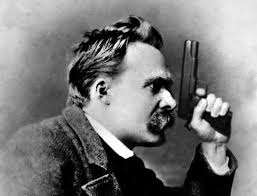
The experience of reading and contemplating Nietzsche is fundamentally different to that of the majority of thinkers. A natural consequence of this is the unprecedented degree to which Nietzsche is misunderstood.
Appreciating Nietzsche isn’t a simple matter of considering a number of competing claims to the truth and deciding if his case is the strongest. He is not such a man that will brook standing in the dock while his ideas are tried by plebs.
Nietzsche is hard for the same reason that integrating a psychedelic trip is hard. This is because to understand him, first you have to concede to his basic contention: that everything you know might be wrong. This makes Nietzsche appear to be a nihilist for anyone who stops reading him at this point, which most people do.
But to appreciate Nietzsche, at least initially, you have to accept that the very way you think may be fundamentally flawed.
His contention is that people have been lied to so often by the church, by the state, by centuries of half-wit philosophers, by power-crazed kings and by the bleating of the herd, that they’re too confused to even begin thinking their way out of it. The way people think is so fundamentally flawed that to make progress the first point of order is to forget all the lies that they currently consider to be true – and there are many.
In fact, you can’t merely forget them – you have to deliberately and purposefully smash them. To get to the truth you have to escape the labyrinth of lies, and so you have to “philosophise with a hammer”.
Understanding the truth of Nietzsche is thus not a pleasant and straightforward experience like sitting in a kindergarten listening to the sweet voice of a kind teacher guiding you gently away from ignorance. It’s more like Hell Week of the Navy Seals, in which a person’s entire personality has to be torn to the ground so that a new, stronger one can be rebuilt in its place.
Regular readers of this column will recognise this phenomenon as the task of the mystic, the shaman or the schizophrenic. Nietzsche himself clearly recognised this when he subtitled Thus Spake Zarathustra as “A Book fof Everyone and No-one.”
This is very evidently not a task for the man of clay; Nietzsche had no intention of founding his own religion for the masses (probably this explains the appeal of Nietzsche among those of the left-hand path).
All of this helps to explain why the name of Nietzsche has been associated with the Nazis.
Any political power who seeks to tear down the established order (which in Hitler’s time was the Anglo-American Empire) and impose their own based on transvaluated values (the Nazi Empire) has one immense – but superficial – connection with Nietzsche’s philosophy in so far that both are revolutionary.
Both seek to tear down old ways that they see as corrupt or decadent. Indeed, crusades against ‘decadent’ art was one of the ways the early Nazis built outrage in their favour, and rhetoric about the corrupting effect of Jews on German society was regular.
Moreover, Nazism was one of the most striking historical examples of a supremacist movement, and supremacists of all stripes find a superficial interest in Nietzsche’s talk of the ‘Superman’.
The great irony here is that Nietzsche would likely have considered the Nazis – like all egoic supremacists – a pack of plebs.
If We Are in A Period of Excess Yin, How Would We Know?
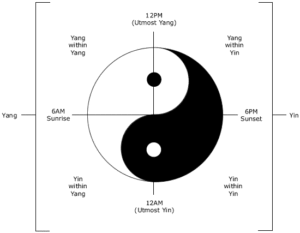
If Francis Fukuyama is correct, and the Great Pendulum of the World swings back and forth every 60 or 70 years or so, then this would suggest right now that we are at a period of peak yin. We can surmise this because the last time there was clearly a period of excess yang it ended in the violent paroxysm of World War II, 71 years ago.
It is certainly not a time of excess yang right now in 2016. We know what that would look like – violence. This is literally the least violent time in human history (however, there is absolutely no evidence that things are guaranteed to remain this way indefinitely).
What are the characteristics of an age of excess yin? As below, so above – we can guess that the characteristics of the world would be a macrocosm of the characteristics of all of us.
Yang is also characterised, especially in Western alchemy in its aspect as the masculine principle, as order. Thus we can expect that excess yin might manifest itself as destructive, senseless chaos.
This would not manifest as the proportionate yin of a predatory beast who destroys with a view to impose a higher form of order, but more like the mindless rage of a school shooter or an Islamic suicide bomber, or even like the 2003 invasion of Iraq, which made little sense to anyone at the time and makes none now.
The masculine discriminates, the feminine does not discriminate. Therefore, in a time of excess yin, the fundamental error is to fail to discriminate when one should have discriminated. Perhaps this is what has happened with the immigration policies of the Western world in recent decades.
It’s especially evident in Europe, for example, where the man in the street has seen his quality of life drop sharply as a consequence of his nation’s naive lack of discrimination and foresight (and it’s been worse for the womenfolk).
The attitude from Western politicians towards people claiming to be refugees over the past 20 years was to open the bosom to allcomers, and to use social pressure to cow into submission anyone questioning this policy.
If yang is the heavens and yin the earth, the immense materialism of our age is perhaps also evidence that this is a period of excess yin. Our mainstream religious traditions are so thoroughly and irrevocably corrupted that expressing a will to become a priest is tantamount to a confession of sexual deviancy – whether justified or not.
There isn’t a skerrick of spirituality to be found in any of the long-dead rituals or in the emotional and manipulative rhetoric, yet our priests ride around in massive Mercedes and fly private jets, and lecture us on our duties to the poor from thrones of solid gold.
So materialistic are we that even most people who educate themselves to postgraduate level – much less the others – cannot conceive of an origin of consciousness different to the current “magic brain” model, in which one has unshakable, 100% confidence and faith in the belief that science will one day prove that the brain generates consciousness through electrobiochemical means.
Finally, we can see it with the rampant overpopulation of the Earth. The yin is associated with love and reproduction, but it is obvious that our recent interest in this is excessive. There are so many of us that we are in the middle of one of the six biggest extinction events in the history of the planet.
Despite the carnage that we are wreaking virus-like on the planet as we consume everything that lives on or under its surface, few seem to have any compunction about bringing another litter of kids into the world to compete for ever-diminishing resources.
Taken together, the reasons to think that we are in a time of excess yin seem overwhelming. This means that the world is about to start heating up – alchemically, if not physically.
Is It Time For Gay and Lesbian New Zealanders to Lose Their Victim Status?

Apart from Rugby World Cup trophies, the one thing that New Zealanders fight for with the most intensity is victim status. Being a victim in our society is to wield the power of laying guilt trips on people, which often brings with it a free media platform to convince people to stop their behaviour and adopt others more to the guilt-tripper’s liking.
Once you have achieved the status of victim no-one can disagree with you without feeling ashamed because if they disagree with you they automatically become part of the oppressor class, who all New Zealanders have been conditioned since kindergarten to reflexively despise.
This social pressuring has an extremely powerful influence on the thoughts and feelings of the individual, but the problem with this cozy arrangement is this.
The reason why gay and lesbian New Zealanders have, as of right now, an impregnable position at the very summit of Mount Victim is that being gay and lesbian is not highly correlated with significant measures of social deprivation in the country today.
The average homosexual is actually fairly wealthy on account of being both better educated than average and being less likely to have children, a phenomenon known as the pink dollar.
There’s no denying being gay and lesbian once was highly associated with measures of social deprivation and disenfranchisement. This is inevitable when you can literally get locked in a cage for being who you are. The contention of this column, however, is that this battle has long been won.
Homosexuality became illegal in 1840 in New Zealand and legal again in 1986 – now thirty years ago – so the people that enforced the legal prohibition on it are all long ago dead and buried.
In the 2011 General Election, seven gay or lesbian MPs were elected to Parliament, which is almost six percent of the total – over twice the actual proportion of gay and lesbian New Zealanders (and this is ignoring the known homosexual MPs who are just not public about it).
If your marginalised group is represented in Parliament at 250%+ of its proportion among general society, so much so that when a law is passed in your favour the entire Parliament will band together and sing a song of regret that they didn’t do it sooner, are you really that marginalised?
The irony of the eternal battle for victimhood is this: once your victim status is recognised by your society at large, you are automatically no longer a victim, because you are instantly doing much better than all the oppressed people whose victim status is not recognised.
The reverse of this is also an irony: in order to get into a position where you can do anything about being a victim, you have to get into a position where you are no longer a victim.
This is why the physically and mentally infirm will always be at the bottom of society – simply because they are in the weakest position to advocate for themselves. It is exceptionally rare to meet a sick person wearing a suit and who is articulate as Grant Robertson.
So perhaps it’s time for another marginalised group of New Zealanders to get some attention?
If you are one of New Zealand’s 400,000 medicinal cannabis users, getting completely ignored by all parties is galling when you can turn the television on and hear Jacinda Ardern passionately arguing for legalising gay adoption – an issue which affects perhaps 50 people a year.
Every day you are ignored is another slap in the face, another insult. But no-one will bring up your plight in Parliament, ever, and merely to point out that it’s time for you to displace some of the wealthy and powerful people raking it in at the victim table is seen as effrontery (no doubt many people will read the headline of this article and become outraged without reading the body).
That’s a real victim of societal prejudice.