
Why the New Zealand Working Class is Destined to Turn to Fascism

With the signing of the UN Compact on Migration, the Sixth Labour Government all but assured that the New Zealand working class will turn to fascism. They won’t do so straight away, and many will claim that they won’t do so at all, but the snowball has been set in motion. This essay will explain why.

From the turn of the century in Europe, a new pattern started to emerge: the resurgence of anti-globalist sentiments. Globalism had dominated the world for the previous half-century. Nationalism was comprehensively defeated in World War II, and the next fifty years were characterised by anti-protectionist trade agreements that liberalised commerce and trade all over the world.

Western workers were promised that this liberalisation would lead to better living conditions, as their wages would be able to buy goods and services more cheaply and efficiently. The reality turned out to be the opposite. Western workers turned out to be the product, and trade liberalisation simply meant that international companies could play workers in different countries off against each other, bidding their wages down to the floor.

Eventually the globalist propaganda stopped being effective, as people started to see through it. They realised that they had been cheated – not only were they not richer, but they now had to live with the effects of the mass importation of cheap labour into their communities. This meant increased violence, increased property crimes and increased sex crimes, all of which the elite were safely inured from by virtue of living in wealthy neighbourhoods.

The European working class were brutalised by globalism. Their wages went down, their neighbourhoods became less safe, and on top of it all, they were regularly humiliated by the same political class who claimed to represent them. Leftists habitually dismissed working-class concerns as “bigoted” or “motivated by racism”, as if it were unreasonable to complain about the destruction of one’s community or of the possibility of raising a family on one wage.

This sentiment has found increasing expression in fascism. At the last Swedish General Election, the Sweden Democrats won 17.6% of the vote. The globalist parties refuse to co-operate with them, and as a consequence the country has been ungovernable for the last 100 days. In Germany, opinion polls are suggesting that the Alternative Fuer Deutschland now has as much support as the major social democratic party, which suggests that the government of Europe’s largest economy risks falling into a similar state of paralysis.

New Zealand is merely a few decades behind on this same miserable path of social decay.

You’d have to be insane to vote National as a working-class person. Not only do they want to cut all of your social assistance, but they also want to import the same hordes of cheap labour that has destroyed Europe over the last 40 years.

But you’d also have to be insane to vote for Labour. The New Zealand Labour Party has long ago replaced all of its working-class sentiments with bourgeois ones. As a result, they’re right behind the UN’s Global Compact on Migration. This follows in the same vein as the recent increase in the refugee quota, and is commensurate with Jacinda Ardern’s ambition to become a highly-ranked UN official.

As a working-class person, an increase in the refugee quota, and an liberalisation of the ability of cheap labour to move here, have a number of terrible consequences.

The first and most obvious is the destruction of the economic position of the working class. The economic position of those who sell their labour for a living is entirely dependent on the supply of that labour. Basic economics tells us that if the supply of cheap labour goes up, the wages go down. So the more people who are let into the country to compete with the working class, the lower the standard of living becomes.

Even worse is the destruction of the social position of the working class. Instead of being seen as economically disadvantaged individuals who might need extra social assistance, the working class (especially the white working class) are now seen as enjoying privilege that refugees don’t have. They now find themselves facing verbal abuse for defending their own class interests by opposing globalisation.

These consequences come on top of the changes brought by the last 30 years of neoliberalism, which has changed the position of the working class from an essential part of the nation to a disposable commodity to be bargained down to the cheapest possible price. The net result of it all is a deep sense of humiliation, rage and betrayal.

If the working class feels like the left has abandoned them (perhaps because the left has become captured by bourgeois interests), they will find an alternative from outside the right-left liberal democratic dichotomy. There is ample historical precedent for this – indeed, it was a deep sense of anger among the working class that led to Mussolini and Hitler taking power in their respective countries.

The Maori working class will be the most receptive to the fascist message. This is apparent from their existing high level of support for the (supposedly) nationalist New Zealand First party. This particular group has already lost their social position from colonisation, and are not at all keen to lose it again to what is effectively more colonisation. They will be among the strongest supporters of fascism in New Zealand.

If the left react to this intensifying sense of abandonment by lecturing the working class about how they are racist, and how they are selfish, and how they need to sacrifice more to do their share of helping out, then a fascist resurgence is all but guaranteed. As Emmanuel Macron recently proved in France, nothing will amplify the fury of the working class more than to inflict moral lecturing on top of their economic and social suffering.

The New Zealand working class will turn to fascism because the two mainstream parties are co-operating – and will continue to co-operate – to take measures that will destroy the economic and social position of that class. The inability of the working class to find expression within the liberal democratic system will lead to them destroying it by supporting a fascist alternative as soon as one arises. The New Zealand Establishment will not heed the lessons of history.

*

If you enjoyed reading this essay, you can get a compilation of the Best VJMP Essays and Articles of 2017 from Amazon for Kindle or Amazon for CreateSpace (for international readers), or TradeMe (for Kiwis).


The Correlation Between Diversity And Poverty

A 2003 article in the Journal of Economic Growth quantified the degree of ethnic and cultural diversity in the various nations of the world, making a range of statistical analyses possible. For this article, we did a study to calculate the correlation between the ethnic fractionalisation index given in the linked article and GDP per capita (the most common measure of wealth), for the sake of investigating the link between diversity and poverty.

For this study we took data for 154 different nations and entered them into a Statistica database for the purposes of calculating a correlation matrix. There were three parts to this data: the first was a measure of the ethnic diversity of the country, the second was a measure of the cultural diversity of the country, and the third was a measure of the average personal wealth of the country.

The first two parts were taken from the 2003 paper linked in the opening paragraph. The third part, the measure of average personal wealth, was taken from International Monetary Fund data regarding the GDP per capita of all countries (measured on a price purchasing parity basis).

If diversity really is a strength, then there will be a positive correlation between ethnic and cultural diversity and wealth. This would happen if diversity led to higher education levels or if it inspired entrepreneurialism.

If, on the other hand, diversity is not a strength but a weakness, then there will be a negative correlation between ethnic and cultural diversity and wealth. This would happen if diversity made it easier to divide and conquer the working class for the sake of driving down their wages.

When a correlation matrix is calculated, a strong link between diversity and poverty is apparent. This can be seen from the fact that there is a significant negative correlation of -0.36 between ethnic diversity and gross domestic product per capita. This means that a country’s score on the ethnic fractionalisation index predicts how wealthy it will be: the more diverse, the less wealthy.

There is also a significant negative correlation between cultural diversity and GDP per capita, although this is weaker at -0.18.

There are several reasons to think that diversity leads to poverty.
Diversity makes it harder for workers to organise, because a plurality of languages and cultures makes it more difficult to find common points around which to rally. Diversity also leads to mistrust, because the social signals that people consider to be signs of trustworthiness are either not present as often, or presented in a form that is not understood as readily. It also leads to corruption, as people are more readily inclined to cheat others if those others lack similarities.

There could, however, be underlying factors at play. If we add the fourth factor of IQ to the correlation matrix, we can see that there is also a correlation of 0.65 between IQ and GDP per capita, and even a correlation of -0.54 between IQ and ethnic diversity. So it might simply be that the reason for the correlation between diversity and poverty is that diverse places tend to be low IQ, and low IQ leads to poverty.

*

If you enjoyed reading this essay, you can get a compilation of the Best VJMP Essays and Articles of 2017 from Amazon for Kindle or Amazon for CreateSpace (for international readers), or TradeMe (for Kiwis).

A Brief History of Modern Racism

I remember the first time I got called a racist. I was 17 years old, and was in my first year of university, involved in a philosophical discussion. Someone had claimed that the word ‘Islam’ means ‘peace’, and I had countered that it really means ‘submission’, only to be told that this was a misconception that I had to be racist to believe. In the 20 years since then, as this essay will examine, our conception of what racism is has only become more ridiculous.

Racism originally started out as a reaction to the racial supremacist sentiments that were blamed, in English-speaking popular culture, for World War II. As the story goes, the evil dictator Adolf Hitler stirred up such latent sentiments among German speakers, which lead to an attempt to invade Eastern Europe for the purposes of securing lebensraum for the overflow of Germans. This led to the deaths of some thirty million people, and all because of racism.

Quite reasonably, there developed a movement within postwar popular culture to reject racist sentiments, so that the causes of World War II would not cause another great conflagration. The problem, as with so much of popular culture, is that things went too far. Far, far too far.

Once upon a time, in order to be called a racist you had to display racial prejudice that harmed someone. A racist would be someone who called a black man a “nigger” in public, or someone who refused to hire the best-qualified applicant on the grounds that he was Asian. An example of something that was racist would be going around your neighbourhood beating up Aborigines. Choosing to hold an unfashionable political opinion was not racist, as this was just a thought, and thoughts weren’t crimes once.

Now, if a person doesn’t actively hate the white race and wish for its destruction, that person is considered some kind of white supremacist. The ‘It’s Okay To Be White’ campaign revealed that, in the minds of many people, a refusal to feel guilt on account of being white is tantamount to support for white supremacy. You can now be racist merely for a refusal to be ashamed for being white.

In modern times, our conception of racism has evolved, and well beyond any directive to treat different races on equal terms. The white man is perfectly evil – if you think that there’s a semblance of good in him, you’re a racist. All men of other races are perfectly innocent – if you think there’s a semblance of malice in them that did not arise as a result of their oppression at the hands of white people, you’re a racist. This is the new dogma – question it at your peril.

All economic and social advantages that the white man possesses can be attributed to his ruthless oppression of coloured people and the theft of their natural birthright, but curiously this does not apply to Jews. Despite being much wealthier than the average white person (at least in America), Jews did not achieve their position by any immoral means, but only by diligent and intelligent application of effort.

It is never explained why the white man can not have become rich by the same application of effort as the Jew, it’s just assumed that the white man became rich through crime, while the Jew – who is far wealthier – did so through honest hard work.

Similarly, an attempt has been made to redefine racism as “prejudice + power”, implying that black people cannot be racist against white people on account of that black people do not possess institutional power with which to oppress white people. But, as above, white people do not possess institutional power with which to oppress Jews, yet white people are accused of anti-Jewish racism all the time.

Believing in science is now racist if science suggests facts that are in any way unflattering to a coloured person. It’s not even okay to suggest that different groups of people evolved to meet the survival challenges of different environments, unless of course all non-white people evolved to be superior to whites (there is no way in which white people could have evolved to be superior over anyone else). The idea that the different challenges of different environments led to different intelligences is right out.

It can be seen from the examples above that much of what passes for modern racism is really an anti-white sentiment, either self-hatred projected outwards (as in the case of the social justice warrior) or simple hatred born of envy and fear (as in the case of most coloured people). This explains why accusations of racism are often made in situations where they make no logical sense, the most common example today being getting called racist for expressing a dislike of Islam.

The truth, of course, is that most of this racism hysteria is part of what is known as “call-out culture” – in other words, it’s mostly a way for bourgeois white people to one-up each other, gaining social capital at the expense of their fellows. The modern concept of racism has, therefore, lost all contact with its roots as a way of reducing suffering from racial prejudice. It’s now just a fashion, displayed as shamelessly as any other.

*

If you enjoyed reading this essay, you can get a compilation of the Best VJMP Essays and Articles of 2017 from Amazon for Kindle or Amazon for CreateSpace (for international readers), or TradeMe (for Kiwis).
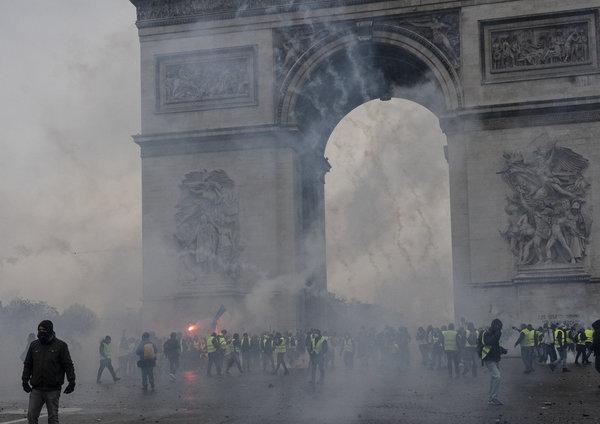
Could Fuel Tax Riots Come to New Zealand?

Europe is caught in its heaviest protests since 1968. Ostensibly as a result of fuel taxes, they have become so large that in France some are concerned they may lead to a nationalist revolution, and French President Emmanuel Macron is rumoured to have given orders to send in tanks to quell any unrest this coming weekend. However, there’s more to the story than this – and the reality suggests that these protests might come to New Zealand.

France is a heavily taxed nation – government spending is 56.6% of GDP, compared to 37.4% in America and 48% in New Zealand. This has long been accepted by the French people, because of their high levels of social trust and solidarity, but the whole system is dependent on the will of the average Frenchman to pay into it. The Frenchmen paying taxes were happy to do so because they believed that this tax money was going to help people like them, but this is no longer the case.

Fuel taxes are something that particularly affect working-class white French people, to the benefit of the middle class and the underclass who live in the big cities. People who live in big cities can take public transport or taxis, and in any case don’t have to drive far. Working-class people who have to commute to work often have to drive from small villages or towns to a city somewhere else, sometimes twice every day, and so become heavily affected by any rise in the fuel price.

A large proportion of the New Zealand population still lives rurally or semi-rurally. There is a commonly-cited statistic that suggests that New Zealand is one of the most urbanised countries in the world, but what this statistic ignores is that our cities are exceptionally sprawling by world standards. So even people who live in cities have to drive a lot as part of everyday life.

Dan McGlashan showed in Understanding New Zealand that this rural population is much more likely to own cars and to drive to work than to walk or to take public transport. Buses are not an option for the majority of New Zealand’s rural dwellers. There’s more to it than just this, however. These fuel taxes would come as another burden to what is an already heavily discontented working-class rural population, who already feel that the cities are benefitting from the current order at their expense.

If Jacinda Ardern and the Labour Party go through with their plans to raise the refugee quota at the same time as raising petrol taxes for the sake of fighting global climate change (or whatever the excuse is), they run the risk of fostering the same kind of discontent that has now erupted in Europe. Although they will deny the connection, the perception will rise among the rural working class that they are being taxed through fuel to pay for the importation of refugees that they didn’t want.

For a working-class white person who already has to see middle-class brown people promoted ahead of him on account of their skin colour, or winning scholarships that he cannot apply for on account of his skin colour, things like fuel taxes are an extra kick in the guts. Despite the attempts of the mainstream media to spin the French protesters as insane anarchists, hooligans and neo-Nazis, the fact is that they belong to the same group of normal, everyday people who have lost out from neoliberalism all over the West.

We already saw some small protests in New Zealand two months ago when the petrol price crept up to $2.40 per litre. As the article linked to in the previous sentence suggests, the Government plans to raise the excise tax on petrol by another 7c over the next two years, primarily to pay for infrastructure projects in Auckland.

This means that the neoliberal Government of Jacinda Ardern is potentially making the same mistakes as the neoliberal Government of Emmanuel Macron.

The Sixth Labour Government certainly seems like it’s willing to raise petrol taxes on the New Zealand rural poor to pay for things like doubling the refugee quota, and for Auckland infrastructure projects that most New Zealanders will see no benefit from. Should this cause the petrol price to get up to $2.40 again – or even higher – then the stage is set for fuel price riots to come to New Zealand as well.

*

If you enjoyed reading this essay, you can get a compilation of the Best VJMP Essays and Articles of 2017 from Amazon for Kindle or Amazon for CreateSpace (for international readers), or TradeMe (for Kiwis).