Understanding New Zealand: Demographics of Tenure of Dwelling

As alluded to in the previous section, a New Zealander’s tenure of dwelling is primarily a function of their socioeconomic status, with the wealthy likely to be freehold, the next most wealthy likely to be mortgaged, and the poorest likely to be paying rent.

That Kiwis of European descent are well-established as the land-holding class is a fact well known. The correlation between being of European descent and living in a freehold house was a very strong 0.78. There was also a positive, but not signficant, correlation of 0.11 between being of European descent and living in a mortgaged house, and a strong negative correlation of -0.68 between being of European descent and living in a rented house.

There were significant negative correlations between every other ethnicity and living in a freehold house. Even the correlation between being Asian and living in a freehold house was significantly negative, at -0.34, despite that the average Asian in New Zealand is fairly middle-class. The correlation between being Maori and living in a freehold house was -0.52, and with being a Pacific Islander and living in a freehold house it was -0.56.

Because we know that most recent immigrants to New Zealand are Asians or Pacific Islanders, these statistics tell the story of how opening the immigration taps has been immensely profitable for the land-holding class, who were then able to charge much higher rents on account of the much higher demand for housing.

Even stronger, and perhaps even less surprising, is the correlation between median age and living on freehold land – a whopping 0.90. The obvious reason for this is people saving their wage or salary for much of their lives for the sake of being able to buy some land and no longer being forced to pay rent.

Mirroring this was the almost as strong negative correlation between median age and living in a rented house – this was -0.86. There is equally little surprising about this statistic because the majority of New Zealanders leave home as soon as they are able, and very few of these move directly into a mortgaged house (much less a freehold one).

Curiously, a person with School Certificate as a highest academic qualification is more likely to live in a freehold house than a person with a doctorate. The correlation with the former is 0.23 and the correlation with the latter is 0.07.

Some might find this very surprising considering that there is a strong correlation between education and wealth and another strong one between wealth and homeownership. The reason for it is that, when it comes to living on freehold land, age trumps both of those things, even added together.

Likewise, it can be seen there is a stronger correlation between living on freehold land and working in agriculture, fishing or forestry (0.32) than there is between living on freehold land and working in a plum industry like information media and telecommunications (-0.38), financial and insurance services (-0.30) or professional, scientific or technical services (-0.16).

Again, the reason for this is mostly because working in those latter three industries generally requires an advanced degree, and these degrees are mostly held by people too young to have saved the capital to secure freehold land.

One statistic that seems amazing when taken out of context is that only Kiwis in the $15-25K income brackets have significant correlations with living in a freehold house, and that only Kiwis in the $50-70K income brackets have significant correlations with living in a mortgaged house.

That might seem strange until one notices the very strong correlation of 0.82 with living in a freehold house and being on the pension.

Seen like that, it seems a bit strange that pensions are much higher than student allowances, despite being paid to people who also do not have to pay rent out of their benefit as a general rule. Then again, the General Disenfranchisement Rule tells us how such a state of affairs came to pass.

*

This article is an excerpt from Understanding New Zealand, by Dan McGlashan, published by VJM Publishing in the winter of 2017.

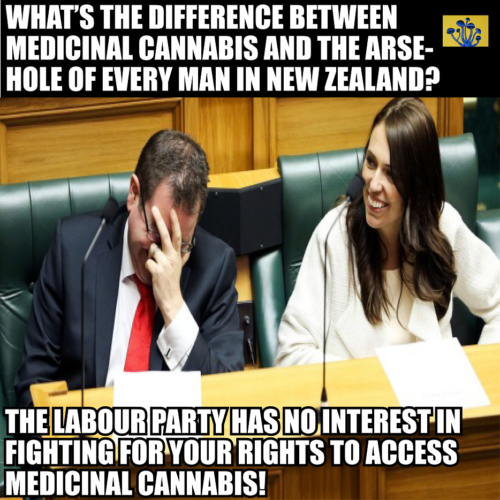
If Doctors Stopped Lying About Cannabis They Might be Believed on Vaccines

The Government’s stupidity with regards to cannabis is hard to overstate. Its 40-year long War on Drugs, conducted against the people of New Zealand at their own expense, has destroyed tens of thousands of lives at the cost of billions. Signs are that they are soon to stop lying about cannabis – but the distrust they have caused will linger for decades.

It’s also hard to overstate the loss of trust that comes from realising that you have been lied to for many years about the effects of using cannabis. For many, this trust is impossible to replace.

At first it’s kind of surreal – if you are from a family background that has many cannabis users in it – to learn that so many diseases and negative outcomes are attributed to use of the plant.

It seems obvious that cannabis is of value to people who can’t handle alcohol, and that if they smoke instead of drink then no-one gets beaten up. This seems so obvious that it’s really astonishing that our entire public recreational culture revolves around the violent drug and not the peaceful one.

Most Kiwis have had the experience of being at school and being forced to listen to a Police officer lie to them about the supposed effects of the drug. That sort of thing is relatively easy to brush off – after all, you’d have to be stupid to trust a Police officer in the first place.

At high school you learn the basic lesson of Animal Farm, which is that the ruling class are pigs and they maintain control and order by setting the dogs onto the other animals. So most people are capable of eventually accepting that politicians and cops aren’t really the good guys and never were, and so their lying to you isn’t that big of a betrayal.

It’s harder to brush off when it’s a doctor lying to you.

An ever-growing number of Kiwis have, over recent years, come to bring their discoveries about the application of medicinal cannabis to the attention of their doctor, only to be firmly told that cannabis has no medicinal value, or even negative value.

This sort of thing is much more difficult to cope with because doctors are generally seen as impartial sources that can be relied upon without politics or money interfering. In many ways, doctors have replaced priests as the kind of person that Kiwis have come to confide in in dark times.

Unfortunately, New Zealand doctors will happily lie to their patients when they are ordered to by politicians who are taking money from pharmaceutical, alcohol or tobacco interests who want to use the law to eliminate a competitor.

This is why they stubbornly refuse to concede that cannabis has medicinal value, even thought it was legalised in California in 1996 and has recently been legalised for medicinal use in Argentina, South Africa, Chile, Colombia, Mexico and other places that New Zealand likes to think itself more developed than.

The unexpected consequence of this lying about the medicinal value of cannabis is that many patients, having become aware that their doctors are lying to them, lose all faith in those doctors, and then stop trusting them on all other matters, such as the need for vaccines and so on.

These medical hyperskeptics are disproportionately young, for the reason that it is almost entirely old people who continue to maintain the fiction that the Drug War is fought for the benefit of the New Zealand people. We know this because there is a correlation of -0.55 between median age and voting for the Aotearoa Legalise Cannabis Party in 2014.

The problem with this is that these young adults are precisely the same demographic that does the vast majority of the breeding, and therefore comprise the vast majority of the people tasked with making decisions about the immunisation schedule of infant New Zealanders.

Here the danger is evident. These people, tasked with making important medical decisions for the sake of their children’s wellbeing, cannot have confidence in what their doctor tells them because they know that their doctor has been less than honest on the cannabis subject.

Let’s not understate how incredible it is for a doctor not to know that cannabis is medicinal. It’s just as astonishing as meeting an astronomer who didn’t know that the Earth rotated around the Sun.

If the New Zealand medical profession is serious about preventing an outbreak of a once-eliminated disease, such as the kind that has been kept from breaking out by mass immunisation, then it needs to take care to repair the damage that its credibility has suffered from 21 years of lying about cannabis.

Californians decided that there was enough evidence to make medicinal cannabis legal 21 years ago.

It’s in the public interest of every Kiwi to see to it that our ridiculous drug laws are reformed as soon as possible.

Understanding New Zealand: Demographics of the Non-Christian Religious

Although the majority of religious people in New Zealand follow some kind of Christian denomination, there are enough non-Christian religious for it to be worth looking at them as a discrete category.

The Spiritualism and New Age movement is perhaps the most interesting group of non-Christians because they are the hardest to categorise. They are like the others in many ways and unlike them in many ways.

Perhaps the most striking set of correlations relating to the non-Christian religious are those with being foreign born. The correlation between being Buddhist and being foreign born was an extremely strong 0.90, and speaks to how little immigration to New Zealand there has been from Buddhist countries until recently.

There was also a significant positive correlation between being foreign born and belonging to any of Islam (0.75), Hinduism (0.74), Judaism (0.41) or other religions (0.34).

Interestingly, though, there was a moderately strong negative correlation between being foreign born and following Spiritualism or New Age traditions – this was -0.45.

Given that it is very likely any given non-Christian religious person is an immigrant, we can also see trends that are true of immigrants replicated with the non-Christian religious. For instance, the non-Christian religious are significantly better educated, especially in the case of Buddhists and Jews.

The correlation between having a Master’s degree and being a Jew was 0.78; with being a Buddhist it was 0.68; with being a Muslim it was 0.37 and with being a Hindu it was 0.34.

However, the correlation between having a Master’s degree and following a Spiritualist or New Age tradition was negative, at -0.07. This is probably because this particular tradition appears to have its own, New Zealand-specific focus and so they are less likely to be from highly educated immigrant groups.

Again replicating the patterns, all of the foreign non-Christian traditions had significant negative correlations with being on the invalid’s benefit, in contrast to Spiritualism or New Age, which had a significant positive one.

Likewise, all of the foreign non-Christian traditions had correlations of at least 0.50 with never having smoked cigarettes, but the correlation between being a Spiritualist or New Ager and never having smoked was -0.41.

All of these five non-Christian traditions had positive correlations with being on the student allowance, which may suggest a generally higher intelligence among this group. The correlation between being on the student allowance and being Buddhist was 0.30; with being Muslim it was 0.29; with being Jewish it was 0.22; with being Hindu it was 0.19 and with being a Spiritualist or New Ager it was 0.18.

Some might be able to predict the very strong correlations being being Buddhist or Jewish and working in one of information media and telecommunications, financial and insurance services or professional, scientific or technical services. Being Buddhist had a correlation of at least 0.55 with all three of these industries and being Jewish had one of at least 0.60 with all three.

One curiosity is when it comes to how people get to work. Hindus and Muslims are significantly more likely to take a private vehicle to work; Hindus, Muslims and Jews are significantly more likely to take a bus to work; Jews, Spiritualists and New Agers are significantly more likely to walk to work and Spiritualists and New Agers are significantly more likely to bike to work.

The fact that Spiritualists and New Agers have a high incidence of being on the invalid’s benefit but are among the most likely to exercise on the way to work speaks of the large proportion of psychiatric casualties among this group.

Here’s one for the conspiracy theorists: the correlation between being a Jew and having a personal income of $150K was a very strong 0.83. The only other non-Christian tradition to have a significant positive correlation with being in this income band was Buddhism, at 0.40.

For Hinduism, Islam, and Spiritualism and New Age the correlations ranged from 0.00 to -0.12.

The main reason for this can be seen if one looks at the correlations between following a particular non-Christian religious tradition and working as a professional. This had a correlation of 0.70 with being Jewish, 0.48 with being Buddhist, 0.13 with being Muslim, 0.12 with being Hindu and 0.11 with being a Spiritualist or a New Ager.

As a general rule, people following a non-Christian religious tradition were marginally more likely to become sales workers or clerical and administrative workers.

*

This article is an excerpt from Understanding New Zealand, by Dan McGlashan, published by VJM Publishing in the winter of 2017.