
Category: new zealand
The Murderers of Free Speech in New Zealand
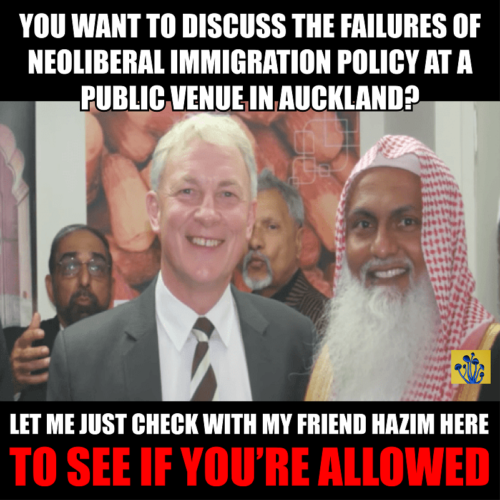
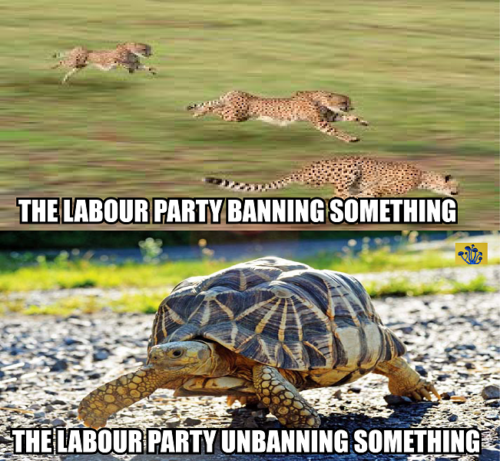
Phil Goff’s Denial of Council Venues to Canadian Speakers Violated the Human Rights Act
People in New Zealand have a set of human rights, enshrined in law. These include the right not to be discriminated against for unjust reasons. As this essay will show, Phil Goff violated the human rights of New Zealanders and of Lauren Southern and Stefan Molyneux when he decreed that the Canadian duo were banned from all Auckland council venues because of their political opinions.
Section 21 of the Human Rights Act 1993 lays out the prohibited grounds for discrimination in New Zealand. These are the usual reasons, considered necessary to the functioning of a modern society: race, marital status, gender, age, disability etc. The logic is that we cannot have a functioning society if people are allowed to deny goods and services to others because of spurious and unfair reasons, therefore to do so is criminal.
So you can’t refuse to serve a person at a bar, for example, simply because they are Maori. Neither can you refuse to give a job to a person for the reason that they are homosexual. These are considered acts of discrimination, and are unlawful.
One of these prohibited grounds for discrimination is “political opinion, which includes the lack of a particular political opinion or any political opinion”. This is a verbatim quote of Section 21(j).
So it’s prohibited to refuse a service to someone on the grounds of their political attitudes. Not even if they are Communists or Nazis may one do so. It doesn’t matter, for example, if the proprietor of a hotel thinks that open borders will lead to the ethnic cleansing of his people through the irreversible dilution of his culture – he is still not allowed to refuse service to other people simply because they believe in open borders.
Section 44 of the Human Rights Act states the following:
It shall be unlawful for any person who supplies goods, facilities, or services to the public or to any section of the public—
(a) to refuse or fail on demand to provide any other person with those goods, facilities, or services; or
(b) to treat any other person less favourably in connection with the provision of those goods, facilities, or services than would otherwise be the case,—by reason of any of the prohibited grounds of discrimination.
So it is not lawful to deny the provision of a facility, such as a council venue, to a speaker based on the political opinions of that speaker. If a speaker wishes to hire a venue – even if it’s a private one – the owner may not refuse service to them simply because of their political opinions.
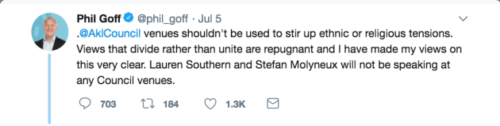
Phil Goff refused to provide use of council venues to Southern and Molyneux on account of their political opinions. He said that the two have views that “divide rather than unite”, and claimed that this was justification enough. This is unlawful in New Zealand. You cannot deny the provision of a venue to another person merely because you have declared their political opinions “repugnant”.
Phil Goff is a criminal and a human rights violator. If there was justice in New Zealand, he would stand trial.
*
If you enjoyed reading this essay, you can get a compilation of the Best VJMP Essays and Articles of 2017 from Amazon for Kindle or Amazon for CreateSpace (for international readers), or TradeMe (for Kiwis).
The Government Needs to Draw Up A List of Opinions We’re Allowed to Express
The Western World risks falling into confusion. Most of us have lived our lives under the impression that we were free people, at liberty to pursue happiness and to discuss ways of achieving it. As we’re now finding out, we don’t actually have the rights that we thought we had. This essay suggests a way out of the predicament.
New Zealanders have, in recent weeks, been surprised to learn that we don’t actually have the rights to free assembly and free speech. This has been demonstrated by the example of controversial speakers Lauren Southern and Stefan Molyneux, who were forbidden from using a public hall by Auckland Mayor Phil Goff. Stating that he doesn’t believe that the political opinions of the two should be permitted to be spoken, Goff banned them from using the Auckland Town Hall.
Southern and Molyneux, whose talks frequently criticise the suicidal policy of mass immigration, have come in for a savaging from the banker-owned New Zealand media. Because the banks are the ones that profit the most from the bloated house prices and rents that come with opening the borders, they are the biggest cheerleaders for it. Consequently, their peons in the New Zealand media whipped up a mob which threatened violence to get the speakers banned.
This imbroglio has raised an important question: what are we actually allowed to talk about?
One potential solution lies in Peter Dunne’s Psychoactive Substances Act. The logic behind introducing this piece of legislation was that synthetic drug manufacturers were coming up with novel, dangerous substances so quickly that the authorities were unable to ban them all fast enough to keep the public safe. So instead of banning specific drugs that were known to cause harm, the Act simply bans all psychoactive substances.
This was a breakthrough in jurisprudence. Anyone wishing to use any psychoactive substance, no matter what it is, even if they just invented it themselves, is automatically a criminal unless they have Government permission to use that substance specifically. An entire class of actions are thereby criminalised, without any proof that actions within this class are harmful to people. They could even be helpful, but they’re still criminal.
We could apply this same logic to free speech and assembly. New ideas come and go in an ever-mutating memescape, and the Government can’t keep up with all the new ideas and opinions that people have and which might be dangerous. The spread of the Internet means that New Zealanders are frequently exposed to opinions that have been formed overseas and brought into the country by way of underground networks, such as 4chan. These new opinions have not had time to be dissected and discussed.
Why not simply ban them all?
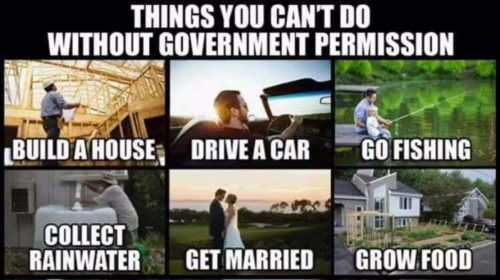
The Government could pass a law that bans expression of all political ideas and opinions apart from those that are on a pre-approved list. This list would contain all of the speech that the Government believes is not harmful to anyone else. It could be called the Dangerous Opinions Act. It would then become illegal to express any political opinion that didn’t have an exemption under the Act.
Because talking about the effects of mass immigration on European society risks stirring up ethnic tensions and hatreds, we could simply ban all such talk in advance, thereby precluding anyone like Southern and Molyneux from ever speaking. Discussing racial differences in IQ would then be illegal. Questioning the mainstream media would be illegal. Questioning the Government would be illegal.
Perhaps the Government could create some kind of central authority that can be tasked with determining what opinions may be freely expressed and what opinions have to be criminalised and repressed for the greater good. This Ministry would be concerned with the truth and the promulgation of same, so naturally it should be called the Ministry of Truth.
All of this might sound fairly draconian, but the people would still have the right to petition the Government to allow certain opinions to be expressed. If enough people wanted to express a certain opinion, they would merely need to petition the current Minister of Truth, and perhaps get enough signatures for a referendum on that opinion. Over time, good opinions would become legal while the bad ones stayed illegal.
*
If you enjoyed reading this essay, you can get a compilation of the Best VJMP Essays and Articles of 2017 from Amazon for Kindle or Amazon for CreateSpace (for international readers), or TradeMe (for Kiwis).