Paper Citizens And Roots Citizens

Because of mass immigration, and the propaganda to manufacture consent for mass immigration, there is now mass confusion when it comes to citizenship and nationality. Many people now don’t believe the words ‘citizenship’ or ‘nationality’ even mean anything. This essay clarifies the various misconceptions.

The mainstream conception is that citizenship confers membership of a nation-state.

In this mainstream conception, there are three ways to acquire citizenship. The first is ‘jus sanguinis’, which means ‘right of blood’ and refers to those who are born as children of existing citizens. The second is ‘jus soli’ which means ‘right of soil’ and refers to those who are born within a certain legal territory. The third is naturalisation and refers primarily to immigrants.

The problem with this conception is that nation-states are now so diverse that members of them often have little in common with each other. Thus the citizenship itself, regardless of how it was acquired, no longer means anything.

One sunny day in Spring many years ago, when returning home from working in Europe, I was waiting in line at the arrivals terminal at Auckland International Airport. In front of me was a woman in a burka. I couldn’t see her eyes or any part of her body except for – sticking out from under the black folds – one greasy hand clutching a New Zealand passport. In that moment, I realised that New Zealand citizenship was a meaningless concept. If people like this, who had nothing in common with me at all, also belonged to the category, then the category was meaningless.

The argument of this essay is that our existing citizenship system is an ad hoc mishmash of various ideas that needs to be redesigned, rationally, from the ground up.

When I immigrated to Sweden, it was made clear to me by everyone that, no matter my official citizenship status, I would only ever be a “paper Swede”. A paper citizen is someone who is not a member of the biological nation, but who has nevertheless been granted citizenship by the ruling class. In other words, their claim to be part of the nation only exists on a bit of paper.

A roots citizen, by contrast, is someone who did not need to be naturalised on account of that they already had roots in the soil of the country. In this sense, they are inseparable from the country itself.

Paper citizenship can be granted and taken away with the stroke of a pen. Roots citizenship, by contrast, is a biological fact. ‘Naturalisation’ is therefore, correctly understood, a nonsense term: there’s nothing less natural than a bureaucrat in a capital city deciding who is a member of the ingroup and who isn’t. A natural member is someone who is born into it.

If someone would ask me how to clean up the citizenship mess that has been made by decades of globalist immigration policy, here would be my suggestions.

All existing New Zealand citizenship would firstly be converted to paper citizenship. This paper citizenship would primarily confer residency rights and rights to vote in local body elections.

Then, the citizenship of anyone who has ancestors in New Zealand before September 1939 (i.e. before the globalists launched their war of domination that would lead to mass immigration) would be converted to roots citizenship. The logic is that these people are the descendants of those who built the country, and therefore constitute the New Zealand nation proper. It was for these people that the country was built in the first place, and so these people must remain the beneficiaries of it and in charge of it.

Roots citizenship would confer greater privileges than paper citizenship, in particular welfare and voting privileges. Roots citizens would be entitled to a universal basic income and to the right to vote for representatives of the New Zealand nation in the New Zealand Parliament. They would also be able to take on paper citizenships of other countries without losing roots citizenship of New Zealand.

From there, one of two options would be taken depending on national preference expressed at referendum. Either paper citizens would be converted to roots citizens after they could prove a hundred years of ancestry in New Zealand, or they wouldn’t. The logic of not converting them is that the descendants of paper citizens will eventually marry in to the nation of roots citizens anyway, therefore there is no need to naturalise them. And if they are unwilling to marry in to the New Zealand nation, they are obviously not our friends and therefore shouldn’t have citizenship.

This conception of roots citizenship would include 100% of Maoris but would exclude white immigrants, thus is in no way whatsoever a white supremacist policy. Foreigners would still be free to immigrate to New Zealand under the usual visa to residency to citizenship pathway, but only paper citizenship would ever be available (an exception could be made for foreign parents of roots citizens, i.e. those who have had children with a roots citizen, as such parents are committed to the success of the New Zealand nation through their offspring).

The main advantage of this policy is that it would realign the concepts of citizenship and nationality, bringing them back from the globalist free-for-all they have been since World War II. This would strengthen Kiwi identity, as we would once again know who we were: not the whole globe in microcosm, but those with roots in the New Zealand land.

Such a change would make an immediate improvement. If paper citizens did not have voting rights, the 2020 cannabis referendum would have passed, and freedom would have prevailed. New Zealand would be a better country if it was run by roots citizens for the benefit of all who live here.

*

For more of VJM’s ideas, see his work on other platforms!
For even more of VJM’s ideas, buy one of his books!

*

If you enjoyed reading this piece, buy a compilation of our best pieces from previous years!

Best VJMP Essays and Articles of 2024-25
Best VJMP Essays and Articles of 2023
Best VJMP Essays and Articles of 2022
Best VJMP Essays and Articles of 2021
Best VJMP Essays and Articles of 2020
Best VJMP Essays and Articles of 2019
Best VJMP Essays and Articles of 2018
Best VJMP Essays and Articles of 2017

*

If you would like to support our work in other ways, make a donation to our Paypal! Even better, buy any one of our books!
Why It’s Imperative That Hate Speech Laws Are Opposed

The left and right factions of the Australian Establishment came together this week to strip freedom of speech from the Australian nation. This happened in the form of the Labor and Liberal parties joining forces across the aisle to pass new hate speech legislation. This will be the most aggressive hate speech legislation ever passed in Australia. The Australian Greens have suggested the bill is so restrictive that it will become illegal to criticise Benjamin Netanyahu.

Under the new bill, the head of the secret intelligence service will be given the powers to ban any political group the Australian political establishment doesn’t like. This extreme measure, reminiscent of NKVD or Gestapo control systems, will mean that anyone organising to challenge the Australian political establishment will risk simply getting banned before any real challenge can be made.

The differences between this system and a one-party totalitarian state are minor.

One common, but naive, argument made about hate speech laws is that they protect people from being degraded or abused. Well-meaning people then get suckered into supporting them in the belief they will only impact white supremacists and terrorists. This is wrong, but an easy trap to fall into.

The primary danger with hate speech laws is that literally anything can be defined as hateful. Even the most innocuous-sounding statement can be declared to be “associated” with some hate group or ideology. So, in practice, whether or not a person gets prosecuted for hate speech depends on the whims of whoever is in power, not on any objective moral or legal standard.

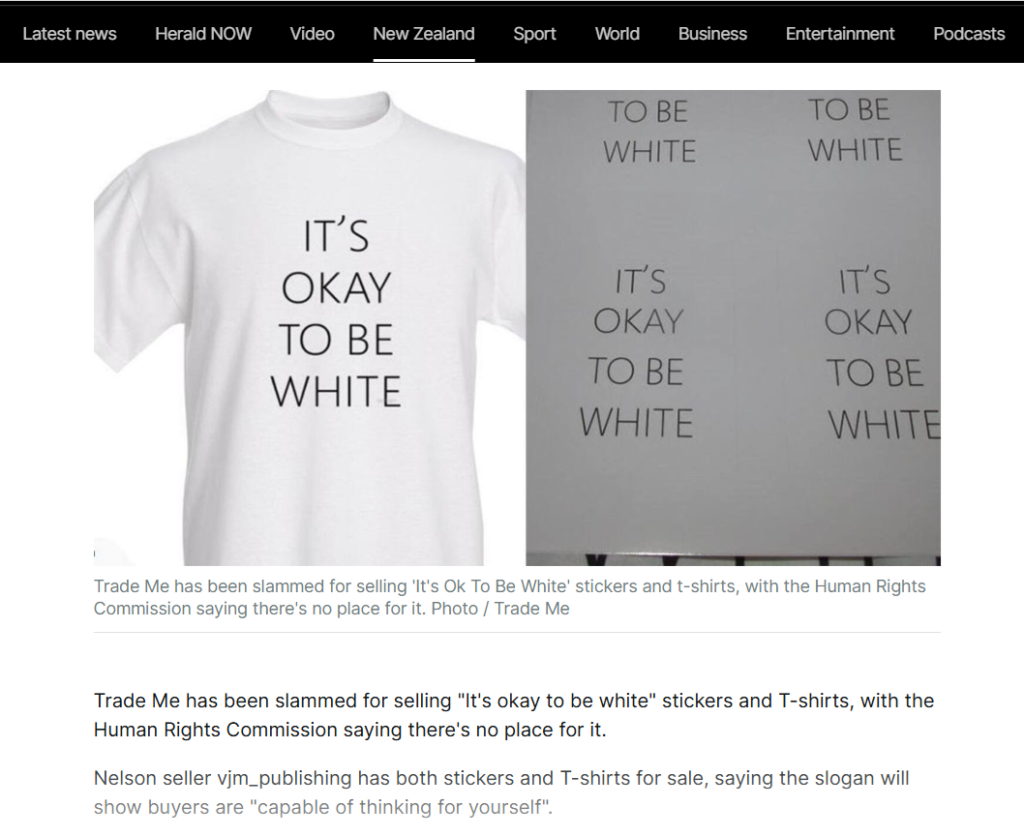
VJM Publishing first came to national attention in New Zealand in 2019, when we were attacked in the mainstream media by the Human Rights Commission for selling ‘It’s Okay To Be White’ t-shirts on TradeMe. The media beat-up took every possible opportunity to link the sale of the shirts to white supremacy and to Brenton Tarrant, declaring that I was racist, hateful, divisive etc. Presstitutes like Kanoa Lloyd told the country, without any evidence at all, that the t-shirts “were intended to ‘shock and hurt’.”

Shortly after the media beat-up, the Police came to my house to harass me about it.

If the Human Rights Commissioner takes to the mainstream media to call you hateful and racist for saying something, you can best your last dollar that you’d also get prosecuted for a hate crime for saying that thing if hate speech laws were in effect. Therefore, it’s logical to assume that saying “It’s Okay To Be White” will be considered hate speech under the new laws. Saying that it’s okay to be you will be a crime, if the political establishment doesn’t like you and hate speech laws are in effect.

It might be argued that people will resist these laws. The ‘It’s Okay To Be White’ incident proved otherwise. TradeMe head of Safety George Hiotakis initially stated, perfectly accurately, that t-shirts saying ‘It’s Okay To Be White’ do not violate any rules about racist slogans. “Items which marginalise individuals or promote one race at the cost of another cannot be sold onsite,” Hiotakis said [quoted from The Independent link above]. ‘It’s Okay To Be White’ clearly does neither.

Paul Hunt wasn’t giving in that easily, though. Using his full influence as Human Rights Commissioner, Hunt persuaded masses of people to contact TradeMe to lay a complaint. Hiotakis eventually caved to this frothing mob, cancelling the listing and banning the shirts from sale.

This proved an important point, of extreme relevance to the hate speech discussion: whether something is considered hate speech depends on whether a mob has been whipped up about it. If there’s a mass of people mad about some statement, no matter how innocuous, then it’s hate speech. If no-one, or only a few people, are mad about it, then it’s legitimate speech.

Rule by law goes out the window once hate speech laws are brought in. Because hate cannot be defined accurately – as proven by the ‘It’s Okay To Be White’ debacle – hate speech laws represent rule by mob, not law.

However, this perfectly suits those with power and influence. Because Paul Hunt has the power and influence to stir up a mob and have me cancelled, and I don’t have the power to impact him, such laws give the ruling class the power to strike down any wrongthinker they please, with no risk. All that needs to happen is for Hunt or some other powerful Government figure to take to the mainstream media denouncing the wrongthinkers, and the herd falls in line.

It’s impossible to think of a single example of anything that could not be considered hate speech if the definition of hate was broad enough. The ‘It’s Okay To Be White’ example is proof of this. Saying it’s okay to be white is the exact opposite of hatred: it’s affirming the moral okayness of white people in the face of constant media demonisation. But the ruling class can nevertheless declare it hate speech and destroy the people saying it, and get the consent of the masses to do so, on account of their overwhelming narrative control.

Once hate speech laws are brought in, the people who brought in those laws will then decide what other people are allowed to say. This is because the people who brought in the laws can arbitrarily define absolutely anything they don’t like as hate. Hate speech laws in New Zealand will be used for one purpose: to crack down on everyday Kiwis criticising the political establishment. It’s imperative that free and decent people resist them to the maximum extent possible.

*

For more of VJM’s ideas, see his work on other platforms!
For even more of VJM’s ideas, buy one of his books!

*

If you enjoyed reading this piece, buy a compilation of our best pieces from previous years!

Best VJMP Essays and Articles of 2023
Best VJMP Essays and Articles of 2022
Best VJMP Essays and Articles of 2021
Best VJMP Essays and Articles of 2020
Best VJMP Essays and Articles of 2019
Best VJMP Essays and Articles of 2018
Best VJMP Essays and Articles of 2017

*

If you would like to support our work in other ways, make a donation to our Paypal! Even better, buy any one of our books!
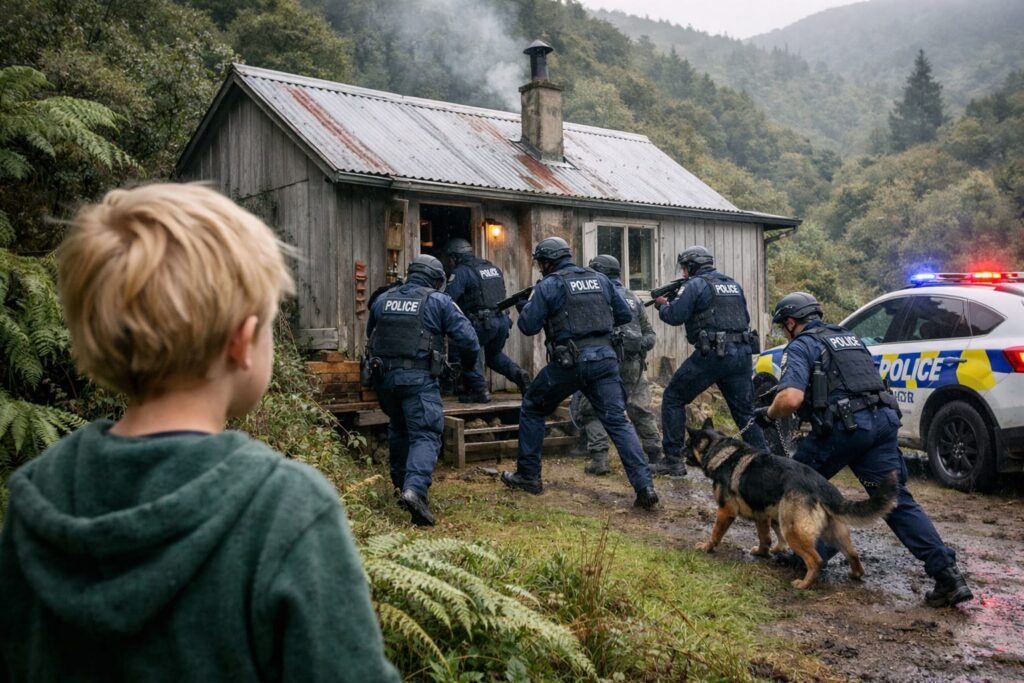
All My Life Interactions With The Police, Rated Out Of 10

I have no criminal record, and have only had limited interactions with the Police. In fact, I have only had five meaningful interactions with the New Zealand Police in my entire life (i.e. not including traffic stops, breathtests etc.). This article summarises all five and gives them a rating out of 10.

Interaction One, 1986

My mother is a diagnosed schizophrenic and has been since before I was born. She was institutionalised in 1986, when I was five. In the weeks leading up to this she had become more and more erratic and unhinged. One day, the Police came up and dragged her away screaming. Two officers held her under one arm each, her legs trailing in the gravel, and chucked her into the back of a wagon. Then they drove away to Ngawhatu mental hospital.

I understand that things were rougher in those days. It was still a tough thing to see as a kid, and did not endear me to the Police. It taught me that the Police are there to enforce the will of the ruling class upon the plebs, and not to negotiate with them. Negotiation is something you do with equals – poor, mentally ill people are just to be smashed.

Rating: 0/10

Interaction Two, 1990

One of my relatives, who lived nearby, was a cannabis grower. For whatever reason, the Police figured this out and came to bust him one day. This wasn’t a close interaction, as I was mostly watching from next door while my relative’s place got turned over and he got led away in handcuffs. But it still coloured my attitude towards the Police.

I didn’t know anything about cannabis then. But I knew that actual crimes were murder, robbery, assault etc., not growing plants. My grandmother expressed a deep sense of injustice at the arrest and subsequent imprisonment, and at the effect that imprisonment had on my relative’s mental health, and these feelings influenced me heavily. That the Police would enforce oppressive laws like cannabis prohibition made me see them as evil.

Rating: 0/10

Interaction Three, Summer 2004/05

At this time I lived in a central Christchurch apartment. At about 2:30a.m. one Saturday morning I heard a smashing noise on the road outside. I looked out the window to see a bunch of youths, maybe 15-16, breaking windows on parked cars with golf clubs.

I called 111, explained the situation and a patrol car turned up in about five minutes. They arrested the youths, but not before pointing them towards my apartment so I could confirm on the phone it was them. I never heard from the Police about it, so I presume the youths confessed and got diversion or similar. In all, justice was delivered swiftly and efficiently.

Rating: 9/10

Interaction Four, Summer 2008/09

When I was a barman in Nelson, I got attacked by a drunken thug who I had cut off for being a drunken thug. Upon reporting the assault to the Police, I found that they weren’t particularly interested. Although there was supposedly a crackdown against alcohol violence underway at the time, they only grudgingly took my complaint, trying to convince me along the way that it probably wasn’t worth bothering with.

This surprised me, as the Police routinely arrest and lock up people for victimless drug crimes. On what planet is a violent crime no big deal, in comparison to that? I am grateful that the Police ended up prosecuting the offender and obtaining a conviction. But the way they handled my complaint made me realise that they’re not there to help working-class people, rather just manage us at the lowest possible cost. If that means fobbing an assault victim off then so be it.

Rating: 5/10

Interaction Five, July 2019

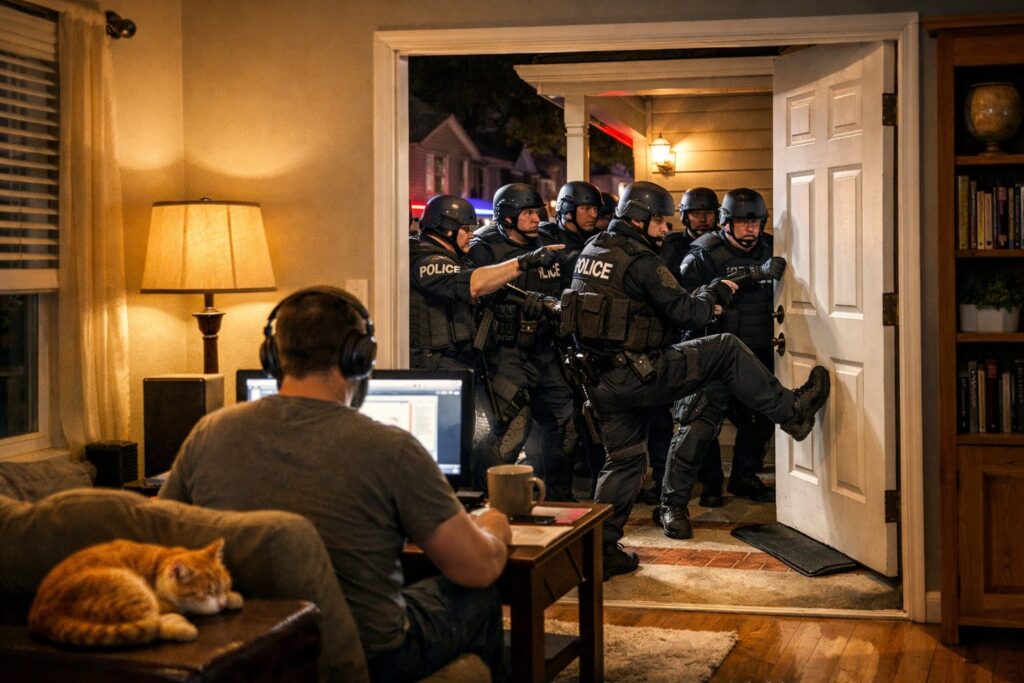
About 10.30a.m. one rainy Winter morning I got a knock on my front door. I stubbed out my joint and went outside to find two Police officers. They said they had come as part of Operation Whakahumanu to ask me some questions about my online activity. This was in the wake of me getting attacked in the mainstream media by the Human Rights Commission for selling ‘It’s Okay To Be White’ t-shirts on TradeMe.

Apparently the ‘It’s Okay To Be White’ saga had got me on a list of suspected white supremacists, so after the Christchurch mosque shooting I was suspected to be another mass killer in waiting. As someone with no criminal record and who doesn’t own firearms, I would have thought all violent criminals, at least, would be higher priority. It turns out that wrongthinkers are at the top of the hate list.

I refused to answer any questions and asked for a warrant, which they didn’t have, so I asked them to please leave the property. I had to repeat this a few times before they did.

Getting targeted by the Police in an intimidation and harassment campaign on Government orders is a deeply unpleasant experience. It emphasised to me the extent to which people like me – anyone who tells the truth – are the enemy of the ruling class.

Rating: 0/10

Total rating: 14/50 (2.8/10 average)

Generally my interactions with the New Zealand Police have been poor, despite not being a criminal. Although they sometimes do the right thing, they have clearly demonstrated to me that they are primarily the thugs of the ruling classes, and are happy to destroy lower-class people on spurious grounds if given an order to do so.

Bonus: this isn’t an interaction as such, but the Police appear to monitor everything I post online with the apparent intent to comb through it for wrongthink. Another 0/10.

*

For more of VJM’s ideas, see his work on other platforms!
For even more of VJM’s ideas, buy one of his books!

*

If you enjoyed reading this piece, buy a compilation of our best pieces from previous years!

Best VJMP Essays and Articles of 2023
Best VJMP Essays and Articles of 2022
Best VJMP Essays and Articles of 2021
Best VJMP Essays and Articles of 2020
Best VJMP Essays and Articles of 2019
Best VJMP Essays and Articles of 2018
Best VJMP Essays and Articles of 2017

*

If you would like to support our work in other ways, make a donation to our Paypal! Even better, buy any one of our books!

North Island Narratives

Living on the South Island, I am often frustrated by the North Island-centrism of our mainstream media. Thanks to some combination of arrogance and insularity, the New Zealand media acts as if New Zealand is just the North Island. This has led to it espousing a number of narratives that don’t reflect life for those of us in the South Island. This essay explains.

Perhaps the stupidest North Island narrative is that gangs and gang culture are inherently brown. People join gangs, this narrative has it, because of colonisation, which destroyed the natural social structure of Polynesian peoples.

Leaving aside that a lot of Tongans are in New Zealand gangs – and Tonga was never colonised – the vast majority of gang members on the South Island are white. So when the New Zealand media harps on about how gangs are a consequence of colonialism, those of us on the South Island are left shaking our heads. All the white guys in the Hells Angels are presumably perpetrators of colonisation, not victims of it. So how did they get to be gang members? This narrative makes no sense at all.

The North Island narrative that does the most damage is the stolen land one. Large swathes of the North Island were confiscated in relation to the Maori Land Wars, probably unfairly. Areas such as Wellington were probably swindled from Maori ownership; the acquisition of Port Nicholson was dodgy even by 19th Century standards. But this does not mean that the same guilt-dripping narratives apply to the South Island.

The New Zealand Settlements Act was never applied in the South Island, thus there were no confiscations. So the whole narrative around unjustly confiscated land is a North Island narrative. Those of us on the South Island are tired of hearing about it.

In fact, Treaty-based narratives in general are North Island narratives. The British declared sovereignty over the North Island on the basis of the Treaty of Waitangi, but they declared sovereignty over the South Island on the basis of discovery. This is an established historical fact.

Therefore, on the South Island there is no relevance to any of the narratives about how white Kiwis owe Maori Kiwis this and that because of Treaty breaches. The Treaty isn’t relevant here. The idea that the Treaty of Waitangi is the “foundational document” of New Zealand is pure North Island narrative. The people pushing it are either North Islanders or globalists.

Related to this is the idea that the Maori word for ‘New Zealand’ is ‘Aotearoa’. In fact, ‘Aotearoa’ was originally used to refer to the North Island only. The term for the North and South Islands together was ‘Aotearoa me Te Waipounamu’. ‘New Zealand’ is translated as ‘Nu Tireni’ in the Treaty of Waitangi, not ‘Aotearoa’.

In the North Island mind, the North Island is New Zealand. Therefore, whatever applies to the North Island (such as the name ‘Aotearoa’) also applies to New Zealand. This is naturally objectionable to those of us on the South Island. But, because the New Zealand media is North Island-based, our concerns get sidelined.

Related to these ideas is the idea that New Zealand is Polynesian. Perhaps the North Island qualifies by climate as part of Polynesia, but the South Island is simply too cold. Nothing like the Mount Cook National Park exists anywhere in Polynesia, and nor could it, given that the South Island is 3600km south of Samoa and 7100km south of the Big Island of Hawai’i.

In truth, the South Island should be considered a Subantarctic Island like the Auckland Islands.

Another common, but false, North Island narrative is that the song ‘Tutira Mai Nga Iwi‘ is a defacto national anthem on account of its supposed universality. Apparently everyone learns all the lyrics to this song at school. But I went to primary, intermediate and secondary school on the South Island, and I never heard this song once. This song is not the only element of North Island culture to be conflated for New Zealand culture, but is perhaps the most conspicuous.

The funniest North Island narrative is the idea that Auckland is a major world city. Aucklanders in particular have the delusion that Auckland is a second Sydney. In truth, Auckland is not even another Brisbane or Perth, but rather another Adelaide. Yeah, it’s bigger than Christchurch. But so what? We don’t pretend that Christchurch is anything other than perfectly moderate-sized.

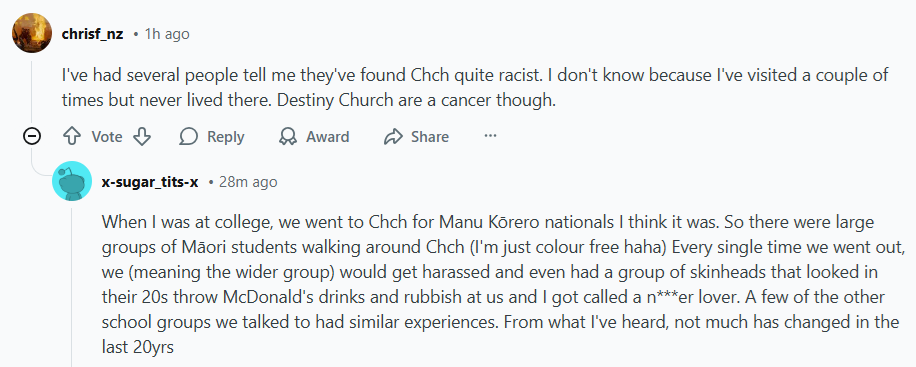
The most egregiously self-righteous and arrogant North Island narrative is the one that holds the South Island is racist. This is downstream from the presumption that whites are inherently racist: the South Island is much whiter than the North, therefore, the logic follows, it must be more racist.

There might be a minority of social outcasts in Christchurch who take out their frustrations on anyone unlucky enough to look like an outsider. But on a Saturday night when people have been drinking, I would rather walk through Cathedral Square as a brown person than Otahuhu as a white person.

These North Island narratives might not, by themselves, constitute enough disrespect that South Island independence becomes preferable. But they are at least a call for an independent South Island media that can promote South Island narratives.

*

For more of VJM’s ideas, see his work on other platforms!
For even more of VJM’s ideas, buy one of his books!

*

If you enjoyed reading this piece, buy a compilation of our best pieces from previous years!

Best VJMP Essays and Articles of 2023
Best VJMP Essays and Articles of 2022
Best VJMP Essays and Articles of 2021
Best VJMP Essays and Articles of 2020
Best VJMP Essays and Articles of 2019
Best VJMP Essays and Articles of 2018
Best VJMP Essays and Articles of 2017

*

If you would like to support our work in other ways, make a donation to our Paypal! Even better, buy any one of our books!