Understanding New Zealand: Demographics of Low-Skill Occupations

The low-skill occupations are generally made up of people who are in the demographics who are struggling. Although they are not doing as badly as beneficiaries, workers in low-skill occupations have to deal with the fact that the supply of low-skill labour is much greater than the demand for it and so wages are poor.

The wages for low-skill occupations are very poor in New Zealand. The correlation between net personal income and working as a machinery operator or driver was -0.59, and with working as a labourer it was -0.51. These are stronger correlations (only in the negative direction) than the one between net personal income and working as a manager.

Ultimately the reason for this is that working in a low-skill occupation does not take much of a personal investment in the form of an education.

The correlations between having no academic qualifications and working in a low-skill occupation were very strong: 0.85 for machinery operators and drivers and 0.82 for labourers.

Both of these fall very sharply towards the negative as academic qualifications increase. The correlation between having a Bachelor’s degree and working as a machinery operator or driver was -0.79, and the correlation between having a Bachelor’s degree and working as a labourer was -0.74.

These occupations are also the ones in which a person is most likely to be injured or to find themselves out of work for seasonal reasons or because of market fluctuations.

As a result, the correlation between working as a machinery operator or driver and being on the invalid’s benefit was 0.67, and with being on the unemployment benefit it was 0.62. The correlation between working as a labourer and being on the invalid’s benefit was 0.71, and with being on the unemployment benefit it was 0.53.

The most favoured industries for machinery operators and drivers were manufacturing (with a correlation of 0.76), transport, postal and warehousing (0.76), construction (0.48) and agriculture, forestry and fishing (0.40).

The most favoured industries for labourers were agriculture, forestry and fishing (0.77), manufacturing (0.72) and construction (0.49).

Consistent with the trend that tobacco use tends to be associated with people who have it relatively hard, the correlation between being a regular smoker and working as a machinery operator or driver was a very strong 0.82, and the correlation between being a regular smoker and working as a labourer was only slightly weaker, at 0.75.

As discussed in several other articles in this study, the immigration system favours the sort of person who is capable of paying a lot of taxes into the future, and this explicitly rules out machinery operators, drivers and labourers, because these occupations are both poorly paid and have a high risk of injury.

Consequently, the correlations between being born in New Zealand and working as a machinery operator or driver was 0.57, and with being a labourer it was 0.77.

The reason why there is a reasonably large gap between these two is because a larger proportion of Pacific Islanders work as machinery operators or drivers compared to labourers. The correlation between being a Pacific Islander and working as a machinery operator or driver was 0.31, compared to -0.19 between being a Pacific Islander and working as a labourer.

In fact, Kiwis of European descent are more likely to work as labourers than Pacific Islanders. The correlation between working as a labourer and being of European descent is 0.11. The main reason for this is probably because of all the general labour that still needs to be done on the South Island.

Being of European descent was, however, significantly negatively correlated with working as a machinery operator or driver – this was -0.31.

Maoris are heavily represented in both low-skill occupations. The correlation between being Maori and working as a machinery operator or driver was 0.66, and with being a labourer it was 0.62.

Consequently, there are relatively few Asians. The correlation between being Asian and working as a machinery operator or driver was -0.42, and with working as a labourer it was -0.67.

There was a moderately strong positive correlation of 0.53 between being a labourer and having the employment status of unpaid work in the family business. This reflects the large number of farm hands on family-run and owned farms, especially on the South Island.

*

This article is an excerpt from Understanding New Zealand, by Dan McGlashan, published by VJM Publishing in the winter of 2017.

Understanding New Zealand: Voting Patterns and Demographics of South Islanders

The South Island is sterotyped as big, cold, old and white. And it is – but there’s more to it than just that. The voting patterns of South Islanders do not fit any neat and obvious pattern.

The most favoured political party by South Islanders were the Greens. The correlation between living on the South Island and voting Green in 2014 was 0.21. The next most favoured party was National. The correlation between living on the South Island and voting National was 0.13.

Some will find this very odd, but it might not be properly appreciated on the North Island the degree to which environmentalism is important to South Islanders, especially those in the North and West.

The correlation between living on the South Island and voting Labour in 2014 was -0.13. This is to be expected given that there is a stronger than average level of National support there. Considering that many young South Islanders vote for the Greens, it is striking that this correlation is not even more strongly negative.

Many will be surprised that the correlation between voting New Zealand First in 2014 and living on the South Island was -0.15. This surprise is because the party is inaccurately stereotyped as a party for old white bigots, whereas in reality most New Zealand First voters are Maori, and there are relatively few Maori on the South Island.

This lack of a strong Maori presence explains the negative correlations between living on the South Island and voting Maori Party in 2014 (-0.15) and with voting Internet MANA in 2014 (-0.17).

There is not, however, a negative correlation between living on the South Island and voting Aotearoa Legalise Cannabis Party in 2014 – this was 0.03. Even though a disproportionate number of ALCP voters are Maoris, and that disproportionately few South Islanders are Maoris, cannabis culture is extremely strong in the North and West of the South Island and very strong elsewhere.

It is true that the South Island is particularly European – the correlation between living there and being European is a moderately strong 0.51. For being Maori it was -0.26, for being a Pacific Islander it was -0.29 and for being Asian it was -0.30.

The staid, dour dependability of South Islanders might be a consequence of the heavy Scottish influence there. This is reflected by the moderately strong correlation of 0.56 between living on the South Island and being Presbytarian.

It may also be that the religious are more well-to-do on the South Island and as a result they do not have the tendency to join those movements who appeal more to the hard done by. The correlations between living on the South Island and having a particular religion was -0.39 for Mormonism, -0.34 for Ratana, -0.33 for Jehovah’s Witness, -0.33 for Pentecostal, -0.31 for Maori Christian, and -0.25 for Methodist. These were all significant.

There was also a significant positive correlation between living on the South Island and having no religion. Considering that South Islanders tend to be older and old people tend to be religious, this is a curiosity. It is best explained by the large numbers of highly religious Pacific Islanders who live on the North Island, especially Auckland.

The correlation between living on the South Island and median age was 0.27. This was significant, and probably so because the bulk of immigrants who move to New Zealand are young and they tend to move to Auckland.

This latter point was evidenced by the sharp distance between the correlation between living on the South Island and being aged 30-49 (-0.07) and the correlation between living on the South Island and being aged 50-64 (0.33).

Curiously, the correlation between living on the South Island and having a Master’s degree (-0.15) was much more negative than the correalation between living on the South Island and having a doctorate (0.10).

This is probably a consequence of the fact that most people with Master’s degrees gravitate towards the power hierarchy, which is mostly established in Wellington and Auckland, whereas people with doctorates gravitate towards where sick people are, and most sick people are elderly and more elderly live on the South Island.

South Islanders are significantly less likely to be on the unemployment benefit. The correlation between living on the South Island and being on the unemployment benefit was -0.30. Probably the main reason for this is that there are fewer South Islanders in the low-skill demographics.

South Islanders’ choice of industry reflect that the South Island is large and sparsely populated.

The correlations between living on the South Island and working in a particular industry were -0.32 for administrative and support services and -0.29 for financial and insurance services, which reflects that the former industry is primarily based in Wellington whereas the latter is primarily based in Auckland.

These correlations were 0.43 for construction, 0.32 for retail trade and 0.23 for hospitality. The first of these reflects the Christchurch rebuild sending demand for construction workers through the roof, and the third reflects the strong tourism industry on the South Island.

Another reflection of the weight that Christchurch has in the South Island is that South Islanders love biking to work, on account of Christchurch being flat. The correlation between living on the South Island and biking to work was a moderately strong 0.54, which could reflect many things, foremost of which might be flatter land, less vehicle traffic, healthier cultural attitudes to exercise etc.

Perhaps the most definitive characteristic of people on the South Island is that they are decidely more middle to upper-middle class than the average Kiwi. This is evinced in three major ways.

The first is that there is a positive correlation between living on the South Island and being in any income band from $15-70K, and a negative correlation between living on the South Island and being in any income band from $0-15K or $70K+.

This means that, although there are more truly highpowered jobs in Auckland and Wellington than on the South Island, there are also considerably more truly broke people.

The second way is the significant positive correlation between living on the South Island and living on freehold land (0.46) and the significant negative correlation between living on the South Island and living on rented land (-0.31).

The third is the significant positive correlation between living on the South Island and being self-employed with employees (0.28). This suggests that South Islanders are more likely to start and to successfully operate a business than North Islanders.

This suggests that South Islanders have a different approach to wealth generation to North Islanders. Whereas North Islanders are more likely to become professionals and work a highly paid job without caring too much about the size of their expenses, South Islanders are more likely to work to minimise expenses first and to invest the resulting surplus.

*

This article is an excerpt from Understanding New Zealand, by Dan McGlashan, published by VJM Publishing in the winter of 2017.

When Politicians Start Competing For Cannabis Voters, Prohibition Is Over

Gareth Morgan showed that he is a cut above the rest of the megalomaniacs who would be king by actually changing his stance on cannabis law reform in response to the wishes of his supporters. This by itself is curious (some are calling the phenomenon “democracy”), but not as curious as the reaction.

The Greens’ health spokeswoman, Julie Anne Genter, responded to the news of Morgan’s intrusion into her political niche like a mother cat protecting her litter.

She made a social media post belittling the capacity of The Opportunity Party to enact reform, calling it “some tiny new political party”, and accused them of planning to be “working with National”.

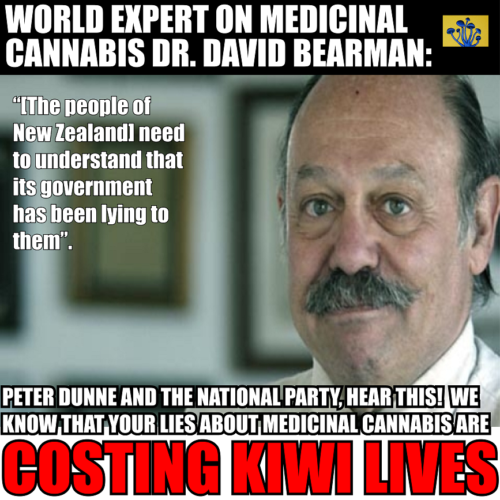
This marks the first time, ever, that politicians in New Zealand have acted like medicinal cannabis users were normal people whose rights were worth defending.

The usual approach, the English-Little-Peters-Shaw approach, is to stand aside and let medicinal cannabis users die for fear of losing votes from people who want to kill them.

If the politicians, the shallowest of shallow whores, are competing for cannabis law reform votes, then it’s fair to say that the cracks in the dam are appearing and that it’s time for those downstream to evacuate.

The next move will be a leader of a big four party stating on the record that cannabis prohibition is unjust. Any consideration of compensation will be out of the question, because to raise the point suggests that politicians can be held accountable for their crimes against the people, but someone might suggest that medicinal cannabis even be subsidised like other medicines.

Maybe one day a politician will do a medicinal cannabis user the honour of having a photo taken with them.

The ridiculous thing will be that, when all of this happens, the politiwhore in question will try to give the impression that they are bravely leading the charge, even though the Aotearoa Legalise Cannabis Party was saying what Julie Anne Genter is now saying since 1996 – 21 years ago.

It’s taken 21 years to even get this far, where there are so many as two second-tier politicians calling for cannabis law reform. Let’s hope it doesn’t take another 21 for a leader of one of the big four parties to find the courage to say something.

Probably the next advance for cannabis law reform in New Zealand will be for someone in the ACT or Labour parties to champion the issue. Damian O’Connor has already dipped a nervous toe in the water, and if he sees the centrist Morgan take up the issue he could well interpret that as a green light to go further.