The Four Tenets of Anarcho-Homicidalism

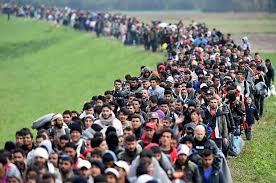
Politicians who push things too far might find themselves faced with this

Anarcho-homicidalism is a radical new philosophy that is rapidly challenging people’s conceptions of what is possible within political space. Despite the tooth-and-claw simplicity of the doctrine, it is not always obvious how one transitions into it from a lifetime of statism. This essay examines four basic precepts.

1. Violence is the basis of self-defence.

In this physical, material world, life is dog-eat-dog to a major extent. Cannibalism is, after all, a fairly recent phenomenon in these very isles, and often the only way you were able to avoid this fate was with counter-violence.

It could even be argued that the very concept of violence perhaps not being fully legitimate is a particularly human invention, and even then not shared by all. As such, the concept of illegitimate violence is far from universal.

A truth frequently denied is that all property rights ultimately come down to the capacity to enforce violence. In our modern societies, there is little more to property rights than being able to bring the Police force to bear on any trespassers.

Therefore, your ability to defend yourself comes down to your ability to inflict violence upon anyone threatening you.

2. You’re allowed to kill anyone trying to enslave you.

If any other person tries to make you into a slave, you have the right to kill them in self-defence. This recognises the fact that anyone who approaches you with a will to enslave you is going to succeed unless deterred.

After all, if you are not allowed (or willing) to kill people trying to enslave you, then you don’t have any rights at all, because you will eventually find yourself unable to assert them.

If a person is not trying to make you into a slave, you don’t have any more right to kill them than you otherwise would (i.e. in the vast majority of cases, doing so would constitute murder).

Therefore, the anarcho-homicidalist only strikes upwards; only ever up the dominance hierarchy. If no-one tries to assert dominance over the anarcho-homicidalist then there is no reason for them to upset the peace.

3. Everyone must decide for themselves who they kill.

Not only does the anarcho-homicidalist never strike downwards, but they also refuse to kill on command. Anarcho-homicidalists do not kill on other people’s orders, because to do so necessarily brings into being a dominance hierarchy.

Note that this gives the anarcho-homicidalist cause to shoot any conscription officer that comes to his house. Conscription is slavery, and if someone else tells you that you have to kill another person who you’ve never met, the anarcho-homicidalist is within their rights to turn the gun on the person giving the orders.

An inescapable consequence of the total application of this tenet would be that no armies could ever be raised to attack anyone else, because anyone being pressed into one would simply kill their conscriptor.

Therefore, nothing like the invasion of Iraq could be possible, because there would be no-one willing to serve in a dominance hierarchy that killed on command.

4. Everyone is 100% responsible for the consequences of their decision to kill.

There is absolutely no guarantee that a person taking anarcho-homicidalist action will be protected from the consequences of having done so.

An anarcho-homicidalist might decide to shoot a government apparatchik who works to enforce some totalitarian horror, but nothing within the tenets of anarcho-homicidalism necessarily protects him from the consequences.

The Police and secret services will still definitely come after anyone who homicides a high-ranking political figure, no matter how fervently the homicidalist believes in their philosophy.

However, a sufficient quantity of anarcho-homicidalists would still be able to form an underground railroad for the sake of protecting any of their own who gave the dominators the full measure.

*

This is an excerpt from Viktor Hellman’s upcoming Anarcho-Homicidalist’s Manifesto.

You Can Never Win Freedoms Back; You Can Only Trade Them

Although the accepted narrative is that we are moving into a time of greater freedom, in many ways we are in fact becoming less free – and these losses are not necessarily easy to notice

Many young Kiwis have felt a sense of relief after Julie Anne Genter and The Opportunities Party decided to champion cannabis law reform. Finally it seemed like the political class were going to grant the New Zealand people some of their rights back. But, as this essay will examine, dealing with politicians is never that simple.

Both Genter and TOP broke with the New Zealand political convention of treating cannabis law reform as a taboo subject earlier this year as the foreshadow of the General Election loomed, incentivising new policy directions that attracted media attention.

Both of them also broke with convention by bringing logic and evidence to this discussion, instead of the usual fear-mongering and hysteria. As has long been argued by this company (most notably in the Cannabis Activist’s Handbook), once the narrative on cannabis shifted from lies to truth, the days of prohibition were numbered.

Once the sheeple of New Zealand came to realise that cannabis was a medicine and not really the devil’s lettuce, it didn’t seem right to put people in cages for it anymore, and that led directly to the need for law reform being taken seriously by everyone today.

So does this mean that New Zealand is moving out of the Puritanical mindset when it comes to psychoactive substances and will now be discussing the issue sensibly?

Of course not! Morgan wants to put the drinking age back up to 20.

Even though his entire message is that prohibition of cannabis isn’t working, and even though it’s widely understood that prohibition of alcohol didn’t work, voting for cannabis law reform through TOP is also going to be a vote for some Kiwis to lose the freedom to consume alcohol.

Some people might not think too much of this, but Morgan’s actions here reveal the strategy that politicians have used to seize control of the plebs throughout all times and places.

Politicians do this by offering you some of your freedoms back at the cost of others. Their trick is to always take away more freedoms than they offer, but to present it in a way that tricks the plebs into thinking that it’s the other way around.

Another example of it also pertains to cannabis: the fact that almost every cannabis user in the country who has a driver’s licence is also a criminal, because it is a crime to drive with any amount of THC in the system, and anyone who has smoked cannabis within the last six weeks will have THC in their system – even if they are not at all impaired.

If the politicians decided to legalise cannabis tomorrow they could simply bring in more punitive consequences for driving a motor vehicle, such as regular checkpoints with saliva swabs to detect for THC in the system.

Enough checkpoints and saliva swabs and it simply wouldn’t matter that cannabis was technically fully legal – the degree of damage done to the population by the state would remain the same. It could potentially even be increased.

And then we’d end up like the states of Australia and America that have “decriminalised cannabis” but made it criminal to drive with THC in the system, impaired or otherwise.

Either that, or we’ll lose our rights to speak freely on the Internet. It’s possible that the wholesale criminalisation of the young that came about as a consequence of the cannabis laws will be replicated with criminal trials for “hate speech” and “harmful digital communication”.

In any case, we can guarantee that the freedom of politicians to lie to the nation – and to cause them great suffering as a consequence of the despair and confusion – will not be impeded by anything.

Apologising For Anti-Gay Oppression Means Nothing If The Government Still Oppresses

Thirty years after the New Zealand Government stopped violating the rights of Kiwi homosexuals, New Zealand politicians have finally worked up the courage to crawl out of their holes and apologise – but are they sincere?

The House of Representatives today took the extraordinary measure of apologising to Kiwis with historical criminal convictions for engaging in homosexual activity. The move was broadly welcomed, the general attitude suggesting that putting someone in a cage for an act that harmed no-one was, in hindsight, wrong.

Let’s be honest. What the New Zealand Government did to gay people wasn’t just wrong – it was a human rights abuse.

The reason why it qualifies as a human rights abuse is that humans have the inherent, inviolable right to do whatever they like as long as it doesn’t harm anyone else.

Engaging in consensual homosexual activity did not harm anyone else, therefore it wasn’t a crime. Therefore, putting gay people in cages for doing it was a human rights abuse.

After some decades of pressure from reasonable people, the New Zealand Parliament appears to have finally accepted this logic and apologised.

But the truly obscene thing about this whole affair isn’t men sticking their cocks up each other’s arses.

The truly obscene thing is how our current crop of gutless politicians, safely separated by thirty years of history, happily stick the boot into their forebears of a previous generation, while paying no mind to the fact that they are still oppressing cannabis users with the same total absence of justification as they once oppressed homosexuals.

So how can we take the Government’s apology for violating the human rights of homosexuals seriously when it continues to do exactly the same thing to cannabis users?

Marama Davidson, who never misses an opportunity to shamelessly grandstand, spoke in Parliament today about the deaths caused by the anti-homosexual prejudice engendered by the law criminalising homosexual activity.

But regarding the fact that prejudice and discrimination against medicinal cannabis users is still taking lives today, she (like everyone in Parliament apart from Julie Anne Genter) remains completely silent.

The cowards in Parliament won’t be making apologetic speeches about the damage caused by cannabis prohibition for another thirty years, not until most of the current lot are dead.

Grant Robertson stood up in Parliament today and said, on the subject of homosexuality being illegal, that “the arrests, the imprisonments and the fear of that happening did not just ruin lives and destroy potential – it killed people. Hundreds, possibly thousands of lives have been lost because men could not bear the shame, the stigma, and the hurt caused by this Parliament.”

Exactly the same words could be said about cannabis prohibition – but our politicians lack the courage to say them.

Justice Minister Amy Adams said “this apology is a symbolic but important act that we hope will help address the harm and right this historic wrong.”

If the New Zealand House of Representatives is serious about being apologetic for violating the human rights of Kiwi homosexuals, why are they continuing to violate the human rights of Kiwi medicinal cannabis users?

The prejudice against cannabis users – one that is enforced by the New Zealand Parliament to this very day – has taken ten times as many lives as the law against homosexuality and continues to take them.

Until the current Parliament takes the general issue of human rights seriously – not just rights for favoured, fashionable minorities – this apology can be dismissed as an exhibition of crocodile tears.