The Third Rejection Of Alternative Centrism

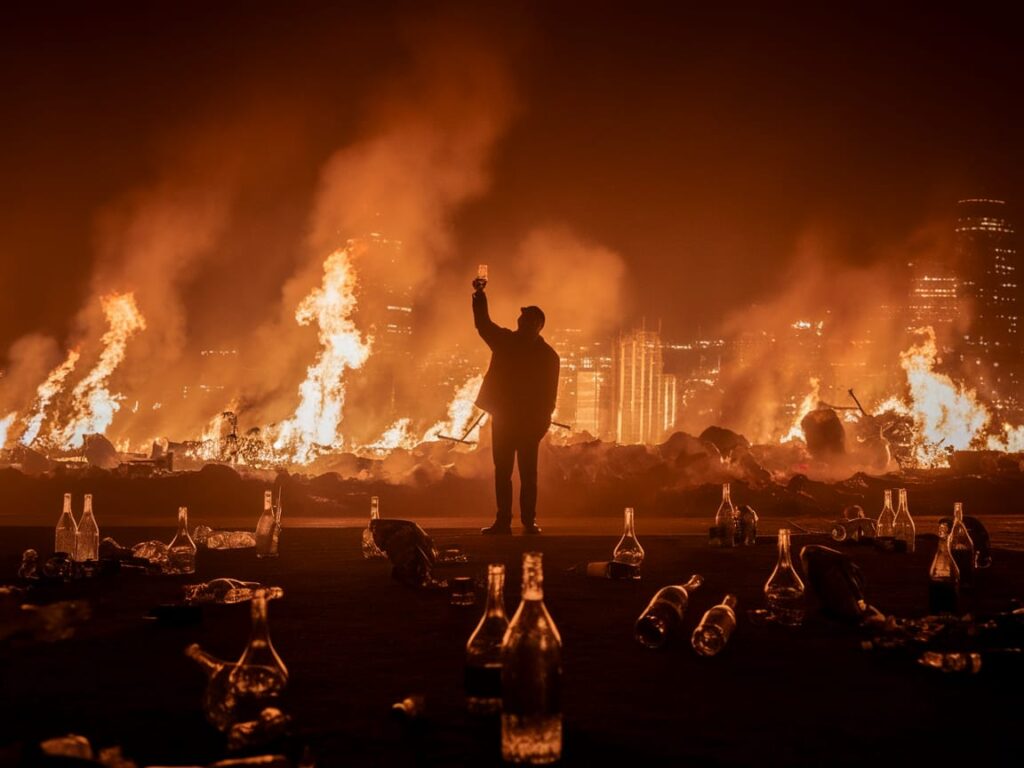
The Third Rejection of alternative centrism is the rejection of degeneracy. The Third Rejection is the contention that excessive peace leads to degeneracy.

There’s a lot to be said for peace. In particular, peace feels great when you’ve just been through war. The reason why the Establishment Centre comes to power in the first place is because the peace they’re offering feels so good. Many people start to go crazy after the Establishment Right and Establishment Left have trashed everything in their efforts to get an advantage over the other. In their desperation, these people often take the first plausible offer of peace.

The human animal, however, didn’t evolve for peace. We evolved in a cut-throat environment where ‘Kill or be killed’ was the only universal law.

Without a moderate amount of tension, the human animal starts getting bored. And then, much like with dogs, it starts getting destructive. This will for destruction, for destruction’s sake, goes against all vital, healthy and natural instincts. Nevertheless, it appears to be the inevitable result of an excess of peace. In rejecting this degeneracy, alternative centrism takes the side of the instincts that promote the creation and maintenance of life.

Sometimes degeneracy manifests as physical destruction. This nihilistic propensity for violence can be seen in gangs and football hooligans. It’s also seen in the indifference to one’s own physical health exhibited by alcoholics, smokers and uncontrolled eaters. Many pill-poppers fall in this category as well. All of these behaviours, as well as deliberately making oneself more ugly, are ultimately the result of degeneracy.

More often, however, degeneracy manifests as spiritual destruction. This is especially true in the modern world. Because soulless nihilistic materialism is so common nowadays, most people assume that it’s natural and normal. In reality, it’s anything but. So most people suffer an awful existential emptiness and longing for purpose, seldom understanding that both things are the result of degeneracy and are far from natural.

One of the best things about peace is that it finally gives people a chance to overcome trauma. Because most people are traumatised (at least to some degree), most people desire peace. This peace makes a low-stress lifestyle possible, which in turn promotes the ability to heal from traumatic stress disorders. The positive nature of this process is why the Third Acceptance is so acceptable.

There is a negative aspect to this process though, and it’s what inspires the Third Rejection.

Most people intuitively understand that if a person is left to overcome trauma forever, to the exclusion of anything else, they will degenerate. Once a person decides to take it easy, they often take it so easy that they lose discipline. They become lazy, fat and resentful. After thousands of instances of taking it easy on themselves, they have found themselves degenerating.

The same is true of societies. These follow the same life cycle as everything else natural (as depicted by the Quadrijitu of Elementalism). Once a society decides to take it easy, it loses discipline too. The decline of the Roman Republic really set in after the Third Punic War, many historians believe, because the Romans became degenerate without an outside enemy keeping them sharp.

The habit of avoiding conflict for peace can become more than a habit. As William James may have warned us, it can become a character, and then a destiny. That destiny is less likely to be eternal peace and more likely to be chaos or stagnation (if not annihilation).

If a man is too peaceful, he doesn’t do anything about the evil around him. In today’s England, the excessively peaceful nature of the average citizen can be seen in their tolerance for Muslim child rape gangs. Some 19,000 children get raped by these gangs every year, an atrocity that could be expected to stir immense anger among most populations in history. But very little anger is evident. There is some grumbling and there are some disapproving social media posts, but there are no protests against the rape gangs, much less revenge attacks. Some of the rapists from the Rotherham gang are already out of prison and again walking the streets they once terrorised. People just accept it.

In fact, British politicians go as far as to play down the importance of these rapes. MP Lucy Powell stated that people expressing concern about the Muslim rape gang epidemic are making a “dog-whistle” to racists and Nazis. Apparently, objecting to children getting pack-raped by foreigners who hate them is a step on the slippery slope to gas chambers. The needs of the white working class who make up the majority of the victims are long forgotten.

History fans will recognise an echo between the children being exploited under the gaze of an indifferent ruling class in England in the 2020s, and the children being exploited under the gaze of an indifferent ruling class in Weimar Germany in the 1920s. The anger of the people was, in both cases, ignored by their ruling class, so it festered. That anger is what gives rise to the Alternative Right.

In Britain at time of writing, the alternative nationalist Reform UK has become the highest-polling party. Most of their voters are angry about mass immigration, in particular that of Muslims or Africans. These latter two groups generally have vastly negative influences on the areas they move to, and people want justice for having been called racists when pointing this out over the years.

It’s apparent that existing Western society is highly degenerate, and that this degeneracy has led to colossal resentment, and that this resentment is powering a resurgence of the Alternative Right. This is a process expounded in detail in my previous work Clown World Chronicles. It’s enough to say here that degeneracy leads to the rise of the Alternative Right through the Third Rejection.

With regard to the Establishment, its primary difficulty is simple: as soon as the Establishment Centre makes peace, the Establishment starts degenerating, ceding power and influence to the alternative positions. It’s almost as if the Establishment Right and Establishment Left become soft and flabby as soon as they stop fighting each other. Maybe they lose purpose without an enemy.

For this reason, the Third Rejection is also a rejection of the balance fallacy, and the logic that leads to the balance fallacy. The idea that the midpoint between two extremes must necessarily be the optimal point is specifically rejected under the Third Rejection as the logic that leads to degeneracy. True moderation requires moderating moderation itself, which requires acceptance of the occasional extreme.

The will to overcome degeneracy is why the Alternative Right is deeply involved with active clubs (which are intended to overcome physical degeneracy) and with occultism (which is intended to overcome spiritual degeneracy). On the flipside, this is also why they can be deeply involved with control freakery, wowserism and authoritarianism, which is much of the reason for the Fourth Rejection.

In summary, degeneracy is the natural end result of Establishment politics and is what ultimately leads to the rise of the alternative positions, whether those positions are for or against it. The first to reject degeneracy is the Alternative Right, which is why this is known as the Fourth Position in alternative centrist philosophy.

*

This chapter is from The Alternative Centrist Manifesto, the upcoming work of political philosophy that offers the answers to the political problems of the West.

*

For more of VJM’s ideas, see his work on other platforms!
For even more of VJM’s ideas, buy one of his books!

*

If you would like to support our work in other ways, make a donation to our Paypal! Even better, buy any one of our books!


The Third Acceptance Of Alternative Centrism

The Third Acceptance of alternative centrism is the acceptance that the Establishment Centre is correct when they speak of the importance of peace.

The Establishment Right and the Establishment Left love to fight. Both feel that they have a legitimate right to rule and are willing to assert that right with force. Thus, much of the march of history is one ruling class fighting a would-be ruling class, back and forth, over years, decades and centuries. Whether it’s nations or classes doesn’t matter. The war to impose order and to be free from someone else’s imposed order goes on and on. Without a peacemaking force that brings both sides to the negotiating table, either side will escalate conflict as soon as they perceive themselves to have an advantage.

This leads to endless war. The logic of extremism is war – the more extreme, the less room for negotiating, thus the more force and aggression. Both the Left and the Right see the will to negotiate peace as weakness. But without peace, nothing gets built, everything gets destroyed. If the Establishment Right and the Establishment Left were the only players in history, it would be a never-ending battlefield, where peace was only achieved by the strong and even then was always temporary. They would lay waste to every facet of civilisation in their fervour to get an edge over the enemy.

When the major political forces act like this, no-one can be wealthy. All wealth is commandeered for the various war efforts, and then destroyed in the war itself. Bombings, artillery strikes and battles destroy buildings and infrastructure. Medical costs from war are extreme, and wounded veterans are much less likely to go on to produce an economic surplus. And of course dead people can’t produce any wealth at all.

Worst of all, the infighting risks that one gets conquered by outsiders. Outside forces that would steal a nation’s wealth take notice when that nation’s Establishment Right and Left are fighting each other. They then swoop in to wipe out the survivors.

This process leads to the rise of the Establishment Centre. The Establishment Centre is not interested in arguments about how the Establishment Right represents quality (or order/stagnation) and the Establishment Left quantity (or freedom/chaos) and blah blah blah. They have little time for the abstract, let alone the metaphysical. They are immensely practical – and equally godless.

The really good thing about the Establishment Centre is that they succeed in getting the other wings of the Establishment to agree on the value of peace, and thereby to negotiate instead of fight. In so doing, they end the cycle of violence between those two wings. This gives them a very special role in the historical development of human society. If the Establishment Centre can negotiate peace between the other wings of the Establishment, prosperity inevitably follows.

Solon might have been the first Establishment Centrist in Western history. He was brought to power at a time when there was immense discord between the wealthy and the poor in Athens. The city-state was on the brink of civil war on account of widespread debt slavery. Both sides trusted him to be an impartial arbiter between them.

The genius of Solon was that he was able to find an acceptable balance between the excessive order of his predecessor Draco, and the excessive chaos of the disadvantaged who wanted to redistribute everything. This did not satisfy the extremists on both sides, but it satisfied enough of the moderates of both sides that they agreed peace was better than further conflict. The influence of Solon’s reforms led directly to the Golden Age of Athens, and he is remembered as one of the Seven Sages of Athens.

The Third Acceptance, then, accepts that peace is more valuable than either excessive order or excessive freedom, and that peace is usually best found by finding the right balance between order and freedom. This Third Acceptance is the key to understanding why the Establishment itself is so enduring – its centre acts to correct any excesses that might form in either wing, so that the overall edifice remains balanced.

In today’s modern democracies, the Establishment Centre often ends up taking control by virtue of controlling the balance of power. Because the most stubborn, irrational and antisocial elements drift to the wings (this is as true of the Alternative as it is of the Establishment), the Establishment Centre often finds itself with more reasonable and intelligent people than either wing. As such, they often come to be seen as the natural leaders of the Establishment.

In New Zealand, this phenomenon is seen with Winston Peters, leader of the pseudo-nationalist New Zealand First party. As an Establishment Centrist, he often finds himself holding the balance of power with 6-7% of the vote. This means that he can play the Establishment Right and Establishment Left off against each other to get the best deal. It also gives him veto power over the makeup of the government. This position in the centre is so powerful that, even after 30 years of broken promises and sleaze, he still cannot be dispensed with. European countries with similar systems often have similar problems.

The phenomenon is not as obvious in America and Britain, because America has a two-party system and Britain has a First Past the Post-style system. Consequently, the largest party in any general election in either country seldom has to rely on the support of the Establishment Centre. It could be, and has been, argued that such an arrangement is inherently unstable and leads to warmongering (the history of America and Britain since the founding of the Federal Reserve certainly supports this argument).

The Establishment Centre, in whatever time and place, is usually full of merchants. If no aristocrats are available to stop the timocrats from fighting, the oligarchs have to step up and find the way to a peace agreement. The Right and the Left might criticise the merchantry as unprincipled, but the merchants themselves would counter that firmly-held principles lead only to bloodshed. Better for everyone to just chill out and trade.

Generally this arrangement has indeed brought peace. It could be argued that historical examples of lengthy peace were often examples of times when the Establishment Centre was in charge. The times of the greatest expansion – and profits – of the British Empire was the time inbetween the Napoleonic Wars and World War I, when men like Nathan Rothschild had the greatest influence. After World War II, another lengthy peace followed the Establishment Centre’s assertion of liberal democracy.

The alternatives to the Establishment Centre finding peace are continual crackdowns and oppression under the Establishment Right, revolutionary chaos under the Establishment Left, or endless warfare under them both. So the Establishment Centre often ends up coming to power, as Solon did, with a mandate from the rest of the Establishment to negotiate peace. The Third Acceptance accepts that this process is natural and good.

There is a problem with eternal peace, though – it leads to the Establishment coming together against the people. This is a unique form of corruption that manifests as degeneracy. It is this process of degeneration and its results that are rejected by the alternative centrist in the Third Rejection.

*

This chapter is from The Alternative Centrist Manifesto, the upcoming work of political philosophy that offers the answers to the political problems of the West.

*

For more of VJM’s ideas, see his work on other platforms!
For even more of VJM’s ideas, buy one of his books!

*

If you enjoyed reading this piece, buy a compilation of our best pieces from previous years!

Best VJMP Essays and Articles of 2023
Best VJMP Essays and Articles of 2022
Best VJMP Essays and Articles of 2021
Best VJMP Essays and Articles of 2020
Best VJMP Essays and Articles of 2019
Best VJMP Essays and Articles of 2018
Best VJMP Essays and Articles of 2017

The Second Rejection Of Alternative Centrism

The Second Rejection of alternative centrism is the rejection of excessive freedom. The Second Rejection is the contention that excessive freedom leads to chaos.

Order might be suffocating, and breaking out of an excess of it might feel wonderful. It might feel so wonderful, and the freedom such a relief, that it becomes easy to believe that the more freedom, the better. But, just as with order, it’s possible to have too much of a good thing. When the last vestiges of order are obliterated, one is left with something more resembling chaos than freedom.

In the same way that a classroom becomes chaos without a teacher, because all are maximally free, society becomes chaos without a ruler. If you, like me, have had the experience of being a relief teacher of a class of primary school kids stuck inside on a rainy day, you will understand that even the perception of unlimited freedom leads quickly to chaos. The line between freedom and chaos becomes thinner and thinner the more freedom there is.

The valuation of freedom above all rests on a certain interpretation of human nature. The assumption of the Left – both its establishment and alternative forms – is that human nature is inherently good.

Here they go much further than Mencius’s argument that a person observing a child crawling towards a well will naturally act to prevent it falling in. The argument is closer to that of Rousseau’s noble savage, in which human nature, unspoiled by modernity, is naturally desiring of peace and goodwill for all living beings, unblemished by malice.

The main problem is that people are naturally selfish, even if they are not sadistic. The world is complicated, and it’s not always obvious if a certain action is a fair one. Consequently, many people just act on what is best for themselves, and rely on the outside environment to provide self-correction. Thus, simple ignorance is enough to guarantee that, given enough freedom, people will take advantage of each other. Without at least enough order to have law, social carnage is the result.

This is why the belief that people don’t need rulers is considered childish by the alternative centrist. It reminds one of children asserting that they don’t need bedtimes.

One can easily imagine what would happen to a society without any laws. Films such as The Purge give us some idea: there would be enormous numbers of revenge attacks, reprisals and blood feuds. The history of Anglo-Saxon England before the imposition of the Danelaw is rife with blood feuds. We know from psychological studies such as the Stanford Prison Experiment that there are very dark streams of malevolence within the human heart. To some extent it’s only fear of legal consequences that keeps this under control.

The French Revolution is perhaps the most famous example of sudden extreme freedom. Although freedom was one of the rallying-cries in 1789, by 1793 the revolutionaries were already chopping off heads en masse. It seems that the more extreme the freedom, the more tenuous, and therefore the greater the need to protect it by purging anyone who might threaten it. This can, of course, be considered a new form of order, which illustrates the degree to which the pendulum of history naturally swings between order and chaos.

The common failure of co-operative societies is a further example. It sounds good having a job where you only work if you feel like it, because it affords the maximum possible freedom from slavery. In practice, few people really feel like it unless they keep their production for themselves. So very little gets done.

Perhaps the failure of Communism itself is the ultimate example. “From each according to his ability, to each according to his need” would be a great slogan if human nature was inherently highly altruistic, instead of opportunistic and callous. The freedom to choose not to contribute is too much for most. The vast majority of people will choose idleness over drudgery and submission to a boss.

The freedom to remake society is also the freedom to destroy everything good about it. This is never the plan, but seems to nevertheless keep happening. Awareness of this is what inspires the Second Rejection.

The major flaw of leftism in general is the leftist misconception of human nature. Human nature isn’t evil, but it certainly isn’t good either. The Second Rejection is also, implicitly, a rejection of the naivete of the Left. In rejecting absolute freedom, the alternative centrist rejects the inaccurate (both misguided and stupid) narratives about human nature that have plagued the Left since the beginning.

An excess of freedom is not limited to legal freedom. Social freedoms are also political, and also subject to the Second Rejection. At time of writing, the New Zealand Parliament has a Green MP with a reputation for coprophagia embroiled in an indecency scandal, and the Spanish Parliament recently produced someone similar: a man filmed eating his own excrement. The ongoing trans hysteria is another example of freedom having undesirable consequences. The alternative centrist happily says No to such dubious freedoms.

All of this degeneracy reminds of the madness of the Weimar Republic (which presages the Third Rejection).

The general rule could be described thusly: when social order is overturned, freedom is the result, but if a new order is not imposed – at least to some extent – the freedom will collapse into chaos.

Plato describes this exact phenomenon in detail in Republic. A lower class of person demands freedom above any other consideration, such as propriety: “In democracy […] there’s no compulsion […] to submit to authority if you don’t want to.” As a result, democracies lack moral authorities and moral guidance. People simply follow their most bestial impulses – fear, lust, wrath, greed – unless or until something stops them.

The end result of too much freedom, Plato tells us, is tyranny. People who are too free can never agree on what the right way forward is, and the all-too-inevitable end result is the rise of a dictator who promises to use force to smash through the deadlock. It can seen thusly that an excess of order and an excess of freedom both lead to dystopic misery.

Even worse, the struggle between these two visions of dystopia causes more dystopia. Without a mediating force, the Establishment Right and the Establishment Left fight it out on the battlefield, often resulting in Pyrrhic victories for whichever of the two remains.

The alternative centrist, in both the First and the Second Rejections, rejects both too much order and too much chaos. But the problem of warfare between the two remains: the pendulum of history keeps swinging, and with each return destroys the lives of millions. Some degree of balance needs to be struck between order and freedom. This presages the Third Acceptance.

*

This chapter is from The Alternative Centrist Manifesto, the book that offers the answers to the political problems of the West.

*

For more of VJM’s ideas, see his work on other platforms!
For even more of VJM’s ideas, buy one of his books!

*

If you enjoyed reading this piece, buy a compilation of our best pieces from previous years!

Best VJMP Essays and Articles of 2023
Best VJMP Essays and Articles of 2022
Best VJMP Essays and Articles of 2021
Best VJMP Essays and Articles of 2020
Best VJMP Essays and Articles of 2019
Best VJMP Essays and Articles of 2018
Best VJMP Essays and Articles of 2017

*

If you would like to support our work in other ways, make a donation to our Paypal! Even better, buy any one of our books!
The Cheap Labour Spectrum

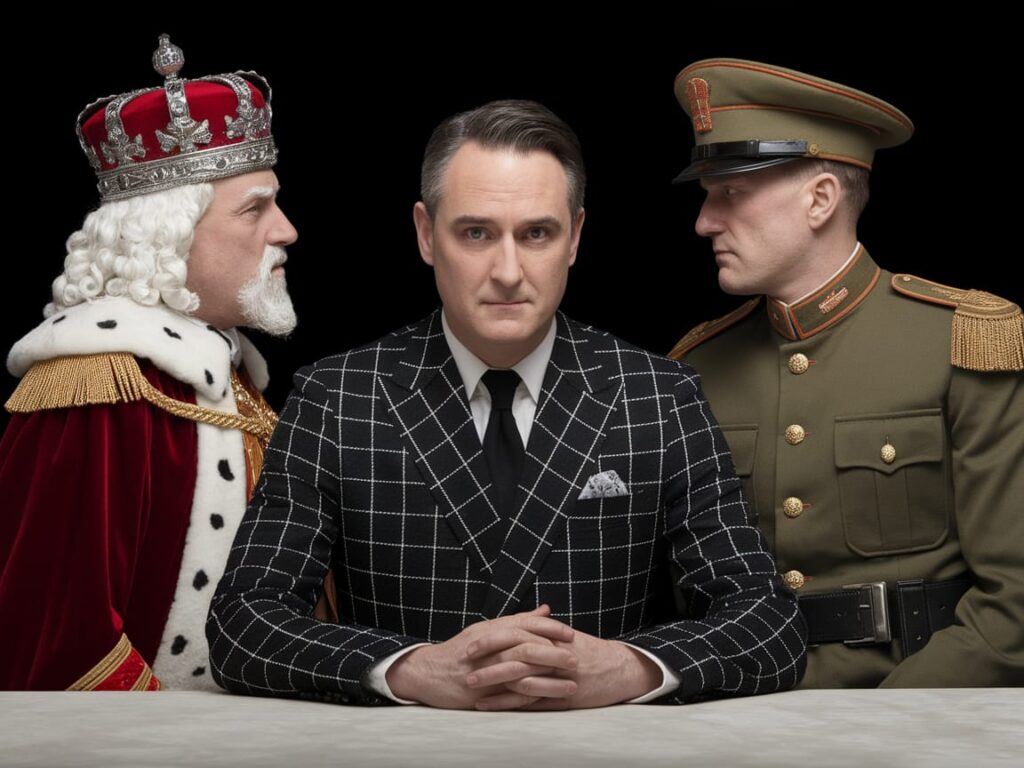
If you are incredibly fortunate (or unfortunate), you will have inherited lands that bring in such an income that you don’t need to work. This will place you in society’s ruling class. If you do not inherit such a fortune, you will have to sell your labour to those who did in order to survive. You will have a position on the Cheap Labour Spectrum.

This position, in turn, is primarily a matter of your negotiating position with regards to employment.

What is the best alternative for you to taking this job? For a member of the upper class, the alternative is to sit at home collecting rents. For everyone else, it’s starvation – there are no longer any commons to hunt or gather as they have all been enclosed. Everyone else is on the Cheap Labour Spectrum, where the upper class tries to pay you as little for your labour as they possibly can.

At the top of the Cheap Labour Spectrum are those in the best negotiating position. This will be friends or family of the upper class. Those who inherit the land usually have someone else manage it. These stewards of the great estates are at the very top of the spectrum. Often they are minor aristocracy themselves, and work to gain political, business or cultural contacts, not because they need to.

In more meritocratic systems, those in possession of the most important skills also have excellent negotiating positions. People who understand how the national electricity grid works, who can perform extensive surgeries, who can lecture the sciences – they will always be able to command an impressive income. They could be said to comprise the upper middle class.

The next level down are the unextraordinary professionals and managers. These people might not be brilliant, but they are willing to work hard for long hours. They sacrifice themselves for the landowners, and this is generally rewarded: the landowners can’t push people willing to work 80 hour weeks down the Cheap Labour Spectrum because there isn’t enough supply of these people. So they make up the core middle class.

In the middle of the Cheap Labour Spectrum are people like you and me (probably). Here one might have a small amount of savings or some skills of minor note, but the general trend is towards getting ground into oblivion. Even if one has a supposedly decent job, time and rent/mortgage pressures will eat heavily into one’s quality of life. This is the fabled lower middle class. In a time of high social mobility (i.e. not today’s Clown World) it’s an okay place to be.

If there’s an upper working class right now, it’s the trades. Many tradesmen today are earning more money than people supposedly above them in the middle class. However, one’s position on the Cheap Labour Spectrum is not a question of income, it’s a question of negotiating power: two related but differing concepts. Even if the tradesman makes more money than some of those in the middle class, he is still more vulnerable to mass immigration.

The middle working class, or core working class, are doing it hard. They’re low enough on the Cheap Labour Spectrum to not be considered fully human by the upper class. As such, they are targeted for replacement. All over the West right now, the simple retail jobs that would have gone to such people now go to cheap labour imports. One can see already that, at the lower levels of the Cheap Labour Spectrum, the quality of life is very low indeed.

Even further towards the lower end of the spectrum are people earning the minimum wage. These are the lower working class, the real precariat. These people have to exhaust themselves through work, but are paid barely enough to live on, and they consider the thought of one day owning a home a sick joke. In the modern West, this is the lower cutoff point of the Cheap Labour Spectrum.

Indentured servants are the next step below this cutoff. Indentured servitude might not legally exist in today’s West, but it has existed in the recent past. Over 300,000 people are believed to have crossed the Atlantic as indentured servants up until the American Revolution, mostly from Britain. A modern form of indentured servitude is when a people smuggler will confiscate a person’s passport while waiting for that person to work off a debt.

Modern wage slavery is akin to indentured servitude. It has been suggested that the secret goal of saddling young people with student loan debts is to make them more desperate and to weaken their employment negotiating position, pushing them down the Cheap Labour Spectrum. Many indentured servants in the Americas were granted land upon the completion of their tenure, a privilege never afforded to 21st Century wage slaves.

Serfdom is the stage below this. In serfdom, a person is bound to a piece of land as a labourer. In theory, the serf and his family get military protection from the landlord, but in practice the lord gets the lion’s share of the serf’s production in exchange for a few promises. The serf might not be cheap enough labour to be expendable, but they’re getting down there.

Slavery is the lowest stage of the Cheap Labour Spectrum; the purpose of the spectrum itself is to drive people towards slavery. Even here, there are divisions. The chattel slavery of the American South was one of the most brutal and dehumanising forms ever practiced. Barbary Coast slavery was also brutal. In certain other slavery systems, the law restricts the extent to which slaves can be abused. Some forms of debt slavery are little different to indentured servitude. In any case, to be a slave is to be at the bottom of the Cheap Labour Spectrum.

In ancient times, slavery meant literally capturing your enemies at spearpoint and enslaving them, or buying them off a king who had enslaved his enemies. In modern times, it’s more a matter of pushing your enemies down the Cheap Labour Spectrum. By opening the borders to hordes of cheap labour, the ruling classes push the middle and working classes further down this spectrum. This is why mass immigration takes place everywhere in the Western World, despite never having been voted for in any democratic election.

For the 99% of us plebs not in the ruling class, social status is primarily a matter of where one is on the Cheap Labour Spectrum. That’s why the number of dollars per hour a person earns is considered the ultimate measure of their value. That number is a measure of how much leverage the upper class has over them – it’s a measure of the degree to which they have not been brought to heel.

Escaping the strictures of the Cheap Labour Spectrum is not an easy task. Because so many of us are on it, a high proportion of us get pushed towards the bottom by sheer competition, making it harder and harder to escape. Perhaps the best hope is a revolution that destroys the modern labour system completely, or a mass dieoff that collapses the labour supply.

*

For more of VJM’s ideas, see his work on other platforms!
For even more of VJM’s ideas, buy one of his books!

*

If you enjoyed reading this piece, buy a compilation of our best pieces from previous years!

Best VJMP Essays and Articles of 2023
Best VJMP Essays and Articles of 2022
Best VJMP Essays and Articles of 2021
Best VJMP Essays and Articles of 2020
Best VJMP Essays and Articles of 2019
Best VJMP Essays and Articles of 2018
Best VJMP Essays and Articles of 2017

*

If you would like to support our work in other ways, make a donation to our Paypal! Even better, buy any one of our books!