
Alchemical Iron, Iron Magic and Iron Magicians

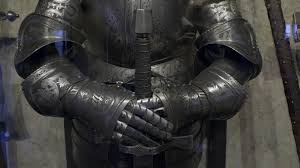
A medieval knight in plate mail armour was the foremost iron magician of his time

A previous essay looked at alchemical silver, silver magic and silver magicians. This essay does the same for alchemical iron, iron magic and iron magicians.

Iron represents the masculine, in contradistinction to the clay of the feminine. It arose as an adaptation to scenarios in which clay was too soft, although like the clay, and unlike the silver and gold, iron is also base. Iron is heavy, like the clay, but unlike the clay it is hard and unyielding. This makes it an ideal substance from which to shape tools – and weapons.

This metaphorical use of iron is everywhere. Iron is used almost universally as a metaphor for men who are firm, determined, strong, protective – the kind of guy who would win the Hawaiian Ironman. This is why a person will say to a young man that he needs to “harden up” if he should adopt an attitude appropriate to war. Ozzy Osbourne, revealing his occult education, described things well in the lyrics of Iron Man, a song about a being that doesn’t seem to be alive and doesn’t seem to think (i.e. it lacks clay, silver and gold).

Iron is best found on the outside, protecting the three softer elements within. This is necessarily the case, except for very simple forms of life, in the biological world, which has evolved to reflect these fundamental principles. In creatures such as crabs, the iron forms an exoskeleton, on the outside. In humans, the iron takes the form of bones and muscles, which serve to protect the clay (in the torso), the silver (in the head) and the gold (the spinal column).

Even on the macro level this is the case – as below, so above. Groups of early proto-humans and even of primates are capable of organising themselves so that strong young men are on the outside, facing other iron magicians in the form of enemy warriors or dangerous creatures, and leaving the women and children on the inside. More notably, it is the instinct of almost every man to step in the way if he observes a physical threat approaching his wife or children.

In some ways, this is a tragic position, and a thankless one. It could also be considered an honourable position that demanded sacrifice, in the sense that it is the duty of a man to protect his wife and children from wild animals and from the elements etc. In this sense, iron is synonymous with masculine strength and virility.

A person who can be described as ‘anaemic’ is one who is physically weak and lethargic, and this condition arises from an absence of iron. So above, so below. A doctor might note that a person’s body lacks iron, but an alchemist might point out that a person’s spirit might also be lacking iron.

The elementary action of iron is to divide. This starts by dividing the clay. A lion that tears up the body of a zebra is essentially acting as iron naturally acts – to divide the clay. Iron is so good at this that it can also divide silver and gold – which is a point long understood by the creatures of silver and gold, who prefer to stay well out of the way of creatures of iron.

Iron magic, therefore, is the magic of dividing, of bringing chaos to order while preserving one’s own order – otherwise known as the art of war. After all, war is little more than maintaining structure while weakening or breaking the structure of the enemy. Indeed, the first time a group of natives saw a firearm discharged in their direction they usually thought it a form of magic.

A professional boxer or soldier is an example of a top-class iron magician. The boxer can throw his fists and cause chaos to a their opponent’s physical structure – a soldier does the same but with bullets. In either case, the methodology used to get past to opponent’s defences and take him out with a shot to a vital area is iron magic.

The Conceit of Iron is that might makes right. It’s easily possible for a man of iron to think that, just because he’s capable of beating everyone up if they disagree with him, that he must therefore be the right one to be in charge. The danger of this conceit is that it can reduce human interaction to an essentially chimp-like level, where power is little more than a matter of force.

Iron can clash with clay, and with silver, mostly because of the Conceit of Iron but also for other reasons. The hardness of iron can feel like fire to those it touches, and this can lead to extreme agitation. It’s common for iron to unwittingly cause discord with the softer elements through a lack of subtlety or caution. For its part, iron can easily become paranoid, and afraid of revenge for past brutalities.

Silver can intimidate iron with its brilliance, which is the main way iron loses to the precious elements. Furthermore, silver is not immediately yielding like clay and gold, and this resistance is usually enough to cause iron to think twice. As any seasoned fighter knows, simply having to think twice is often enough to cause a man to lose the will to fight, and in this sense silver magic can trump iron magic.

For fear of counterattack or future reprisals, iron tends to be wary about moving into silver or gold. If iron is capable of learning, it will quickly learn that silver is capable of anticipating its actions and accounting for them. Therefore, risking a direct attack is unlikely unless the silver already looks weak, or tarnished for some reason. It will also quickly learn that attacking gold invites massive reprisals from all quarters.

When it does, silver tends to become very resentful, because they may be forced to harden up in order to deal with the aggressive intrusion (and, in hardening, become more material and therefore less intelligent). Silver likes to think that iron serves it and works according to its direction. When the opposite happens it feels like a violation.

Traditionally speaking, men of iron were associated with the colour blue, because iron swords and armour have a blue tinge. This is the reason why Police forces in Western countries that have followed the Western alchemical tradition have blue uniforms – the Police are the wall of iron between the soft elements of women, children and the elderly ruling class against the criminal element.

*

If you enjoyed reading this essay, you can get a compilation of the Best VJMP Essays and Articles of 2017 from Amazon for Kindle or Amazon for CreateSpace (for international readers), or TradeMe (for Kiwis).
Alchemical Silver, Silver Magic and Silver Magicians

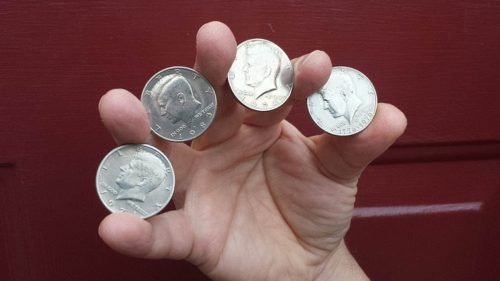
Silver is brilliant and dazzling, and its magic can pacify the man of iron and bring peace and order to the world

The elementary masculine division is into precious and base, into good and bad. The secondary masculine division is the further division of the precious into silver (colourless precious) and gold (colourful precious). This essay describes more closely the paradigm of silver and the phenomena associated with it.

In biological terms, silver represents intelligence. It is the quality that arises from finding the correct balance of masculine and feminine to suit the situation, instead of the masculine extreme (represented by iron) or the feminine extreme (represented by clay). This means that silver does not win by violence, as does the iron, but rather by deception. It’s no coincidence that spiders spin silvery webs.

Characteristic of silver is that it shines or dazzles – hence the metonymn “silver screen” for the cinema screen. Silver is so amenable to polishing that it can be made into a mirror. This is symbolic for how a man of silver can be highly educated – to the point of being able to shine in oratory, scientific achievement, philosophy or letters. People of iron or clay cannot be polished so brightly on account of their inherent baseness.

Science, knowledge and social status is the paradigm of silver. This is its own hierarchy, entirely different to the hierarchy of iron, which is all about who can beat who in a fight. A college of men of silver would frown most heavily on the use of iron magic within their group. The hierarchy of silver is who knows the most about something. More esoterically, it refers to whoever can see physical reality the most accurately.

This is the basis for the power that silver magicians have over iron. It isn’t obvious how a physically weaker person can dominate a physically stronger one, and in a state of raw, primal nature it’s extremely difficult. It’s not necessarily enough to be more intelligent, because the physically stronger man might not respect that the man of silver is more intelligent, or they might simply not care. One must make use of that intelligence by performing silver magic.

Crucially, iron may be harder than silver and dominate it when it comes to physical battle, but silver will dominate it on all other occasions. Therefore, peace, order, civilisation and goodwill are all cultivated by the man of silver. Inventing alcoholic beverages, by means of which the muscle advantage of the man of iron can be neutralised, is an example of silver magic.

It’s necessary to note here that silver itself has no moral sense. For a person of silver, any non-violent way of gaining power is legitimate, including fraud. After all, fraud can be considered a battle of intellect, in which the person defrauded lacked the wit to defend themselves against the fraud attempt.

That doesn’t mean that silver is immoral, per se, rather that morality belongs to the paradigm of gold. Silver is perfectly capable of reducing the amount of suffering in the world. Indeed, it must do so to some extent, because it must bring peace and civilisation to all in order to counteract the physical dominance that the men of iron have.

Also characteristic of silver – and this is the crucial way in which it is different to gold – is a cold, ruthless elitism. This elitism is capable of manifesting all as kinds of narcissisms and resentments. This is otherwise known as the Conceit of Silver – it is bedazzled more than anyone else by its own reflection, by its own glory.

Neither does silver have any sympathy for the resentment caused by its apparent brilliance. In the mind of a person in the paradigm of silver, it’s simply natural for beings of clay and iron to understand that they are of lesser value to the person of silver. The conceit of silver is such that it cannot countenance the thought that everything has its own value, in its own niche.

Having said that, much of the self-regard that silver possesses is fair. The man of silver knows that if it had not been for his predecessors, the human animal would still be much like a monkey – it was he who mastered fire, he who developed the flint axe, he who understood the military advantage of a spear. That the man of iron has resented him ever since is due that the baseness inherent within iron.

It’s common for men of silver to identify with this as their primary characteristic and to eschew bonds of nationality, race or religion. Voltaire once wrote “When it comes to money, everyone is of the same religion”. Indeed, to the men of silver, being wealthy (in the sense of possessing alchemical silver) makes you part of an elite inner circle of initiates.

This can easily be observed in places of heavy concentration of silver, such as universities or the CBDs of major financial centres. In such places, it’s rare for anyone to express a will to enforce the rigid divisions between groups of people that the man of iron loves to enforce. No-one cares if you’re black, or gay, or from a religion that worships goats – as long as you have class.

To the silver magician, bonds of blood and solidarity are for plebs. All that matters is wealth. If I am wealthy and you are wealthy, then you are part of my ingroup, even if we are of different races, peoples, cultures etc. The man of iron sees this as a betrayal of blood, which helps to fuel his resentment and chagrin.

*

If you enjoyed reading this essay, you can get a compilation of the Best VJMP Essays and Articles of 2017 from Amazon for Kindle or Amazon for CreateSpace (for international readers), or TradeMe (for Kiwis).
A Closer Look at the Four Masculine Elements

The masculine is to go upwards, outwards and onwards; to shine without burning

Previous essays here have discussed the difference between the four feminine elements and the four masculine elements, and the four elementary perceptions. This essay looks more closely at the four masculine elements and, more specifically, how awareness of them arises in perceptual space.

According to one manner of thinking, masculinity is judgment in the place where femininity is perception. Where feminine divides into light and dark (where both have equal value), masculine divides into good and bad, where one is prized and the other despised.

Thought of in terms of elements, the basic masculine division is into precious and base. This means that applying the simplest possible masculine lens to the world will divide it into things that are valuable and things that are not valuable. Those things that are already valuable don’t need to be (or ought not to be) acted upon, because they are good as they are. That which does not have value can be freely acted upon, because such actions do not (or ought not) destroy value.

The elementary masculine action is to impose order upon chaos. This means to impose order upon the world. Before this can be done, the masculine perception must be adopted, so that the world can be divided into precious and base. The precious does not need to have order put to it; it has value inherently. The base, however, can freely be worked because in doing so one cannot damage anything valuable, and can in fact improve the value of it if the correct order is imposed.

Regarding the base, the natural masculine question is to ask: can some of this be shaped into a tool? If a blob of clay – which is simply an ordinary part of the natural world – can be shaped into an object that is useful as a tool, then the crafter has performed an act of basic alchemy: through an application of will he has turned clay into iron. This he has done by imposing a useful order upon it.

Imposing useful order upon clay makes it more valuable than mere clay, because it is possible for information to have value, and if that information is encoded into the shape of an object then that object also has value. A worthless blob of clay can be thrown into a pot, and a pot has value as a tool because it can be used to store things. A stick can be fashioned into a spear; rocks can be melted to produce copper and iron, which can themselves be formed into tools.

The two precious elements – those which are perceived to be good and valuable instead of otherwise – are silver and gold. Both of these are very bright in comparison to the base elements, which is how their essential masculinity manifests – as light. Because these elements manifest themselves as light, and because light is associated with valuable things (like warmth, the Sun, daytime etc.), these elements have inherent value.

Ultimately, the reason why gold is more valuable than silver is because it is richer. Gold is shiny like silver, but where silver is colourless, gold is a vibrant kind of yellow. In this sense, gold contains all of the range of colours that clay does – all the colours of life. Thus, it is easier to distinguish gold from iron than it is to distinguish silver from iron, which means that the gold is more obviously valuable.

Metaphysically speaking, this arrangement of the world into four elements of increasing rarity and value tells an entirely different creation story to the seemingly random appearance of the feminine elements of earth, water, air and fire. It tells a story of order emerging out of an ocean of chaos by means of an act of will, first hardening itself, then polishing itself, then finally refining itself to become something immensely valuable that somehow stood as an avatar for all of life – a God.

*

If you enjoyed reading this essay, you can get a compilation of the Best VJMP Essays and Articles of 2017 from Amazon for Kindle or Amazon for CreateSpace (for international readers), or TradeMe (for Kiwis).

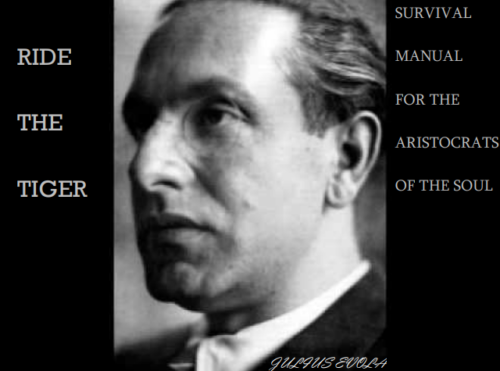
VJMP Reads: Julius Evola’s Ride the Tiger X

This reading continues on from here.

The 27th essay in Ride the Tiger is called ‘Relations Between the Sexes’ and seeks to cover a different range to the essay about marriage. When the order of the world is dissolving, men and women are naturally separated. Our sexual prejudices have contaminated our ethics. Nowhere is this more evident that in the idea of sexual revolution.

Processes have worked towards a freeing of sex, but not a freeing from sex. The sexual revolution has not liberated us from the suffering caused by sexual desire; to the contrary, we are now intoxicated by it. This is contributing to the collapse of society, but we can use the space afforded by the chaos to assert higher values. Bourgeoisie values, being materialistic, cannot conceive of woman in anything more than her anatomical capacity as instrument of reproduction – in reality, she has a spiritual value.

Sexual liberty therefore leads to materialism, and thereby away from spirituality. Incredibly for the 1960s, Evola is already able to anticipate how widespread pornography has affected the “polarity” between men and women. Nowadays a naked woman doesn’t stir much more interest than the sight of a cat. This is a tragedy because the sexual union is capable of acting as a bridge to higher consciousness via “an existential rupture of planes”. Making love can be Dionysian.

Part Eight of Ride the Tiger is where Evola finally gets to the spiritual side of things. This final section is titled ‘The Spiritual Problem’, and consists of two essays. The first of these is called ‘The “Second Religiosity”‘.

In this essay Evola decries what he calls “neospiritualism”, which he describes as an attempt to lead people beyond the material without giving any credence to the old, dogmatic religious movements. He has no time for the “movements, cults, sects, lodges, and conventicles” of the modern day, and considers them also a phenomenon of dissolution. In fact, things have gone so far that we are now in the rigor mortis stage, and all that awaits is the decomposition of the corpse.

When man closed himself off to the higher, transcendent world in the 19th century, this did not liberate him from superstition but merely opened him up to the lower, primitive emotional world in the 20th. We are now in the “soulless, collectivistic and materialistic phase corresponding to the closing of a cycle of civilisation”. All of these neospiritual movements thus represent an excess of the feminine. Evola is highly cynical and dismissive of these movements.

It’s difficult to correctly discriminate between all the garbage thrown up by neospirituality and the wisdom of genuine value. The emphasis ought to go on the deconditioning of the spirit. Here, Evola is at pains to emphasise that a person cannot achieve initiation by themselves, in contrast to the belief espoused by many. One is either born initiated, or one achieves initiation by way of spiritual emergency or ordeal, or one is initiated deliberately by someone who is part of a tradition and who knows what they’re doing. This is hard to achieve because the organisations that do so hardly exist any more.

The 30th and final essay is titled ‘Death – The Right Over Life’. Evola begins here by talking about the common belief, held by Heidegger (as well as by Socrates) that life is in some way a preparation for death. Death appears to be the end of the “person”, and atheism and materialism have made this simpler to deal with. Contemplation of death is a noble endeavour, as it can lead to a heightened state of appreciation of one’s life.

The traditional doctrines had the correct approach to death. The truly differentiated man cannot believe that his being began with the beginning of his physical body. He must solve the problem of nihilism by “displacing the I towards the centre of ‘being'”. Here Evola is talking about consciousness: “the human condition οf earthly existence is only a restricted section in a continuum, in a current that traverses many other states.” This eternal truth is not easy to grasp in an age of dissolution like ours, but it is much better than the lies of theistic creation myths.

A truly differentiated man, much like the Stoics and the Pythagoreans, could never take his own life, no matter how poor his conditions. This is because to do so would acknowledge that he was not strong enough to overcome the irrational part of his being. However, one always has the moral right to exit the world, should one decide that remaining ordeals are not meaningful. The differentiated man would be extremely disinclined to take this option in any case, right or otherwise. This is because of the possibility that one has chosen and said yes to – whether before or beyond this life – all of the ordeals in it.

In the final analysis, one can say that, no matter how degenerate and dissolute the world, it can still have value. It might be that, in order to achieve the highest state of being, consciousness must challenge itself as intensely as possible. To that end, there’s little more challenging than existing in a world where everything is contrary to one’s nature.

*

If you enjoyed reading this essay, you can get a compilation of the Best VJMP Essays and Articles of 2017 from Amazon for Kindle or Amazon for CreateSpace (for international readers), or TradeMe (for Kiwis).