
The Case For Cannabis: Cannabis Is A Religious And Spiritual Sacrament

We are supposed to have freedom of religion in the West, but in practice this only applies to certain favoured religions, in particular Abrahamism and its derivatives. Other religious traditions, particularly those that employ psychoactives as part of their rituals, are effectively discriminated against by the War on Drugs. This article will discuss the established tradition of cannabis use as a religious and spiritual sacrament.

The Indo-European peoples have been using cannabis as a religious and spiritual sacrament for thousands of years.

Cannabis is mentioned in Indian texts going back to 1,000 B.C., primarily for its use as a medicine, but also for its purported ability to facilitate contact with the divine. There is an age-old tradition in India of weed-smoking holy men known as sadhus. These are ascetics who have renounced worldly wealth and pleasure, and who use cannabis to get into touch with Shiva. Among sadhus, use of cannabis is especially popular when meditating, for the moments of tranquillity and serenity that it is capable of bringing.

The Nepalese smoke it publicly and ceremonially during the festival of Maha Shivaratri. The enlightenment brought about from the cannabis high is said to represent the coming-to-awareness of the first guru in the world. It is said that it was at this moment that the consciousness of the first guru transcended the material and the illusion of space and time, and the cannabis high is intended to replicate this.

In ancient China, cannabis was used by holy men in healing and early magical rituals. Early Taoist shamans systematically experimented with the ritual use of cannabis, with some declaring that smoking it was as good as climbing into the mountains for those who were physically unable. Their traditions began with burning cannabis as incense for the sake of smoking out demons and evil spirits, and soon evolved into inhaling cannabis for the sake of drawing in good energy from God.

Cannabis was also used by the Scythians in a ritualistic form that amounting to the hot-boxing of small smoke tents. The participants would gather inside these tents as part of funerary rites and cast buds onto superheated rocks, causing them to burn and to fill the tent with cannabis smoke. The change in consciousness brought about by these rituals were considered to bring the participant into contact with the spirits of the dead.

From there, it spread to Germany, and from there to Britain and Scandinavia. The Vikings came to associate its aphrodisiac effects with the fertility goddess Freya, and spring festivals sometimes involved the ritual consumption of cannabis. Viking herbalists were also aware of the pain-killing properties of cannabis, and they appear to have cultivated it in Southern Norway since 650 A.D. Evidence suggests that at least some of this cannabis was cultivated for ritualistic and shamanic purposes.

Therefore, cannabis use has been part of our natural spiritual traditions for thousands of years. The state of cannabis prohibition brought about by Abrahamism is an obscenity, the kind that comes from such false doctrines. It is not right for us Westerners to live in a state of cannabis prohibition, because it separates us from our natural connection to the divine, replacing it with a doctrine of women-hatred, gay-hatred, genital mutilation and ignorance.

Many modern people could tell you that cannabis use is still part of our natural spiritual traditions. It is the Western subcultures that smoke cannabis who are most likely to reject the obsession with materialism that has captured our culture. After all, the spiritual effect of cannabis comes from its ability to separate the user from the material. By inducing a state of physical and emotional calm, consciousness focuses instead on the spiritual. By pacifying the user’s base physical desires, they can concentrate on a form of living that pays homage to God.

Rastafarians say of cannabis that “The herb is the key to new understanding of the self, the universe, and God. It is the vehicle to cosmic consciousness”. Many Westerners who do not follow an organised religious tradition can likewise tell you that smoking cannabis gets you closer to God. There are millions of us who could tell you that we have had profound spiritual epiphanies from sacramental cannabis use, and that these epiphanies are worth gold.

Cannabis being illegal therefore amounts to religious discrimination. It’s essentially no different to a law that makes the Bible or the Koran illegal. If cannabis use is a means by which some people get closer with God, how can it possibly be anyone else’s right to say otherwise? The people who support cannabis prohibition would be appalled at the thought of Government agents going into someone’s house to take their Bible away, but they do much the same thing with cannabis without a second thought.

There is a need for cannabis law reform so that religious and spiritual alternatives to Abrahamism can be explored. There is no valid reason for people to be forced to follow an Abrahamic tradition, and therefore no valid reason for the law to prohibit the spiritual sacraments of non-Abrahamic traditions. True spiritual and religious freedom requires that none of the established methods for coming closer to God are made illegal – this includes cannabis use.

*

This article is an excerpt from The Case For Cannabis Law Reform, compiled by Vince McLeod and due for release by VJM Publishing in the summer of 2018/19.
Why Science, Correctly Performed, Will Lead To A Belief In God

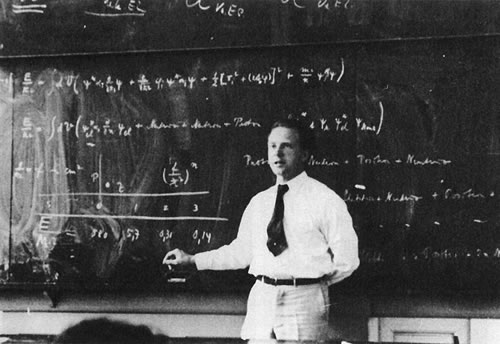
Nobel Physics Prize laureate Werner Heisenberg once said “The first gulp from the glass of natural sciences will turn you into an atheist, but at the bottom of the glass God is waiting for you.” Something that Heisenberg understood, but which most lesser scientists do not, is that a belief in God will arise from doing science correctly. As this essay will examine, atheism is not necessarily the correct attitude to take into the natural sciences.

The scientific method begins with determining what we know for sure, and from there reaching out to what else can be stated with some degree of certainty. For instance, if a particular chemical reaction has transpired in a particular way a hundred times, we can predict with a high level of certainty that it will transpire that way one more time. From there, we can make alterations to our methodology in order to learn more.

What do we know for sure?

As it turns out, there is only one thing that a person can know 100% for sure: that they are conscious. Everything else is necessarily a matter of faith. Every belief, apart from the belief that one is conscious, is a matter of faith, because it is a statement about the material world.

All phenomena within the material world are known to be transitory, and therefore they contain an element of chaos that precludes total understanding of them. One might declare with certitude that “The Sun will rise tomorrow,” but even this is an article of faith – the Earth could be struck overnight by a gigantic comet that reduced the planet to cosmic rubble, thereby proving one wrong.

Although one might be 99.9999% sure about such predictions, one can never truly be certain, in the way that one can be certain that one is conscious. No prediction that depended on the permanence of some aspect of the material world could ever be made with 100% certainty – Heisenberg himself expressed this understanding with his Uncertainty Principle. It is certainly possible to predict that things will change (i.e. that you will die), but it is seldom possible to predict precisely when.

If one doesn’t know for sure that the material world exists, but one knows for sure that consciousness exists, then it doesn’t make logical sense to assume that the material world is the basis of reality. Consciousness can easily create the impression of a material world – it does so every night in our dreams. But there is no scientific explanation, no plausible explanation, that can demonstrate how the material world might develop consciousness. All talk of “emergent properties” is merely materialist dogma, special pleading.

Ockham’s Razor tells us that it’s more likely that consciousness dreamed up the material world and Planet Earth, in much the same way that it dreams worlds at night (an explanation that requires one step), than that the material world spawned from nowhere and evolved to be conscious (an explanation that requires hundreds, if not thousands of steps).

Therefore, there is no reason to assume that the death of the physical body ought to affect consciousness. If the material world is simply a set of phenomena that are dreamed up by consciousness, then there is no reason to assume that the death of one’s physical body ought to affect that consciousness. Therefore, there is no reason to assume that consciousness “disappears” or “dies” or even so much as changes form when the physical body dies.

The real question, then, is: of what does one become conscious upon the cessation of the temporal patterns that corresponded to one’s physical body? It isn’t easy to speculate about such things, because it depends on how laws from this world translate to the next. One thing can be said for certain though: of the next world, one will be conscious.

Ockham’s Razor can also be applied to the realm of biology to support the contention that consciousness is the prime materia.

Evolutionary science tells us very clearly that organisms do not evolve unnecessary appendages. None of limbs, organs, or parts of the brain will come into existence unless there is an evolutionary pressure that favours them. This will only be the case if those limbs, organs or parts of the brain (or early forms of them, at least) confer some kind of selective advantage. Without this advantage, there will be no selective pressure in favour of that appendage, and without that pressure it will not come to exist.

Consciousness confers no survival advantage. The human animal does not need to be aware in order to carry out any of its survival functions. All of the thoughts and calculations that the human brain performs over the course of a human life could just as well be made without consciousness. After all, a computer or android could be programmed to scan its physical environment for the sign of predators or food sources. It wouldn’t need to be conscious to do so.

If consciousness confers no survival advantage, then it cannot have been selected for by natural selection (i.e. by biological or material means). If it was not selected for by natural selection then it cannot be biological and attached to, or arising from, any part of the brain. To the contrary – the material world, including the brain, arises from consciousness.

If consciousness can dream up this world, and if it can dream up the fantastic nightscapes of our dreams, then it can dream up an infinitude of other world, realms and dimensions. And indeed it has – the entire rest of the Great Fractal is currently being explored by consciousness, in an infinitude of realms that you cannot even hope to perceive (yet).

Anything within the Great Fractal (i.e. everything that it is possible to perceive) can be dreamed up and explored by consciousness. Consciousness is infinitely creative. Consciousness can find a way to perceive anything that is perceivable. If it’s perceivable, then there’s a path to it through the Great Fractal from where consciousness currently is.

This effectively means that consciousness is omnipotent: after all, it is capable of conjuring anything from all the permutations of what’s possible.

It is often said that belief in God is a question of faith. Indeed it is. There is no possible way to prove that any being apart from oneself is conscious. All other beings could be conscious like you, or they could be programmable meatbags – and you have no way to prove otherwise. If they are conscious, that consciousness cannot be observed or measured. There is no instrument that will detect its presence or absence.

If consciousness is eternal, has the power to create anything possible, and whose presence in others is necessarily a question of faith, then consciousness is therefore God. It fulfills all of the criteria commonly attributed to God by Epicurus and others. This understanding can be arrived at scientifically, by logic, without need for faith.

*

If you enjoyed reading this essay, you can get a compilation of the Best VJMP Essays and Articles of 2017 from Amazon for Kindle or Amazon for CreateSpace (for international readers), or TradeMe (for Kiwis).

The Four Ways to Become Enslaved

Chains can be physical, mental, or spiritual

There are many different ways that a person can become enslaved to the will of another or to a group of others. Although people usually associate the term ‘slavery’ with the chattel slavery of the American South, there are as many different kinds of slavery in the human world as there are ways of exploitation in the natural world. This essay describes four distinct ways of being enslaved that accord with the four masculine elements.

The four ways to enslave are, effectively, the four different ways of introducing artificial scarcity. Only when a state of artificial scarcity has been induced will another person surrender themselves to the will of another. There are effectively four ways of doing so: two physical, two non-physical.

The most basic way of asserting dominance over another of your own kind can be observed in other mammals, especially other primates, when they fight over their food supply. To enslave another person in this sense is to deny them the peace and solitude to gather food from nature. The alpha primate will not allow any others to eat until he himself is satisfied. Disobedience is punished with violence.

To be enslaved in this manner is to wear chains of clay. This is because a lack of food is the most natural and immediate survival problem that faces life forms such as mammals, primates or humans. To not be able to eat when one needs to nourish oneself is slavery, because hunger will cause one to grow weak.

Chains of iron are what most people think when they hear the term ‘slavery’. This refers to iron manicles and shackles that prevent or hinder movement when fastened around a person’s wrists or ankles. It’s extremely rare to see a person enslaved by chains of iron nowadays, but it’s still common to see people who are more or less enslaved in the same way as a person wearing irons – i.e. by an artificial scarcity of security in that person.

What chains of iron refers to on a metaphysical level is control of another person’s physical safety, and their ability to remain free from wounding and physical harm. This is effectively how criminal gangs establish a presence in a neighbourhood – business owners are guaranteed physical security for them and for their business, but only if those business owners agree to pay for the “service”.

Chains of silver are frequently used metaphorically, usually to denote a person who has been enslaved by wealth. A person who has allowed themselves to become controlled by the physical objects and possessions they have hoarded could indeed be said to be enslaved by chains of silver, but there’s more to it than just that. Metaphysically, chains of silver refers to all tricks of the mind, which is all lesser magic.

In other words, chains of silver refer to an artificial scarcity of knowledge, in particular knowledge relating to the physical world. A person who has thousands of dollars in credit card debt that they can never clear, so that the bank regularly takes a hundred dollars in interest charges every month, just because they bought some crap they saw on television, could be said to wear chains of silver. In this case the term refers to the financial literacy needed to avoid debt traps like credit cards.

Likewise, a person trapped in a political ideology could be said to wear chains of silver. If a person’s social circle all think in a certain way, and their media organs all speak in the same way, and their courts and Police enforce it, a person might forget that there’s any other way of thinking. Many English speakers are subjected to so much capitalist propaganda that they are astonished, travelling overseas, to see other avenues of solidarity.

Very few people are enslaved by chains of clay and iron nowadays, and although most of us wear chains of silver to some extent, they are seldom a heavy burden.

However, the vast majority of people are enslaved by chains of gold, and many of those are so enfeebled by these gossamer bonds that the other forms of enslavement become virtually inevitable. A person enslaved by chains of gold is someone who is not aware of the fact that consciousness is the prima materia, and who consequently believes that the death of their brain means the extermination of their consciousness.

Chains of gold, therefore, refer to an absence of spiritual knowledge. It is the birthright of all humans to be made aware of the true nature of the relationship between consciousness and the physical world, and therefore anyone who does not possess that knowledge has been enslaved by chains of gold. This is something that has purposefully been done to enslave us by way of destroying our natural spiritual traditions, for example by prohibiting entheogen use.

Gold is the softest of all metals, and fittingly, chains of gold are also the weakest. This does not mean that they are the easiest to break. In fact, the opposite is true. These chains of gold are the trickiest of all, and not just because they are invisible. Those who wear them cannot conceive of them, by any sense. A person enslaved by chains of gold cannot be induced to believe in God.

A person enslaved by chains of gold will not believe in God, and consequently they will not believe in chains of gold. No-one enslaved by chains of gold is aware of it; as soon as a person becomes aware of chains of gold they are broken.

It could be argued that a person can only be enslaved with baser elements if they are first tricked into wearing chains of gold. For instance, a spiritual person might be better able to resist the temptation of loaning some money to satisfy a short-term urge. They might also be unafraid of death, and therefore willing to choose death before submitting to chains of iron.

Alchemically speaking, these are the four ways that a person can be enslaved. Although chains made of the baser forms of clay and iron are rare in the modern world, it’s important to remember their historical role, because a return to them is possible if we get weighed down enough by chains of silver and gold.

*

If you enjoyed reading this essay, you can get a compilation of the Best VJMP Essays and Articles of 2017 from Amazon for Kindle or Amazon for CreateSpace (for international readers), or TradeMe (for Kiwis).

We’ve Had the Great Financial Depression, Now We Have the Great Spiritual Depression

We’ve got all the money and stuff we ever wanted – but it’s not making us happier

Tyler Durden in Fight Club told Generation X that “Our Great War is a spiritual war.” This is the truth, and we have been too slow to see it. The narrative has changed since our parents’ and grandparents’ time: the major struggle of human life is no longer physical survival, but making sense of our lives.

Durden was speaking directly to Generation X because ours is a different story. The Great Depression that our elders endured, while terrible, was ultimately a financial one, and we were guaranteed to get out of it once the markets reset. What we have to endure is also worthy of the epithet Great Depression, only what we have to endure is spiritual.

This Great Spiritual Depression has been caused by a perfect storm of factors.

The first major factor is the rottenness of what passes for spiritual tradition in our culture. It’s obvious to any outside observer that the Christian rituals are empty and meaningless – this can be determined simply by speaking to the average Christian and hearing his hatred of other religions, of homosexuals, and of drug users. It’s apparent from that that Christians do not have any privileged access to understanding the mind of God.

A person who enters a Christian church to hear a sermon from a learned man is far more likely to hear something political about the need to obstruct progress on gay rights or drug law reform. If that person stays to talk to those who think they understand the nature of God, those people will say that a women’s place is subordination, and that anyone who doesn’t worship the Magic Jew will be condemned to an eternity of hellfire.

If there was ever anything spiritual in the Abrahamic tradition it has rotted away centuries ago.

The second major factor is that all of our cultural and political narratives are entirely materialistic. It’s materialist capitalists versus materialist socialists. Whichever side wins, we get materialism. Neither side has a solution to the problems of human existence that goes beyond accumulating more physical resources or power.

This materialism has arisen as a reaction to the fact that religion, in the guise of Christianity, retarded progress in the West for over 1,000 years. Because of this, the people and societies that developed an interest in discovering the truth naturally came to distrust anyone who spoke about non-materialist concepts. Moreover, most of the advances in alleviating human suffering made in recent centuries have come through materialist sciences such as medicine, engineering, biology, chemistry and physics.

The problem with this materialism is that people have been thinking in these terms so so long that most of us have forgotten that any other terms are possible, or even sometimes necessary. Emotional, intellectual and spiritual paradigms have all been forgotten in favour of who controls the most stuff. Even psychiatrists – supposedly doctors tasked with healing the soul – can only think in terms of chemical imbalances and pharmaceuticals.

As Terence McKenna was fond of saying, “the way out is back”. Westerners have historically shown themselves capable of exceptionally sophisticated metaphysical thought – one only need read Plato for ample proof of this. The solution is the revival of the perennial philosophy and the perennial, universal, cosmic religion, in a form that suits the world of today.

This will have two major benefits.

The first will be the return to each human being of their birthright to be initiated into the spiritual truths. Instead of being brainwashed from birth with some horseshit story about being specially chosen by God, virgin births or last prophets, and how God’s love is conditional upon obeying the moral dictates laid down by the political authorities of the time, people shall be instructed truthfully from the beginning.

This means that something like the Eleusinian Mysteries will have to be reinstated, and the ceremonial mass public consumption of psychedelics encouraged, but in a highly ritualistic and orderly manner. This will mean that the public at large will once again be connected with God, and all will know the truth. This will lead to our spiritual elders transmitting useful information to the youth instead of old Middle-Eastern stories that justify genital mutilation and slavery.

Because the spiritual elders will no longer be lying, there will no longer be cause for the men and women of silver to respond by going in the other direction. Thus, being a freethinker will no longer correlate highly with being a materialist (as it has for the past three or four centuries). People will be free to discuss metaphysical subjects without the assumption that they are dangerous fanatics.

The second major benefit will be to cause the coming of new political ideologies that are not based on materialism. These will transcend the ancient capitalist-communist paradigm. In other words, they will not be grounded in settling arguments about who gets what stuff, and who can extort what labour, taxes and rent out of who. These ideologies will be much better suited to meet the challenges we face because they will reflect reality more accurately and faithfully.

What exact form they do take is not clear, but it is likely that they will be grounded in reducing the amount of suffering in the world rather than the redistribution of resources. This specifically means reducing the suffering of sentient beings, through all of their thwarted desires.

It’s certain that cognitive liberty will play a central role here, as it has been the lack of cognitive liberty that caused this Dark Age in the first place. We can guess from this that the social sharing of consciousness-altering sacraments will flourish – not merely alcohol and cannabis, but psychoactives that are capable of a wide range of desirable effects.

*

If you enjoyed reading this essay, you can get a compilation of the Best VJMP Essays and Articles of 2017 from Amazon for Kindle or Amazon for CreateSpace (for international readers), or TradeMe (for Kiwis).