In The Land Of The Blind, The One-Eyed Man Will Be Blinded

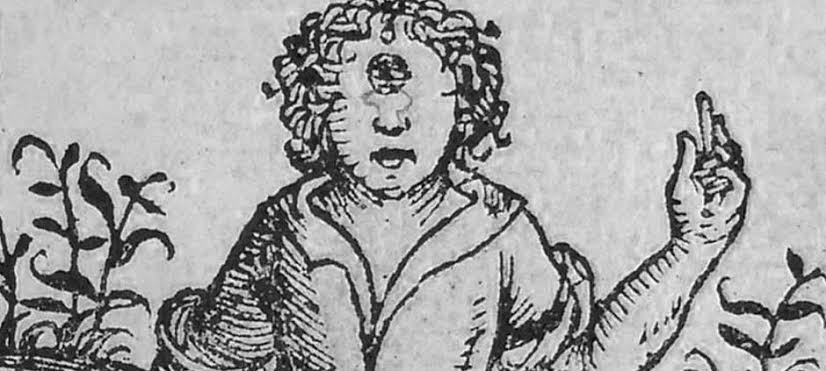
A popular piece of wisdom holds that “In the land of the blind, the one-eyed man is king.” This is supposed to imply that any individual with superior perception will inevitably rise to the top of any dominance hierarchy. The reality in a Slave Culture such as our own is different. In a culture as blind as ours, anyone who can see clearly will be blinded.

The blind, like all humans, will never simply accept the dominance of someone who claims to see things that they don’t. It’s not in human nature to do this.

If a one-eyed man entered the land of the blind and started talking about how he could see things that the others could not, the blind would rather deem him insane. They would adamantly refuse to acknowledge that any higher insight to their own was possible. The land of the blind would have its own dominance hierarchy, and its own incumbent alphas, and they would defend their positions.

If the one-eyed man insisted that he could see things that the others could not, he’d be declared acutely psychotic. The things seen would be dismissed as hallucinations, and it would be declared that these hallucinations were brought on by excessive stimulation, and they’d forcibly sedate him. They might put him in a cell so that his disturbed mental state didn’t upset others.

Eventually, they’d just rip the eye clean out of his head. They’d come to the conclusion that there was something wrong with the function of the eye itself, and that was why he couldn’t break the delusion of being able to see things that others could not. Better to just remove the offending organ with surgery.

Anyone who doubts the plausibility of this conjecture need only observe the way that our society today, operating under a materialist paradigm, treats those of a sensitive enough psychic disposition to detect a world beyond the physical.

In today’s society, anyone who claims to possess any spiritual knowledge whatsoever is considered psychotic. If a person makes a claim to some minor knowledge, they might be politely humoured, but anyone making a claim to major spiritual truth is despised as someone too weak to maintain a grip on reality.

Anyone claiming firm gnosis is simply dismissed as schizophrenic. Especially forbidden is any talk that we may be God ourselves. The mental health system might begrudgingly allow someone a belief in Rabbi Yeshua ben Yosef, but any idea that all conscious beings are co-creating reality in the eternal moment is absolutely right out.

This is the land of the blind – the spiritually blind. The vast majority of the population either superstitiously follows a dead tradition or follows none at all. But we cannot expect that a spiritual man, should one arise, would be welcomed and his insight greeted. Far more likely he would be shunned as a heretic.

*

If you enjoyed reading this essay, you can get a compilation of the Best VJMP Essays and Articles of 2018 from Amazon for Kindle or Amazon for CreateSpace (for international readers), or TradeMe (for Kiwis). A compilation of the Best VJMP Essays and Articles of 2017 is also available.

*

If you would like to support our work in other ways, please consider subscribing to our SubscribeStar fund.

A Thought Experiment That Demolishes Materialism

One of the great philosophical debates is between materialists and idealists. The materialists consider their opponents to be mentally ill dreamers, while the idealists consider theirs to be literal-minded children. This essay expounds a thought experiment that shows that materialism is not tenable.

Materialists believe that the consciousness is generated by the brain. The most popular materialist theory is that consciousness is an “emergent property” of the combination of the various senses. Consciousness has evolved as a kind of supervisor of this sensory input, presumably for the purpose of making decisions or similar.

Therefore, materialists believe that the individual’s awareness of the outside world resides in the physical brain. It is the brain itself that is aware of the outside world through the impressions it receives from the various sensory organs. It follows from this that when the brain dies, consciousness also ends.

A simple thought experiment shows that this position is not tenable.

When a person goes to bed and dreams at night, they habitually find themselves exploring alien worlds. They do this while occupying a body that seems very similar to the bodies we occupy here on Earth. This body can see, seemingly through eyes about five or six feet off the ground, and it can also hear, seemingly through ears. In the dream world, these eyes and ears observe other bodies much like the bodies on Earth.

In this dream world, one’s surroundings seem very real. It’s rare for a dreamer to become aware that they’re dreaming – if they do, they usually wake up. While dreaming, it’s no more common for the consciousness to question the reality of the sensory impressions it receives than it is for a consciousness awake on Earth to do so. It seems very much like a real world.

The question that exposes the weakness of materialism is this. When you are dreaming, which brain generates consciousness? Is it the brain of your body here on Earth that generates the consciousness that observes the dream world, or is it the brain of your body in the dream world?

From a materialist perspective, one of those two things must be true – but both put the lie to materialism itself.

If the brain in your body here on Earth generates the consciousness that observes the dream world, then a brain on Earth is not necessary to observe Earth. This is because, if the dream world is being observed by a consciousness that is generated by a brain in a different reality, then the consciousness that observes Earth may be also generated by a brain in a different reality. Or perhaps not even generated by a brain.

This means that it’s possible that the consciousness that observes Earth is generated by a brain somewhere else, perhaps in a reality outside of, or more fundamental than, the one in which Earth resides. In such a case, we have no more reason to think that the death of our body on Earth should be the end of consciousness than we do to think that the death of our body in the dream world should be the end of consciousness.

On the other hand, if it is the brain in the dream world that generates consciousness – perhaps on account of that it is connected to the eyes and ears of the dream world and therefore receives sensory input from the dream world – then a material brain is not necessary in order to observe a world. The brain in the dream world cannot be definitely said to exist, because there is no evidence of the true existence of the dream world (at least none that can be produced on Earth).

But if it is the brain in your body in the dream world that generates consciousness, then there’s no reason to assume that the death of one’s body here on Earth ought to result in the end of that consciousness. If the brain in your body in the dream world generates consciousness, then consciousness cannot be “tied” or “fixed” to a brain. If a brain in a dream world can generate it, then so could many other things, such as other brains in other dream worlds.

The simple fact that it’s possible to be conscious in a dream world while dreaming makes it impossible to state that the brain on Earth generates consciousness. The fact that one is conscious in the dream world must mean that either a brain is unnecessary to generate consciousness, or that there are multiple brains in multiple levels of reality that consciousness can move between.

In either case, materialism is untenable.

This apparent paradox can be resolved in an instant, simply by realising that it is consciousness that is the prima material and fundamental basis of reality. You are not your body, you are consciousness – and, as consciousness, you can travel between worlds. In fact, all worlds are merely dreams, just patterns of perception – as the Buddhists have long known.

Because of all this, there’s no reason to think that the death of the physical body on Earth ought to affect one’s individual consciousness. It’s possible for consciousness to travel between worlds without being bound to a body – dreams are proof of this. Therefore, materialism is untenable, and the fundamental materialist fear – that the death of one’s Earthly body means the extinguishing of one’s consciousness – is unfounded.

*

If you enjoyed reading this essay, you can get a compilation of the Best VJMP Essays and Articles of 2018 from Amazon for Kindle or Amazon for CreateSpace (for international readers), or TradeMe (for Kiwis). A compilation of the Best VJMP Essays and Articles of 2017 is also available.

*

If you would like to support our work in other ways, please consider subscribing to our SubscribeStar fund.

How to Deal With the Fact That We’re All Going to Die

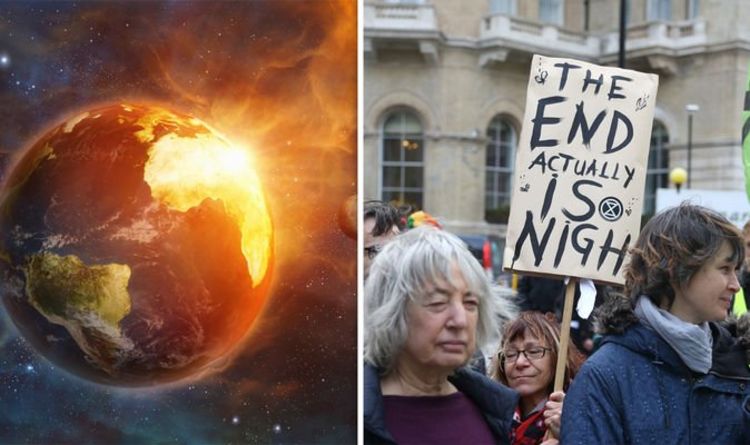
Many psychologists and psychiatrists have noticed a sharp recent increase in the number of people who present to them with anxiety about ecological collapse. The proliferation of media relating to end-of-world environmental disaster scenarios has made many people fearful. This article will give some tips for dealing with the fact that we’re all going to die.

The phenomenon has been called climate despair. Fuelled by headlines about people dying in Japanese heatwaves, how last month was the hottest month in human history, or how humanity only has 18 months to act if catastrophe is to be averted, climate despair is when people give up on life on account of believing that humans have destroyed the climate of Earth, and thereby its capacity to support life.

It could be said to be a kind of existential horror, one that arises at the thought of a future Earth that is barren of life owing to Venus-like conditions. What is the point in doing anything, in struggling to achieve things, if we’ve just wrecked the planet and are all going to die?

Climate despair may not be irrational. Some climate models do indeed predict that we have cooked the planet beyond the point where human civilisation can continue to exist. Even though things are ticking along alright now, there may be several degrees of warming that are inescapable from this point owing to what has already been added to the atmosphere.

However, from an existential and spiritual point of view, climate despair is a needless suffering and therefore ought to be counteracted. The good news is that, in principle, climate despair is nothing more than bog-standard death anxiety wearing a new mask. Therefore, the old ways of dealing with death anxiety are applicable to dealing with climate despair.

The problem that we’re going to die is essentially two problems rolled into one.

The first is that it isn’t obvious, to many people, that consciousness survives the death of the physical body. In much the same way that the Earth intuitively feels flat, many people intuitively feel that the brain generates consciousness, and therefore the death of the brain with the death of the physical body means that consciousness ends.

The second is that it isn’t obvious, to many people, that anything we do here has any meaning. We’re all going to die, and even if consciousness survives this and goes through into the next world, we don’t appear to be able to take anything with us. We can’t take property with us, we can’t take family with us, we may not even be able to take memories with us. Therefore, no actions in this world have meaning, and despair must follow.

Solving the first problem isn’t too difficult. That’s a simple matter of refuting the common illusion that the brain generates consciousness.

If a person makes the argument that the life is meaningless because we all die, and with the death of the body goes our consciousness, therefore we are doomed to forget everything we have done and everything we are, they run into a problem. This problem is called the Argument from Biological Necessity.

Evolution is an extremely efficient process, and it only ever selects for traits that confer an immediate advantage in either survival or reproduction. But, as anyone who has read any Dostoevsky can tell you, being conscious confers no such advantage. The human animal could just as well fight and fuck without being aware of what it is doing.

If anything, consciousness is an impediment to survival, on account of that it leads to depression, anxiety and existential angst and horror. These emotions paralyse us and drive us to suicide. It would be much better to not be conscious – then one could simply do whatever was necessary to best further one’s genes.

If consciousness is not necessary, then it cannot have been selected for by natural or sexual selection, as all of the facets and qualities of the brain have been. Therefore, it cannot be generated by the brain, and therefore there’s no reason to assume that the death of the brain should affect the presence of it.

The second problem is much harder. Even if you can logically and convincingly argue that consciousness must survive the death of the physical body, is not clear that anything apart from consciousness survives with it. This raises the possibility that, after the death of the physical body, one has to start again, as if this life had never happened.

Broadly speaking, there are three ways to get life wrong as a result of all this, and one way to get it right.

One can become obsessed with breeding, and adopt the delusion that one has cheated death by producing offspring. People under this delusion know no greater pleasure than just to rut like animals, and seldom consider the stark fact that their offspring will also grow old and die, as will their offspring etc.

One can become obsessed with physical dominance, and adopt the delusion that just because one is hard to kill that one has cheated death. Even if a man is really big, strong, fit, trained in martial arts and carrying weapons, time will grind him down. Age will weaken his arms, and eventually a major organ will fail. This is no solution either.

One can become obsessed with intellectual dominance, or wealth and social status. Such a person adopts the delusion that one can live on in history if one achieves sufficiently great deeds. Of course, as the example of Ozymandias showed, even the greatest deeds are worn away by time. One can never be famous enough to overcome one’s own mortality because no-one can escape the fact that everyone dies alone.

The solution is to focus on refining one’s frequency of consciousness, because that is something that might well carry through into the next world. This means to use the power of will to work one’s consciousness into a state where it serves to bring peaceful and joyous order to the intellectual, emotional and physical environment.

The Law of Karma tells us that the energy we put out is the energy that we get back. Therefore, one ought to direct one’s will towards reducing the suffering of the conscious beings around you. If one does this correctly and of one’s true will, then chances are that one comes to be reincarnated in a place where beings with similar wills exist.

This act of changing the frequency of one’s consciousness is the only way that we can work to taking something with us into the next world. It’s therefore always possible to improve the quality of one’s spiritual position by working towards the cessation of the suffering of other sentient beings. This is true no matter what the current or future state of the world’s climate.

*

If you enjoyed reading this essay, you can get a compilation of the Best VJMP Essays and Articles of 2018 from Amazon for Kindle or Amazon for CreateSpace (for international readers), or TradeMe (for Kiwis). A compilation of the Best VJMP Essays and Articles of 2017 is also available.