Understanding New Zealand: Demographics of Maori Speakers

With the uptick in interest in Maori language recently, there has also been an interest in understanding who speaks the language. A large correlation matrix based on electoral and Census data can tell us a great deal. In this article, Dan McGlashan (author of Understanding New Zealand) tells the statistical story of Maori speakers.

There are two different ways of telling the story of the Maori-speaking demographic. The first is by comparing them to the population as a whole, and the second is to compare to them to the general Maori demographic. This article will do both because it is worthwhile to look at the two separately.

The correlation between being a Maori speaker and being a Maori is 0.99. Essentially this means that virtually everyone who speaks Maori in New Zealand is ethnically Maori. It also means that all of the correlations with being a Maori speaker will be close to the respective correlations with being a Maori, so that any differences between the two groups will be subtle ones (but hopefully instructive).

Curiously, the correlation between median personal income and being Maori (-0.48) was exactly the same as the one between median personal income and speaking Maori, but if we go down a level we can see a wider pattern in this data. For the most part, the voting patterns of Maori speakers mirrored that of Maoris, but there are patterns in the differences.

The average Maori speaker is slightly less likely than the average Maori to have voted Labour in 2017 (0.56 to 0.58). This is a small difference and it remains a fact that the average Maori speaker is strongly inclined to vote for the Labour Party. This is mirrored for National: the average Maori speaker is slightly more likely than the average Maori to have voted National in 2017 (-0.72 to -0.74).

The average Maori speaker was also slightly more likely to vote Green than the average Maori. The correlation between voting Green in 2017 and being a Maori speaker was -0.12, compared to -0.14 for the correlation between voting Green in 2017 and being Maori.

But if being a Maori speaker made one slightly more inclined to vote for the Greens, it made one slightly less likely to vote for New Zealand First. The correlation between voting New Zealand First in 2017 and being a Maori speaker was 0.35, compared to 0.38 for being Maori.

Because the Greens and National are the parties that tend to attract the most well-educated people, we can guess from this that the average Maori speaker is slightly better educated than the average Maori. Indeed, this proves to be the case.

The correlation between being a Maori speaker and having a university degree was -0.42 for all of Bachelor’s, Honours and Master’s degrees and -0.38 for a doctorate, whereas the correlation between being Maori and having a university degree was -0.45 for both Bachelor’s and a Master’s degrees, -0.46 for an Honours degree and -0.41 for a doctorate.

This tells us that the average Maori speaker is slightly better educated than the average Maori, despite being more poorly educated than the New Zealand average.

The correlations with age brackets tell us that the average Maori speaker is a bit older than the average Maori. The correlation between being in the 0-4 age bracket and being Maori was 0.82, whereas the correlation between being in that bracket and being a Maori speaker was 0.78. Conversely, the correlation between being in the 65+ age bracket and being Maori was -0.48, compared to a correlation of -0.47 between being aged 65+ and being a Maori speaker.

The correlations with the various industry types tells us in which industries we are more likely to find Maoris who speak Maori.

The correlation between working in the education and training industry and being Maori was 0.43, but the correlation between working in that industry and being a Maori speaker was 0.48. This tells us that a very high proportion of the Maoris working in that industry speak te reo (possibly because they work in whare whananga or similar).

On the other side of the equation, Maoris in some professions were less likely than average to be a Maori speaker. These were usually working-class professions. The correlation between working in the transport, postal and warehousing industry and being Maori was 0.47, whereas the correlation between working in this industry and being a Maori speaker was only 0.41. From this we can conclude that very few of the Maoris working in transport, postal and warehousing are Maori speakers.

In summary, this suggests that the average Maori speaker is a Maori who is a bit older and better educated than the Maori average.

*

Dan McGlashan is the man with his finger on the statistical pulse of New Zealand. His magnum opus, Understanding New Zealand, is the complete demographic analysis of the Kiwi people.

How to Tell if You’re Really A Libertarian

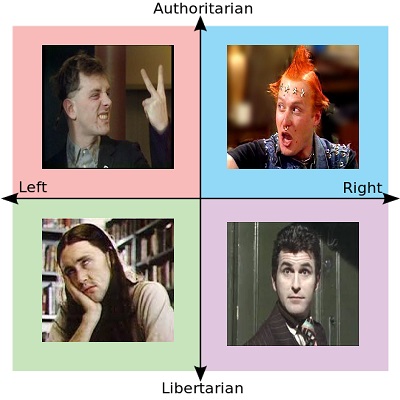
The most famous political chart puts everyone into one of four quadrants: authoritarian left and authoritarian right at the top, and libertarian left and libertarian right at the bottom. It’s fashionable to claim to be libertarian, but not everyone who does so really is. This essay looks at how to tell if you’re really a libertarian.

The political consensus of the Western World is still profoundly affected by the horrors of the authoritarian governments of the 20th century.

Authoritarian governments in the form of Nazism and Communism caused the deaths of some 150 million people, directly or indirectly, through a variety of wars and famines. These acts live on in infamy with names such as the Holocaust and Holodomor, the very mention of which summon images of starvation, misery and death.

Since then, it’s been extremely unfashionable to be authoritarian. But it’s still tempting – as tempting as it ever was. The thought that some ideas are not merely great, but so great that they have to be forced on the populace at gunpoint by a government that will kill its own citizens before it will compromise, is one that reoccurs throughout human history. All that’s necessary for it to actually become a reality is a sufficient degree of arrogance, or self-righteousness, on the part of the rulers.

Once a government has enough hubris – and whether they are left or right doesn’t matter here – they will start thinking that the lessons of history don’t apply to them, or that their actions are so righteous that human nature will change in recognition, or that they are uniquely talented and therefore can achieve things that no previous rulers could.

Once this stage is reached, it’s possible for the government to start doing things to people whether they want it or not, instead of helping them get things done in accordance with their own wills, and at that stage the government meets the definition of authoritarian. We have ideas so good they have to be compulsory! is the rallying-cry of the self-righteous authoritarian.

A person who is really a libertarian will stay committed to liberty no matter how tempting the proposal to abandon it might be. They therefore reject the idea that ideas can be so good that the government has to force them on people. Exceptions to this rule are only made in the gravest circumstances – never to try to make the world better, whether the justification be to “put order to things” or for “the greatest good”.

A person who is really a libertarian will reject proposals from both the left and the right if those proposals are too authoritarian, even if they have minor sympathies towards one of the two poles.

They will not (for example) only reject leftist authoritarian ideas, such as raising taxes or making a minority language compulsory for all school children, while accepting any and all right-wing authoritarian ideas, such as starting wars or drug prohibition.

A person who claims to be a left libertarian will happily criticise the left if it does authoritarian things. Many authoritarian leftists have been agitating to remove speaking rights from various conservatives (or even just people labelled “conservative” by the media), a process they refer to as “deplatforming”. This is blatantly authoritarian, so anyone supporting it on the grounds that it furthers leftist interests cannot also claim to be a libertarian.

Not even if they believe that the left is the side of liberty! Being an authoritarian under the guise that one’s authoritarianism ultimately serves libertarian ends is a fail. All psychopathic dictators claim this.

Likewise, a person who claims to be a right libertarian will genuinely be against crony capitalism and genuinely be against the political influence that large corporate interests exert on the legislation. They will refuse to complain only about taxation, and will also complain about corporate welfare and bailouts of inefficient companies.

Because authoritarianism is so unfashionable, many people will try and sneak authoritarian ideas into the discourse under the guise of them being either left or right. If the person they are speaking with is simple enough to equate either left or right eternally with libertarianism, then getting that person to oppose something is as simple as equating it with whichever of the left or right that person associates with authoritarianism.

The left does this with rhetoric about the need to make up for past injustices and for forced equality of outcome, and the right does this by stirring up fear of government and of minorities. Any person who is really a libertarian will reject all of this reasoning, and will remain steadfast to the belief that ideas should not be forced onto others, because justifying authoritarianism from either the left or the right will justify more of it from the other side as well.

*

If you enjoyed reading this essay, you can get a compilation of the Best VJMP Essays and Articles of 2017 from Amazon for Kindle or Amazon for CreateSpace (for international readers), or TradeMe (for Kiwis).


Writing Autism Spectrum Disorder

Autism has gone from being a little-known condition to being a condition that everyone is accused of having, autistic or not. However, just because everyone is aware of autism doesn’t mean that everything they think they know about the condition is accurate. This article looks at how to write believable and realistic characters with autism.

The most characteristic feature of autism is a pronounced difficulty with social interaction, usually coupled with an obsession with certain repeated actions. This difficulty with social interaction is enough to cause immense difficulty in the lives of some autists and the people around them. This goes beyond mere awkwardness, to a point where fundamental communication becomes difficult.

From the perspective of a person with autism, much of the difficulty about living with the conditions comes from an inability to make the intuitive understandings about other people, and their behaviour, that is usually taken for granted. A person without autism (a “neurotypical”) seems to have an almost psychic understanding of how other people think and behave. Social interaction just seems so effortless for such people.

Your protagonist might have difficulty getting along with someone who has autism, on account of that the autistic character doesn’t seem to understand what the protagonist believes to be the rules of social interaction. The protagonist might make jokes that don’t get laughed at, and come to think that the autistic character doesn’t like them, when the problem is a low level of communication.

Then again, your protagonist might get along with an autistic character just fine. Autists can make a lot of sense, in their own way. Often, a person with autism will be capable of observing human interaction without all the pretense and brainwashing, and can arrive at objective, if odd and unconventional, conclusions. These can sometimes be valuable wisdom (and they can sometimes be juvenile truisms).

Viewed from the outside, an autistic character might appear as excessively orderly, to the point of dysfunction. Autists often like to ritualise certain behaviours (much like Obsessive-Compulsive Disorder), to the point where not being able to perform the ritual sometimes creates unbearable anxiety. Their speech can be likewise regimented and repetitive. It’s common for them to compulsively stack objects or line them up.

Moreover, autists often feel solidarity with other neurodiverse people, and vice-versa. Autism is entirely different to, say, schizophrenia, but much of the lived experience of autism is similar to other mental conditions. The social rejection and the anxiety about more rejection, the anxiety, the shame, the frustration, the despair: these are all emotions that mentally ill people tend to experience more than others. An autist might relate strongly to someone who also feel them, even if that person is not autistic.

If your protagonist has autism themselves, you will have to be very careful about how you render their internal dialogue, should you write about them in the first person. A lot of fiction is poorly written because the characters in it have an unrealistically high level of understanding the behaviour of other people. An autistic protagonist will frequently be baffled by the behaviour they encounter. Much of their behaviour will be a complete mystery.

One of the most dramatic things about autism is the emotional consequences of the social difficulties that arise from having the condition. The awkwardness of autism is often mistaken by other people for malice, psychopathy, pedophilia, terrorist intent and all manner of other things. This makes life extremely difficult and can make for a harrowing story (unless your protagonist turns out to be a pedophile or terrorist).

It ought to be easy to engender sympathy from your reader here, because most people are sympathetic to the sense of injustice that comes from undeserved social rejection. Despite that, the other characters might feel like they have good reasons to reject the autistic character. After all, it is hard to tell the difference between social clumsiness and malice sometimes.

Because autism is a spectrum, there are many subclinical versions of it. A character with a subclinical level of autism will be relatable for many – after all, there is no person who has perfectly smooth social interactions all day every day. For them, their autism might be something that just makes life more colourful or interesting.

Autism can increase in severity all the way up to the point where a character with it will just about live in their own world, divorced from the concerns of most of the others. Realistically, a character with severe autism will have a hard time being a major character in your story because their degree of communication impairment will be so severe that no-one else will understand them. More moderate forms could involve a degree of social impairment that can be more or less overcome.

There is reason to believe that small amounts of autism can be helpful in certain occupational fields, especially those that pertain to the imposition of order upon chaos. Therefore, an autist need not be presented as conspicuously mentally ill. They might have found a niche that suits them perfectly, in some job that requires order to be imposed upon chaos. Mechanics and computer engineers are favourites.

*

This article is an excerpt from Writing With The DSM-V (Writing With Psychology Book 5), edited by Vince McLeod and due for release by VJM Publishing in the summer of 2018/19.

Writing Dissociative Identity Disorder

Once known as Multiple Personality Disorder, and known casually by some as “split personality”, Dissociative Identity Disorder (DID) is a condition characterised by more than one distinct personality in the same physical body. The disorder is one of the most misunderstood and mischararacterised of all psychiatric conditions. This article looks at how to write believable and non-cliched characters who have Dissociative Identity Disorder.

People who have DID don’t change personalities whimsically. It usually only happens in response to intense stress or emotional pressure. When it does, however, it can be frightening and confusing for the people who see it. A person who has “switched” personalities might indeed seem to be an entirely different person, with different facial expressions, a different gait, different body language and an entirely different way of talking. Their vibe might feel entirely different, and not just in the sense of a change of mood.

Like many of the conditions in this book, DID is believed to have origins in early childhood abuse. The currently prevailing theory is that particularly intense early childhood trauma can cause the mind to dissociate. If this is severe enough, this dissociation can lead to one part of the mind becoming almost quarantined from the others, as if to protect the whole.

For example, a child might receive such intense physical abuse that their personality splits into a regular child’s personality (or primary identity) and a second, much harder and meaner one, who comes about as an adaptation to the abuse. What this can lead to is a situation where the second personality comes out in stressful situations as if trying to “defend” the primary personality from further trauma and abuse. That second personality might be willing to make decisions and take measures that the first cannot countenance.

Characteristic of this condition is the inability for one persona to remember things that have been said to another persona. Because the various personas are complete personalities with their own set of memories, things that are understood by one persona are not necessarily understood by others. People with DID can also lose track of time very easily, on account of that time that passes for one personality doesn’t necessarily also pass for another.

If the protagonist of your story encounters a character with DID, their first clue might be observing signs of depression in that other character. People with DID commonly also have depression, partially on account of the difficulty of living with the condition, and partially as a result of early childhood trauma and abuse. Other conditions are commonly comorbid with DID, especially the other conditions that are believed to have origins in heavy childhood trauma, such as schizophrenia, borderline personality disorder, anorexia and bulimia.

Your protagonist might find it baffling how that the character with DID sometimes doesn’t remember what’s said to them. Even more baffling is that the character with DID will often react with anger if it is put to them that a certain subject had already been talked about. Your protagonist might conclude that the character with DID is on drugs of some kind, and they might feel like they have good reason to draw such a conclusion.

In other ways, your protagonist might have to tread carefully. The heavy childhood abuse that usually precedes the development of DID can make a character with the condition hard to deal with for reasons not directly related to it. For example, they might be paranoid, suspicious, vicious etc. before the effects of DID are accounted for. This might mean that your protagonist mistakes the separate personalities of a person with DID as them being dishonest. Your protagonist might feel that the character with DID is only pretending not to remember things.

If the protagonist of your story has DID themselves, then telling a story about them automatically becomes a challenge because it isn’t clear who is speaking in the first person and who is speaking in the third. Assuming that there’s a primary personality and a secondary one, the primary one might be the one that is written about in the first person. It’s possible to do both, but care has to be taken not to sound like you are retelling the story of Jekyll and Hyde.

Your protagonist’s encounters with other characters could become extremely difficult if the protagonist has this condition. They might find themselves confronted with repeated accusations of being two different people – an accusation which is, understandably, not simple to deal with. Neither are accusations of being on drugs, or being a bastard, or lying, or just being fucked-up – all things that a protagonist with DID might have to deal with from other characters.

DID is not schizophrenia, but it shares many things in common with schizophrenia. DID is believed to be the single most strongly correlated psychiatric condition with severe early childhood abuse and neglect, with schizophrenia closely behind. So a person with DID might have deep understanding of how schizophrenics think and operate, and may have gone through some parts of the schizophrenia spectrum themselves.

It’s worth noting here that attempting to get off a criminal charge by claiming that one has DID and that one’s alternate personality did the crime has virtually zero chance of success, and that even if it did succeed the consequences would probably entail involuntary psychiatric care every bit as unpleasant as going to prison. Juries and judges are wise to such simple tricks and it won’t succeed outside of an extraordinary setting.

*

This article is an excerpt from Writing With The DSM-V (Writing With Psychology Book 5), edited by Vince McLeod and due for release by VJM Publishing in the summer of 2018/19.