
Understanding New Zealand: Voting Patterns of High-Skill Occupations

The demographic of high-skill occupations breaks down into managers and professionals. The general rule, put crudely, is that managers like to vote National whereas professionals like to vote Green.

Working as a manager had a correlation of 0.56 with voting National in 2014, which was moderately strong and in line with what most people probably could have guessed.

The National Party exists to bring in laws that weaken the position of workers and make them easier to control, and this directly benefits the sort of person who works as a manager.

Predictably, then, there was a very strong negative correlation with being a manager and voting for the Labour Party – this was -0.75. After all, the Labour Party exists to oppose the National Party.

The only party apart from National to have a positive correlation with being a manager was the Conservatives. The correlation between voting Conservative in 2014 and being a manager was 0.31.

Even though it is also a right-wing party, the correlation betwen voting ACT in 2014 and being a manager was not significant, at 0.06. This may be because their love of neoliberalism is too radical for the average manager – who is fairly elderly – to handle.

Some might be surprised that the correlations between being a manager and voting for the Maori-heavy parties are not negatively significant. The correlation between being a manager and voting New Zealand First in 2014 was -0.06; with voting Aotearoa Legalise Cannabis Party it was -0.05; with voting Internet MANA it was -0.17 and with voting Maori Party it was -0.14.

The reason for this surprising set of correlations is that Maoris who live to be in the age bracket from which most managers come are not significantly less likely to become one than a European New Zealander who lives to the same age. But because the bulk of Maoris are much younger than non-Maoris, proportionately fewer of them are in that age bracket, and the young ones like to vote Labour.

Working in a professional occupation had a correlation of 0.73 with voting Green in 2014. This fits with the fact that highly educated people in general like to vote Green.

The party that the professional class was most opposed to was not Labour but New Zealand First. The correlation between working as a professional and voting New Zealand First was -0.58.

This was in striking contrast to the other Maori-heavy parties. The correlation between working as a professional and voting for the Maori Party was -0.12; with voting for Internet MANA it was -0.07; and even with voting for the Aotearoa Legalise Cannabis Party – hardly a favoured cause of the sort of person driven enough to become a professional – it was only -0.25.

There exists a genuine antipathy between Green and New Zealand First voters, and this is exposed most evidently when the voting patterns of professionals are examined.

For the sort of person who becomes a professional, things like freedom of movement are paramount (as they often are for people with higher levels of human capital than financial capital). This means that their values naturally align with the Green Party.

The average New Zealand First voter is characterised by their low level of education, and consequently their low level of human capital. For a person with a low level of human capital, who usually ends up a member of the low-skilled occupations, freedom of movement is a danger because it exposes their low-skilled niche in the market to greater competition.

Green voters have this problem less often because people with professional educations do not have to compete for employment opportunities as a general rule. In fact, professional occupations are almost permanently on the New Zealand skilled shortages list and consequently people with professional educations can go straight into the immigration fast lane.

Freedom of movement is an opportunity for these people because it broadens the potential employer pool.

Both managers and professionals had a significantly higher turnout rate. For managers the correlation with turnout rate in the 2014 General Election was 0.38 and for professionals it was 0.28. These correlations reflect that fact that people in highly skilled occupations tend to be strongly enfranchised and engaged with the system.

*

This article is an excerpt from Understanding New Zealand, by Dan McGlashan, published by VJM Publishing in the winter of 2017.
Understanding New Zealand: Voting Patterns of Maoris

One of the least surprising statistics in this entire study is that there is an extremely strong positive correlation between being Maori and voting for the Maori Party – this was 0.91. What might surprise some people, though, is the strength of the correlation with other parties.

The correlation between being Maori and voting for the Aotearoa Legalise Cannabis Party was 0.89, almost as strong as for voting for the Maori Party. This is because Maoris are greatly adversely affected by the cannabis laws, which are a major contributor to their disadvantaged position.

Because Maoris are more likely than non-Maoris to be arrested for cannabis offences, less likely to be offered diversion for those offences, more likely to stand trial for them, more likely to be given a custodial sentence for them and because they get longer average custodial sentences upon conviction for cannabis offences, there are plenty of reasons for Maoris to vote for the ALCP.

The correlation between being Maori and voting Internet MANA was 0.84, also very strong, but not quite as strong as the above two, perhaps because Internet MANA, despite mostly targeting its rhetoric to disadvantaged Maoris and Pacific Islanders, also appealed to a high-tech young Pakeha and Asian demographic.

Between being Maori and voting New Zealand First the correlation was 0.66, which is a reflection mostly of how well this party does in the Maori electorates, where they regularly score more than 10% of the party vote. It also reflects the degree – surprising to many – that nationalist sentiments exist among Maoris.

Another unsurprising statistic is the strength of the relationship between being Maori and voting for the National Party in 2014 – this was -0.75. Curiously, this figure of -0.75 was also the degree of correlation between being Maori and turnout rate in 2014. Perhaps it reflects the degree of Maori disenfranchisement from the political system.

Neither it is surprising that Maoris do not like to vote for far-right parties. The correlation between being Maori and voting Conservative in 2014 was -0.53, and with voting ACT in 2014 it was -0.42. This is probably a function of culture, in that Maoris are very unlikely to vote for parties that put money above people.

Interestingly, the correlation between being Maori and voting for the Green Party in 2014 was not significant (-0.09), despite the fact that Green voters are significantly wealthier than average and Maoris considerably poorer. This was the only party to have no significant correlation in either direction between voting for them in 2014 and being Maori.

This reflects the fact that Maoris with middle class pretensions vote Green well before they vote National, and that many Maoris are young and so in the student demographic that heavily votes Green.

*

This article is an excerpt from Understanding New Zealand, by Dan McGlashan, published by VJM Publishing in the winter of 2017.
Understanding New Zealand: Voting Patterns of Labour Force Status

This is a very interesting category because here it is the Greens and ACT that represent the centre, and Labour and National that represent the extremes.

At the employed end, there is the National Party. Being unemployed (i.e. not in the labour force) had a correlation of -0.86 with voting for the National Party in 2014. This is not at all surprising to anyone who can remember the attitude of the Bolger-Richardson-Shipley Government towards beneficiaries in the 1990s.

At first glance it might seem odd that the correlation between working part-time and voting National in 2014 (0.39) is stronger than the correlation between working full-time and voting National in 2014 (0.25). But this can be easily explained by the third factor of age.

New Zealanders don’t tend to work full-time until they completely retire. The usual patterns appears to be working full-time until about age 50 or 55, and then working part-time for a number of years, and only then retiring.

So although Kiwis working part-time have less of an income than those working full-time, this doesn’t make them vote National less because most part-time workers are elderly, and thereby more conservative.

This is reflected in mirror form with the Labour votes. The correlation between working full-time and voting Labour in 2014 (-0.31) was also much weaker than the correlation between working part-time and voting for that party in 2014 (-0.65). And predictably, the correlation between being unemployed and voting Labour in 2014 was a very strong 0.72.

This is mostly a function of the fact that Labour voters are considerably younger on average and – as discussed above – consequently more likely to be working full-time than part-time (although still less likely to be working full-time than National voters).

The patterns of labour force status for New Zealand First voters reflected the somewhat bifurcated nature of this party’s constituency. Not only was there a moderately strong negative correlation between working full-time and voting New Zealand First (-0.43), but there was also a moderately strong positive correlation between being unemployed and voting New Zealand First (0.44).

This reflects that New Zealand First support comes chiefly from people too old to be employed and from Maoris who are generally young enough to be in the most likely age brackets for full-time employment.

These same patterns express themselves in the patterns of labour force status for Green Party voters. Because the average Green voter is middle aged and middle class, they are in some ways like National voters. The correlation between working full-time and voting Green in 2014 was 0.32, and the correlation between working part-time and voting Green in 2014 was 0.26.

In that regard, Green voters are very similar to National voters. The major way in which they differ is the proportion of voters who are unemployed. The correlation between not being in the labour force and voting Green in 2014 was -0.07, which is not significant. The main reason for this is the number of young trendy people who vote Green but do not have jobs – almost none of this sort of person votes National.

This meant that the Green Party was, unusually, closer to the New Zealand centre than either Labour or National, assuming the centre to be defined by labour force status. This was also true, even more unusually, of the ACT Party, for which none of the correlations between voting for them in 2014 and any of the three categories of labour force participation were more than marginally significant.

The voting patterns for the other three Maori-heavy parties generally reflected the fact that Maoris are much more likely to not be in the labour force compared to other Kiwis. The correlations between being unemployed and voting for a given party in 2014 were 0.76 for the Maori Party, 0.75 for Internet MANA and 0.62 for the Aotearoa Legalise Cannabis Party.

None of those three parties, however, had a significant negative correlation with being in the labour force, not for either full-time or for part-time work. This reflects the fact that, although the average Maori is more likely to be on the unemployment benefit, they are much less likely to be on the pension, and so their overall rate of absence from the labour force is not much different to the rate of non-Maori absence.

The correlations between voting for the Conservatives in 2014 and a given labour force status were -0.12 for working full-time, 0.29 for working part-time and -0.69 for being unemployed. These are all similar, but weaker, than the correlations for the National Party, which reflects the general fact that the Conservative Party appeals to the least educated segment of National voters.

Finally – and predictably – the turnout rate strongly reflected the degree to which labour force status reflected general disenfranchisement from society. There was a very strong negative correlation between turnout rate in the 2014 General Election and being unemployed – this was -0.82.

The correlation between turnout rate in 2014 and working full-time (0.24) was not as strong as that for working part-time (0.45), which probably reflects the fact that many full-time workers are actually doing worse than the semi-retired elderly who often work part-time and who often have investment income.

*

This article is an excerpt from Understanding New Zealand, by Dan McGlashan, published by VJM Publishing in the winter of 2017.

Cannabis Cowardice is Punishing Andrew Little in the Preferred PM Stakes

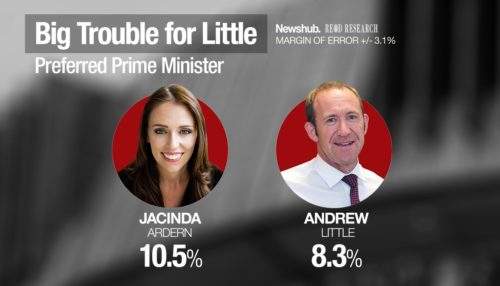
Andrew Little has been the Labour Party leader since 2014, and has struggled so far to gain much traction with prospective Labour voters. A recent poll brought some very bad news for him – namely that he has now fallen behind his deputy Jacinda Ardern in the preferred Prime Minister stakes.

No doubt the Labour Leader will have a team of pollsters working overtime ringing people up to ask why they’re not interested. However, they won’t ask the large numbers of Kiwis who are disenfranchised from the political and economic systems – and this is supposed to be Labour’s constituency and is the key to their recent failure.

These disenfranchised people are mostly the young, the invalid’s beneficiaries and Maori. These three groups will all tell you that they are crying out for a change to New Zealand’s cannabis laws.

The young are crying out for a recreational alternative to alcohol. All young people have had the unpleasant experience of watching people in their parents’ generation destroy themselves with alcohol, while noting that people who preferred cannabis generally had a much better time of things.

Invalid’s beneficiaries are crying out for medicinal relief for their suffering. Huge numbers of invalid’s beneficiaries in New Zealand have found that cannabis is a better medicine for alleviating the suffering that comes with their condition than the pharmaceutical alternatives.

They will point that since medicinal cannabis is now legal in 28 states of the USA there’s no continuing to deny that it is a medicine.

Maori are probably the group worst brutalised by cannabis prohibition, for a number of reasons. The foremost is the lack of genetic resistance to alcoholism that has seen so many Maori come to prefer cannabis as a recreational alternative to cannabis.

Not only Maori – there are many, many New Zealanders whose close family history has a detailed history of either alcoholism or violence related to drinking. All of these people are desperate for a recreational alternative to booze.

Andrew Little’s refusal to even consider a 21st century approach to the cannabis laws is causing him to bleed support among all of the Labour Party’s major demographics – all of which are crying out for some kind of cannabis law reform.

On the cannabis issue, Little appears to hover somewhere between cowardice and supporting a National party-style prohibition. This hits hard against exactly those sort of people who like to vote Labour.

As has been described in an excerpt to Dan McGlashan’s upcoming book Understanding New Zealand, the sort of person who votes Labour is the same sort of person who is likely to be adversely affected by the country’s cannabis laws.

The correlation between median age and voting for the Aotearoa Legalise Cannabis Party in 2014 was -0.55, which tells us that the bulk of ALCP voters were young. The correlation between median age and voting for the Labour Party was -0.70, so that tells us that Labour and the ALCP are competing for the same voters to a large extent.

The correlation between being on the invalid’s benefit and voting for the ALCP in 2014 was a very strong 0.76. This is because many, if not most, people on an invalid’s benefit would be greatly helped by any change to the law that made cannabis more readily available.

Finally, the correlation between being Maori and voting for the ALCP in 2014 was a whopping 0.89. This is not at all surprising considering that Maori suffer by far the worst of the abuse from cannabis prohibition. This is enough to suggest that a mature, intelligent cannabis law reform policy would attract masses of Maori voters.

All three of these groups also have very strong correlations with not voting at all in 2014 – because of the total failure of any of the mainstream political options to represent their needs.

What this tells us is that there are legions of disaffected, disenfranchised New Zealanders who will not support the Labour Party as long as it has a leader who is too timid to support a definitive change to the country’s cannabis laws.

Going by the large numbers of young, sick and Maori non-voters who are desperate for a change, we can predict that the Labour Party will lose the General Election this year unless it adopts an intelligent, modern, compassionate cannabis law reform policy.