
Could Fuel Tax Riots Come to New Zealand?

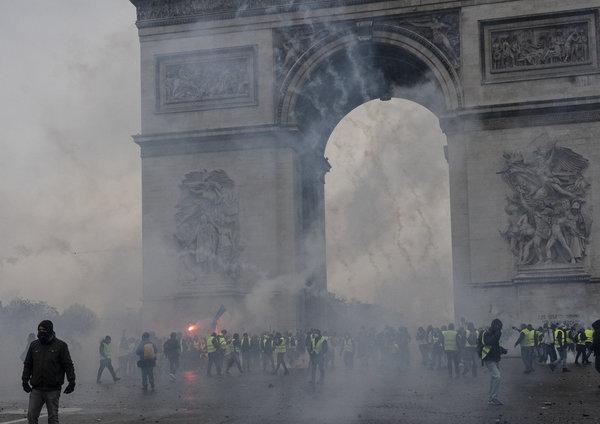
Europe is caught in its heaviest protests since 1968. Ostensibly as a result of fuel taxes, they have become so large that in France some are concerned they may lead to a nationalist revolution, and French President Emmanuel Macron is rumoured to have given orders to send in tanks to quell any unrest this coming weekend. However, there’s more to the story than this – and the reality suggests that these protests might come to New Zealand.

France is a heavily taxed nation – government spending is 56.6% of GDP, compared to 37.4% in America and 48% in New Zealand. This has long been accepted by the French people, because of their high levels of social trust and solidarity, but the whole system is dependent on the will of the average Frenchman to pay into it. The Frenchmen paying taxes were happy to do so because they believed that this tax money was going to help people like them, but this is no longer the case.

Fuel taxes are something that particularly affect working-class white French people, to the benefit of the middle class and the underclass who live in the big cities. People who live in big cities can take public transport or taxis, and in any case don’t have to drive far. Working-class people who have to commute to work often have to drive from small villages or towns to a city somewhere else, sometimes twice every day, and so become heavily affected by any rise in the fuel price.

A large proportion of the New Zealand population still lives rurally or semi-rurally. There is a commonly-cited statistic that suggests that New Zealand is one of the most urbanised countries in the world, but what this statistic ignores is that our cities are exceptionally sprawling by world standards. So even people who live in cities have to drive a lot as part of everyday life.

Dan McGlashan showed in Understanding New Zealand that this rural population is much more likely to own cars and to drive to work than to walk or to take public transport. Buses are not an option for the majority of New Zealand’s rural dwellers. There’s more to it than just this, however. These fuel taxes would come as another burden to what is an already heavily discontented working-class rural population, who already feel that the cities are benefitting from the current order at their expense.

If Jacinda Ardern and the Labour Party go through with their plans to raise the refugee quota at the same time as raising petrol taxes for the sake of fighting global climate change (or whatever the excuse is), they run the risk of fostering the same kind of discontent that has now erupted in Europe. Although they will deny the connection, the perception will rise among the rural working class that they are being taxed through fuel to pay for the importation of refugees that they didn’t want.

For a working-class white person who already has to see middle-class brown people promoted ahead of him on account of their skin colour, or winning scholarships that he cannot apply for on account of his skin colour, things like fuel taxes are an extra kick in the guts. Despite the attempts of the mainstream media to spin the French protesters as insane anarchists, hooligans and neo-Nazis, the fact is that they belong to the same group of normal, everyday people who have lost out from neoliberalism all over the West.

We already saw some small protests in New Zealand two months ago when the petrol price crept up to $2.40 per litre. As the article linked to in the previous sentence suggests, the Government plans to raise the excise tax on petrol by another 7c over the next two years, primarily to pay for infrastructure projects in Auckland.

This means that the neoliberal Government of Jacinda Ardern is potentially making the same mistakes as the neoliberal Government of Emmanuel Macron.

The Sixth Labour Government certainly seems like it’s willing to raise petrol taxes on the New Zealand rural poor to pay for things like doubling the refugee quota, and for Auckland infrastructure projects that most New Zealanders will see no benefit from. Should this cause the petrol price to get up to $2.40 again – or even higher – then the stage is set for fuel price riots to come to New Zealand as well.

*

If you enjoyed reading this essay, you can get a compilation of the Best VJMP Essays and Articles of 2017 from Amazon for Kindle or Amazon for CreateSpace (for international readers), or TradeMe (for Kiwis).

VJMP Reads: Ted Kaczynski’s Unabomber Manifesto V

This reading carries on from here.

The next chapter in Industrial Society and Its Future is ‘Control of Human Behaviour’. Having established that invasive control of human behaviour was inevitable given a high enough level of technology within a society, Kaczynski now turns to the question of how that behaviour is controlled.

Pressures to control human behaviour have arisen from the beginning of civilisation. When civilisations try to control people so tightly that those people go beyond the limits of their endurance and collapse, then that society will also collapse. Human nature therefore limited the development of human society, but technology threatens to change this by making it possible to change humans.

The passage “Imagine a society that subjects people to conditions that make them terribly unhappy, then gives them drugs to take away their unhappiness. Science fiction?” reads as extremely prescient for 1995. Kaczynski was writing at the start of the Prozac wave, but the trend has worsened severely, with as many as a quarter of some populations on a psychiatric drug at any one point in time. It can be said, therefore, that he predicted the current state of widespread dismay and despair.

Psychiatric drugs are not so much medicines as they are ways of postponing the collapse of society. “In effect, antidepressants are a means of modifying an individual’s internal state in such a way as to enable him to tolerate social conditions that he would otherwise find intolerable.” With a strong sense of irony, Kaczynski notes that the system is often doing the individual a favour when it brainwashes him into submission, because the alternative is destruction. Likewise, the definition of “child abuse” changes depending on which childrearing techniques produce results the system wants, and which do not.

The social disruption we see today is the result of what the system has done to people. This can lead to a totalitarianism that arrives after a number of steps, each one an apparently necessary reaction to a social problem, often with a humanitarian justification. We will probably have to contend with widespread genetic engineering for this reason. The system tends to regard as a “sickness” any mode of behaviour that is inconvenient for it, and therefore that manipulating people to fit in is a “cure”.

In ‘Human Race At A Crossroads’, Kaczynski points out that the system is not in control over everyone. Although it has total control over those who could be termed ‘bourgeois’, there are still many different kinds of disaffected rebel groups. The main concern of the system is to make these people docile so that they can no longer threaten. With this achieved, technology can then expand to take over everything on Earth. Human resistance will be impotent.

A total collapse of the technological system would give humanity the chance to start again. Kaczynski concludes that those who hate the industrial-technological system have two major duties: the first to increase the stresses within the technological system so as to hasten its collapse, the second to develop an alternative ideology that can serve to order a new world when it does.

The last chapter in this section is ‘Human Suffering’. Kaczynski was able to note, even in 1995, that the world’s population has become overblown on account of the technological system, and a collapse of the system would shortly be followed by a collapse in that population. This might entail much suffering in the short term, but this is less than the suffering that would arise if the system was allowed to grow even bigger. In any case, some consider dignity and freedom more important than merely avoiding suffering.

It is far from clear that the collapse of the industrial system would lead to less suffering anyway. Technology has meant that natural controls on population have been removed, which has resulted in a population explosion and all the suffering ensuing from that. Our relationship to Nature has been destroyed, and this is before we account for the effects of future problems like climate change.

Technophiles are unwilling to admit that when a technology comes and makes great changes to a society, this results in many other changes further down the line. For instance, agricultural advances that solve the problem of poverty merely lead to overpopulation, which leads to new problems of stress and aggression. This is an easily predictable problem, and there are many, many others that are not as predictable.

*

If you enjoyed reading this essay, you can get a compilation of the Best VJMP Essays and Articles of 2017 from Amazon for Kindle or Amazon for CreateSpace (for international readers), or TradeMe (for Kiwis).
VJMP Reads: Ted Kaczynski’s Unabomber Manifesto IV

This reading carries on from here.

The next chapter in Industrial Society and Its Future is ‘Restriction of Freedom is Unavoidable in Industrial Society’. Here Kaczynski expounds at length what appears to be the central thesis of the manifesto.

Modern man is strapped down by a number of rules and regulations that have been laid down on him by faceless people far away and who he cannot hope to influence. Kaczynski contends that this is not because bureaucrats are malicious or because the system is yet to be perfected – this is the nature of technological society. Generally speaking, our lives have to be closely regulated by large organisations in order for society to function. Human lives have to be modified to fit the system.

This close regulation happens even to children. The system needs people educated in a particular manner in order to run its machines, and so children have to be forced to study things that they don’t really care about. This social pressure creates a lot of dysfunction in the form of dropouts and mentally ill people. The system uses propaganda to try to induce people to want what the system is doing to them. This is a complicated and dishonest process.

In ‘The Bad Parts of Technology Cannot Be Separated From the Good Parts’ Kaczynski argues that technology is a double-edged sword. Not only does advanced medical treatment require an entire industrial society to maintain, but it also removes the natural selection pressure that is, in many ways, keeping the human race healthy. The only solution to this is either eugenics or massive genetic engineering. Kaczynski contends that this genetic engineering is inevitable owing to the good things it promises.

The next chapter is ‘Technology is a More Powerful Social Force Than the Aspiration For Freedom’. Freedom is continually forced to compromise to technology, and after many repeated instances of this, all freedom is gone. The motor vehicle is a great example: when first introduced, they took no freedom away from the walking man, but society has been forced to adapt to accommodate them, and now walking in many places is impossible. Moreover, regulations such as driver’s licences and insurance have tied people down.

New technology changes society in a way that people are forced to use it. Each new advance, taken by itself, is desirable, but the cumulative effect is to lose freedom to people far away. Technology always advances, but can never be rolled back without a collapse of the system. This means that reform is impossible, which in turn means that any resisters effectively have to be revolutionaries. History shows that social arrangements are temporary, but technological advances are more or less permanent.

The last two chapters in this section are ‘Simpler Social Problems Have Proved Intractable’ and ‘Revolution is Easier than Reform’. These contain a summary of the main statements made so far. Humans have proven themselves incapable of dealing with much easier problems than resisting technology, and therefore cannot succeed without a revolution that destroys the entire industrial system. Kaczynski points out here that we have already left massive environmental problems to our grandchildren merely for the sake of convenience now.

Revolution will not be as difficult as it seems, because the prospect of revolution is capable of inspiring powerful emotions in people. By contrast, the prospect of reform can only inspire lukewarm emotions at best. It is not necessary for a majority of people to become revolutionaries, just enough so that the system is incapacitated.

*

If you enjoyed reading this essay, you can get a compilation of the Best VJMP Essays and Articles of 2017 from Amazon for Kindle or Amazon for CreateSpace (for international readers), or TradeMe (for Kiwis).

VJMP Reads: Ted Kaczynski’s Unabomber Manifesto III

This reading carries on from here.

The next chapter in Industrial Society and Its Future is ‘How Some People Adjust’, namely, how people adjust to industrial society.

The first thing that Kaczynski points out is that people naturally differ with regards to their drive for power. They also vary with regards to susceptibility to marketing and advertising techniques. These people can never be satisfied, because they will always want something else. These desires add to the collective frustration. Adding to this frustration are the wide range of instincts that our oversocialisation causes us to repress.

Other people adjust by joining a political organisation and adopting its goals, because they find satisfaction when some of those goals are achieved. By this method can their desire to partake in the power process be satisfied. Many people experience the power process vicariously through the actions of these larger political movements. On top of this are a variety of surrogate activities, but for the majority of people the desire to experience power goes unfulfilled.

In a section on ‘The Motives of Scientists’, Kaczynski dismisses the idea that scientists are driven by curiosity. Neither are they driven to benefit humanity necessarily, because some subjects (archaeology and comparative linguistics given as examples) are of no benefit to humanity at all. In reality, most scientists are simply motivated by going through the power process by way of scientific endeavour as a surrogate activity. As a result, science itself has become like a destructive juggernaut.

In ‘The Nature of Freedom’, Kaczynski defines freedom as the ability to participate in the power process to achieve real (not surrogate) goals, and without supervision or control by any outside agency. “Freedom means having power; not the power to control other people but the power to control the circumstances of one’s own life.” One does not have freedom if another entity has power over one – having permission to do something is not the same as having the freedom to do it.

We don’t actually have much freedom, because in practice freedom is a function of the economic and technological structure of a society, and not by its laws. A lack of technology makes people more free, because it makes it more difficult for the ruler to enact their will. The press is not freeing because it is tied to major media enterprises, who dominate the informational space through sheer volume. Frighteningly, our freedom is restricted, to a large part, on controls that work on our subconscious.

Kaczynski lays out some of his theory in ‘Some Principles of History’. He considers history to be a function of two subfunctions, one which is erratic and almost random, the other composed of long-term trends. Here he is concerned with the long-term trends. Outlining five basic principles of history, Kaczynski asserts that any chance large enough to change a long-term trend will also change the nature of society, and in unpredictable ways.

New societies cannot just be laid out on paper and expected to function. This is because they are too complex. The economy, the environment and human behaviour are all interdependent, and changes to any one will create changes in the others. Relating to this is the principle that people do not choose the nature of their own societies – this is something that evolves over time, and is not under rational human control.

This is the theoretical basis for his contention that industrial society inevitably will take away more and more of our freedoms. This is the argument in ‘Industrial-Technological Society Cannot Be Reformed’. Resistance is futile – as long as the general trend is towards more technology, the general trend will be towards less freedom. The sentence “It seems highly improbable that any way of changing society could be found that would reconcile freedom with modern technology,” suggests that Kaczynski saw us on a crash course with a technodystopia.

*

If you enjoyed reading this essay, you can get a compilation of the Best VJMP Essays and Articles of 2017 from Amazon for Kindle or Amazon for CreateSpace (for international readers), or TradeMe (for Kiwis).