The Basics Of The Alchemy Of Character Development

Westerners are used to thinking in material terms, and we take the same approach to writing fiction. We tend to think our of characters as primarily material beings, who are challenged by emotions that are themselves evolutionary adaptations to survival challenges. As such, the life of a fictional character is mostly about the neurotransmitters that flow through their brain.

The fundamental viewpoint promoted by this book, instead, is that of viewing one’s characters as primarily frequencies – namely, the frequency of their consciousness. The higher a character’s frequency of consciousness, the lighter their soul, and vice-versa.

In this book, it will be explained, a character’s frequency of consciousness is the most important thing about them. It is the driving force that impels them to take action. It is the fundamental explanatory force that makes sense of the character’s station of birth, his basic motivations, intentions and aspirations.

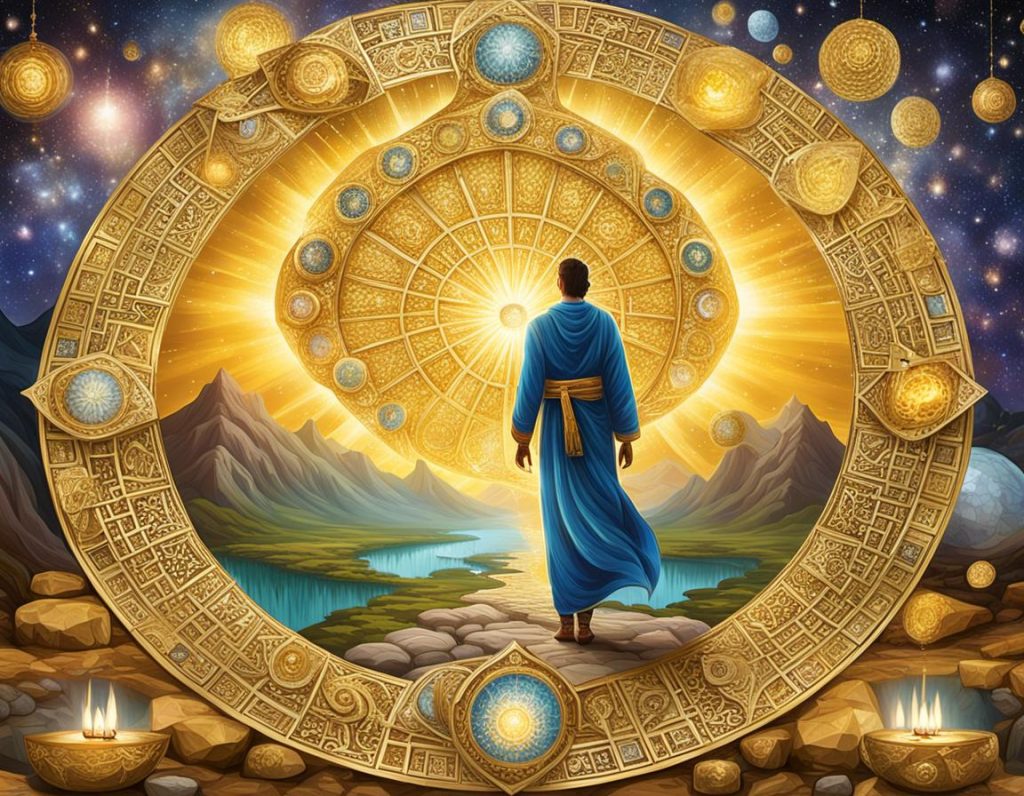
Herein it is assumed that the reader understands the truth of the phrase ‘turn lead into gold’: namely that this phrase does not refer to physical lead and physical gold, but rather to the transmution of the soul, from spiritual lead to spiritual gold. The true alchemist is not interested in mere material wealth, but in much subtler forms of wealth. This includes the treasures of the world beyond as well as the more sublime emotions here on Earth.

To make a truly interesting story, the main character’s frequency of consciousness has to change. This tends to make for a gratifying reader experience, as long as the reader can identify with that main character. By the end of a good story, the reader ought to have an appreciation for the development that protagonist has undergone to make them what they now are.

In the most typical character arc, a low frequency of consciousness is transmuted into a higher one. This is the typical heroic character arc beloved of stories going all the way back to The Epic Of Gilgamesh. Gilgamesh begins his story as a low-frequency hedonist, and ends it as a high-frequency man of his people.

Countless tales follow this same pattern. The protagonist begins the story as a more-or-less normal person, and, through various trials and tribulations, they become something special – stronger, smarter, wiser, better than before. It’s what Joseph Campbell called the Hero’s Journey and it’s been known about since the oral traditions that predated literature.

This character arc is very common, however, so skillful authors like to throw some twists into the story. Sometimes the protagonist has to lose to make the story interesting. As such, the development of a character’s frequency throughout the course of a story doesn’t usually follow a linear upwards progression.

The basics of the alchemy of character development, as described in this book, are the basics of telling an interesting story. It’s all about alchemy – and hence this book is all about alchemy too. The logic is that the Hero’s Journey is primarily an alchemical journey, and that the joy the reader gets from a story primarily comes from the alchemy of character development, and the ups and downs of that development over the course of that story.

There are three main parts to this book.

The first explains the Mithraic Ladder, and its seven steps. The Mithraic Ladder is the axis along which alchemical development occurs. The bottommost step is lead, and the alchemist ascends through tin, iron, copper, silver and mercury to reach the top step, which is gold.

The second explains how a character can move up from one step to the one above. This is keeping in accordance with the principle that people like to read about main characters who overcome challenges and transform themselves while doing so.

The third explains how a character can move down from one step to the one below. This is in keeping with the principle that stories of linear progression are not very interesting, and so readers prefer stories in which the protagonist suffers setbacks, withdrawing temporarily so that they can rise again (or even descend further, in the case of tragedies).

The totality of this book is about how a writer can understand the Hero’s Journey from an alchemical perspective.

*

This is an excerpt from Vince McLeod’s The Alchemy of Character Development, the sixth book in VJM Publishing’s Writing With Psychology series. This book will show you how to use alchemy to create deep, realistic and engaging characters for your creative fiction.

*

If you enjoyed reading this piece, buy a compilation of our best pieces from previous years!

Best VJMP Essays and Articles of 2023
Best VJMP Essays and Articles of 2022
Best VJMP Essays and Articles of 2021
Best VJMP Essays and Articles of 2020
Best VJMP Essays and Articles of 2019
Best VJMP Essays and Articles of 2018
Best VJMP Essays and Articles of 2017

*

If you would like to support our work in other ways, make a donation to our Paypal! Even better, buy any one of our books!
The Four Elemental Spiritual Forces

Various physical theories exist to explain the phenomena of the natural world. Far fewer theories exist to explain the phenomena of the spiritual world. This very basic essay seeks to explain the four elemental spiritual forces that operate on people’s lives.

This essay contends that there are two factors of utmost importance when it comes to determining the true nature of any spiritual force.

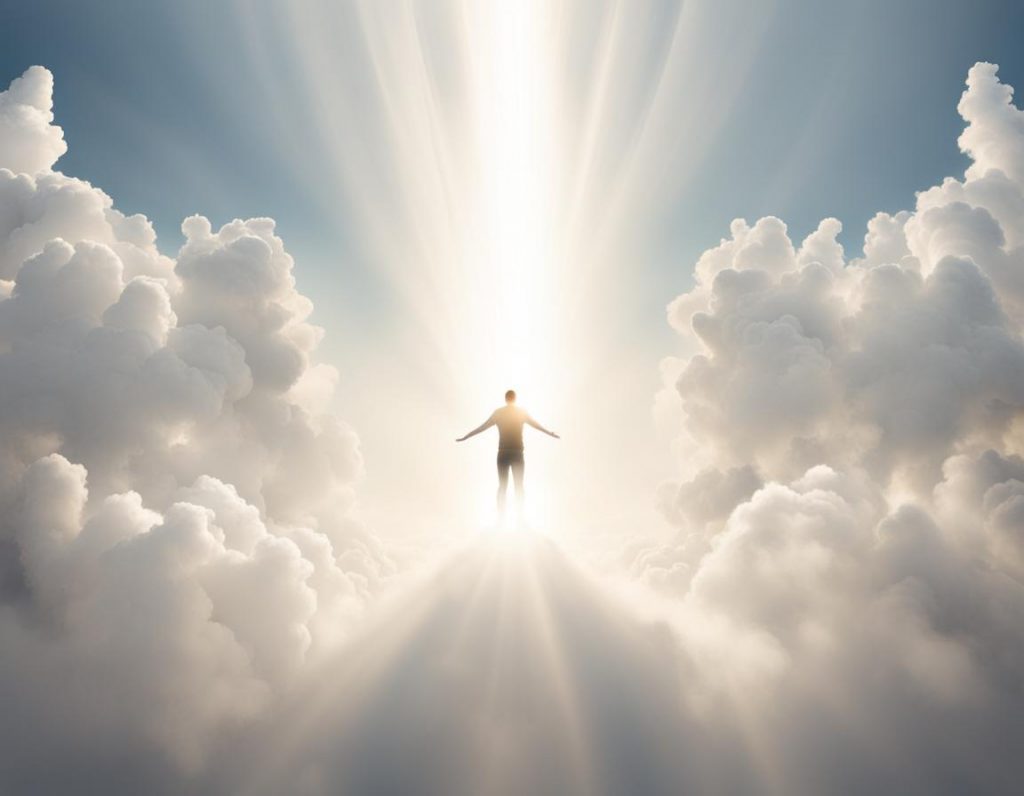
The first is whether the force causes a person to raise the frequency of their consciousness or to lower the frequency of their consciousness. Forces that raise the frequency of consciousness cause a person to act more like Socrates. Forces that lower the frequency of consciousness cause a person to act more like a wild beast.

The second is whether the force comes from an internal or an external energy. It’s not quite as simple as saying that internal forces come from the soul and external forces are material. This is because there are spiritual forces outside of oneself, on account that all of us are a fragment of consciousness that God cast into the Great Fractal for the sake of entertainment.

The best kind of spiritual force is that which rises up from within. This is also the hardest to harness. In principle, there are two major ways that a person can generate a spiritual force within themselves that takes them to a higher place. The first is meditation and the second is spiritual sacrament use.

Meditation works as a kind of alchemy, through which a dumb animal that identifies with its body transmutes itself into a fragment of consciousness that sees the body as something subordinate to its true essence. As the Bhagavad Gita states: “the self is not killed when the body is killed.” Through meditation one can distinguish the true self from the false self.

Spiritual sacrament use is also a kind of alchemy, only it’s more like being struck by lightning. With judicious psychedelic use it’s possible to transmute one’s soul from that of a beaten-down wretch to that of an angel of the Sun. ‘Psychedelic’ means ‘soul-revealing’, and many atheists have been transformed into spiritual people through a dose of psilocybin, mescaline or LSD.

Another positive spiritual force is that which pulls up from above. This is when a person is able to draw inspiration to raise their frequency from their environment. Sometimes climbing a mountain can lead to the sense of awe that leads people to believe in divinity. Others have drawn such inspiration from great works of art or architecture.

Being pulled up from above does not necessarily mean that God pulls people back to Godself. As mentioned elsewhere, the Will of God is to entertain the gods. Life is not a matter of learning or overcoming anything (if it was, God would have created us already learned). But the gods can be entertained by watching humans otherwise lost in the darkness becoming able to “see the light” and become spiritual.

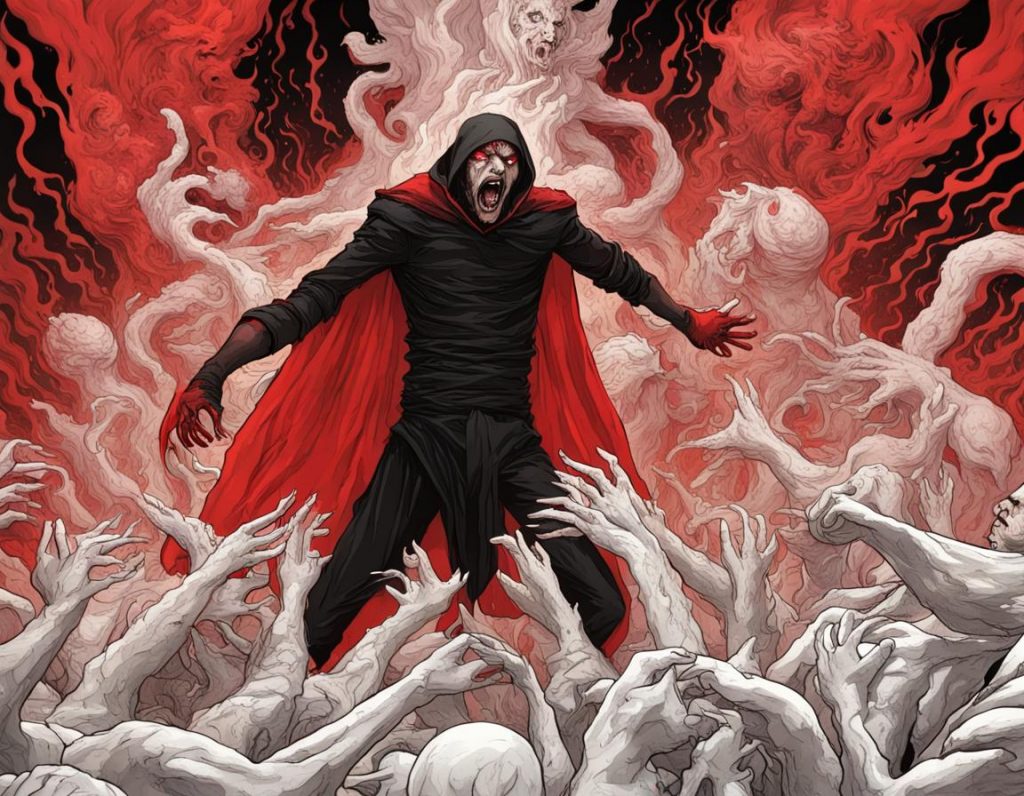
The most dangerous force is that which sinks down from within. This happens when a person gives in to their bestial impulses. The soul takes on a lower frequency when a person chooses to act like a lower animal. It becomes darker and heavier. The face of the person often transfigures to reflect the inner nastiness.

Contrary to the usual Abrahamic moralising, sinking down because of inner factors is not necessarily a bad thing. The most important thing is to entertain the gods. Therefore, it might be correct on some occasions to indulge in the sloth, gluttony or lust of the lower frequencies. However, people should always be aware that, in so indulging, they are playing with danger.

The fourth force is that which pulls down from below. This is described in various ways. Some call it the Matrix, some the Control System, others Angra Mainyu. It consists primarily of threats and terrors. In principle, anything that depresses, demoralises, horrifies or humilates will pull a person’s frequency of consciousness down towards the bestial level.

In our unfortunate modern lives, where we are materially blessed and spiritually impoverished, almost the entire political establishment can be described as a spiritual force that rips people down. As readers of 1984 will know, the control system is incentivised to make the population suffer because suffering makes them easier to control.

Mastery of these forces means that one can rise up the Great Masculine Axis at will.

Failure to master these forces will mean that one gets dragged back and forth through the Great Fractal by powers beyond one’s comprehension.

*

For more of VJM’s ideas, see his work on other platforms!
For even more of VJM’s ideas, buy one of his books!

*

If you enjoyed reading this essay/article, you can get a compilation of the Best VJMP Essays and Articles from 2021 from Amazon as a Kindle ebook or paperback. Compilations of the Best VJMP Essays and Articles of 2020, the Best VJMP Essays and Articles of 2019, the Best VJMP Essays and Articles of 2018 and the Best VJMP Essays and Articles of 2017 are also available.

*

If you would like to support our work in other ways, subscribe to our SubscribeStar fund, or make a donation to our Paypal! Even better, buy any one of our books!
The Seven Alchemical Ages Of Man

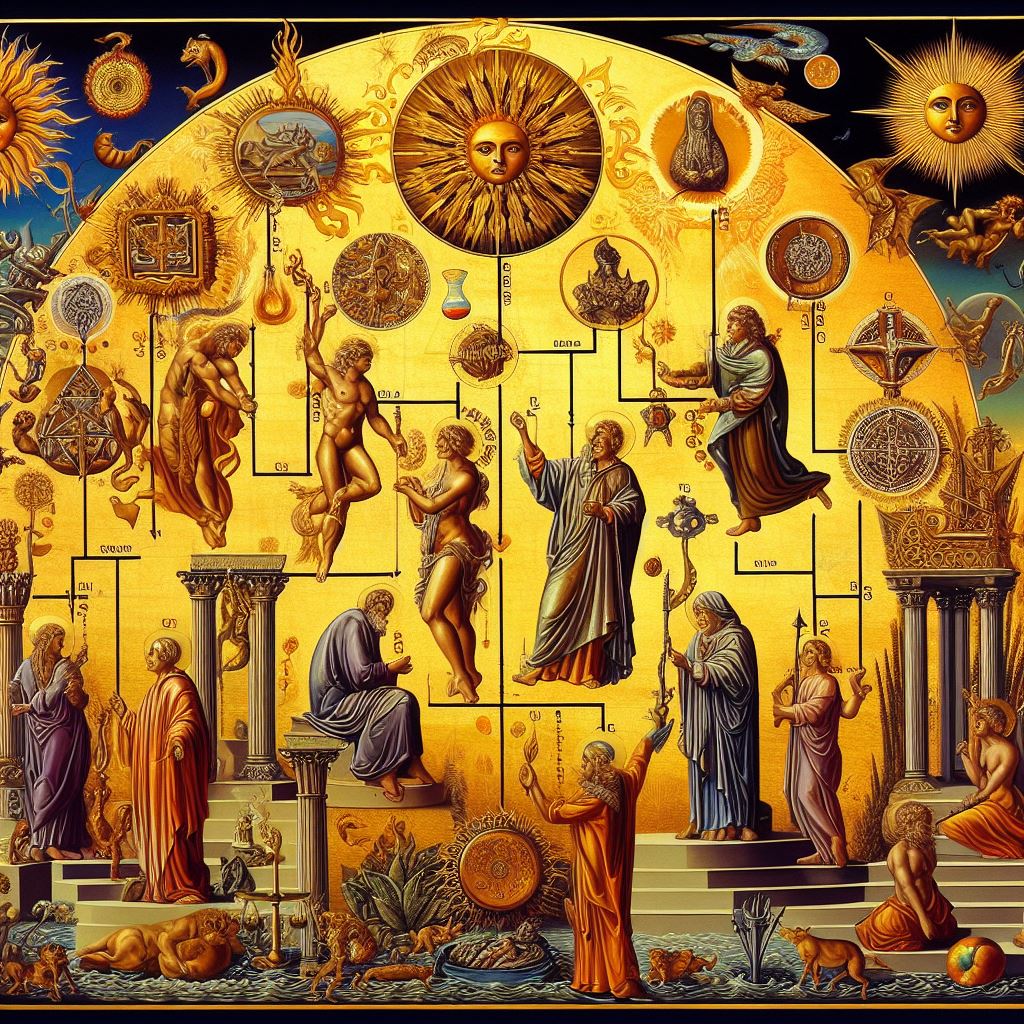
In the same way that the Mithraic Ladder consists of seven steps, so too can the life of a human being. From an alchemical perspective, the human life can be divided into seven distinct stages, each with its own metal and patron gods. These seven ages of man constitute a life ideally lived.

The first age, from zero to 12, is analogous to lead. At this level, base survival is the most important concern of all. Children aged between zero and 12 have to learn not to fall off cliffs, not to run out in front of traffic, not to provoke dangerous animals/people, not to eat poison or to stick a fork in an electrical socket.

This is the realm of Saturn. Being in the realm of Saturn, things are very serious. There is no room for levity when you’re trying to teach a child not to get hit by a bus. Historically speaking, most people died in the first 12 years of life, mostly from childhood diseases. Thus there is a connection between Saturn and the Grim Reaper.

From 12 to 24, the relevant alchemical metal is tin. This is the realm of Jupiter, where joy is the natural state. This second alchemical age is achieved by anyone who survives the age of Saturn, i.e. the age of basic physical survival. No longer being concerned with death or dying, teenagers become primarily concerned with overcoming boredom.

All play and all games occur under the auspices of Jupiter, whose jovial nature embodies the frequency of recreation. Tin is brighter than lead; this represents the overcoming of the saturnine seriousness of the first age and the transmutation of dullness into brightness.

The years 24 to 36 are spent under the auspices of Mars, the god of iron. These years are when a man masters fighting and martial prowess. The peak fighting ability of most men will be during this age. Usually a man learns how to fight as an individual at the beginning of the age of iron. By the end of the age of iron, he could lead a century of men into battle.

Iron can carry a sharper edge than any other metal, hence it represents the basic masculine action of dividing. For millennia, an iron sword was the very emblem of strength and virility. Successful transmutation of tin into iron means that a man learns how to impose order upon the material world. Being able to impose order, he is now a warrior.

Venus rules the years from 36 to 48. Here the relevant metal is copper, representing romance and lovemaking. Having proven himself on the battlefield, here the alchemist has to prove himself with the trophy of battle: a woman. Hence the peak sexual market value of a man who has lived well is between these two ages (the less well one lives, the earlier one peaks).

Copper is both softer and more colourful than iron. This represents the age when man realises there is more to life than battle. Here he must soften because he must engage with his children instead of foes on a battlefield. So he softens, becomes funnier and less serious. Transmutation of iron to copper is about the change from warrior to family man.

From the years 48 to 60 man labours under Athena, the goddess of civic participation. Having raised his children so that they have successfully survived the gauntlet of lead in the first alchemical age, a man moves beyond his family and moves into a position of social power. Silver is more brilliant than copper, representing man’s broadening of focus from family to society.

Plato wrote in Republic that a man is ready for a political life at age 50. By the fifth alchemical age a man should have exhibited enough mastery over his life so far that other people want to be like him. He is not yet capable of radiating divinity but, under the auspices of silver, he can reflect it (as does the Moon). As such he can play a role bringing people together.

Between 60 and 72 a man is in the realm of mercury. Mercury is also the name of the god of the sixth alchemical age. Silver is transmuted to mercury by a process of quickening, in other words, through the entry of the divine into the material world. This is a minor form of illumination compared to the seventh age, but it’s powerful enough to have major effects.

This is the age of greatest temporal power. At the completion of the age of mercury a man might be an emperor with control over all the known world. Compared to a man of silver, a man of mercury has more gravitas and inspires more awe. Some might even consider him a demigod.

From age 72 to age 84 – or until the end of life – a man is in the realm of gold. Here he ought to fashion himself after Apollo, who represents perfection and illumination. In this age a man ought to learn how to radiate divine truth. Learning to do this is the secret of transmuting mercury into gold.

Ideally, a man reaching this stage would retire from all material concerns and focus entirely on readying himself for death. Temporal power has little appeal to those in God’s waiting room. Those who can grow old and die with grace and dignity can be said to have apotheosised, as Socrates did. Dying with the highest possible frequency brings the best chance of taking one’s place among the gods after death.

The example given in this article is idealistic. The actual life of any given alchemist will not progress this smoothly. Aspects of all seven ages are present in every age, and so a person can work the frequency of any stage at any time.

*

For more of VJM’s ideas, see his work on other platforms!
For even more of VJM’s ideas, buy one of his books!

*

If you enjoyed reading this essay/article, you can get a compilation of the Best VJMP Essays and Articles from 2021 from Amazon as a Kindle ebook or paperback. Compilations of the Best VJMP Essays and Articles of 2020, the Best VJMP Essays and Articles of 2019, the Best VJMP Essays and Articles of 2018 and the Best VJMP Essays and Articles of 2017 are also available.

*

If you would like to support our work in other ways, subscribe to our SubscribeStar fund, or make a donation to our Paypal! Even better, buy any one of our books!
If Darkness Ruled

Have you ever wondered what our world would look like if it were ruled by the powers of darkness? Imagine that the evil and self-absorbed demiurge Yahweh, or Satan, or Lord Mara of the Buddhist tradition, held total dominion over the world. What could we expect to see?

If darkness ruled, we would have evil posing as sanctity, from the lowest of places to the highest places of power in order to breed shadow, to mislead and blaspheme against Truth.

Because the world would be a hellish quagmire of the soul, it would be forbidden to spare a child being born into it, so abortion would be categorically outlawed, as would those in unbearable suffering being provided the mercy of an assisted death. This is an attempt to seize the power of birth and death as its own hellish tool, yet the motives of darkness would be shrouded in a veil of righteousness and sanctity.  Those enslaved to the powers of darkness would never see through that holy shroud into the hypocrisy behind it, and they would defend it to the death.

If darkness ruled, we would be told that the highest service to the peace of the world is to engage in warfare and destruction. We would be enslaved to the degree that we would find delight in the tools of destruction, claiming defence of the material body against danger as the highest religion. The darkness would insist by almost unseen increments of cultural pressure that its soldiers become religious fundamentalists in order that their sense of empathy for their enemies is disengaged and their primitive capacity for causing unbridled trauma with no recourse to conscience is potentiated.

Darkness would have learned this from its much earlier experiments in interfaith warfare.

Darkness would entrain a culture prepared to be excited to kill. Being such a skilled liar, the darkness would have also learned the mastery of claiming that the brutality of these wars had nothing to do with inter-religious violence. It would also demand that its subjects carry out the most heinous of crimes against humanity under the banner of what they value most, which is a false sense of freedom offered conditionally by their patriotism for ‘their’ country (they would be convinced they were members of a country, not a world of people). The darkness would have found a way to take what makes them feel special and turn it back into what makes them feel separate, then use that as fuel for violence, domestically and globally.

If darkness ruled, every man woman and child would have the freedom of their souls bound to a new device like a mass-produced weirdstone. This demented implement would nefariously track their thoughts, by watching their faces, as well as by subtle twists of dark psychology tell them what to want and think, carefully implying where their allegiances lie.

It would also bestow great power, allowing them the illusory freedom of temporarily entering other dimensions, and have some of their most obscene fantasies seemingly materialise out of thin air. Such devices would be seen as novelties for the wealthy at first, but would soon be considered necessity even to the most poverty stricken in society.

If darkness ruled, our leaders would not be in the least concerned with communicating truth. Nothing would be more important to avoid. They would first and foremost become perfectly adept at communicating mistruth before any other consideration came to mind. Since truth is like a lantern to darkness, as in psychopathy, their total focus would be fully entrained upon appearing to others how they intend to appear rather than ever once broaching the topic of truth.

What such leaders say must fit their agenda, otherwise it would never be uttered.

Such a trait would be so fundamentally objectionable in any social situation that they would be forced to rely upon entirely different personalities for dealing with humans in their personal lives so that they are not met with a sense of enduring horror. Selective slivers of this human aspect would also make its way to the media so that people were reassured of the leader’s fundamental humanity, despite not realising that this had been a most brilliant ploy.

If darkness ruled, every platform of media would be screaming and shouting with the distraction of what was the least important in life. We would have distraction and triviality marketed to us at breakneck speed, at the most oppressive volume. We would be up to our eyes in the refuse of the world which either comes to rest in our oceans or our brains, never to decompose or be removed unless the most revolutionary of actions is taken.

If darkness ruled, our natural resources would be stolen from us beneath our noses, sacrificing the freedom and well-being of every future child to be born on this planet for the fattening of billionaires’ already swollen coffers. Water that could not be bought would be destroyed at the source by nefarious means weakly claimed in ignorance, destroying the planet’s living systems, enforcing further scarcity onto an already overpopulated world of sad, lost, dying beings.

If darkness ruled, the power of the divine light would have been attempted to be stamped out at every occasion. Powers of darkness would strip the authentic specialness of any occasion to make room for a calendar in which each day is claimed to be filled up with misery and nonsense. The sacredness of nature would be seen as a threat, so inch by inch, it would be razed to make way for the Satanic altars of enslavement and mass production.

If darkness ruled, our ideologies would be so skilfully divided so that wherever your political allegiances lie your hand would be forced to support long-term dysfunction and harm.

If darkness ruled, you wouldn’t want to spend another minute under the spell of such a world, no matter how unwell your mind had been made in the process, demanding a steady supply of sickening thrills and demonic highs. Knowing about it would mark the beginning of the end of illusion, the power of the spell would begin to wane, and the only sane recourse would be to begin the process of detoxifying our souls and healing.

*

Simon P Murphy is a Nelson-based esotericist and philosopher, and author of His Master’s Wretched Organ, a brilliant collection of weird fiction stories.

*

If you enjoyed reading this essay/article, you can get a compilation of the Best VJMP Essays and Articles from 2021 from Amazon for Kindle or Amazon for CreateSpace (for international readers), or TradeMe (for Kiwis). Compilations of the Best VJMP Essays and Articles of 2020, the Best VJMP Essays and Articles of 2019, the Best VJMP Essays and Articles of 2018 and the Best VJMP Essays and Articles of 2017 are also available.

*

If you would like to support our work in other ways, subscribe to our SubscribeStar fund, or make a donation to our Paypal! Even better, buy any one of our books!