

A Closer Look at the Four Masculine Elements

The masculine is to go upwards, outwards and onwards; to shine without burning

Previous essays here have discussed the difference between the four feminine elements and the four masculine elements, and the four elementary perceptions. This essay looks more closely at the four masculine elements and, more specifically, how awareness of them arises in perceptual space.

According to one manner of thinking, masculinity is judgment in the place where femininity is perception. Where feminine divides into light and dark (where both have equal value), masculine divides into good and bad, where one is prized and the other despised.

Thought of in terms of elements, the basic masculine division is into precious and base. This means that applying the simplest possible masculine lens to the world will divide it into things that are valuable and things that are not valuable. Those things that are already valuable don’t need to be (or ought not to be) acted upon, because they are good as they are. That which does not have value can be freely acted upon, because such actions do not (or ought not) destroy value.

The elementary masculine action is to impose order upon chaos. This means to impose order upon the world. Before this can be done, the masculine perception must be adopted, so that the world can be divided into precious and base. The precious does not need to have order put to it; it has value inherently. The base, however, can freely be worked because in doing so one cannot damage anything valuable, and can in fact improve the value of it if the correct order is imposed.

Regarding the base, the natural masculine question is to ask: can some of this be shaped into a tool? If a blob of clay – which is simply an ordinary part of the natural world – can be shaped into an object that is useful as a tool, then the crafter has performed an act of basic alchemy: through an application of will he has turned clay into iron. This he has done by imposing a useful order upon it.

Imposing useful order upon clay makes it more valuable than mere clay, because it is possible for information to have value, and if that information is encoded into the shape of an object then that object also has value. A worthless blob of clay can be thrown into a pot, and a pot has value as a tool because it can be used to store things. A stick can be fashioned into a spear; rocks can be melted to produce copper and iron, which can themselves be formed into tools.

The two precious elements – those which are perceived to be good and valuable instead of otherwise – are silver and gold. Both of these are very bright in comparison to the base elements, which is how their essential masculinity manifests – as light. Because these elements manifest themselves as light, and because light is associated with valuable things (like warmth, the Sun, daytime etc.), these elements have inherent value.

Ultimately, the reason why gold is more valuable than silver is because it is richer. Gold is shiny like silver, but where silver is colourless, gold is a vibrant kind of yellow. In this sense, gold contains all of the range of colours that clay does – all the colours of life. Thus, it is easier to distinguish gold from iron than it is to distinguish silver from iron, which means that the gold is more obviously valuable.

Metaphysically speaking, this arrangement of the world into four elements of increasing rarity and value tells an entirely different creation story to the seemingly random appearance of the feminine elements of earth, water, air and fire. It tells a story of order emerging out of an ocean of chaos by means of an act of will, first hardening itself, then polishing itself, then finally refining itself to become something immensely valuable that somehow stood as an avatar for all of life – a God.

*

If you enjoyed reading this essay, you can get a compilation of the Best VJMP Essays and Articles of 2017 from Amazon for Kindle or Amazon for CreateSpace (for international readers), or TradeMe (for Kiwis).
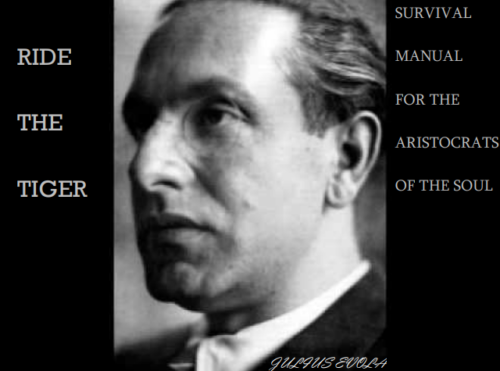
VJMP Reads: Julius Evola’s Ride the Tiger X

This reading continues on from here.

The 27th essay in Ride the Tiger is called ‘Relations Between the Sexes’ and seeks to cover a different range to the essay about marriage. When the order of the world is dissolving, men and women are naturally separated. Our sexual prejudices have contaminated our ethics. Nowhere is this more evident that in the idea of sexual revolution.

Processes have worked towards a freeing of sex, but not a freeing from sex. The sexual revolution has not liberated us from the suffering caused by sexual desire; to the contrary, we are now intoxicated by it. This is contributing to the collapse of society, but we can use the space afforded by the chaos to assert higher values. Bourgeoisie values, being materialistic, cannot conceive of woman in anything more than her anatomical capacity as instrument of reproduction – in reality, she has a spiritual value.

Sexual liberty therefore leads to materialism, and thereby away from spirituality. Incredibly for the 1960s, Evola is already able to anticipate how widespread pornography has affected the “polarity” between men and women. Nowadays a naked woman doesn’t stir much more interest than the sight of a cat. This is a tragedy because the sexual union is capable of acting as a bridge to higher consciousness via “an existential rupture of planes”. Making love can be Dionysian.

Part Eight of Ride the Tiger is where Evola finally gets to the spiritual side of things. This final section is titled ‘The Spiritual Problem’, and consists of two essays. The first of these is called ‘The “Second Religiosity”‘.

In this essay Evola decries what he calls “neospiritualism”, which he describes as an attempt to lead people beyond the material without giving any credence to the old, dogmatic religious movements. He has no time for the “movements, cults, sects, lodges, and conventicles” of the modern day, and considers them also a phenomenon of dissolution. In fact, things have gone so far that we are now in the rigor mortis stage, and all that awaits is the decomposition of the corpse.

When man closed himself off to the higher, transcendent world in the 19th century, this did not liberate him from superstition but merely opened him up to the lower, primitive emotional world in the 20th. We are now in the “soulless, collectivistic and materialistic phase corresponding to the closing of a cycle of civilisation”. All of these neospiritual movements thus represent an excess of the feminine. Evola is highly cynical and dismissive of these movements.

It’s difficult to correctly discriminate between all the garbage thrown up by neospirituality and the wisdom of genuine value. The emphasis ought to go on the deconditioning of the spirit. Here, Evola is at pains to emphasise that a person cannot achieve initiation by themselves, in contrast to the belief espoused by many. One is either born initiated, or one achieves initiation by way of spiritual emergency or ordeal, or one is initiated deliberately by someone who is part of a tradition and who knows what they’re doing. This is hard to achieve because the organisations that do so hardly exist any more.

The 30th and final essay is titled ‘Death – The Right Over Life’. Evola begins here by talking about the common belief, held by Heidegger (as well as by Socrates) that life is in some way a preparation for death. Death appears to be the end of the “person”, and atheism and materialism have made this simpler to deal with. Contemplation of death is a noble endeavour, as it can lead to a heightened state of appreciation of one’s life.

The traditional doctrines had the correct approach to death. The truly differentiated man cannot believe that his being began with the beginning of his physical body. He must solve the problem of nihilism by “displacing the I towards the centre of ‘being'”. Here Evola is talking about consciousness: “the human condition οf earthly existence is only a restricted section in a continuum, in a current that traverses many other states.” This eternal truth is not easy to grasp in an age of dissolution like ours, but it is much better than the lies of theistic creation myths.

A truly differentiated man, much like the Stoics and the Pythagoreans, could never take his own life, no matter how poor his conditions. This is because to do so would acknowledge that he was not strong enough to overcome the irrational part of his being. However, one always has the moral right to exit the world, should one decide that remaining ordeals are not meaningful. The differentiated man would be extremely disinclined to take this option in any case, right or otherwise. This is because of the possibility that one has chosen and said yes to – whether before or beyond this life – all of the ordeals in it.

In the final analysis, one can say that, no matter how degenerate and dissolute the world, it can still have value. It might be that, in order to achieve the highest state of being, consciousness must challenge itself as intensely as possible. To that end, there’s little more challenging than existing in a world where everything is contrary to one’s nature.

*

If you enjoyed reading this essay, you can get a compilation of the Best VJMP Essays and Articles of 2017 from Amazon for Kindle or Amazon for CreateSpace (for international readers), or TradeMe (for Kiwis).

VJMP Reads: Julius Evola’s Ride the Tiger VIII

This reading continues on from here.

The 22nd essay in Ride The Tiger is called ‘Dissolution of Modern Art’. Much like everything else, Evola contends that art has also degenerated. In the case of art, it has degenerated into a feminine subjectivity that is too afraid to say anything. Now we can no longer even speak of traditional art because no-one has any idea what that even is.

In this essay Evola echoes Plato’s description of the degeneration of political forms, only applied to the world of art. Modern art would be best served by achieving maximum craptitude, because that would provide the clean spiritual slate upon which something authentic could be written. Literature is also criticised as “fetishising” human relationships and merely documenting them with full banality.

As in many previous essays, Evola concludes that art has been given too great an importance, to the detrimental of the spiritual. What gives meaning to life can exist “even in the virtual absence of art”. Art has, in reality, undermined idealism, especially in the modern world. Positive realism lies in the assertion of values such as truth and spiritual courage. That which truly has value needs no consensus to agree.

The 23rd essay is ‘Modern Music and Jazz’. Evola has a keen interest in music and understands its development over the course of recent centuries. Perhaps weirdly, Evola writes here about the “preponderance of dance music over vocal and emotional music” – a sentiment shared by many today. He considers that the drift towards nihilism in philosophy and art has been echoed by one in music.

Music has, according to Evola, developed in ways that mirror the development of all other social movements. Therefore, the advent of jazz is no surprise – it is merely the democratisation of music, something “primitively ecstatic”. This doesn’t mean that jazz is crude, though, or that jazz players are unskilled musicians. It simply heralds the return to the world of fundamental, elemental forces.

This “Negro music” is associated with “dark forms of ecstasy” in Evola’s reckoning. He compares the feelings that arise from dancing to rhythmic music to the frenzies of the dervishes: “possessions of savage ritual”. Despite frequently being paired with drugs, these occasions cannot be compared to the ancient rites of Dionysus etc. because there is nothing sacred about them – they are mere escapism.

On the subject of drugs, the 24th essay is ‘Excursus on Drugs’. Evola considers drugs to “most visibly have the goal of an ecstatic escape”. Some of the people who choose such an escape are those who have perceived the meaninglessness of human existence. Others are “neurotics and psychopaths”. Part of the danger of drugs is, like rhythmic music, they can be used to open up awareness to a suprasensible world, such as in initiatory ritual.

Despite this caution, Evola gives due credit to the use of various drugs in sacred ritual. The Taoists considered even the use of alcohol to have a kind of magical effect, and he mentions the Central American shamanic traditions that made much use of mescaline, peyote and psilocybin mushrooms. However, he also points out that no-one really understands how to use these sacraments anymore, because no-one is capable of the necessary spiritual preparation. This leads to the risk of “possession by dark powers”.

If used correctly, nonprofanely, drugs offer the possibility of coming into contract with a superior dimension of reality. Stimulants and depressants can more or less be ignored for these purposes. Hallucinogens are excellent but have many drawbacks; their ancient use involved guiding the trip with symbols and a preliminary catharsis of emotion, two things that are seldom done today. Narcotics can be useful for the sake of dissociating from the mundane but the experience is hard to control.

*

If you enjoyed reading this essay, you can get a compilation of the Best VJMP Essays and Articles of 2017 from Amazon for Kindle or Amazon for CreateSpace (for international readers), or TradeMe (for Kiwis).

The Masculine Approach, the Feminine Approach, and the Four Elementary Perceptions

If one wishes to divide the world into two halves, a problem immediately arises: on what basis does one make the division? There seem to be an infinite number of dimensions that a division can be made along. This essay argues that there are two orthogonal, fundamentally different ways to divide the world in two, and this leads to four elementary perceptions.

In its initial state, perception is untrammelled. When consciousness is united with God, one is aware of everything. From this state, the only way that change is possible is for this perfect perception to become occluded somewhere. Somewhere, consciousness must turn to unconsciousness, light to dark, warm to cold.

There are two ways to look at this inevitable fall from union with God. The first way is to simply perceive the change; the second way is to judge the change. This dichotomy is true of all distinctions between feminine and masculine, as the feminine is associated with the perception end of the perceiving-judging spectrum, and the masculine with the judging end.

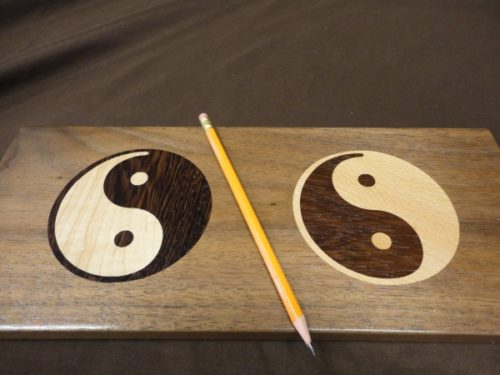
This first way, making the choice to perceive, is the feminine way. This way divides the world into light and dark or hot and cold, where no judgment is made about one of the two being better than the other. The feminine way of dividing the world does so horizontally, in that the halves are seen as interdependent and as feminine and masculine.

The second way, making the choice to judge, is the masculine way. This way divides the world into good and bad, where good and bad are different to (but overlapping with) the feminine division of yin and yang. This way of dividing the world does so vertically, in that one half is judged to be worth more than the other half. Good is set above bad.

These two perceptions are just perceptions. Neither of them is right or wrong, and that isn’t important in any case. What is important is when these perceptions are useful, because either is useful in some situations and not in others.

Masculine is good when you have just come inside from the rain. Then, masculine is a warm cup of coffee. Feminine is good when you have just come inside from a hot day of playing sport in the Sun. Then, feminine is a cool beer. So either masculine or feminine can be good or bad in the moment, without a moral judgment needing to be made.

Likewise, judging is good when deciding whether to let a person into your house. It’s important to make sure that a person is not bad before opening your doors to them. Perceiving is good when trying to enjoy a piece of music, because it’s enough to just experience the sound and to let oneself by raised and lowered by it. Judging might take the fun out of it.

So the decision whether to perceive or to judge in any given moment depends on the environment a person is in and the situation around them. Generally speaking, if things are relaxed then people are inclined to perceive and if they are stressful people are inclined to judge. It also depends on inherent personality characteristics: women are more likely to break towards perceiving if in doubt, while men are more likely to break towards judging.

In all, this means that there are four different perspectives that one can take to anything in the world. Any other thing can be treated as either good, evil, yang or yin, depending on whether one chooses to primarily judge it or to primarily perceive it. Whichever of the four is chosen only makes sense in reference to the other three not chosen: bad is non-perceptive, non-good; good is non-perceptive, non-bad; feminine is non-judgmental, non-masculine, and masculine is non-judgmental, non-masculine.

This way of thinking (of dividing four elementary perceptions into two groups of two, based on approach) represents a middle point between the vertical, masculine logic of clay-iron-silver-gold and the horizontal, feminine logic of earth-water-air-fire. It might therefore claim to be a way of thinking that represented a higher degree of balance than the other two.

It also leads to them both after a small amount of extrapolation, because the distinction between good and evil is essentially identical to the distinction between precious (gold and silver) and base (iron and clay). Here gold distinguishes itself from silver by being double good, because silver is relatively bad as far as precious elements go. Likewise, iron is good in comparison to clay, because it is hard and can be used in tools, and is therefore relatively good as far as base elements go.

Likewise, the distinction between masculine and feminine is essentially identical to the distinction between warm (fire and air) and cold (water and earth). Here, fire distinguishes itself from air by being double masculine (i.e. it is hot and dry, not just hot), and earth distinguishes itself from water by being double feminine (i.e. it is cold and unyielding, not just cold).

*

If you enjoyed reading this essay, you can get a compilation of the Best VJMP Essays and Articles of 2017 from Amazon for Kindle or Amazon for CreateSpace (for international readers), or TradeMe (for Kiwis).