

Why You Can Never Know if Another Person is an NPC, And What This Means

Much recent interest has been devoted to the idea that a significant proportion of other human beings might be “NPCs” (non-player characters). What is meant by this is that “the lights are on but nobody’s home” – that the person is not conscious, despite appearing to be. As this essay will discuss, this philosophical problem has a number of chilling interpretations.

When people decry others as NPCs, what they are really saying is that these people are not conscious. There might be bodies moving around and saying and doing things, but there is no conscious observer that pays attention to the lived experience of such bodies. Individual NPCs might just as well be androids of some kind, machines that replicate the functions and actions of conscious beings without actually being such.

The reason why recent interest has attached to this idea is that some people seem to be utterly incapable of thinking for themselves.

Certain political issues have made it apparent that a large proportion of voters do not think about reality at all. They are happy enough to adopt wholesale a Weltanschauung from the television and from their peers. This is especially true if a person adheres to one or the other side of the mainstream political spectrum, but a political allegiance isn’t necessary. Many people’s heads seem to be more or less empty: they simply repeat whatever has been pumped into them from the outside.

This has led others to wonder if there’s anyone really in those heads at all. These apparently unthinking people might be NPCs: essentially meat-puppets that look and sound like humans but which have no conscious will, and who therefore are incapable of creative direction. They can only follow orders like drones, whether those orders come from other humans (PCs or NPCs), the Government or the television. They are therefore categorically different to those of us who are conscious.

But this line of reasoning opens up some extremely thorny philosophical questions.

Primary among these is that you can’t measure or detect consciousness empirically. Consciousness is a state of being aware, and this is impossible to measure because awareness cannot be detected by any instrument. A materialist will object that it is possible to measure responsiveness, and this can be done with (for e.g.) EEG machines that can tell whether a person is awake – but these measures are always of purported correlates of consciousness, not consciousness itself.

We seem to intuitively believe that being “awake” is somehow linked to being conscious, but the simple fact is that we are also conscious of experiencing dreams, and are therefore also conscious even when asleep. Therefore, our intuitive perceptions about who is conscious are not necessarily accurate. It may be that the common perception that all humans are conscious is erroneous.

One can be aware of one’s consciousness, of course. This is logically trivial: if one is conscious of anything at all, then one is conscious. Therefore, if you’re even aware of yourself asking the question of whether or not you’re conscious, you must be. Although, because one’s own consciousness cannot be measured any more than that of other beings can, its presence cannot be proven to anyone other than oneself.

It really seems that the only way consciousness can be sensed in others is by means of some intuition. It certainly seems as if consciousness can be detected in others; at least, this seems intuitively true to most people. This is the basis of the NPC phenomenon: by whatever means this intuitive decision is made, a person decides that another person is either conscious or not.

The difficulty then arises: is it true that all other humans are conscious, or only some? Because not everyone necessarily agrees. Some argue that only their race is conscious, and that others are some kind of ‘bugmen’. Others argue that only members of their religion are conscious, because only these have been “infused with the light of God” or similar. Yet others argue that only members of their class are conscious, and that the poorer someone is, the more like an animal.

The obvious problem with this way of thinking is that it leads to asking questions like: if other races/religions/classes are not conscious, why not just wipe them out for the sake of securing a better position for our own? It’s clear to anyone who has studied World War II that the dehumanisation of other people, by way of declaring them less conscious, can easily lead to bloodshed and genocide. This is why the vast majority of people have adopted the unspoken assumption that all other humans are conscious.

Even if all humans are declared conscious, one must then ask if all other beings are conscious, or only some?

Another thorny philosophical question is moral: if another individual is an NPC, and therefore not conscious, is it immoral or not to exploit that individual? One the one level, it seems like nothing should be different, but on another, it could be argued that if nothing is aware of any injury caused to the physical body then it isn’t really suffering. Therefore, harm done to beings that are not conscious is not immoral (unless those beings are the property of someone else).

Because you can never really know if another person is an NPC, the default response seems to be to assume that no-one is, i.e. that all other people are conscious and that their suffering is meaningful. This is certainly the approach that a courtroom will take if you beat up someone because you think they are an NPC. But you can’t ever really be sure.

*

If you enjoyed reading this essay, you can get a compilation of the Best VJMP Essays and Articles of 2017 from Amazon for Kindle or Amazon for CreateSpace (for international readers), or TradeMe (for Kiwis).
Why Science, Correctly Performed, Will Lead To A Belief In God

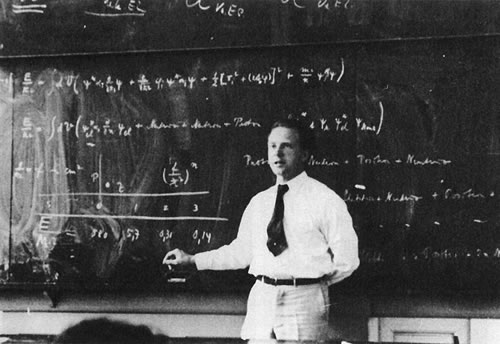
Nobel Physics Prize laureate Werner Heisenberg once said “The first gulp from the glass of natural sciences will turn you into an atheist, but at the bottom of the glass God is waiting for you.” Something that Heisenberg understood, but which most lesser scientists do not, is that a belief in God will arise from doing science correctly. As this essay will examine, atheism is not necessarily the correct attitude to take into the natural sciences.

The scientific method begins with determining what we know for sure, and from there reaching out to what else can be stated with some degree of certainty. For instance, if a particular chemical reaction has transpired in a particular way a hundred times, we can predict with a high level of certainty that it will transpire that way one more time. From there, we can make alterations to our methodology in order to learn more.

What do we know for sure?

As it turns out, there is only one thing that a person can know 100% for sure: that they are conscious. Everything else is necessarily a matter of faith. Every belief, apart from the belief that one is conscious, is a matter of faith, because it is a statement about the material world.

All phenomena within the material world are known to be transitory, and therefore they contain an element of chaos that precludes total understanding of them. One might declare with certitude that “The Sun will rise tomorrow,” but even this is an article of faith – the Earth could be struck overnight by a gigantic comet that reduced the planet to cosmic rubble, thereby proving one wrong.

Although one might be 99.9999% sure about such predictions, one can never truly be certain, in the way that one can be certain that one is conscious. No prediction that depended on the permanence of some aspect of the material world could ever be made with 100% certainty – Heisenberg himself expressed this understanding with his Uncertainty Principle. It is certainly possible to predict that things will change (i.e. that you will die), but it is seldom possible to predict precisely when.

If one doesn’t know for sure that the material world exists, but one knows for sure that consciousness exists, then it doesn’t make logical sense to assume that the material world is the basis of reality. Consciousness can easily create the impression of a material world – it does so every night in our dreams. But there is no scientific explanation, no plausible explanation, that can demonstrate how the material world might develop consciousness. All talk of “emergent properties” is merely materialist dogma, special pleading.

Ockham’s Razor tells us that it’s more likely that consciousness dreamed up the material world and Planet Earth, in much the same way that it dreams worlds at night (an explanation that requires one step), than that the material world spawned from nowhere and evolved to be conscious (an explanation that requires hundreds, if not thousands of steps).

Therefore, there is no reason to assume that the death of the physical body ought to affect consciousness. If the material world is simply a set of phenomena that are dreamed up by consciousness, then there is no reason to assume that the death of one’s physical body ought to affect that consciousness. Therefore, there is no reason to assume that consciousness “disappears” or “dies” or even so much as changes form when the physical body dies.

The real question, then, is: of what does one become conscious upon the cessation of the temporal patterns that corresponded to one’s physical body? It isn’t easy to speculate about such things, because it depends on how laws from this world translate to the next. One thing can be said for certain though: of the next world, one will be conscious.

Ockham’s Razor can also be applied to the realm of biology to support the contention that consciousness is the prime materia.

Evolutionary science tells us very clearly that organisms do not evolve unnecessary appendages. None of limbs, organs, or parts of the brain will come into existence unless there is an evolutionary pressure that favours them. This will only be the case if those limbs, organs or parts of the brain (or early forms of them, at least) confer some kind of selective advantage. Without this advantage, there will be no selective pressure in favour of that appendage, and without that pressure it will not come to exist.

Consciousness confers no survival advantage. The human animal does not need to be aware in order to carry out any of its survival functions. All of the thoughts and calculations that the human brain performs over the course of a human life could just as well be made without consciousness. After all, a computer or android could be programmed to scan its physical environment for the sign of predators or food sources. It wouldn’t need to be conscious to do so.

If consciousness confers no survival advantage, then it cannot have been selected for by natural selection (i.e. by biological or material means). If it was not selected for by natural selection then it cannot be biological and attached to, or arising from, any part of the brain. To the contrary – the material world, including the brain, arises from consciousness.

If consciousness can dream up this world, and if it can dream up the fantastic nightscapes of our dreams, then it can dream up an infinitude of other world, realms and dimensions. And indeed it has – the entire rest of the Great Fractal is currently being explored by consciousness, in an infinitude of realms that you cannot even hope to perceive (yet).

Anything within the Great Fractal (i.e. everything that it is possible to perceive) can be dreamed up and explored by consciousness. Consciousness is infinitely creative. Consciousness can find a way to perceive anything that is perceivable. If it’s perceivable, then there’s a path to it through the Great Fractal from where consciousness currently is.

This effectively means that consciousness is omnipotent: after all, it is capable of conjuring anything from all the permutations of what’s possible.

It is often said that belief in God is a question of faith. Indeed it is. There is no possible way to prove that any being apart from oneself is conscious. All other beings could be conscious like you, or they could be programmable meatbags – and you have no way to prove otherwise. If they are conscious, that consciousness cannot be observed or measured. There is no instrument that will detect its presence or absence.

If consciousness is eternal, has the power to create anything possible, and whose presence in others is necessarily a question of faith, then consciousness is therefore God. It fulfills all of the criteria commonly attributed to God by Epicurus and others. This understanding can be arrived at scientifically, by logic, without need for faith.

*

If you enjoyed reading this essay, you can get a compilation of the Best VJMP Essays and Articles of 2017 from Amazon for Kindle or Amazon for CreateSpace (for international readers), or TradeMe (for Kiwis).

The Four Ways to Become Enslaved

Chains can be physical, mental, or spiritual

There are many different ways that a person can become enslaved to the will of another or to a group of others. Although people usually associate the term ‘slavery’ with the chattel slavery of the American South, there are as many different kinds of slavery in the human world as there are ways of exploitation in the natural world. This essay describes four distinct ways of being enslaved that accord with the four masculine elements.

The four ways to enslave are, effectively, the four different ways of introducing artificial scarcity. Only when a state of artificial scarcity has been induced will another person surrender themselves to the will of another. There are effectively four ways of doing so: two physical, two non-physical.

The most basic way of asserting dominance over another of your own kind can be observed in other mammals, especially other primates, when they fight over their food supply. To enslave another person in this sense is to deny them the peace and solitude to gather food from nature. The alpha primate will not allow any others to eat until he himself is satisfied. Disobedience is punished with violence.

To be enslaved in this manner is to wear chains of clay. This is because a lack of food is the most natural and immediate survival problem that faces life forms such as mammals, primates or humans. To not be able to eat when one needs to nourish oneself is slavery, because hunger will cause one to grow weak.

Chains of iron are what most people think when they hear the term ‘slavery’. This refers to iron manicles and shackles that prevent or hinder movement when fastened around a person’s wrists or ankles. It’s extremely rare to see a person enslaved by chains of iron nowadays, but it’s still common to see people who are more or less enslaved in the same way as a person wearing irons – i.e. by an artificial scarcity of security in that person.

What chains of iron refers to on a metaphysical level is control of another person’s physical safety, and their ability to remain free from wounding and physical harm. This is effectively how criminal gangs establish a presence in a neighbourhood – business owners are guaranteed physical security for them and for their business, but only if those business owners agree to pay for the “service”.

Chains of silver are frequently used metaphorically, usually to denote a person who has been enslaved by wealth. A person who has allowed themselves to become controlled by the physical objects and possessions they have hoarded could indeed be said to be enslaved by chains of silver, but there’s more to it than just that. Metaphysically, chains of silver refers to all tricks of the mind, which is all lesser magic.

In other words, chains of silver refer to an artificial scarcity of knowledge, in particular knowledge relating to the physical world. A person who has thousands of dollars in credit card debt that they can never clear, so that the bank regularly takes a hundred dollars in interest charges every month, just because they bought some crap they saw on television, could be said to wear chains of silver. In this case the term refers to the financial literacy needed to avoid debt traps like credit cards.

Likewise, a person trapped in a political ideology could be said to wear chains of silver. If a person’s social circle all think in a certain way, and their media organs all speak in the same way, and their courts and Police enforce it, a person might forget that there’s any other way of thinking. Many English speakers are subjected to so much capitalist propaganda that they are astonished, travelling overseas, to see other avenues of solidarity.

Very few people are enslaved by chains of clay and iron nowadays, and although most of us wear chains of silver to some extent, they are seldom a heavy burden.

However, the vast majority of people are enslaved by chains of gold, and many of those are so enfeebled by these gossamer bonds that the other forms of enslavement become virtually inevitable. A person enslaved by chains of gold is someone who is not aware of the fact that consciousness is the prima materia, and who consequently believes that the death of their brain means the extermination of their consciousness.

Chains of gold, therefore, refer to an absence of spiritual knowledge. It is the birthright of all humans to be made aware of the true nature of the relationship between consciousness and the physical world, and therefore anyone who does not possess that knowledge has been enslaved by chains of gold. This is something that has purposefully been done to enslave us by way of destroying our natural spiritual traditions, for example by prohibiting entheogen use.

Gold is the softest of all metals, and fittingly, chains of gold are also the weakest. This does not mean that they are the easiest to break. In fact, the opposite is true. These chains of gold are the trickiest of all, and not just because they are invisible. Those who wear them cannot conceive of them, by any sense. A person enslaved by chains of gold cannot be induced to believe in God.

A person enslaved by chains of gold will not believe in God, and consequently they will not believe in chains of gold. No-one enslaved by chains of gold is aware of it; as soon as a person becomes aware of chains of gold they are broken.

It could be argued that a person can only be enslaved with baser elements if they are first tricked into wearing chains of gold. For instance, a spiritual person might be better able to resist the temptation of loaning some money to satisfy a short-term urge. They might also be unafraid of death, and therefore willing to choose death before submitting to chains of iron.

Alchemically speaking, these are the four ways that a person can be enslaved. Although chains made of the baser forms of clay and iron are rare in the modern world, it’s important to remember their historical role, because a return to them is possible if we get weighed down enough by chains of silver and gold.

*

If you enjoyed reading this essay, you can get a compilation of the Best VJMP Essays and Articles of 2017 from Amazon for Kindle or Amazon for CreateSpace (for international readers), or TradeMe (for Kiwis).