A popular piece of wisdom holds that “In the land of the blind, the one-eyed man is king.” This is supposed to imply that any individual with superior perception will inevitably rise to the top of any dominance hierarchy. The reality in a Slave Culture such as our own is different. In a culture as blind as ours, anyone who can see clearly will be blinded.
The blind, like all humans, will never simply accept the dominance of someone who claims to see things that they don’t. It’s not in human nature to do this.
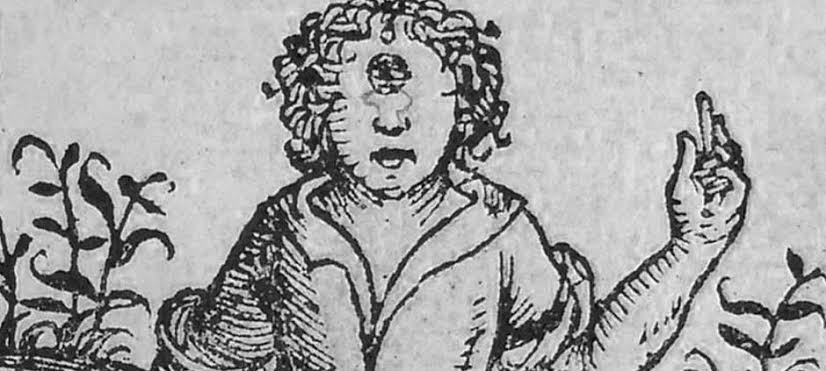
If a one-eyed man entered the land of the blind and started talking about how he could see things that the others could not, the blind would rather deem him insane. They would adamantly refuse to acknowledge that any higher insight to their own was possible. The land of the blind would have its own dominance hierarchy, and its own incumbent alphas, and they would defend their positions.
If the one-eyed man insisted that he could see things that the others could not, he’d be declared acutely psychotic. The things seen would be dismissed as hallucinations, and it would be declared that these hallucinations were brought on by excessive stimulation, and they’d forcibly sedate him. They might put him in a cell so that his disturbed mental state didn’t upset others.
Eventually, they’d just rip the eye clean out of his head. They’d come to the conclusion that there was something wrong with the function of the eye itself, and that was why he couldn’t break the delusion of being able to see things that others could not. Better to just remove the offending organ with surgery.
Anyone who doubts the plausibility of this conjecture need only observe the way that our society today, operating under a materialist paradigm, treats those of a sensitive enough psychic disposition to detect a world beyond the physical.
In today’s society, anyone who claims to possess any spiritual knowledge whatsoever is considered psychotic. If a person makes a claim to some minor knowledge, they might be politely humoured, but anyone making a claim to major spiritual truth is despised as someone too weak to maintain a grip on reality.
Anyone claiming firm gnosis is simply dismissed as schizophrenic. Especially forbidden is any talk that we may be God ourselves. The mental health system might begrudgingly allow someone a belief in Rabbi Yeshua ben Yosef, but any idea that all conscious beings are co-creating reality in the eternal moment is absolutely right out.
This is the land of the blind – the spiritually blind. The vast majority of the population either superstitiously follows a dead tradition or follows none at all. But we cannot expect that a spiritual man, should one arise, would be welcomed and his insight greeted. Far more likely he would be shunned as a heretic.
A previous essay in this magazine discussed the four masculine elements. This conception is the same as taking the Fundamental Masculine Axis – a spectrum that spans good and evil and everything in between – and dividing it into four distinct levels. There’s a more sophisticated way to do it. This essay discusses a division of the spectrum of good and evil into seven masculine elements.
At the feminine pole of the Fundamental Masculine Axis is the element of lead. This is a dull, heavy and malleable metal, and is therefore the most feminine of them all. The root chakra corresponds to the element of lead, and is represented by Saturn, the planet furthest from the Sun (of the planets known to the ancients).
The mentality that comes with the element of lead is the primary feminine. The lead is the basest of all the seven elements, and therefore it is the ground from which the others spring. The human spirit, in its unworked form, will sit at the level of lead. Such a person will be indistinguishable from another animal, such as a chimpanzee.
One step up from the feminine pole is the element of tin. This metal is brighter and lighter than lead. Metaphysically, tin distinguishes itself from lead by being larger. Tin doesn’t represent strength and muscles so much as size and natural vigour. The sacral chakra corresponds to the element of tin, and is represented by Jupiter, the largest of the planets.
The mentality that comes with tin is joviality. The word ‘jovial’ comes from Jove, another name for the god Jupiter. At this level, one enjoys very base and simple pleasures, such as getting drunk, gambling and rutting with women. It’s for this reason that the adjective ‘tinny’ gets applied to anyone who goes through life with Zeus-like dumb luck.
One step up from the element of tin is the element of iron. The essential aspect of iron is that it is hard. A sword made of iron will carry a much keener edge than a sword made of tin. Therefore, it is a much better tool for imposing order and control. The solar plexus chakra corresponds to the element of iron, and is represented by Mars.
Iron may be a blueish-grey, but in a metaphorical sense it is the red of the blood that it spills. Appropriately, this is the same colour as the red of the planet Mars. It’s from the Roman god named after this planet that we get the adjective ‘martial’, dealing with physical discipline and prowess in combat. People at this level feel a moral imperative towards honour and order.
One step up from the element of iron is the element of copper. The essential aspect of copper is its attractive colourfulness. Copper sits at the centre of the Fundamental Masculine Axis. Therefore, it is the meeting point of the masculine and feminine energies. It’s for this reason that copper represents the heart chakra, a place from where true love can flow in any direction it deems appropriate. It also represents the planet Venus.
Copper represents true romantic love, as opposed to the physical love represented by lead, tin and iron. This is why it has colour, because romance gives colour to life. Love, of course, is whimsical, and it comes and goes. This whimsicality gives us the word ‘capricious’, sharing an etymology with the Latin word cuprious, meaning copper-containing.
One step up from copper is the element of silver. Essential aspects of silver are that it shines, reflects and is bright. Like the word ‘bright’, silver stands for a simple kind of intelligence. While simple, this intelligence represents a higher level of animation than any of lead, tin, iron or copper. Silver is represented by the throat chakra and by the Moon, which itself reflects the light of the Sun at night.
Silver is associated with speech and communication. A person who is glib, verbose and perhaps a bit dishonest is one that might get described as ‘silver-tongued’. Al Pacino’s character in The Devil’s Advocate is an archetypal example, using his linguistic ability to baffle, bluff and beguile. The simple intelligence represented by this element is far from the final stage of spiritual development.
One step up from silver is the element of mercury. The essential aspect of mercury is that it has been quickened. Here the concentration of spirit is so great that it starts to influence behaviour. This quickening represents a complex, deeper kind of intelligence, as opposed to the simple reflection of the element of silver. Mercury is represented by the third eye chakra and by the planet Mercury itself.
Mercury is associated with intuition and imagination, and is why creative people are often described as ‘mercurial’. Someone at the level of silver might be able to hear a lecture or read a book and then repeat the philosophy they heard, but only someone at the level of mercury will be able to produce truly original thought. In doing so, they are beginning to approach the divine action of creation.
One step up from mercury is the element of gold. This is also the masculine pole of the Fundamental Masculine Axis, and as such represents the highest possible good. This point on the axis represents what a Taoist would call the Tao, and what Plato would call the Form of the Good. It is represented by the crown chakra, and by the Sun, whose light brings life and order to the world.
Gold is the most precious of all the elements. In this, it represents the most precious of all things, which is the grace of God. A person who has raised their frequency to the level of gold is someone who is enlightened. From the vantage point at the very top of the Fundamental Masculine Axis, they can see beyond.
These seven elements comprise a hierarchy from the most base to the most precious. Not only does each of them represent both an emotional state and an energy, but they also represent seven stages in the raising of spiritual energy from the animalistic to the godly. Through understanding these elements it is possible to understand how to transform oneself from a place of suffering to a place of absolution.
The art of alchemy is the art of transmuting base elements into precious ones. On the personal level, a successful alchemist will transmute their own baser nature into something that is in tune with God. As above, so below: such a process also occurs on the collective level. Civilisation itself is an act of alchemy.
The main life objective for any spiritual person is to overcome their raw animal instincts, especially when those instincts cause suffering to other sentient beings. The instincts to dominate and destroy, and to kill and conquer, are controlled by the spiritual person so that they don’t harm anyone. The spiritual man seeks to impose order upon the chaos of his soul.
Chaos, in this sense, represents the vital biological energies and instincts that have been shaped by evolution to meet survival and reproduction challenges, and which would have found expression with or without consciousness. Chaos represents the workings of Nature in raw form.
As awesome as the workings of Nature in raw form may be, they don’t take into account the suffering of conscious beings. Nature is famously indifferent to that. In a state of Nature, men fight and kill each other over food and territory and women, and survival to adulthood is rare. The spiritual impulse is the impulse to transcend and to overcome this.
Transcending and overcoming is the reason why so many religious traditions practice some form of abstinence. To fast is to learn to go without food, which is to learn to be at peace with one’s instincts to eat. To be celibate is to learn to go without sex, with is to learn to be at peace with one’s instincts to reproduce. Admonitions against violence and greed are likewise intended to encourage people to go against their savage natures.
It’s also why many religious traditions practice repetitive tasks, such as Buddhism with meditation, which requires a person to sit still for some time. If a person can learn physical discipline, then they can try to learn mental discipline, and if they can learn that, then they can try to learn spiritual discipline. Achieving spiritual discipline is the highest goal of the alchemist.
The ideal is to take the energy of some instinct, such as for sex or violence, and to sublimate it into a higher order, such as an art. This is what is meant by the transmutation of lead into gold. An alchemist can take their base impulses (represented by lead), which are indifferent to the suffering of others, and transmute them into energies (represented by gold) that work to reduce those others’ suffering .
As above, so below: all the things stated above as truths of personal alchemy are also true on a global level. There is a work of alchemy taking place right now on Earth that amounts to the imposition of order upon chaos on a planetary scale.
The fundamental act of civilisation is, like the fundamental act of alchemy, the imposition of order upon chaos.
The history of civilisation is the history of the imposition of the higher order of will upon the chaos of raw animal instinct. To be civilised is to have developed the ability to resist impulses to attack, rape and steal. A civilised man can laugh off insults, because he knows that to give in to his instinct to punish would be weakness. His highest value is not dominance but composure.
Our society invests a tremendous amount of time in trying to teach young people to think twice before giving in to temporary impulses that might have permanent consequences. Children are told morality stories from when they are old enough to listen and they continue getting lectured well into adulthood. The idea is to induce them to behave in ways that do not cause suffering to others.
Civilisation, then, is the same thing as alchemy, only it is the name given to alchemy at the collective level.
A statesman transmutes lead into gold by passing a law that proscribes certain behaviours. A great author does the same thing by writing a novel that gives its readers insight into the human condition. A great sportsman transmutes tribal bloodlust into a performance of improvisational theatre. All of these people further civilisation by minimising actions that cause suffering.
An ideal civilisation will operate on the frequency of gold. At this level, the ruling class is guided by God, and all of their actions are in tune with the will of God. If the ruling class is correctly devoted to God, then those devoted to the ruling class will be devoted to God, and so on, so that even the simplest peasant acts in accordance with the divine will.
A civilisation that has lost touch with God might operate on the level of silver, as ours appears to. We are godless but are yet to disintegrate into the level of all-out warfare – although this may happen if we fail at the great work of alchemy that is civilisation. A civilisation at war has fallen to the level of iron, and one that falls so far that its very survival is in question has regressed to the level of clay.
The alchemical future of our civilisation will depend on whether we can reconnect to God, or whether we fall further into violence and savagery. It seems that many of our most primal instincts for acquisition and competition are making a comeback, and this has led to a lower frequency of consciousness all over the world. If it keeps decreasing, then war is all but inevitable.