
Why Intelligence Can Never Be a Fixed Concept

Intelligence is something that everyone appears to understand, but no-one can agree on a definition. Despite this, people are pretty sure that it can be measured. Although tests that measure IQ have been shown to have a lot of predictive value, a precise definition of term remains elusive. But as this essay will examine, intelligence can never be a fixed concept anyway.

What is intelligence? A common definition of intelligence is “ability to recognise patterns and avoid dangers”. Another is “the ability to apply knowledge and skills”, which assumes that intelligence is an entirely different thing to instinct. Other definitions involve a capacity for learning, logic, reasoning, self-awareness etc. Despite this variety, most people think they know it when they see it.

A previous essay here discussed how there are at least two different spectrums of intelligence, and how both of them might appear to be intelligent in some situations and not in others. Another essay suggested that there is both a masculine and a feminine intelligence and stupidity. What’s apparent from all of these different definitions is that some behaviours are intelligent in some circumstances, and unintelligent in other circumstances, depending on how adaptive they are to the environment.

For example, being able to faithfully repeat what you are told is a sign of intelligence when a student has a good teacher who educates them honestly. When the student is a political cadre being indoctrinated into a dangerous ideology, it’s not a sign of intelligence. However, the underlying neurological and psychological attributes that enable either are roughly the same.

Most people can also accept that intelligence is something that evolved, controversial as that may be when one gets into the specifics of it. The reasons for this evolution are presumably because intelligence provided a selective advantage in either staying alive or finding mates and reproducing.

The first one of these points seems pretty obvious: if you are smart you are better able to avoid the dangers that the natural world has created. Intelligence is highly correlated with pattern recognition, and recognising patterns is the key to recognising dangers. If you notice that the last person who did something died, you are less likely to do it. Therefore, you are more likely to survive to reproductive age yourself.

The second point is more subtle, but equally clear if one thinks about it. The more intelligent a creature is the better shape it will keep itself in, therefore the healthier it will be, and the more attractive a mate it will seem to others of its kind. This greater attractiveness will lead to more mating opportunities, and therefore more offspring (all other things being equal).

However, there’s a hidden paradox in this simple biological definition. If intelligence is biological, then it cannot be a fixed concept, because if it’s an adaptation to the environment it will change along with that environment.

Aside from the odd species like crocodiles, who have found one evolutionary niche and just stayed there, animal species tend to be opportunistic. They tend to range across a number of niches and take food, water and reproductive opportunities when they arise. The most excellent example of this is the human being, who has adapted to many environments and who is capable of anything.

As the environment keeps changing, so too will the optimal behaviours within each environment change.

For instance, much of the behaviour that we currently associate with intelligence has much to do with avoiding impulsive behaviours. Someone who stops and thinks before taking action will be almost universally considered more intelligent than someone who does not. Likewise, someone who saves money will be considered more intelligent than someone who wastes it, and someone who reads books will be considered more intelligent than someone who parties.

This is all well and good in a civilised, industrial society like ours. But if society should break down, then the equilibrium point will shift back from cautious deliberation towards opportunism. If there is no law and order, then there’s no advantage in taking one’s time to consider things. The advantage shifts towards those with the propensity to hit and run before the opportunity is lost. Intelligence would then become a matter of understanding the importance of not hesitating.

Another problem is that the kind of skills and aptitudes that made a person become considered intelligent by their peers in the ancient past are not necessarily the same today. Human survival in the past had a lot to do with astrology, animal husbandry and swordsmanship – all skills that are now only practiced by small minorities. A person might have been considered highly intelligent in the past on account of that their brain made them good at animal husbandry, but the same person might be considered low intelligence today if they can’t find a technological skill.

It might even go the other way. Society might continue to become more and more technological, so that the selective advantage wasn’t in favour of impulsivity but in favour of the kind of semi-autistic gadgetry obsession that distinguishes people who are today considered nerds. Such a society might no longer have any need for social intelligence but would rather operate on computer science aptitude.

In all of these cases, the society that results after massive environmental change will define intelligence as adaptation to it, not as adaptation to some other time and place. Neither will they define intelligence as an adaptation to the natural world in which we evolved, because such a thing no longer exists.

In the end, the concept of intelligence is a biological one, and therefore can only be understood relative to a specific environment, or set of environments. Because the natural world keeps changing – and our social world even faster – the concept of intelligence will keep evolving as humans do. It can therefore never be a fixed and clearly defined concept.

*

If you enjoyed reading this essay, you can get a compilation of the Best VJMP Essays and Articles of 2018 from Amazon for Kindle or Amazon for CreateSpace (for international readers), or TradeMe (for Kiwis). A compilation of the Best VJMP Essays and Articles of 2017 is also available.
Esoteric Aotearoanism

If the Spear of Destiny ever comes to New Zealand, we ought to be ready to receive it. To that end, we can act to attract it, by employing the Law of Attraction. We can do that by promoting a cultural movement that recognised the excellence of New Zealand and our future greatness. This essay describes a mystical tradition that could serve these ends: Esoteric Aotearoanism.

Elementary alchemy has it that if one combines masculine and feminine in the right manner, one achieves a combination that is greater than the mere sum of its parts. By combining the feminine clay and the masculine iron, it’s possible to get silver, an element neither feminine nor masculine but somehow both, and not just both but the correct proportion of both.

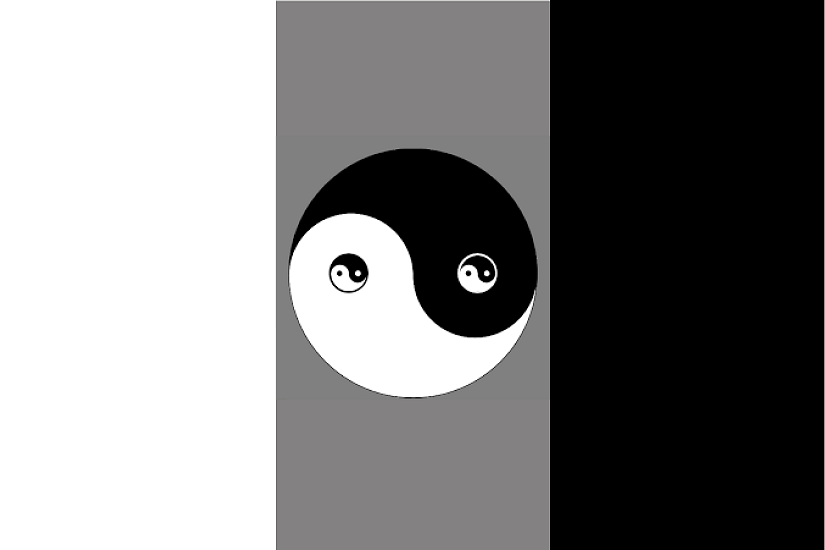
This is represented in Taoism by the Taijitu, which combines the white yang and the black yin to create a shape that has a life of its own, one that tells a story. The energy, light and life of the yang projects itself into the darkness of the yin, which in turn follows the yang in devotion. The result is a spiral that turns for eternity.

Esoteric Aotearoanism tells a similar story. This story is represented in the flag of Esoteric Aotearoanism, which consists of three vertical stripes: the leftmost white, the rightmost black, and the central one silver. It is crucial to note here that the central band is silver, and not grey, because the combination of the two parts has created something more valuable than their mere summation.

The opening degree of Esoteric Aotearoanism is that the Esoteric Aotearoan flag represents the nation of New Zealand in the Kiwi people. 

The white is yang, which represents the British. This is not just because the British are white, but also because they are orderly. The British came from the West and therefore the leftmost third of the flag is white. It is from there that the energy and organisation to create the institutions of New Zealand came.

The black is yin, which represents the Maoris. As with the British, this does not simply reflect skin colour, but rather a vital, invigorating passion. Because the Maoris come from the East, the black occupies the rightmost third of the flag. It is from there that the soul of the nation comes, and how we get direction to differentiate ourselves from the globohomo masses (and from Australia in particular).

The silver stripe represents New Zealand, the space where those two ingredients meet, and where they combine to become something more valuable than either. The yang is bright but unyielding; the yin is gentle but dull. Together they are colourful, and shine as silver. As silver is more valuable than either iron or clay, so too is the combination of British and Maori more valuable than either alone.

The silver stripe also represents those who have come together under the silver fern, because they have acted to create something that is greater than either the British or the Maori components. It signifies that what we have of greatest value is that which comes from the land here. It’s not what we imported from Britain or from Polynesia – it’s what we have created ourselves here, according to the direction of our own wills and of the spirit of the nation.

It’s also a reminder that our future lies in the unity of these two forces.

Sir Apirana Ngata hinted at Esoteric Aoteraroanism being the way forward when he said:

Ko to ringa ki ngā rakau a te Pākehā

Ko to ngakau ki nga taonga a o tipuna Māori

Ko tō wairua ki to Atua

In English this means “Your hands to the tools of the Pakeha, your heart to the treasures of your Maori ancestors, your spirit to God.” The sentiment behind this was that we ought to take the best of both worlds. Both the Maori and the European world brought things that were good and things that were bad. We can take the best of both, and leave the worst of both.

This leads naturally into the teaching of the second degree of Esoteric Aotearoanism, in which the various qualities contributed by the British and the Maori are mapped onto the four masculine elements.

The clay represents the Maori. This is because he is vital and passionate, but has a dark side of sometimes expressing unrestrained violence. He is soft and likes to share, but this can sometimes lead to a lack of discipline.

The iron represents the Briton. This is because he is hard and disciplined, but has a dark side of sometimes being cruel. He is orderly but can sometimes be hard-headed, unforgiving and pedantic.

The silver also represents the Briton (this conception of silver is related to, but separate from, the conception of silver in the first degree). This is because his scientific and technological prowess made it possible for New Zealand to become wealthy and prosperous, and for us to defend ourselves without need for submission.

The gold also represents the Maori. Like the clay, the Maori is soft, but he is also colourful. This represents spirituality and an understanding of the world beyond. The Briton is intelligent but he is spiritually ignorant. The realm of gold is where New Zealanders connect to God, and the Maoris, particularly those with an enthusiasm for cannabis or psilocybe wereroa, have a vital role to play here.

Esoteric Aotearoanism considers it a tragedy for a Kiwi to identify as either a white person or a Maori. This would be like denying one of your parents. It’s a small-minded and petty thing to do. That sort of solipsistic narcissism will lead to the nation tearing itself apart down the centre. To identify as one and repudiate the other is an idiocy that is promoted by the enemies of this nation.

In reality, Kiwis are already so intermixed that as many as a quarter of us are some kind of Northern European-Polynesian hybrid. It is this sort of person – not Maoris – that is unique to these isles, the true tangata whenua. There are Europeans in Europe and Polynesians in the Pacific, but only in New Zealand can those who are a mix of the two truly say that they have a home.

This leads onto the third degree of Esoteric Aotearoanism, which deals with the future of the two contributors to Aotearoa. The fact is that white people and Maoris are interbreeding at an extremely high rate, and therefore will eventually mix into one people, who are not separated by category but only by degree. Even then, it will not be a degree of value but simply a degree of proportion of yin or yang.

This people will be a true Kiwi people, and they will best be able to channel the best of the yang and the best of the yin to create something truly precious. Many of them will be among the most excellent individuals on Earth on account of hybrid vigour. There are already plenty of examples of this, such as Buck Shelford, Shane Bond, Michael Jones and (allegedly) Dan Carter.

In all, Esoteric Aotearoanism is a new narrative for a new century, one that repudiates the nation fighting against itself, and one that encourages the nation coming together to embellish the strengths and ameliorate the weaknesses of its constituent parts. This is a narrative that, if supported, can bring peace and prosperity to all Kiwis.

*

If you enjoyed reading this essay, you can get a compilation of the Best VJMP Essays and Articles of 2018 from Amazon for Kindle or Amazon for CreateSpace (for international readers), or TradeMe (for Kiwis). A compilation of the Best VJMP Essays and Articles of 2017 is also available.
The Two Fundamental Political Questions

There are a myriad of political questions under discussion, and every day that goes by there are more. All of these questions have contributed to a state of confusion. This essay seeks to cut through it, by arguing that all of those questions fundamentally boil down to two interdependent ones: Who and How Much?

Politics exists in other mammals, in particular primates, and could be said to be a cultural method of minimising violence in the distribution of resources. It’s a way of deciding who gets what, and who goes without. The first fundamental question of politics, then, is: “Who is part of the ingroup?”

All political arrangements are a way of reaching the most satisfying arrangement for the group. In cases where it’s clear who is in the group and who isn’t, such arrangements are simple. The practical reality, however, is that it’s very difficult to draw clear and distinct lines between who belongs and who does not.

It’s an easy question to answer when the subject is a family. This group derives from the strongest bond of solidarity that exists: that between mother and child. The members of the group are therefore the mother and children, plus the father, plus the parents (especially the maternal grandmother).

When it’s an extended family, or a village, it’s also easy to answer. It’s when the group size starts to exceed Dunbar’s Number that problems start to arise. Dunbar’s Number is an ethological rule of thumb that posits the breakdown of social structure once the size of the group exceeds about 150. This number is an estimation of the number of meaningful social connections a person can maintain.

Once you have a group that exceeds this, like a town, city-state or kingdom, then it becomes impossible for individuals to remember enough social connections for them to recognise every person they meet. This means that individuals start to encounter strangers. This is an everyday concept for us, but only because we are civilised – in the biological past, encounters between strangers frequently resulted in violence.

To circumvent this violence, lines were drawn to clearly delineate who was part of the ingroup and who was not. Another way to ask the first of the two fundamental political questions is, therefore: “Who counts as ‘us’, and who counts as ‘them’?”. As will be shown, this question is interdependent with the second.

The second fundamental political question is: “What does it mean to be ‘us’ and ‘them’?” Once you have a group, it then becomes a matter of what the members of the group are willing to do for each other. Are they willing to die for each other, or do they merely extend a slight favouritism sometimes?

Viewed another way, the second fundamental political question is one of solidarity. How much solidarity do members of this group have for one another? If they have high levels of solidarity, the group could be a fearsome political or military force in their region, or upon the world stage. If they have low levels of solidarity, then the name of the group might be something of a joke.

From looking at the consequences of the various ways of answering these two questions, two laws of group psychology become evident.

The first is: the larger the ingroup, the weaker the bonds of solidarity. As mentioned above, the strongest bonds are between mother and child, followed by the wider family bonds. Tribal bonds are also very strong, but once the group becomes larger than 150, bonds begin to weaken appreciably. When the group becomes too big, ingroup members start being treated as strangers. Then, new ingroups form.

The second law is: the more diversity within the ingroup, the weaker the bonds of solidarity. At one extreme is the example of a family. Such a group will co-operate so closely that individuals are happy to make extreme sacrifices for each other. At the other extreme would be a group that was comprised of one half Nazis and the other half Communists. Such a group will tear itself apart in short order.

The inverse relationship between diversity and wealth within a nation is established: the more diverse a nation, the poorer it tends to be. The reason why is clear if one considers that the most important factor in national wealth is the human capital of the workers. It costs money to make an investment in the human capital of the young, and people are less willing to pay to make that investment the less they have in common with those young people.

A loss of solidarity with increasing diversity can also be observed by comparing the nature of society in Scandinavia or Japan with society in America or Brazil. In the former countries, people are generally happy to pay taxes because they believe those taxes will help people like them. Their answer to the second fundamental political question is that there ought to be strong bonds of solidarity within a nation, like an extended family, and their answer to the first is that who constitutes ‘us’ needs to be tightly controlled.

The two fundamental political questions are therefore interrelated. The first question determines the answers to the second question, and vice-versa. It is impossible to decide how much solidarity one should have for other group members until you know who is in the group, and it’s impossible to decide who should be in the group until you decide how much solidarity is expected of each member.

But until those questions are answered, it’s impossible to decide any other question. A person’s position on issues such as how much tax to pay, what social services should be covered, immigration, defence and more, are all functions of their positions on these two fundamental political questions. Until you know who counts as ‘us’ and what that entails, it’s impossible to decide anything else.

*

If you enjoyed reading this essay, you can get a compilation of the Best VJMP Essays and Articles of 2017 from Amazon for Kindle or Amazon for CreateSpace (for international readers), or TradeMe (for Kiwis).

Thoughts of a Luciferian Occultist Upon the Tenth Anniversary of His Apotheosis

On Boxing Day, 2008, I took a heavy dose of psilocybin mushrooms for the first time. It wasn’t a reckless decision. I had been a heavy cannabis user for some years already, and as a schizophrenic I was well accustomed to strange and sometimes terrifying thought patterns. It was about six o’clock in the evening.

Perhaps forty minutes later, I started to feel unusually good. The come-up had already become more pleasant than was possible with cannabis alone (much less alcohol). I felt so good that I decided to go over to my neighbour’s house to split the rest of the mushrooms.

Standing on the road outside my house, on my way to my neighbour’s, I started to feel unusually good. I was certain that this was the best I had ever felt in my life. It was a sense of exhilarating peace, in that all of my suffering had been abolished, replaced with an overwhelmingly confident sense that everything was going to be alright.

My neighbour and I divided up the rest of the mushrooms. After a while, he suggested that we smoke some weed to “kick it on a bit”. So we did. At about 8 p.m. the experience started to become unusual – I started to enter psychedelic space for real.

My ordinary vision started to be replaced by a shimmering field of reds, yellows, greens and blues. These colours took on more and more of my view, but when someone spoke, or if I moved my head suddenly, the room I was in would become apparent again. These colours were not simply placed on top of my ordinary vision, but were a higher-order interpretation of it, as if I was seeing elemental fire, air, earth and water.

Soon this vision collapsed from four colours into two: an electric neon blue, and black darkness. The neon blue was alive, and it seemed to reach out into the darkness as if by sexual impulse. It reached out with tendrils that curved into every available space, but not merely three-dimensionally – the electricity reached into every available space in a countless number of higher dimensions.

What I was seeing was the material world represented as masculine and feminine. This was an ancient Taoist secret: that the world is yang and yin, interdependent and meshed together so tightly that it is impossible to ever see pure masculine or pure feminine in a state of Nature. That I was able to see it was because my mind was rising through the dimensions, into metaphysical space.

Soon this vision also faded, and I was left with no sensations at all, just pure awareness. My mind no longer contained words, until I was asked how much of it I wanted to see. In my mind, I responded: “The full measure.” This is the Luciferian in me – I had waited my entire life, perhaps even several lifetimes, for this exact moment, and I knew what to do.

As if by lightningbolt, the Veils of Isis were lifted, and I looked directly into the face of God. What was seen cannot be described, for reasons that will shortly be explained. It is sufficient to say that the ancient Vedics were correct when they claimed that there is no such thing as space or time, and that behind Maya is absolution.

Looking into the face of God, I realised that everything I knew was wrong. It wasn’t that everything I knew was factually wrong, it was that reality was so fundamentally different to what I thought it was that every assumption had to be revisited. I was open to all possibilities – and in that state of maximum receptivity, and in the presence of God, some things were revealed to me.

There is no such thing as time and space. In the same way that twenty-five still frames a second gives the impression of a moving image, what we think of as time is closer to multiple universes flashing in and out of awareness. This happens so quickly that we think we’re actually moving around, but we’re really just jumping through the multiverse.

The multiverse is not merely a large number of universes. It is, in fact, a practically infinite number of universes, that are related to each other by way of a fractal pattern. This was called the Great Fractal, for the simple reason that it contained all possible perceptions. Maya, or the material world, is a fractal that contains every single possible universe, in every single configuration. Every universe that can exist, exists somewhere in the Great Fractal.

Now aware of this, I felt so profoundly different that I knew I had opened a door that would not be closed again on this side of the death of my physical body. I was now a master of the physical world, in that I could explain it from first principles of yin and yang. But there was more. Eventually I realised that it was necessary to spend some time with God – perhaps years.

As if on cue, knowledge came, about God. I had more-or-less been a materialist atheist up until then, despite considerable dabbling in Eastern traditions, so what came was shocking.

Consciousness is God. This is why it can fairly be said that God is all-knowing, all-powerful and all-wise. God is all knowing because everything that is known is perceived by consciousness, and God is consciousness. God is all-powerful because everything that exists has been created by consciousness, and God is consciousness. God is all-wise on account of the combination of the previous two.

It is true that consciousness cannot be described empirically. It cannot be sensed, and therefore cannot be described in terms of appearance, sound, taste or touch. Neither can it be measured. There is no instrument that can detect its presence or absence. Therefore, it cannot be a material phenomenon.

In understanding this, I understood the first line of the Tao Te Ching: “The Tao that can be spoken of is not the Eternal Tao.” God, as consciousness, is the prima materia of reality. Therefore, God is more fundamental than any human conceptions that may be dreamed up, such as words and language. God is even more fundamental than yin and yang, and therefore there is nothing about God that can be said. Therefore, all the claims of organised religion as to the nature of God are false.

Consciousness is more fundamental than the physical world because consciousness is the prima materia. God is the prima materia. The first thing ever to exist was consciousness, and it is more fundamental than time, and therefore does not need a cause. Therefore, it is not necessary to suppose some kind of “creator” that “willed” consciousness into being.

The only thing that really exists is consciousness, and this is eternal and without blemish. Everything else is merely something that consciousness is aware of, and, because no two consciousnesses are the same, that which is apparent to one is not necessarily apparent to any other. Therefore, nothing material can meaningfully be said to definitely exist.

Because there is no material world, there is also no death. The realisation of this brought me immense elation; I realised that I had suffered awfully under the delusion that the death of my physical body meant the cessation of my consciousness. In reality, it is the consciousness that creates the material body, and therefore the death of that body – like the death of all bodies – does not impact consciousness.

The persuasiveness of the illusion of the material world is the reason for the so-called “hard problem of consciousness”. The hard problem only makes sense if you already assume the presence of a solid material world, inside of which consciousness arose. Explaining how consciousness arose within a material world is, indeed, a hard problem, because it’s impossible. The reality is that consciousness exists, and has dreamed up a world that is as close to plausible as possible, when viewed from the perspective of the conscious present moment.

All that exists is consciousness and the contents of consciousness. Consciousness is more fundamental than the contents of consciousness; the latter is dreamed up by the former. The contents of consciousness, for every individual, is a slice of the Great Fractal. Therefore, it is possible for any individual consciousness to experience anything whatsoever that is possible – it’s just a matter of navigating to that part of the Great Fractal, which may take several lifetimes.

Every possible arrangement of the contents of consciousness is being experienced by God right now, because God is split into an infinite number of consciousnesses. These are not inferior in any way to the original, or to each other. God is experiencing your life ten seconds ago, and ten days ago, and whatever decisions you will make ten days or ten years in the future are already being experienced by God, and forever will be.

Therefore, all of the other people in life are also God, in exactly the same way that you are. They all are consciousness, an extrusion of God into the material world, so that God might experience something. It is true that All is One. We may be separate – and even competitors – in the material world, but behind it all, everything that exists is on the same team, God playing at the experience of being God.

Becoming God is not a question of growing in power as if life were some kind of game of Dungeons and Dragons. There is no spiritual progress to be made, and there are no spiritual points to be earned. You are already God, perfect and complete; you just forgot. Apotheosis is nothing more than anamnesia, remembering something that has been forgotten.

The reason why you forgot – why we all forgot – is clear, if you consider what it means to never forget. Being God is a state of perfect bliss. It is the absence of all suffering and longing. Looking into the face of God, I also felt this complete absence of desire – and realised its drawbacks.

Sitting for eternity in a state of perfect bliss is extremely limited from an experiential point of view. It is boring. It is so painfully boring that it makes sense to dream up the material world, for the sake of having something novel to experience. Thus, you chose to forget that you were God because it’s more interesting that way.

The problem is that, because God is perfect and complete, any change to this must necessarily be a desecration. Because God is a state of perfect knowledge and bliss, the process of individuation into a human consciousness necessary implies the introduction of ignorance and misery. Awareness of this is why so many religious traditions have a conception of a “Fall of Man”.

This is also true of the Great Fractal. There is an ideal life, and there are a practically infinite number of fractally similar lives. All of the fractally similar lives involves imperfections in comparison to the ideal one. Each one of us has a unique pattern of suffering, much like how the fractal forms of other things within Nature are variations of one ideal.

The real mind-bender is that it’s better this way, with all the suffering, than without. Existence as God is so painfully boring that all the misery in the entire Great Fractal is preferable (at least temporarily, and for a change). This means that there is a higher order of morality than mere pleasure and suffering. God seeks relief from boredom, and therefore the suffering of individuals is a good thing, as long as that suffering entertains God.

Therefore, it makes sense for individual consciousness to get slung into the material world (or, at least, to appear to have been) and to fully adopt the illusion of being a particular creature, separate from the wider whole and with desires that work against that whole.

All of this knowledge was downloaded into my mind in an infinitely small passage of time, because God is more fundamental than time and therefore not subject to its laws. Had I not already been a Luciferian, and therefore somewhat prepared, this downloading of knowledge probably would have fried my brains completely.

As it was, it took four years for me to make any sense of it all, six years before I could think about it calmly, eight years before I could be happy about it and ten years before I could write it down. The distillation of the wisdom of those ten years with God is the essay that you have just read.

*

If you enjoyed reading this essay, you can get a compilation of the Best VJMP Essays and Articles of 2017 from Amazon for Kindle or Amazon for CreateSpace (for international readers), or TradeMe (for Kiwis)