

VJMP Reads: David Seymour’s Own Your Future VII

A Liberal Vision for New Zealand in 2017

This reading carries on from here.

The sixth chapter in Own Your Future is ‘Immigration’. It starts with an attack on Winston Peters’s “twenty year racist dogwhistling campaign”, in which Seymour takes the opportunity to position himself as a crusader against racism and bigotry. This is a wise strategic move on Seymour’s part, considering that his party gets more votes from the foreign-born than any other. The Greens are also accused of racism for wanting to lower immigration levels.

Astonishingly, Seymour makes a passionate appeal to New Zealand’s moral obligation to help displaced refugees – but at no point in this book so far has he made any appeal to New Zealand’s moral obligation to help its own people, especially its poorest and most disadvantaged. Here Seymour comes across as the out-of-touch, highly privileged urban dweller who is horrified by a tennis ball to the head.

Ironically, Seymour pillories those who cry “racist” at everyone who claims that we need some immigration restrictions, despite doing the same thing himself on the previous page. This he does in an attempt to position himself as the supporter of a “smart” immigration policy, pointing out that no-one wants no immigration and no-one wants open borders.

He lists at length what he perceives to be the good things about New Zealand, as a way of explaining why so many people want to come here. He claims that New Zealand has a “generous” welfare system, no doubt by way of comparison to Samoa or India. Noting that New Zealand would be swamped tomorrow if we decided to throw open our borders, he seems to think it’s good enough for New Zealand to be doing better than the global average. No word about our domestic violence, child abuse or teen suicide rates.

He also makes some fair criticisms of the current immigration system, such as the absurdity of getting an investment visa from buying and holding for a few years a couple of million dollars’ worth of Government bonds. He laments the shortage of workers at tech companies and hospitals, but manages to resist the temptation of arguing that we need to attract them through lower tax rates.

New Zealand First comes in for special criticism here, with Seymour going as far as to claim that their “poisonousness” is “intended to hurt those who want to bring their skills and settle in New Zealand”. Seymour might not be aware that Maoris vote New Zealand First much more often than white people, so one wonders what he makes of this. Are Maoris racist for not wanting mass immigration? No-one knows.

There are many contradictions in this essay, many of them glaring. Possibly the most grievous encountered so far is when he complains that previous Governments have failed to make sure that the immigrants coming there are those who will integrate and contribute to economic growth, but in the very next sentence complains that those Governments only “reluctantly and begrudgingly” increase the refugee quota when concern about overseas suffering becomes “overwhelming”.

Anyone with the most passing familiarity with the situation in Europe knows that refugees are precisely the sort of person who are least likely to integrate, and who will offer negative economic growth. This contradiction is so glaringly incredible that it’s unclear if Seymour is being dishonest here or if this essay is simply poorly written.

Hilariously, Seymour is willing to grit his teeth and write that New Zealand doesn’t need “upper middle class foreign citizens flashing their bank accounts at us on their way through customs to get to a beach house” – when those people make up most of ACT’s voters. Also, we don’t need more Pacific Islanders “taking the piss” by using family migration to get their extended family “to come and live and take advantage of our generous welfare system”. Seymour writes this, apparently completely unaware that, earlier in the chapter, he pilloried New Zealand First and called them racist for saying much the same thing.

Seymour concludes this chapter with some virtue signalling about how our refugee quota is an “embarrassment”. He doesn’t appear to understand that keeping the number of Muslims and Africans low is the only way that the New Zealand population will remain favourable to immigration in general – this has been the lesson of the last twenty years in Europe. This contradiction is typical of what has so far been the most poorly written and argued essay in this book so far.

*

If you enjoyed reading this essay, you can get a compilation of the Best VJMP Essays and Articles of 2017 from Amazon for Kindle or Amazon for CreateSpace (for international readers), or TradeMe (for Kiwis).


How Mass Immigration Leads to The Loss of Freedom

The right to free expression is not a universally held cultural value, and can only be maintained as long as a sufficient proportion of the population support it

Historically speaking, the main reason why people have resisted mass immigration into their territories is because it usually leads to a loss of freedoms, in particular freedom to practice one’s culture. In recent decades, Westerners have been told that mass immigration to the West would not cause them to lose freedoms, but this turned out to be lies. This essay will examine how immigration, especially from undeveloped countries, leads to a loss of freedoms for the host population.

For people to have any freedoms at all they have to value those freedoms highly enough to assert them. If they cannot assert them, the ruling class will take them away. It can be seen in every society that, in order for people to value those freedoms highly enough to assert them in the faces of the ruling class, they have to share them in common, enough so to call it a culture.

Without a shared belief in the value of certain freedoms, they cannot be maintained. If only part of a population believes in a freedom, then the ruling class can ban it and not enough of the population will believe in it to assert it. Therefore, it will be lost. We can see, then, that freedoms are lost as soon as the proportion of the population that supports them falls below a certain level.

For example, naturally speaking, people are free to walk the land. There is no private property in a state of Nature, and originally there were no prohibitions on where one could go. Over the past 5,000 years, as something called civilisation got invented, this freedom was eventually stripped from the people by rulers who commanded men of iron able to use violence to drive undesired people away from certain territories.

The Swedes, possibly on account of the hard-won lessons of solidarity learned by their Viking forebears, were not willing to lose their right to walk the land freely. Thus, they asserted that right in the face of enclosures, and won what they call the allemansrätt (this was known as the Freedom to Roam back when Anglos used to assert this right). This means that Swedish people have the right to walk through property owned by other people as long as they do not come within sight of the main house (and some other restrictions).

Immigration is not likely to threaten allemansrätt anytime soon, but it is threatening (or has already destroyed) other freedoms, all over the West.

New Zealand Federation of Islam Associations president Hazim Arafeh voiced his opposition to a talk by journalist Lauren Southern in Auckland earlier this month, leading to it effectively getting banned by Auckland mayor Phil Goff’s refusal to approve a venue for it. Arafeh, in his attempt to get the talk banned, stated that “I don’t think insulting Muslims comes under free speech, that’s an abuse of freedom of speech.”

As everyone who actually values free speech knows, free speech is precisely what that is. The cultural value of free speech entails that the responsibility is on the listener to not chimp out when they hear something provoking. The reason why this is important is that it makes it possible to talk about things like rational human beings instead of keeping quiet out of fear, because this leads to resentment and then violence.

Satire, windups and pisstaking necessarily come under this umbrella, as do insults and criticisms of governments and religions.

Free speech acts as a safety valve that releases political pressure when the ruling class starts veering off path. An incompetent ruling class will always try to crack down on criticism rather than accept that they have been incompetent, and for this reason free speech must be ardently defended. The alternative is that ruling class corruption and incompetence becomes entrenched.

It is because the Anglosphere values free speech that we have never had a fascist or communist dictatorship come to power in any of our countries. None of Britain, America, Canada, Australia or New Zealand have ever had a totalitarian government, for the reason that our right to free expression enables us to criticise the bastards, and thereby to organise opposition, before they fuck everything up. Thus, no Hitlers, no Stalins, no Pol Pots, no mass starvation of tens of millions.

Arafeh, not being a Kiwi, doesn’t understand any of this. It’s not important to him. He will not defend it.

Islamic culture forces women to cover up because it considers those women responsible for the urges that their appearance might induce in men. The onus of responsibility is not on the Muslims, but on women, who are inferior, to moderate themselves. By the same token, the culture forces people whose speech it disapproves of to keep their mouths shut because it considers those people responsible for the violent urges that their speech might induce in Muslims.

The onus of responsibility is on us Westerners, as inferior, to moderate ourselves. We can see from what happened with Lauren Southern that Muslims are forcing us to shut our mouths in the same way they force their women to cover up – under the implicit threat of violence.

It’s obvious that if we had not allowed any Muslims to immigrate to this country, Arafeh could not have written a letter to Goff “on behalf of 50,000 to 60,000 Muslims in New Zealand”. It’s equally obvious that if we let in another 50,000 to 60,000 Muslims, we will lose even more rights, because we can see this happening in other countries that have made the mistake of opening themselves to mass Muslim immigration.

Multiculturalism necessarily means that the only freedoms that remain are universal values that are supported by all people. What Westerners have failed to understand is that free speech is not a universal value. Most people on this planet are pathetic slave-creatures, not educated citizen-orators that can be expected to assert their rights through reasoned debate.

In short, we’re losing our freedom to speak freely because we’ve let in a lot of people who do not value free speech, and this is just one example. As shown by Europe, if we continue to let these people in, our rights to free expression will be further curtailed, and then the rights of people to walk certain neighbourhoods free of molestation will be curtailed, and then the rights of women to walk in public without covering up will be curtailed.

As long as banks continue to demand mass immigration for the sake of propping up house prices, gutless politicians will continue to placate those making the threats of violence for the sake of appearing to maintain order. We need to take care that our immigration policies don’t end up robbing us of our hard-won rights of free expression.

*

If you enjoyed reading this essay, you can get a compilation of the Best VJMP Essays and Articles of 2017 from Amazon for Kindle or Amazon for CreateSpace (for international readers), or TradeMe (for Kiwis).
National Alt-Centrism

A wide range of different political positions have been tried over the past 4,000 years, each one leading to varying but terrible amounts of human suffering and misery. If it is true that politics is the art of compromise, then all political philosophies are sets of compromises. This essay discusses one such: the philosophy of national alt-centrism.

National alt-centrism is the answer to all problems. In particular, it’s the answer to three massive questions that have divided people (both mentally and physically) since the dawn of civilisation.

The first question of politics is the question of how wide to throw open the circle of solidarity. Keep it too narrow, and you risk your people becoming insular, myopic, small-minded and inbred. Open it too wide, and you no longer have any bonds of solidarity that would cause a person to act bravely on behalf of another one, and you will be conquered.

This question has long been understood by political philosophers, who have had to strike a balance between the xenophobia that leads to a culture collapsing out of insularity, and the xenophilia that leads to a culture collapsing out of no longer possessing common bonds.

The fashion today appears to be in favour of removing borders, but it isn’t plausible that the human species is ready to unify as a single entity. The range of behaviours exhibited by people in various places around the world is so vast, that they cannot all mingle together peacefully any more than chimpanzees could freely wander the main streets of major Western centres.

Disagreements are already so numerous that no one single world authority could possibly hope to mediate them all without unrest. Worse, no one world government could possibly have the trust of the whole world, for it will inevitably be comprised of people who have deep historical antipathy towards other people who they intend to rule. The only possibility would involve the introduction of totalitarianism.

On the other hand, however, it’s obvious that very small units, such as city-states, are not viable (outside extremely unusual circumstances) on account of their inability to project any meaningful force on the world stage, which means that they quickly get overrun by larger neighbours. This suggests that a balance between global and parochial, such as national, is the right size of circle to optimise the benefits of solidarity and co-operation.

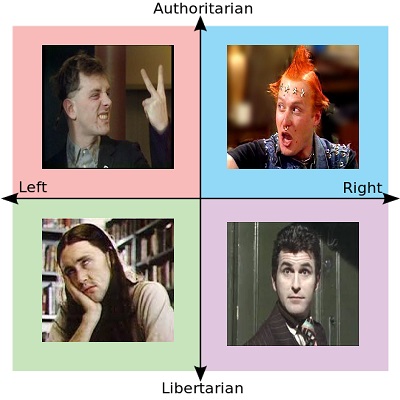
The second question is essentially the question between left and right. There are a variety of ways of posing this question and there are a number of ways of summarising what this question all boils down to. It’s apparent that the right is masculine and the left is feminine, but there are a near-infinite number of different ways of interpreting what this means.

In either case, it can be seen that the political solutions offered by either extreme are insufficient, and only cause the political pendulum to swing back equally as far as it is initially pulled. Leftist solutions are short-sighted, naive and reckless, and this inspires right-wing countermovements. Right-wing solutions are cruel, exclusionary and narrow-minded, and this inspires left-wing countermovements.

This swinging back and forth along the left-right paradigm has torn all nations of the West in two. None of them work as true nations any more: they are comprised only of a cadre of politicians and their wealthy backers trying to screw an ever-increasing horde of suckers as hard as possible. No-one has any national solidarity any longer because both sides have imported so many randoms that no-one has anything in common.

The left-right paradigm has to be abolished because it induces people to put their class interests above the national interests and, in so doing, makes it impossible for the people to have any real solidarity. Instead of being members of the nations, people self-segregate into social circles based on ideology. In doing so, they are divided and conquered.

Here it can be seen that a centrist position is the most naturally fitting to those who have already decided to operate on a national level. This avoids at once the cruelty of the right and the stupidity of the left, striking a balance in much the same way that silver is alchemically speaking a balance of iron and clay. This gives us National Centrism.

The third question is whether to go along with the established systems or to overthrow them. Regardless of the precise balances struck on the range of solidarity and the left-right questions, one separate question has to be asked: whether to co-operate with the established systems or to overthrow them if those systems are hopelessly corrupt. This is the alt question.

It’s apparent that the centrist parties have failed to create a worthy compromise between the left and the right. Rather than taking the best from both they have either taken the worst from both (in the form of neoliberalism) or adopted a piss-weak compromise that satisfies no-one except for major moneyed interests (such as most of the centrist parties in Europe). This is a political error akin to the balance fallacy in philosophy.

Alt-centrism is the refusal to fall prey to the balance fallacy. It seeks to harness both the strengths of the right and the strengths of the left. The right may be cruel, but within that cruelty is a healthy self-interest that can induce a people to stand up proud. The left may be stupid, but within that stupidity is an honest and earnest will to make the most out of what life offers.

Alt-centrism is, by contrast, an uncompromising position. The emphasis is not on the insipid compromises that have destroyed public faith in the West but rather on a dynamic fusion of the yin and the yang. This naturally eschews materialism by way of appealing to metaphysical ideals, and therefore leaves room in the national consciousness for the spiritual, which is the major domain in which the current political system has failed.

National alt-centrism is, therefore, a revolutionary nationalist philosophy that seeks to combine the orderliness of the wealthy with the creativity of the poor, for the benefit of both sides as one nation. It solves at once five separate problems: the problem of opening the gates to barbarians, the problem of becoming insular and weak, the problem of hoarding wealth in too few hands, the problem of losing touch with reason, and the problem of how to deal with an incumbent political system that is rotten to the core.

*

If you enjoyed reading this essay, you can get a compilation of the Best VJMP Essays and Articles of 2017 from Amazon for Kindle or Amazon for CreateSpace (for international readers), or TradeMe (for Kiwis).

VJMP Reads: David Seymour’s Own Your Future VI

A Liberal Vision for New Zealand in 2017

This reading carries on from here.

The fifth chapter in Own Your Future is ‘Welfare’. Here Seymour opens with what appears to be sympathy for the disadvantaged, telling a story about the children without shoes or food at Raumanga Middle School, before white flight took all the pakeha kids (including him) elsewhere. This doesn’t last long. Within a few paragraphs, he’s fuming about how welfare “saps the will to live”.

Seymour then tells a story about how Michael Joseph Savage, when he carried a table through the front door of the first state house in New Zealand, put that table down immediately after passing through that door. It’s not clear why this story is told here, because it doesn’t fit the rest of the section. It seems to simply fit Seymour’s narrative that anything done to help people is bad.

Like a 21st-century echo of Ebenezer Scrooge, Seymour decries the entire welfare system, going all the way back to 1937. The problem isn’t so much the usual right-wing canards of welfare queens and benefit fraudsters, the problem is that the welfare system is designed to “allow the disadvantaged to live full lives participating in equal footing in the community”.

In this section, the brutal and dishonest reasoning at the heart of neoliberalism is laid bare. Seymour makes a list of all of the problems in society and then blames them all on welfare, without providing any evidence or even so much as an argument that the two are connected. He lists a number of statistics about people on welfare, but provides no comparison to other times and places so that we can judge if those numbers are angstworthy.

Without a hint of irony, Seymour writes that “A Treasury report on life outcomes showed that at every stage of life, having parents relying on benefits predicted worse outcomes for children.” The fact that he conflates being on a benefit, rather than poverty, with being the cause of these poor outcomes, is the central error in Seymour’s reasoning, in the ACT Party’s reasoning, and is why the party can never and will never succeed electorally.

He talks about being on welfare as if it was a simple choice, and the man writing that is every bit the man writing about the horror of getting a tennis ball to the head. Seymour comes across as so out of touch that it’s almost comical, such as when he argues against the idea that “welfare is good for the people receiving it”.

The idea that welfare is bad because it makes people lazy is a fringe belief of the American Republican Party, considered gauche even by them, but it’s front-and-centre here. “Being out of work harms people, and more importantly it harms their children,” Seymour wails, crocodile tears spurting. One can easily imagine him as the overseer of a cotton plantation in the antebellum South, cracking the whip for his wealthy employers.

In an outburst of raw neoliberalism, Seymour quotes John Key when it comes to describing Working For Families as an example of “Communism by stealth”. Seymour goes as far as suggesting that not offering tax cuts when possible is equivalent to totalitarianism by stealth. Not ashamed of absurdity, he even accuses National, who slashed the welfare system so badly that we now have the developed world’s highest youth suicide rate, of not being opposed to Communism.

Laughably, Seymour claims here that ACT supports greater access to mental health care. Anyone who has been a mental health patient for long will know that the Fifth National Government slashed funding and access to mental health care, going as far as cutting benefits to severely mentally ill people – and the ACT Party supported them every step of the way. This is why there was a very strong correlation of -0.66 between voting ACT in 2017 and being on the invalid’s benefit (c.f. Dan McGlashan’s Understanding New Zealand).

It’s most notable that nowhere in this essay does Seymour mention the supply side of the welfare question. At no point does he touch on the poor wages in New Zealand, and at no point does he suggest that Kiwi employers ought to do their bit by offering a fair wage. Employers are completely exempt from playing any role in motivating workers to work by offering them a wage that they can live on or buy a house with.

*

If you enjoyed reading this essay, you can get a compilation of the Best VJMP Essays and Articles of 2017 from Amazon for Kindle or Amazon for CreateSpace (for international readers), or TradeMe (for Kiwis).