
What Lee Kwan Yew Might Have Said To Bronze Age Pervert (And To Us)

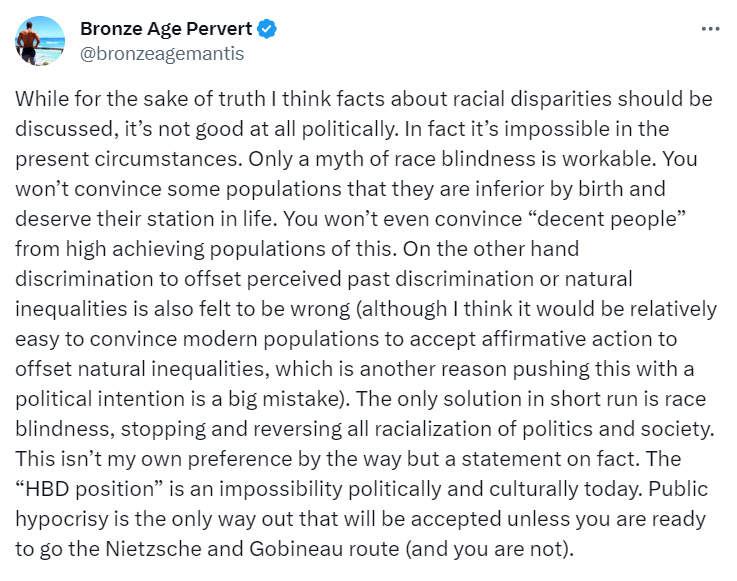
A recent tweet from Bronze Age Pervert has caused a shitstorm on Twitter. BAP wrote that “Only a myth of race blindness is workable.” The accompanying tweet thread (highly recommended reading) contains much controversy.

The logic that Bronze Age Pervert is describing is the logic that has ruled the West since World War II. It’s very close to the idea of Plato’s Noble Lie, in the sense that many understand it to be false, but it’s supported anyway for moral reasons (BAP states that supporting it is not his own preference but that avoiding this is politically impossible).

This logic claims that social harmony in the West depends on everyone believing in the myth that all races are equal. If certain races are told that their adverse collective outcomes are the result of their inferiority, they will get angry and destructive. It’s a matter of survival, therefore, that human biodiversity is denied, even as a concept.

If denying racial differences is the Anglo-Judaic approach post World War Two, Lee Kwan Yew supported a different approach.
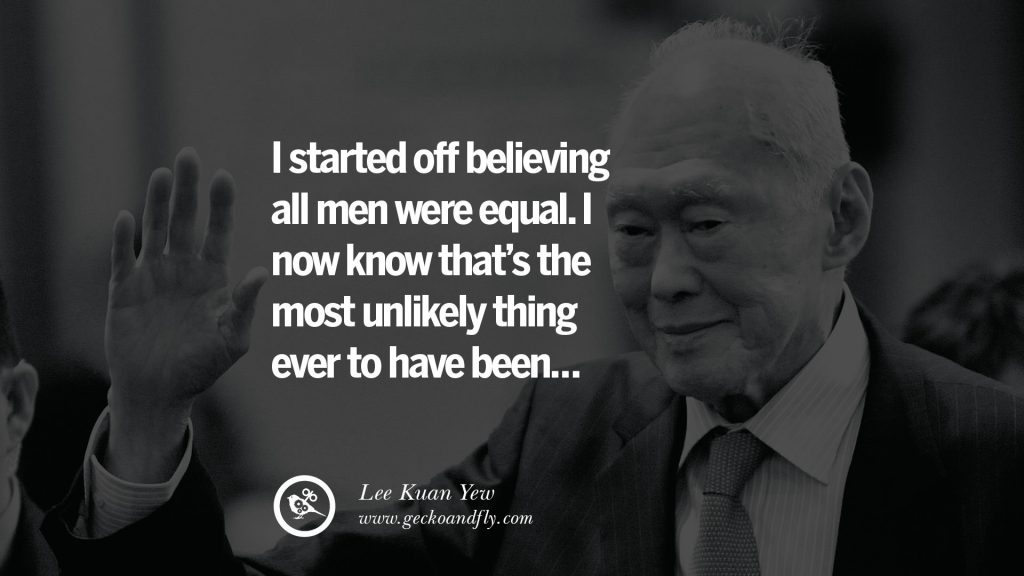
Lee Kwan Yew was perhaps the most famous proponent of the race realist position. Being Chinese, he mostly managed to avoid accusations of being a Nazi. Lee was happy to state that different races had different average intellectual potentials, and that these different potentials were the reason for their different economic and academic outcomes.

Not only was Lee happy to state this, he was unrepentant. He had very good reason to be so.

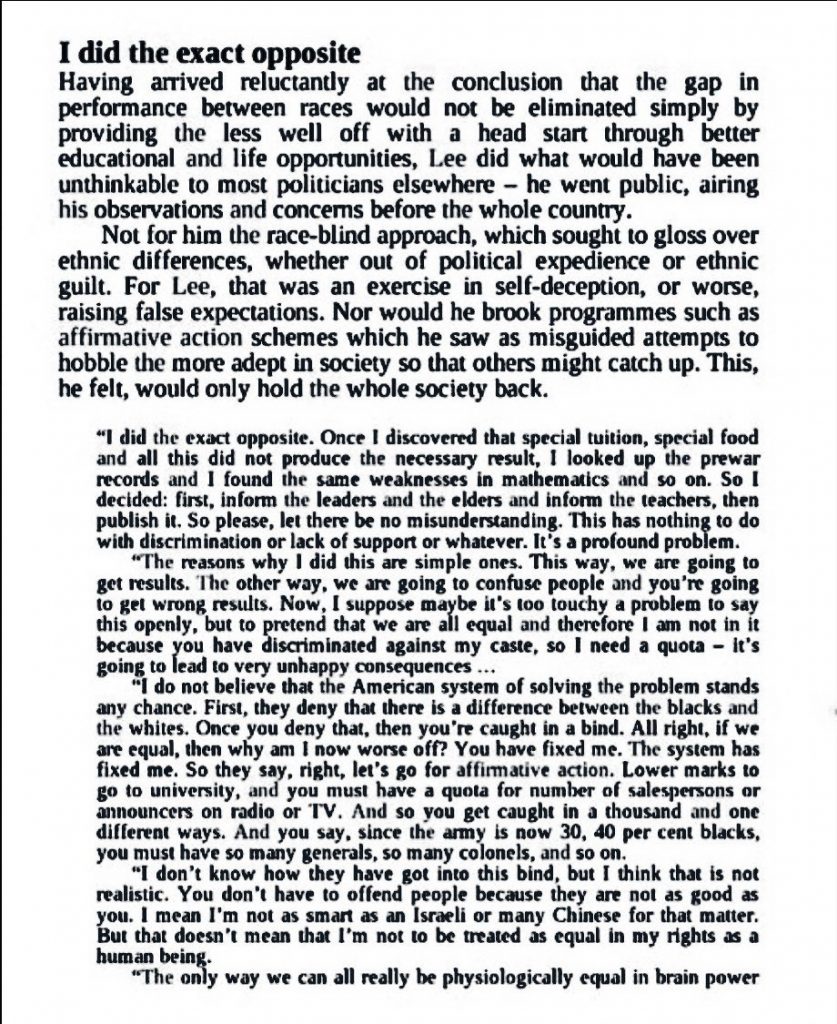
Lee Kwan Yew pointed out, quite reasonably, that there were many great pitfalls to the race blindness approach. First and foremost, if we assume that all races are equal, then it logically follows that the lower economic and academic achievement of the less successful races is due to racist discrimination.

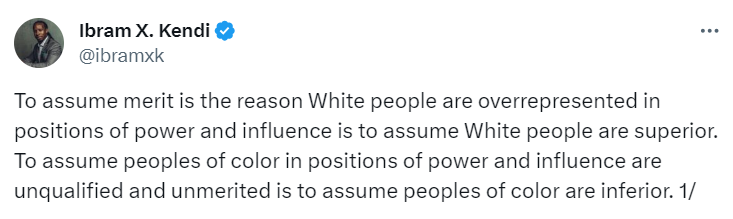
If a recipe for inter-racial resentment could be written, it would consist of claiming that wealth gaps cannot be explained by natural wealth-creating aptitude, and that they must be explained by structural discrimination, and that anyone who denies this is a racist. As Ibram X. Kendi’s writing reveals, raceblindness axiomatically assumes that if you aren’t raceblind, you’re a racist bigot.
Lee also pointed out, correctly, that if racist discrimination is widely believed to be the reason for the underperformance of certain races, then demands for quotas and affirmative action would inevitably follow. And then if those quotas and affirmative action programs did not result in equal outcomes, more demands for more of them would come.

The end result of “race blindness” is a never-ending cycle of increasing demands of equal treatment.

The resentment caused by this cycle is, as Lee realised, a major threat to social cohesion. When you have a large proportion of the population believing that the rest of the population has stolen something from them, social cohesion disintegrates. But this is the inevitable result of pushing the race blindness myth.

In the New Zealand mainstream media, one often sees articles decrying a supposed Pacific pay gap. The New Zealand Human Rights Commission’s “Pacific Pay Gap Inquiry” is ostensibly intended to discover the reasons for the fact that Pacific Islanders get paid less than white and Asian people. In reality, the reason for the inquiry is to fearmonger about white supremacism.

The reason for the Pacific pay gap is the same reason as for the working-class vs. middle-class pay gap: intelligence. It’s known that the average Pacific Islander IQ is considerably lower than the average white/North Asian IQ (see: Samoa 88, Tonga 86, Fiji 85). This is as predicted by Cold Winters Theory. So the pay gap simply reflects the gap in cognitive resources bestowed by Nature. It has nothing to do with discrimination.

The narrative that the pay gap necessarily implies structural discrimination, and that anyone who disagrees is a Nazi who sees others as racially inferior, is a narrative of pure resentment. It’s a slave mentality, designed to rabble-rouse and to destroy.
As Lee was aware, racial equality narratives are often pushed by Communists in particular, who push any and all anti-nationalist narratives. This is one of the reasons why he had to oppose them so hard. He knew that if a Communist narrative of Malays getting exploited by Chinese took hold, Singaporean society was liable to disintegrate.

If Lee Kwan Yew could give advice to those of us in the modern West, he would likely tell us to abandon the myth of racial equality. Promulgating it might make certain white people feel morally superior, and it might placate the egos of browns and blacks, but it creates a massive resentment that itself leads to an explosive social tension. He might argue that the “every man for himself” nihilism of the modern West was an inevitable consequence of this resentment.

Finally – and Lee made this same argument many times – races do not have to be intellectually equal for individuals from those races to be equally worthy of respect. There is no reason to disrespect an individual just because his race might have a lower IQ, not any more than there is to disrespect someone because his family is lower class. To do so is vulgar, a sign of low frequency.

*

For more of VJM’s ideas, see his work on other platforms!
For even more of VJM’s ideas, buy one of his books!

*

If you enjoyed reading this essay/article, you can get a compilation of the Best VJMP Essays and Articles from 2021 from Amazon as a Kindle ebook or paperback. Compilations of the Best VJMP Essays and Articles of 2020, the Best VJMP Essays and Articles of 2019, the Best VJMP Essays and Articles of 2018 and the Best VJMP Essays and Articles of 2017 are also available.

*

If you would like to support our work in other ways, subscribe to our SubscribeStar fund, or make a donation to our Paypal! Even better, buy any one of our books!

Five Signs That Someone’s Secretly Trashy

By the time most people finish high school, they know that it’s best to avoid trashy people. The problem is that, in the adult world, people engage in elaborate deceptions to hide their level of trashiness. This essay looks at five (relatively) subtle ways that you can see through the deception.

Note here that when we’re talking about trashiness, we’re talking about a person’s own level of rectitude. We’re not talking about social class, much less wealth. Low-frequency people who spread misery, fear and depression around them are trashy, no matter how much bling they may be adorned with.

For most people, it isn’t easy to determine whether another given person is trashy. Most people judge trashiness by inaccurate measures, so easily become misled. An education or a fortune doesn’t mean that one can’t be trashy. There are, in fact, several ways that a person can unwittingly reveal their inner trashiness to observers.

One of the most obvious ways to tell that someone’s secretly trashy is that their family don’t talk to them. If they have one or more adult children who don’t talk to them, chances are high you’re dealing with trash. This is especially true if the person claims to not know why their family members have stopped talking to them.

It’s not easy for someone to go no contact with a close family member. If it does happen, you can be confident that the reason was to protect against further abuse. Abusing one’s own family is perhaps the most characteristic sign of trashiness anywhere. If someone abuses their close genetic relative, it’s a certainty that they won’t feel bad about abusing you as well.

A second way is that a person is abusive to those weaker than them. The classic dating advice that if he’s rude to the wait staff he’ll be rude towards you is classic for good reason. It’s a sign of a bully. Trashy people tend to respect others only if they need to, they don’t respect by default. So if you’re getting respected by one of them now, don’t count on it lasting.

It could be countered here that abusing the weak is an obvious sign of trashiness, and that there’s nothing secret about it. That might be true, but there are a number of subtle signs of contempt and disrespect. A person’s regular use of them is a good sign that they are liable to turn to abuse. This is especially true if it’s coupled with obsequiousness towards the powerful.

A third sign is that a person chimps out whenever told no. In reality, if you respect someone’s boundaries then you also respect when they tell you no, even if you really wanted them to say yes. But some people treat being told no as if it was a grievous personal insult. This is a sign of very poor impulse control, which itself leads to many trashy behaviours.

A person who gets aggressive when told no is very likely to be the kind of person who takes advantage of others. It’s a sign that their moral development has stalled somewhere in early childhood. That kind of victimhood makes it possible for them to justify all manner of malicious actions. So be wary of anyone who behaves in such a manner, because if you ever have to assert your boundaries against them they will rage.

A fourth sign is that a person makes everything about them. Even at other people’s birthdays, weddings or funerals, trashy people act like the spotlight should be on them at all times. This powerful desire to be recognised is usually compensation for a life of little achievement. It’s often a sign of grandiose narcissism.

The classic sign that a person is a histrionic narcissist is that they seem excited when you talk about them, but then you talk about yourself and their eyes glaze over. This reveals the Main Character Syndrome that all but guarantees a person will treat those around them with undeserved contempt.

A fifth sign, perhaps the most subtle, is that a person discounts other people’s suffering. It might be a truism that tragedy is when it happens to me and comedy is when it happens to you. But a person who really acts as if other people’s suffering is meaningless is usually extremely trashy. A failure to empathise with a suffering people is a reliable indicator of trashiness.

This is especially true if their own suffering is considered important, just not anyone else’s. That’s the kind of egomania that is found among the trashiest of people. This goes triple if a person bullies people and claims that they’re joking, but get outraged when someone else “jokes” back at them.

In summary, there are several useful ways you can determine if another person is secretly trashy so that you can avoid them. These ways are mostly subtle signs of malignant narcissism.

*

For more of VJM’s ideas, see his work on other platforms!
For even more of VJM’s ideas, buy one of his books!

*

If you enjoyed reading this essay/article, you can get a compilation of the Best VJMP Essays and Articles from 2021 from Amazon as a Kindle ebook or paperback. Compilations of the Best VJMP Essays and Articles of 2020, the Best VJMP Essays and Articles of 2019, the Best VJMP Essays and Articles of 2018 and the Best VJMP Essays and Articles of 2017 are also available.

*

If you would like to support our work in other ways, subscribe to our SubscribeStar fund, or make a donation to our Paypal! Even better, buy any one of our books!
Clean And Dirty Information, And How To Tell The Difference

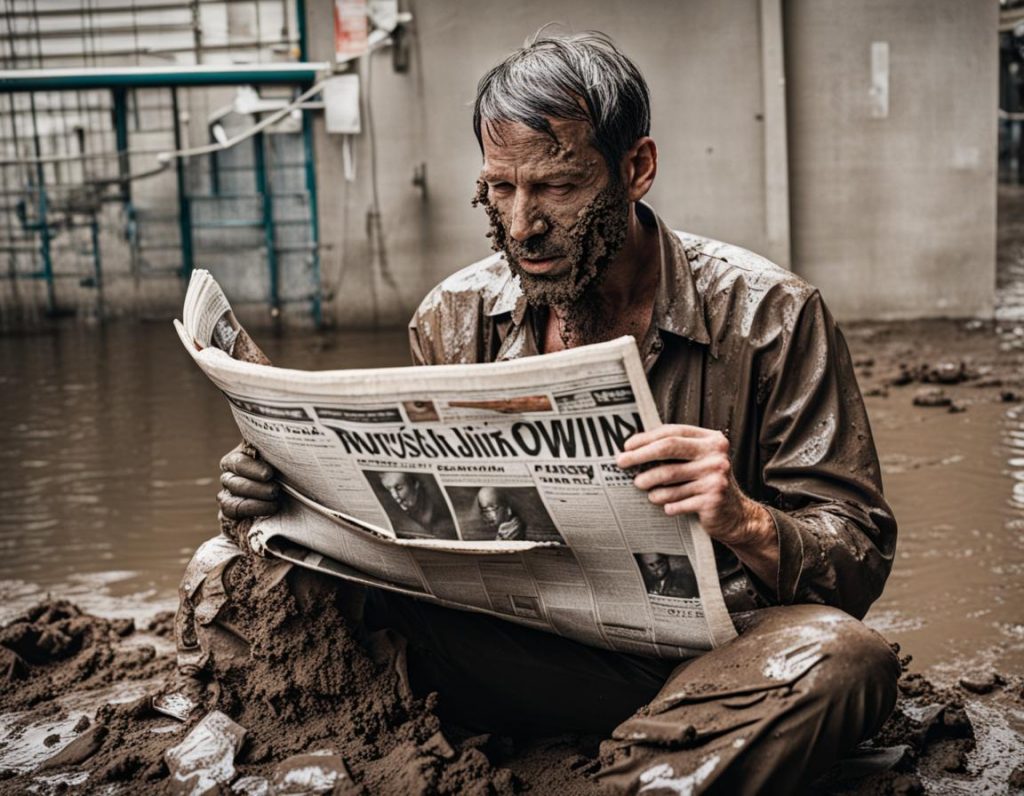
This essay describes a concept in information science. This is a concept that is of extreme importance in today’s Post-Truth Age, now that the media is even more full of propaganda than usual. It relates to the art and science of deciding whether a given set of information is trustworthy.

There are already conceptions of clean vs. dirty data. However, those conceptions are inadequate, because cleanliness is considered the same thing as accuracy. As such, they are not useful, because it would be simpler and easier just to use the term ‘accurate’ instead of ‘clean’.

A useful conception of clean vs. dirty information has to take into account the moral dimension of the people promulgating the information. Essentially, then, clean information comes from a clean source who cares about the truth only, with no view to the propaganda value of the information, and dirty information comes from a dirty source, who doesn’t care about the truth at all.

This division is very simple, but applying it in the real world of propaganda is highly complex.

For one thing, it takes great knowledge of the world and of the people in it to make accurate judgments about other people’s biases. The usual, poorly-educated approach is to trust people based on whether they have attributes in common with oneself: race, class, education, occupation etc. The more qualities they have in common, the more trusted.

Another poorly-educated approach used by many people is to determine truth based on whether the speaker has a high rank in the listener’s herd or not. So one’s pastor, boss, father or club leader becomes the authority to which one listens. All that matters is a high position in a friendly dominance hierarchy. This was the approach described in detail by Edward Bernays in Propaganda.

It can safely be said that all information from a political source is dirty. Any press release put out by a political party can be considered filthy. So can any article or book written by a member of a political party. The greater the influence of politics on any source of information, the dirtier it is.

It can also safely be said that most information from religious sources, particularly Abrahamic ones, is dirty. This is especially true of those who are seeking to gain followers for money or political power. Anyone who says that you have to obey them or suffer everlasting pushishment in a Hell Realm can be confidently written off as a dirty source. But in this regard, as with others, the world’s religions vary greatly.

Here it’s necessary to look at the reputations of the people pushing the information. Have they murdered their way around the world over the centuries? Do they regularly sexually abuse their children? Do they practice barbarisms such as infant genital mutilation? Do they have transparently sadistic animal slaughter protocols?

Perhaps there was once a time when the mainstream media was a clean source of information. This was back in the times when honest people chose to become journalists for the sake of spreading the truth (i.e. before the Charlie Mitchells took over). Today, no rational or intelligent person can trust anything in the mainstream media.

It used to be possible to trust scientists, because a lot of the people drawn to academia are the sort of person who values truth above merely material concerns such as political power or wealth. But then corporations started buying research favourable to their products. It turns out that scientists are only slightly harder to buy than politicians.

Who actually does tell the truth?

In order to reliably tell the truth, a person has to believe that there are positive consequences for speaking truth and negative consequences for telling lies. They have to believe in something like karma, or at least the Law of Attraction, before they can be trusted to put the truth before their own interests.

This is to say that it’s possible to trust genuinely spiritual people. But there, again, is another major problem: usually it’s impossible to tell if someone is genuinely spiritual or not. The low-IQ approach is to trust people at the top of the same religious herd as yourself. High-IQ people go on the reputation of the source among other high-IQ people.

If you would ask the ten most intelligent people you know who they consider clean sources of information, and if more than one of them suggested the same source, you could be reasonably sure that source was clean. This is the same logic as academic peer review, and, while an effective way of distinguishing clean from dirty, it’s far from infallible.

The tough news is that there’s no truly reliable way to tell if someone is a clean source of information other than going through everything they have written or said, comparing all facts therein stated to known truths, and subjecting their logic to the most rigorous examination. If they regularly make predictions that turn out to be false, that’s a good sign they’re a dirty source.

Perhaps the two rules of thumb are firstly: never trust an authority figure, because they have reason to lie to you. Secondly: prefer to trust someone who is trusted by smart people and distrusted by dumb people.

The great thing about clean information is that it can be absorbed without the need to take time and energy correcting for bias. A truly clean source of information is worth gold in the information marketplace of 2023. In this age of pervasive AI-generated content though, best of luck finding it.

*

For more of VJM’s ideas, see his work on other platforms!
For even more of VJM’s ideas, buy one of his books!

*

If you enjoyed reading this essay/article, you can get a compilation of the Best VJMP Essays and Articles from 2021 from Amazon as a Kindle ebook or paperback. Compilations of the Best VJMP Essays and Articles of 2020, the Best VJMP Essays and Articles of 2019, the Best VJMP Essays and Articles of 2018 and the Best VJMP Essays and Articles of 2017 are also available.

*

If you would like to support our work in other ways, subscribe to our SubscribeStar fund, or make a donation to our Paypal! Even better, buy any one of our books!

The Great Resistance, Fully Realised

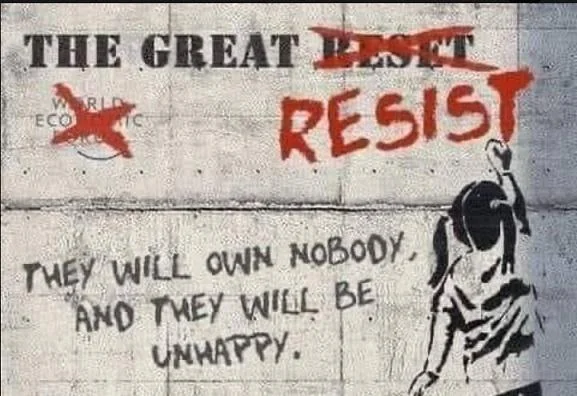
The Great Awakening appears to be going very slowly. The control system is very clever, and it knows that there are various ways to keep a population submissive. One of the tried-and-true methods is to work the population so hard that it doesn’t have time to organise an awakening or revolution. So before there can be a Great Awakening, there has to be a Great Resistance.

The Great Resistance has been described as a pushback from workers who want to keep working at home. The Coronavirus lockdowns led to a large number of workers working from home, and most of those workers decided that they preferred that to the daily grind of commuting for hours on top of a full day of work.

Many workers have been confused by their bosses’ demands for them to come back to the office post-Covid. It’s hard to see what, apart from a sadistic need for control, would motivate them to demand their workers commute when it isn’t necessary. This has led to some resentment, and that resentment has led to resistance.

Some have taken the Great Resistance concept further, to the point where it has become a Western version of the Chinese “lying flat movement“. After all, the reasoning goes, if you want to save on your commuting time because it’s wasted, why not save on other forms of wasted time as well? Such as working for a wage that you can never own a home and raise a family on?

There’s potentially much more to it than even that.

The Great Resistance has the potential to become an entirely new social movement towards resisting tyranny. If it can combine the right-wingers concerned about losing free speech and other freedoms, and the left-wingers concerned about unaffordable rents and housing, such a movement could have a major societal impact.

The Great Resistance could be a resistance of many things – not just of our material exploitation but also our spiritual exploitation.

Perhaps the most obvious and immediate cause for the Great Resistance relates to the share of wealth accrued by the bottom 99% of society. At the end of 2023, young and working-class people all over the West are in a state of deep malaise. The chance of owning a home that a family can be raised in seems remote for most of those people.

The first cause, then, is liberating wealth from the top 1%. Housing, especially, must be liberated so that people at an age to start families can afford it. This will involve shifting the entire balance of power back from the hoarders of land to the workers of it. Immigration must be stopped so that employers are forced to pay fair wages to locals.

The workday must be reduced so that Westerners have time for something other than work. Everything that sucks time from people unnecessarily, whether commuting, bullshit jobs, unpaid overtime, being always-on-call etc. must be abolished, by law. If the average worker today has become twice as productive as the average worker in the 1970s, they should see at least half of that benefit.

Resisting corporate propaganda is part of this. If any revolutionary social movement is to be successful, its members have to be ideologically clear. This means that they will have to resist the messaging of the mainstream media, the television in particular. Resist the corporate media’s tireless attempts to insert its advertising into your brain. Consume clean information.

Another part of the Great Resistance must also involve resisting shit food and drugs. Some Clown Worlders have coined the term ‘goyslop’ to describe the low-quality garbage food that pervades Western culture. The high goyslop consumption rates are partially because all the energy and time that would have been used for cooking is stolen by the employer. This must be resisted.

Naturally, this also involves getting fit. It’s not just about resisting slop but also resisting laziness. The Great Resistance will involve resistance training. Physical strength is a tangible sign of one’s refusal to collapse into the dirt. The attempts by the ruling class to drive the rest of us into the ground must be resisted.

Also, if any success is to be had, the members of the revolutionary social movement must resist spiritual lies intended to induce submission. The Great Resistance must continue the work and sacrifice made by those throughout history who have battled spiritual terrorism, in whichever form it has arisen. Death narratives must be rejected, and life narratives must be emphasised.

Fully realising the Great Resistance, then, will go far beyond merely working from home. It will involve a complete rebalancing of the relative powers of workers and capital owners, in both physical and metaphysical spheres. Previous attempts to achieve this rebalance have failed, mostly because working-class leaders were replaced by ruling-class lackeys. It’s time to try from a different angle.

*

For more of VJM’s ideas, see his work on other platforms!
For even more of VJM’s ideas, buy one of his books!

*

If you enjoyed reading this essay/article, you can get a compilation of the Best VJMP Essays and Articles from 2021 from Amazon as a Kindle ebook or paperback. Compilations of the Best VJMP Essays and Articles of 2020, the Best VJMP Essays and Articles of 2019, the Best VJMP Essays and Articles of 2018 and the Best VJMP Essays and Articles of 2017 are also available.

*

If you would like to support our work in other ways, subscribe to our SubscribeStar fund, or make a donation to our Paypal! Even better, buy any one of our books!