
Everything is a Matter of “Muh Feels”

It’s common for one side of an argument to demand from the other side a cold, logical, rational reason to justify their position, while at the same time decrying all appeals to emotion as fallacious. The problem with this line of reasoning is that there are no truly objective reasons to make moral judgments about anything. As this essay will investigate, all political motivations are based on emotion.

Usually the person dismissing an argument as emotional is the sort of person who is a bit autistic, perhaps themselves not really in touch with their own emotions. This sort of person has a tendency to dismiss the genuine outrage, horror or disgust of other people as illegitimate motivators. They also have a striking tendency to not realise how emotional their own arguments are.

For instance, on the question of taxation for the sake of paying for social services, many people on the left make the argument that the right are without emotion when it comes to child poverty, mental health services, rape crisis centres and the like. The usual rightist counter to this is to claim that them keeping the maximum amount of their own income is a moral imperative to oppose communism or the likes, and that left-wing “feels” about starving children etc. do not and cannot ever justify the government levying taxation upon people.

What these rightists usually miss when it comes to this line of reasoning are their own emotions that are tied up in the issue.

The government levying taxation upon people is not wrong by dint of some decree from God. It is usually only opposed by those who believe that their personal net return of government services received from this taxation is negative. For these people, a sense of anger arises from feelings of having one’s energy parasitised; a similar sort of anger arises in cases of property theft or gross disrespect.

It can thus be seen that the right wing opposes taxation for emotional reasons. In other words, “muh feels”.

Political questions, when it comes down to it, are all a matter of “muh feels”. Feelings of injustice motivate most of them, and for many people such feelings are unavoidable. After all, the feelings of the population about what is the optimum level of taxation fall along a bell curve with no taxation at one end and full communism at the other, but the actual overall level of taxation must fall on a point on that curve, meaning that many above it will be outraged that it isn’t higher and many below it will be outraged that it isn’t lower.

Even murder fulfills this criteria. After all, what’s wrong with murder other than that it makes us feel bad? If it wasn’t for the fact that a person likely feels terrified when they’re being murdered, or the fact that the people left behind feel bereaved when someone they love is murdered, or the fact that the people in the neighbourhood feel afraid by murders in case they are next, or the fact that other citizens feel disgusted by murder because they consider it a bestial act of brutality, then there would be no reason to even make murder illegal, much less anything else.

Indeed, it could even be argued that, without feels, none of us would be capable of feeling motivated to do anything, and we would simply lie about until we died of metabolic failure.

Although it’s often true that a person does not examine their own emotional impulses and makes political decisions by just lurching from one burst of neurotransmitters to the next, this does not by itself mean that emotional input into decision making is necessarily undesirable, or that a line of reasoning appealing to an emotion is necessarily fallacious.

It could even be that, for a social species, correct decisions cannot be made without some accounting for how people will emotionally react to them. If one drills deep enough, there may not be much more to life than “muh feels”.
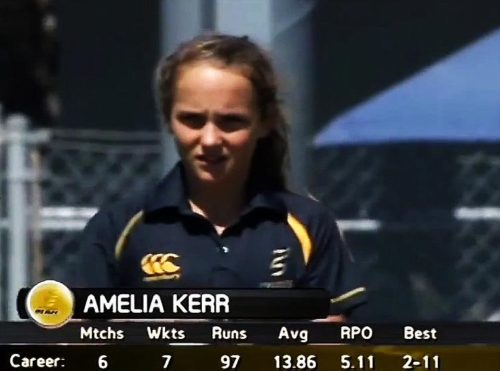

Could Amelia Kerr Play For the Black Caps?

Cricket is a game of skill, not strength, and Amelia Kerr has bags of that. Could she compete with the men?

The main reason for dividing sports teams into men and women is because this reflects the basic division of labour that has occurred in nature: into male fighters and female reproducers. This is the same logic as dividing boxers into weight divisions – that the categories are so different that to pit them against each other is not a fair competition. As this essay will examine, one niche within sports where the female body has an advantage over the male one is that of legspinner.

The chance of a female competing with men in heavyweight boxing, absent some wicked cybernetic arms or computer targeting systems in bionic eyes, is practically zero, and the same could be said of Greco-Roman wrestling or rugby. These sports are too similar to actual fighting for women to compete with men, who are the result of millions of years of natural and sexual selection of fighting skills.

Cricket is, like other sports, a metaphor for combat, but it is not like other sports. It’s not primarily a contest of strength, speed, size, height or aggression. Cricket is a contest of skill, guile, concentration and nerve – qualities that might be of immense value in the conduct of warfare, but not so much in actual fighting.

This is why the sportsmen who become the world’s top cricketers are very seldom in top fighting shape. Kane Williamson, Steve Smith, Joe Root and Virat Kohli are far from musclemen; Rangana Herath, who just moved past 400 Test wickets, is known as “Fatty” for his distinctive pot belly and the less said about Dwayne Leverock the better.

There’s a lot of skill in fast bowling, but physical attributes are crucial. Although the most skilled fast bowlers – like Dale Steyn, Trent Boult and Jimmy Anderson – are not particularly tall, they are all far from short. Moreover, any player lacking those skill levels almost has to be tall in order to make it.

In either case, women can’t compete with men in fast bowling because so much of the action of slinging a weight (like a ball) is a function of shoulder strength, and shoulder strength is one of the ways in which men are stronger than women by the greatest amount.

There’s a lot of skill in batting, but there’s also a lot of strength. Williamson and Kohli might trade on skill but they are far from weaklings. No woman could realistically compete with either player, much less the heavy hitters like Martin Guptill, Chris Gayle, David Warner or Brendon McCullum.

As in the two categories of cricketer above, there’s a lot of skill in spin bowling, but in this regard there is no benefit at all to being strong.

In fact, having big muscles might be a disadvantage. Muttiah Muralitharan, the single most successful spin bowler in the history of cricket, had famously rubbery wrists, extremely flexible, which enabled him to sling the ball with a whipping action that imparted incredible turn.

It’s known that women are more flexible in the wrists, elbows and shoulders than men, which is partially a function of having less muscle mass. This flexibility ought to make it possible for female bowlers, like legspinner Amelia Kerr (see video), to put more spin on the ball for the same reasons that Muralitharan could.

However, the big thing when it comes to spin bowling is smarts. The bowler is trying to deceive the batsman, trying to make them play down the wrong line or put their feet in the wrong place anticipating spin in, for example, the other direction.

To this end they need a lot of variations. It seems like Kerr already has most of the variations – and speaking of variations, very few international men’s cricket sides will have faced a bowler as short as Kerr, and therefore they will not be used to the trajectory her deliveries come from.

All this raises a question. Kerr currently has 20 wickets in women’s ODI cricket at an average of 22, and it might be that the coaches of the Black Caps decide that her cunning, guile, variations and unpredictability make her more dangerous against the Black Caps’ next opponent than the best legspinning male. Should Kerr then be eligible for the Black Caps?

Some might argue that the Black Caps are specifically a male representative team and so it doesn’t make sense to pick a woman to play in it, in same way that no-one would select a man to play in the Silver Ferns.

Others would argue that the sport of cricket was only gender-segregated in the first place because of the unlikelihood that any given woman could compete with men, so if a woman is good enough to compete with the best men there is no reason to enforce segregation.

In any case, this column predicts that if Kerr would get the chance to bowl in a net with the Black Caps, the men would learn a thing or two from her.

Should We Lower Women’s Pensions to Bridge The “Gender Death Gap”?

The average Kiwi female enjoys 26% more life post-retirement than the average Kiwi male – this is dubbed the “gender death gap”

The national consciousness is currently in a state of hysteria over an Auckland electrician’s decision to offer a 12% discount to female customers on account of New Zealand’s “gender wage gap”. For those of you not in the matrix, the gender wage gap refers to the fact that the average weekly income of a woman is lower than the average weekly income of a man.

Although Dan McGlashan proved in Understanding New Zealand that the wage gap is entirely due to the fact that men work full-time jobs more often and the women work part-time jobs more often, and that there is no difference in wages for those men and women who are part of the professional class, the perception persists that women are deliberately ripped off in remuneration for their labour by some nefarious conspiracy of people with Y chromosomes.

Some, like the Auckland electrician mentioned above, seem to believe that this perception of a malevolent bias against women justifies giving women discounts when it comes to trade, in an effort to redress the imbalance in wages.

The real injustice when it comes to differential treatment of the genders is that women live much longer than men do. Females born today are expected to live 3.7 years longer than men do, an injustice many times more cruel than a piddling difference in wages.

The average female can expect to live 83.2 years from birth, whereas the average male can not even count on getting to 80. His average life expectancy is only 79.5.

Another way of looking at it is that the average female gets another 18.2 years of life after hitting retirement age at 65, compared to the paltry 14.5 years of the average male.

Measured in percentages, this means that the average female gets to enjoy 26% more life in their golden years than the average male. This is a disparity that weighs much heavier than that of mere money. Here we are talking about life itself.

We can call this disparity the “gender death gap”. Knowing about this gap in life expectancy, and knowing that there are tireless calls for restitution from working age men on account of the gender wage gap, one question immediately arises: should we call for restitution from pension age women?

It could be argued that, if tradesmen like the electrician mentioned earlier give discounts to working age women on account of the gender wage gap, they also should give discounts to pension age men. After all, the clock is ticking for those men in a way that does not compare to the experience of the female.

Perhaps the fairest solution would be to immediately cut female pensions by 26%, which would equalise the amount of post-retirement money that the different genders got out of the Government.