
When Cannabis Becomes Legal, Psychedelics Are Next

Almost all of the arguments for legal cannabis apply for legal psilocybin

21% of Americans now live in states that have legal recreational cannabis, and an overwhelming majority of them live in states with legal medicinal cannabis. It’s now obvious to every honest person that cannabis is a medicine, and that the recreational positives of it vastly outweigh the negatives. However, even when cannabis law reform wins its inevitable comprehensive victory, it won’t be the end of the struggle for cognitive liberty.

The struggle for cognitive liberty has been waged for several thousand years. It arguably begun when the first ever conversational topic became taboo – perhaps when some alpha male enforced a rule that meant his tribe were forbidden to speak of a certain subject. Since then, the forces of cognitive enslavement have only become more aggressive and more sophisticated.

In the New Zealand of today, we plebs are not even allowed to smoke medicinal flowers such as cannabis, not even if one of us has a severe medical condition that causes them to suffer badly. We’re not allowed to because the deconditioning effect of cannabis means that all of the shameless bullshit and lies that the political class have pumped into our heads for decades would be at risk of getting rejected.

Because the conditioning that enslaves us is profitable to the ruling class – as it makes us compliant, submissive and obedient – it is worth money. It could effectively be considered capital. This means that allowing the population cognitive liberty to question their own psychological enslavement, and the means to achieve this liberty, is a risk to the accumulated wealth of the ruling class.

This is true of cannabis, and is true ten times over for psychedelics.

Ultimate cognitive liberty comes from the complete destruction of the conditioned mind (or programmed mind). The behaviours that have been deliberately programmed into us have, and are intended to have, the ultimate effect of making us unhappy, because there is nothing more profitable than human misery.

This refers to the programmed behaviours that the ruling class force into your head at school, in the workplace, and through the mass media. They do this because your slavery is profitable, and because it allows them to impose a form of order on society that is beneficial to them. For these two reasons, the ruling class opposes the legalisation of drugs that allow cognitive liberty to flourish.

For example, it is known well enough by the people who need to know such things that smoking cannabis makes a person less desiring of, and less attached to, material possessions. This is because it has the effect of reducing suffering, which makes a person less likely to work long hours to save the money necessary to buy the crap that they mistakenly believe will make them happy. So reduced suffering means reduced profits for the ruling class.

Therefore, maximum profitability demands that the cognitive liberty of the people who might question this brainwashing be minimised.

When the Western World was first exposed to the power of psychedelics, we just shat our pants. We were in no way emotionally mature enough to deal with an entheogen that reunited our individual consciousness with that of God. Reuniting one’s consciousness with God is the same as absolution from all suffering, and we were in no way ready for that.

However, now that many of us are mature enough to treat cannabis as what it really is – a deconditioning agent that alleviates psychological suffering – we are starting to become aware that much of the suffering we endure on a daily basis has been forced on us from positions above us on the dominance hierarchy.

This means that the further we can decondition ourselves, the less suffering.

This fact was understood by Kevin Saunders, who is the man behind the recent Californian ballot initiative that seeks to “exempt adults 21 and older from penalties of possessing, selling, transporting, or cultivating psilocybins.” Saying that the ballot is “a natural progression from marijuana legalization,” Saunders relates a personal story of overcoming heroin addiction as a result of the deconditioning effects of the drug.

Psychedelics have incredible potential for alleviating all suffering arising from psychological conditions that are caused by excessive conditioning, in particular anxiety, depression, post-traumatic stress and addiction. Many people are aware of this, though they are currently shunned by the mainstream narrative, which has been set (as mentioned above) by those who profit from the suffering.

Over time, however, the truth will out, and this means that the legalisation of psychedelics is an inevitability.

Freethinkers! It’s Time to Pull Back to the Secret Societies Again…

Every honest person in the Western World is right now suffering from a profound sense of unease. With another Cultural Revolution sweeping the West, it seems like the barbarian hordes are about to win their ultimate victory of destroying all order in the world. Fret not! There is historical precedent to guide us out of this turmoil – but it’s not going to be easy.

This profound sense of unease is easy to explain. Our cultural and political elites – rotten with corruption, bloated by the easiest life of any generation in history and blinded by ideology – have simply lost control. There is no longer a coherent shared sentiment that holds us together, and, without this, we have lost all solidarity.

In order to be a people, and not just a mess of randoms, we have to have solidarity. In order to have solidarity, a people needs to have a common ground.

The fashionable attitude of our time is the Orwellian “Diversity is Solidarity.” The contradiction here is obvious – the more diversity there is, the less we have in common with each other, and therefore the more diversity there is the less solidarity.

The rot has started at the top. We have an utterly corrupt political class. They inherited the highest standard of living in history after World War II and, bereft of historical awareness, have come to think it natural, and are interested in nothing beyond maintaining this comfortable lifestyle into senescence.

What happens to the generations that come after them is of no concern – as long as there are workers to sweep their streets and to wipe their arses, the Baby Boomers are happy enough. Because there naturally aren’t enough low-paid workers to maintain this lifestyle, the Boomers have chosen to simply import them, and have left us with the impossible task of maintaining a coherent culture in this maelstrom.

In recent centuries, anyone wishing to educate themselves into the nature of reality was able to do so at a university. The word ‘university’ means community, in the sense of a community of teachers and scholars. The idea is that, as a result of the collective effort of intelligent, honest truth-seekers, the true nature of reality will become apparent to the seeker.

This was true up until fairly recently. The New Zealand university system was able to produce a Rutherford a little more than a century ago.

Over the past twenty years, however, the university system has fallen into decline, and is no longer fit for purpose. Instead of honest, unconditioned freethinkers, the Western university system has become a production line of sheep-like drones, conditioned to be terrified of original thought by the ever-present threat of merciless social disapproval.

So, instead of being a community where seekers of wisdom can come together and share knowledge about the nature of reality, debating it and refining it, most of the products of this system are just pure cancer. University graduates are now more interested in virtue signalling than in the truth; indeed, the entire concept of ‘truth’ has been destroyed in the confusion wrought by postmodernism.

There’s only one solution, and history tells us what it is. In an age where the rights to free speech and free association have been lost (to both direct and indirect attacks), it’s necessary to once again meet in secret. Behind closed doors. Entry only by an invitation that is jealously withheld until proof that one is made of the right stuff has been given.

In other words, it’s necessary to fall back to the network of secret societies inspired by the Mystery Schools of ancient Egypt and Greece. The public ground has been lost to the barbarians – it’s time this was admitted by men of truth and the appropriate measures taken.

Indeed, this was where the original university system originated from – this is why people are not awarded Master’s Degrees but are rather “Admitted to the Degree of Master.”

This company has already begun work to source a kykeon capable of inspiring the spiritual insight that formed the basis of the Eleusinian Mysteries. At some point in the near future we will reinstate these mysteries in Sun City, New Zealand.

The Great Fractal

In the beginning was consciousness. This is the same as God, and it is the same as yourself. God is consciousness, and God is you, and you are consciousness. This didn’t really happen in the beginning, because there’s no such thing as time, but it’s the start of the story.

All religions and spiritual movements are inspired by gnosis about the real nature of God. It’s very simple – God is consciousness because consciousness is sufficient to create the entire physical world (and all possible worlds), and consciousness is outside of time and space and is complete even in division.

Nothing over and above consciousness is necessary to create the appearance of the entire material world and everything in it, and the appearance of every possible material world and everything in that. In fact, all of these possible material worlds can be derived through repeated iteration of a simple fractal equation – the Great Fractal.

So when people say that God is omniscient and omnipotent and everywhere and eternal they are entirely correct, because all of these things are true of consciousness.

The only disagreement arises when people try to describe the precise nature of God. These efforts are doomed to failure because consciousness is more fundamental than language, and therefore cannot be defined in language. And so all efforts to describe God or to interpret the will of God are errors, usually made through a person conflating their ego with God and therefore confusing their personal desires for the will of God.

That’s all there is to life. You, being conscious, are conscious of things. This never changes, not even on the other side of the death of your material body.

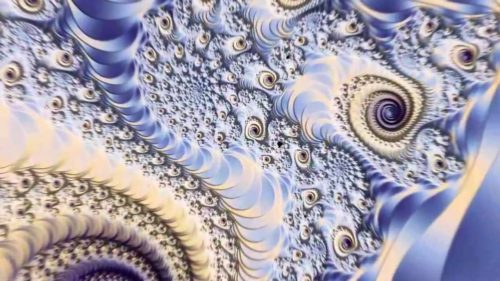
The Great Fractal is the sum total of all of the possible phenomena that God can be conscious of. It is called the Great Fractal because all possible lives are similar to all other possible lives in ways that, if represented graphically, form a fractal of infinite complexity and depth.

Every possible life is being lived by God, right now, with full consciousness – and always has been and always will be. There is a being exactly the same as you who is right now living the life you lived up until ten minutes ago – and there are an infinite number of lives being lived inbetween now and ten minutes ago.

The Great Fractal is alive. It is bursting with consciousness. Every possible life that God can imagine – from the simplest flatworm to seventh-dimensional wizards, is consciously being lived right now, and always will be, forever.

How? God just dreamed them up, and God continues to dream as an act of will. That’s all that this – what we call life – is: just a dream. You know this because it’s not any more real than the dreamworlds that you experience at night. Nothing is different at such a time – you are consciousness, and you are conscious of phenomena, and that’s all there is to it, awake or asleep.

What you consider to be your life is just one infinitely small and infinitely limited perspective of the Great Fractal, at the human-on-Earth-in-the-21st-century level. Just like a computer program that can give you the impression of an entire journey merely through zooming in on particular co-ordinates of a fractal, so is your life just a pathway through the Great Fractal and what you see along the way.

You do have free will, only you are limited by certain laws whose purpose is to make this illusion more immersive. What you consider to be free will is nothing more than navigating through the Great Fractal to the degree that you are able – you decide on a part of the Great Fractal that you would like to experience and then – if it’s possible to get there from where you are now while obeying the laws of immersion – you go there.

Why did this happen, instead of something else happening?

Being pure consciousness, God is perfection. God resides in a state of perfect bliss, complete and without desire.

Although this is perfect on one level, it’s grossly imperfect on another: it’s not very interesting.

Simply put, the most enjoyable game that God can play is to look into a limited section of the Great Fractal for long enough so that God can actually come to convince Godself that this limited section is really the whole thing – and then God can feel a sense of awe and grandeur by once again awakening to an appreciation of the whole, an appreciation of itself, an awakening from the delusion that God was ever something else.

And then to do it again, and again and again, forever – an unceasing pattern of forgetting and remembering, of mistaking the illusion of the material world for transcendental reality and then realising the trick and laughing about the fact that one could ever fall for something so obvious.

What we call enlightenment is what naturally arrives as a consequence of turning the common, understandable, materialist perspective around; from looking backwards at the uncreated consciousness instead of looking forwards into the created Great Fractal.

The Great Fractal is the sum total of all the contents of consciousness and all the possible contents of consciousness. It is what the ancient Vedic culture called Maya. We mistake it for reality to the extent that we are making a game of this life.

If Materialism Is False, Death Is Nothing To Fear

Materialism is such a dominant perspective in today’s culture that we’ve almost forgotten that it is a perspective. The near-universal assumption is that consensual reality is a mindless collection of atoms and molecules, and of temperature and energy, and that the brain generates consciousness. This essay is a reminder that this perspective is just a perspective, and not necessarily the truth.

Thinking logically, it soon becomes apparent that there’s nothing especially rational about adopting the perspective of materialism, although doing so may be temporarily useful for anyone trying to run a scientific experiment.

From an existential perspective, the only thing you know for sure is that you’re conscious. That’s it. Existence precedes essence – this is another way of saying that consciousness precedes the contents of consciousness.

At this point, most people will protest that they are also aware of the material world. This conclusion follows naturally from the assumption that the brain generates consciousness, because once a person has made this assumption it seems natural to think that the brain has developed to become aware of the material world.

But no-one knows for sure that what they are aware of is a material world. A person might be conscious of a perspective that relates to some mental attempt to make sense of the stimuli that they have received from what appears to be a material world, but this is in no way evidence that such a material world exists – the map is not the territory.

Some might argue here that the sensory impressions that impact upon our consciousness are, nonetheless, impressions from the material world, and that we know that our sensory organs have made accurate impressions of this material world because of our successful adaptation to it.

But the worlds that we encounter in our dreams, which can be as real and as detailed as this material world, are evidently not creating impressions on our eyes, because those are closed and we are asleep. From this we can deduce that eyes are not necessary to create an illusion of a material world realistic enough for a consciousness to want to survive in it.

And from this it follows that a material world is itself entirely unnecessary, because consciousness could simply dream one up in its absence and would be unable to tell the difference.

At this point a materialist might continue to object, claiming that although the dreamworld that the dreamer experiences is evidently non-material (despite being equally as real from an existential perspective), the appearance of it is nonetheless created by the brain, wherein it resides.

But at this point the materialist has allowed themselves to become a magical thinker. The belief that consciousness resides in the brain does not follow from any logical process.

Usually the materialist will continue to profess that science will one day prove what the “origin” of consciousness is, and that when it does so this origin will doubtlessly be material, but this line of reasoning is just the mirror opposite of what materialists deride as “the god of the gaps”.

In other words, it’s magical thinking, not rational thinking.

Talking to a materialist about the idea that consciousness itself has generated the contents of consciousness (i.e. it has dreamed up the material world as a particularly convincing delusion) is like talking to a medieval theologian about the idea that man has generated the idea of the Christian god – their basic existential assumptions about reality make a conversation about it essentially impossible.

If one refuses to make the assumption that the brain generates consciousness, then there is no reason to believe that the death of the physical body and brain should affect the experience of being conscious. Therefore, it follows that, if the existence of consciousness is not predicated on temporal phenomena, consciousness must be eternal.

And if consciousness is eternal, then all the contents of consciousness are just forms – things that come and go. And your body, being nothing more than some of the contents of your consciousness, is one of those things that comes and goes – but it isn’t you.

Therefore, there is no significant difference between the death of the physical body and any other major change in the contents of consciousness. The death of the physical body might portend a great change in the contents of consciousness, but there is no logical reason to think that this necessitates a change in consciousness itself.