Cricket is a game of skill, not strength, and Amelia Kerr has bags of that. Could she compete with the men?
The main reason for dividing sports teams into men and women is because this reflects the basic division of labour that has occurred in nature: into male fighters and female reproducers. This is the same logic as dividing boxers into weight divisions – that the categories are so different that to pit them against each other is not a fair competition. As this essay will examine, one niche within sports where the female body has an advantage over the male one is that of legspinner.
The chance of a female competing with men in heavyweight boxing, absent some wicked cybernetic arms or computer targeting systems in bionic eyes, is practically zero, and the same could be said of Greco-Roman wrestling or rugby. These sports are too similar to actual fighting for women to compete with men, who are the result of millions of years of natural and sexual selection of fighting skills.
Cricket is, like other sports, a metaphor for combat, but it is not like other sports. It’s not primarily a contest of strength, speed, size, height or aggression. Cricket is a contest of skill, guile, concentration and nerve – qualities that might be of immense value in the conduct of warfare, but not so much in actual fighting.
This is why the sportsmen who become the world’s top cricketers are very seldom in top fighting shape. Kane Williamson, Steve Smith, Joe Root and Virat Kohli are far from musclemen; Rangana Herath, who just moved past 400 Test wickets, is known as “Fatty” for his distinctive pot belly and the less said about Dwayne Leverock the better.
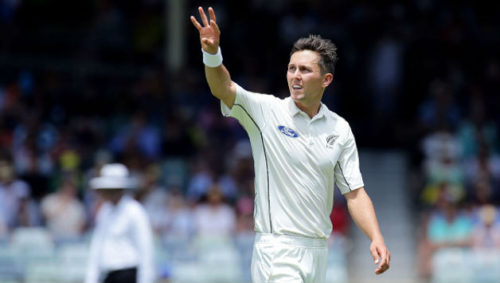
There’s a lot of skill in fast bowling, but physical attributes are crucial. Although the most skilled fast bowlers – like Dale Steyn, Trent Boult and Jimmy Anderson – are not particularly tall, they are all far from short. Moreover, any player lacking those skill levels almost has to be tall in order to make it.
In either case, women can’t compete with men in fast bowling because so much of the action of slinging a weight (like a ball) is a function of shoulder strength, and shoulder strength is one of the ways in which men are stronger than women by the greatest amount.
There’s a lot of skill in batting, but there’s also a lot of strength. Williamson and Kohli might trade on skill but they are far from weaklings. No woman could realistically compete with either player, much less the heavy hitters like Martin Guptill, Chris Gayle, David Warner or Brendon McCullum.
As in the two categories of cricketer above, there’s a lot of skill in spin bowling, but in this regard there is no benefit at all to being strong.
In fact, having big muscles might be a disadvantage. Muttiah Muralitharan, the single most successful spin bowler in the history of cricket, had famously rubbery wrists, extremely flexible, which enabled him to sling the ball with a whipping action that imparted incredible turn.
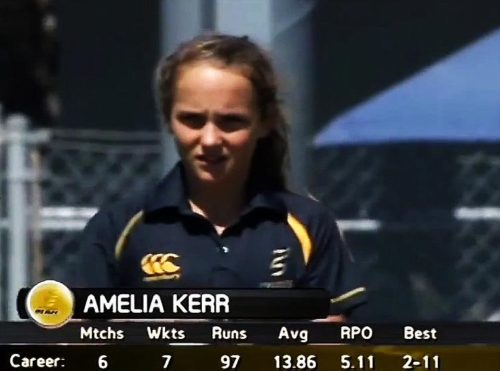
It’s known that women are more flexible in the wrists, elbows and shoulders than men, which is partially a function of having less muscle mass. This flexibility ought to make it possible for female bowlers, like legspinner Amelia Kerr (see video), to put more spin on the ball for the same reasons that Muralitharan could.
However, the big thing when it comes to spin bowling is smarts. The bowler is trying to deceive the batsman, trying to make them play down the wrong line or put their feet in the wrong place anticipating spin in, for example, the other direction.
To this end they need a lot of variations. It seems like Kerr already has most of the variations – and speaking of variations, very few international men’s cricket sides will have faced a bowler as short as Kerr, and therefore they will not be used to the trajectory her deliveries come from.
All this raises a question. Kerr currently has 20 wickets in women’s ODI cricket at an average of 22, and it might be that the coaches of the Black Caps decide that her cunning, guile, variations and unpredictability make her more dangerous against the Black Caps’ next opponent than the best legspinning male. Should Kerr then be eligible for the Black Caps?
Some might argue that the Black Caps are specifically a male representative team and so it doesn’t make sense to pick a woman to play in it, in same way that no-one would select a man to play in the Silver Ferns.
Others would argue that the sport of cricket was only gender-segregated in the first place because of the unlikelihood that any given woman could compete with men, so if a woman is good enough to compete with the best men there is no reason to enforce segregation.
In any case, this column predicts that if Kerr would get the chance to bowl in a net with the Black Caps, the men would learn a thing or two from her.
“Just give me one that swings thanks Kane, and we’re going to No. 1.”
There’s something you can see right now that hasn’t been seen for thirty years. It’s not a rare comet: it’s an official Test cricket rankings that has New Zealand higher than Australia. It might come down to decimal points – both teams are on 97 overall ratings points – but the Black Caps are in fourth, the Baggy Greens in fifth. Do the Black Caps deserve to be considered a better Test side than Australia? This article has a look.
We will comparatively examine the relative strengths of either nation in the positions of established opener, junior opener, No. 3, No. 4, No. 5, allrounder, wicketkeeper, first seamer, second seamer, third seamer and spinner.
This article will compare them at all positions, championship boxing style, with an advantage in one of these positions worth a one point win and a knockdown advantage worth a two point win, to be judged along eleven rounds.
Established opener:Tom Latham vs. David Warner
On the briefest glance, this looks like a hands-down win for Warner. He boasts a Test batting average of 47.94, with 20 centuries, compared to Latham’s Test average of 38.84 with six centuries. Warner’s overall average, however, masks the stats of a home track bully.
Although Warner has a considerably higher average than Tom Latham, the two players have a similar average when batting away from home: Warner averages 36.81 away compared to Latham’s 38.46. This is the reason for Warner’s reputation as a home track bully – Latham averages about the same at home as away but Warner averages 59.12 at home.
In all, you’d probably have to give this one to Warner on the basis that he is more likely to play an innings of matchwinning destructiveness once in than Latham is, and that Latham is yet to play a definitively excellent innings against a top-flight team yet.
New Zealand 9, Australia 10
Junior opener: Jeet Raval vs. Matt Renshaw
Jeet Raval is a batsman in the style of Mark Richardson, and in a seven-Test career has functioned an average of 44, the same as Richardson. An average of 44 for a second-choice opener is incredible by recent Black Caps standards, and if Raval can keep his concentration and stick to his simple, AK-47esque simple brutality, he could be excellent in the future.
Matt Renshaw is even less established. He does have one Test century, which Raval has yet to manage, and it’s a big one: a 184 against a visiting Pakistani side this January. Apart from that, he’s not shown too much, maintaining a decent but unremarkable average of 36.64 from ten matches.
This one might be marginal, but it’s still New Zealand’s.
New Zealand 10, Australia 9
No. 3:Kane Williamson vs. Steve Smith
Steve Smith is currently at the top of the Test batting rankings, and there’s few who could really dispute that based on the numbers. He sits at 936 ranking points right now, befitting his stratospheric average of 59.66.
Unlike the days of Ricky Ponting, however, New Zealand boasts a No. 3 in the same league. Kane Williamson is not far behind Smith on the ICC rankings, at 880. Coming off a series in which he scored two hundreds in three matches against the excellent South African attack, Williamson can lay claim to being at least a pretender to Smith’s throne.
Smith is almost universally regarded as superior but here’s a curious statistic: since the start of 2015, Williamson averages 68.37 compared to Smith’s 67.79. Smith has certainly accomplished more in this time frame, but that’s primarily because he has played 15 more innings than Williamson has.
Smith has scored centuries at a marginally higher rate than Williamson during this time: 13 of them from 56 innings for a 23.2% chance per innings. Williamson has scored 9 centuries in 15 fewer opportunities than Smith, which works out to a 21.9% chance.
So in terms of who’s better right now or in the immediate future, on balance it goes to Smith but only by a whisker.
New Zealand 9, Australia 10
No. 4:Ross Taylor vs. Peter Handscomb
Over the last three years, Taylor has averaged 51.21 with the bat. That’s good enough to see him ranked 14th in the world, ahead of Tamim Iqbal, Dean Elgar and Faf du Plessis. He’s been a world-class presence at No. 4 for the Black Caps for many years, and is one behind Williamson and Martin Crowe on the all-time New Zealand Test century scorers table.
Handscomb has only played in 10 Tests, and cannot really be considered an established player. He has a 50+ average, which is very good for ten Tests, but his First Class average of 41 suggests that this will come down a fair bit.
If you consider that Ross Taylor scored the highest ever Test score by a visiting batsman to Australia – 290 in Perth – this is a knockdown win to the Black Caps.
New Zealand 10, Australia 8
No. 5:Henry Nicholls vs. Sean Marsh/Hilton Cartwright
Henry Nicholls could be considered semi-established at No. 5. He hasn’t been excellent so far in Tests – averaging 31.94 from 21 innings – but in his last series it looked like he had turned a corner. On a pitch and against a bowling attack that Kane Williamson could only manage three runs in two innings against – in the second Test against South Africa – Nicholls came in at 21/3 and played a rearguard 118 to take New Zealand from the brink of obliteration to a semi-competitive total. He’s got the goods, it’s just a question of consistency.
Australia’s choices for No. 5 are yet to show either the goods or consistency. Sean Marsh has been unable to make that spot his – despite averaging 50 there over ten innings, Marsh has scored almost everything at home, and Hilton Cartwright, heralded by many on account of his First Class average of over 50, is yet to establish himself here (or anywhere).
This one seems like New Zealand’s as well, thanks to Nicholls’s 2017 average of 48.66. This ultimately suggests that the Black Caps batting is better than the Baggy Greens batting overall. This may be the first time this has ever been true.
New Zealand 10, Australia 9
Allrounder:Colin de Grandhomme vs. Glenn Maxwell
Lord Colin de Grandhomme is now officially considered the Black Caps’ premier allrounder. In six Test matches he is yet to play a really good innings with the bat, but has on several occasions had an important impact with the ball. The most notable of these was a 6/41 against Pakistan that won New Zealand a low-scoring shootout.
Maxwell, in comparison, seems like a straight-out gamble that hasn’t paid off. Despite being one of the best pure hitters in any format of the game, he has only managed to pass 50 once in 14 Test innings. Although a batting average in the mid 20s compares favourably with what de Grandhomme has hitherto achieved, his bowling returns of 8 wickets @ 42 are much poorer than de Grandhomme’s 16 wickets @ 25.
This one goes to de Grandhomme on the basis of his bowling being considerably better.
New Zealand 10, Australia 9
Wicketkeeper:BJ Watling vs. Matthew Wade
Since the start of 2015, BJ Watling has not only given excellent service with the gloves but has scored over 1,200 runs at 42.56, with three centuries. In this regard he has been world-class for the Black Caps and probably the fourth name on the team sheet after Williamson, Taylor and Trent Boult.
Matthew Wade, by contrast, has struggled to dominate in the role and could be said to be picked by default. Over his last 10 matches he has averaged 20 with the bat and so this is fairly another knockdown victory to the Black Caps.
New Zealand 10, Australia 8
Right-arm seamer:Tim Southee vs. Josh Hazlewood
Since the start of 2015, Josh Hazlewood has taken 109 wickets @ 25, cementing him as one of the world’s premier Test bowlers. Only Jimmy Anderson is ahead of him of seamers on current rankings, and it’s easy to see how Hazlewood’s mean accuracy and unpredictable bounce has him at the top here.
By every measure, this is a long way ahead of what Tim Southee has achieved. Southee has 70 wickets @ 34 since the start of 2015, with the only truly matchwinning performance a six-wicket bag to destroy Pakistan’s first innings in Hamilton in 2016.
Southee, even with all his experience, is a much weaker bowler than Hazlewood and Hazlewood is still improving so this would have to go down as a knockdown victory to Australia.
New Zealand 8, Australia 10
Left-arm seamer:Trent Boult vs. Mitchell Starc
Mitchell Starc and Trent Boult have a similar career bowling average of about 28 runs per wicket. Starc has, however, been much stronger over the past 3 years. Since the start of 2015 he has taken 103 wickets at under 25 per wicket.
Boult has still been very good, with 84 wickets @ 30, wrecking England twice, Australia once and South Africa once during that time. One also gets the feeling that he has been unlucky recently, with long periods of sustained pressure inexplicably not ending with wickets.
In the end, though, Starc has a legitimate claim to world-class status whereas Boult is probably at the level below still.
New Zealand 9, Australia 10
Third seamer:Neil Wagner vs. Pat Cummins
Neil Wagner is the highest-ranked Black Caps Test bowler at 10th place. It’s easy to see why – since the start of 2015 he has taken 72 wickets at 24.41, with a sub-50 strike rate. Unlike his teammates Boult and Southee, Wagner doesn’t need as much assistance from the conditions to be effective, and he’s a genuine weapon anywhere.
Pat Cummins is an excellent bowler, but it’s not clear that we’ve seen enough of him to argue that he’s better than Wagner. He came back to the Test arena this year after six years of injury-enforced layoff, and he looked good in taking 14 wickets at just under 30.
Perhaps in five years Cummins will be decisively ahead on this count, but for now Wagner has much more proven effectiveness.
New Zealand 10, Australia 9
Spinner:Mitchell Santner vs. Nathan Lyon
This one is interesting because Santner is clearly the better batsman and Lyon clearly the more effective bowler, it’s just a matter of how to split the balance.
Lyon averages 28.73 with the ball since the start of 2015, with 135 wickets and a couple of Man of the Match efforts in there. This is only three runs per wicket more than Shane Warne averaged, but in a more batter-friendly era. Santner, by contrast, averages just under 40 with the ball and has only claimed 31 wickets so far.
Santner does however average 26 with the bat. Lyon, by contrast, is a genuine tail-ender, with a high score of 40 from 69 Tests and an average of 11.
In the end, you have to say that bowlers are there to bowl, not to bat, and so Lyon’s advantage here ought to be decisive in his favour.
New Zealand 9, Australia 10
Summary: New Zealand 104, Australia 102
Even if it’s agreed, on the basis of the above analysis, that the Black Caps are stronger at Tests than the Baggy Greens, the margin is extremely slim. The Black Caps might be genuinely stronger with the bat, for the first time in the history of Test cricket, but both of the Australian opening bowlers are stronger than their Kiwi counterparts and so is their spinner.
In the Australians’ favour it could be argued that good bowlers are more important than good batsmen and so the difference between Hazlewood and Southee ought to weigh heavier than the difference between Taylor and Handscomb.
If the two sides would play each other on neutral soil in a Test match now there might be a slight advantage to the Black Caps. That there might be a slight advantage is the most you can really say.
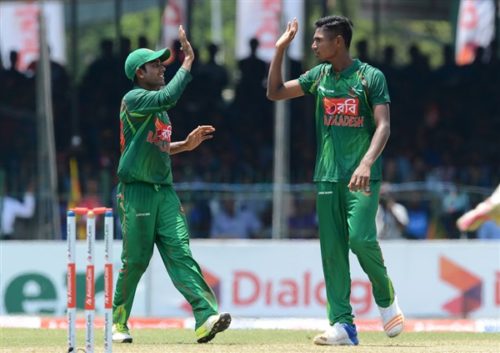
Mustafizur Rahman, with a strike rate of 22.7 in ODIs, would fancy himself against the Black Caps middle order if he gets a chance against them in tonight’s do-or-die encounter in Cardiff
This Champions Trophy has been one of upsets. The Black Caps got themselves into a position of control before the rain set in against the slightly favoured world champion Australia side, then Pakistan defeated the moderately favoured South Africa side, and last night Sri Lanka defeated the massively favoured India side.
An even worse omen for the Black Caps is the fact that they lost their previous encounter with Bangladesh in the Ireland tri-series a few short weeks ago.
This will give the Bangladeshis confidence before their crucial Group A encounter with the Black Caps in Cardiff tonight. They will, however, have to contend with facing a very different Black Caps side to the one they beat in Dublin.
Most notably, the Black Caps will now have the presence of all of their four genuinely world-class players, with Martin Guptill, Kane Williamson and Trent Boult, all of whom missed the Ireland tri-series for IPL duty, rejoining Ross Taylor in the side.
This explains why the Black Caps are still the favourites to win the encounter on BetFair. They are only paying $1.33 compared to Bangladesh’s $3.90, making them heavy favourites.
Martin Guptill has looked very good in his two starts this tournament, but has been unable to go on and play a punishing innings. With Luke Ronchi likely to continue partnering him at the top, Bangladesh will be forced to take early wickets or risk getting hit out of the game.
With Kane Williamson and Ross Taylor completing the top order, the most likely outcome of the match appears to be the Black Caps top four batting the Bangladeshi bowlers – a class weaker than the English and Australian batteries – out of the game.
If they don’t, Bangladesh will feel confident of rolling the rest of the order. The Black Caps lost 7 for 37 against Australia and 8 for 65 against England, and Bangladesh know that if they can get Williamson in early and then out early, they will be in a very strong position.
The Black Caps might be tempted to fiddle with their middle order a bit, knowing that this has been their soft underbelly for a long time.
Neil Broom’s returns have been poor this tournament – only 11 and 14 – but he has averaged 43.53 since coming back into the Black Caps side last December. His position should be okay for now.
The real question is how to fit both of Jimmy Neesham and Corey Anderson in the team. It may be that one of them comes out for Colin de Grandhomme, who has shown the ability to come to the crease and start hitting straight away.
It may also necessary to drop Mitchell Santner below Adam Milne in the batting order, as Santner has had great struggles with the bat recently.
Another option is bringing Latham in to open and moving Ronchi back down the order.
Bangladesh may find it much more difficult to chase down scores like 271, as they managed to do in Dublin, because they will have to do it against Boult, Tim Southee and Adam Milne.
However, their batting down to 7 is much stronger than it has ever previously been in Bangladesh cricket history.
Tamim Iqbal is their strongest bat on recent form. In 30 matches since the last Cricket World Cup he averages 59.53 with the bat, and has scored over 200 runs in two innings so far this tournament.
Around him there are a number of very talented batsmen, in particular Sabbir Rahman, Soumya Sarkar, Mushfiqur Rahim and the allrounder Shakib al Hasan.
If they can keep Boult, Milne and Southee out with the new ball, as England managed to do, then it will be possible for them to milk a plethora of runs in the middle stages.
A major danger for Bangladesh is that if they fail to bowl New Zealand out, they may lack the hitting power to match them across 50 overs. Despite the talent in the Bangladeshi side it’s hard to see them chasing 300 or more, even in the most favourable circumstances.
All of this could be moot in the very real circumstances of rain, as a washout would see the Black Caps eliminated and Bangladesh with only a mathematical chance of progress.
For the winner, however, an Australian loss in their matchup against the bookies’ favourites England, or a washout in the same encounter, would see them progress to the semi-finals.
Considering the chaos in the other group, there’s every chance that they would then play a relatively soft team like Pakistan or Sri Lanka in the semifinal.
The Black Caps demolished England the last time these two sides met in a major competition, with Tim Southee taking 7/33. The England team of today, however, is an entirely different beast
The washout against Australia a few nights ago gave Black Caps fans a lesson in expectation akin to being given a lesson in orgasm denial from a professional dominatrix. With Australia reduced to 53/3 in the tenth over of their chase, all signs were pointing towards an opening round upset as shocking as the Black Caps’ win over Australia in the 1992 Cricket World Cup.
Instead, the rain came in to deny us a fair finish to the contest. So the Black Caps will be champing at the bit to have a go at England tonight (9:30 p.m. NZT) in Cardiff, in a match that they almost have to win in order to advance to the semifinals.
The English side has been heralded as prospective champions from all corners, and this is reflected in the short odds offered on BetFair for England to win this contest: $1.52, compared to $2.90 for the Black Caps.
Looking at the achievements of the England batting unit it’s not hard to see why.
Joe Root looks unstoppable at the moment, with an ODI batting average of 49.68 and just coming off 133* against Bangladesh. Around him are three batsmen who are ranked just behind Ross Taylor on the ODI charts right now: Alex Hales, Eoin Morgan and Jos Buttler.
All of these batsmen, including Root, are capable of batting at a very fast clip, and so are opener Jason Roy and allrounder Ben Stokes.
So the Black Caps will go into the match knowing that a failure to take early wickets will likely leave them chasing a gigantic score. They need to at least get Joe Root out early if they want to have a real chance of bowling England out.
But if English batting stocks are strong, the bowling stocks are another question.
Chris Woakes has been ruled out of this match through injury and Ben Stokes may not be able to bowl his full quota of 10 overs on account of a minor knee injury.
On top of this, Jake Ball has been very expensive in recent games and neither David Willey, Mark Wood nor Steven Finn have shown a particular talent for taking wickets. This means that Liam Plunkett – at 16th – is likely to be the highest-ranked English bowler on display.
The weak English bowling is where, if anywhere, the match is most likely to be decided. They will have to get Kane Williamson and Taylor out cheapish, and avoid being hit out of the game by Martin Guptill or Luke Ronchi at the top, to have any realistic chance of winning.
If they can, then they will be into the currently misfiring Black Caps middle order. The Black Caps lost 7 for 37 at the end of their innings against Australia, mostly thanks to their middle order finding Australian fielders with most of their lofted shots.
The New Zealand middle order had already been identified as a point of weakness before this tournament, so the English bowlers should feel confident of restricting the Black Caps to a small total if they can get into it before the death overs.
However, if they can’t, then they will not be able to defend anything less than 350, because otherwise the Black Caps will hit them out of the game.
Adam Milne was extremely impressive against Australia, despite only bowling a few overs. This will make him, alongside Trent Boult and Mitchell Santner, the likely choices for bowlers.
They will be partnered by either Tim Southee or Jeetan Patel, depending on which of the two appear best suited for the conditions, and a combination of Corey Anderson and Jimmy Neesham as the fifth bowler.
All of Milne, Boult and Santner are more impressive than any bowler England is fielding – for reasons of pace, skill and economy respectively – so it is most likely to be here that the Black Caps win the match.