
VJMP Reads: Julius Evola’s Ride the Tiger II

This reading continues on from here.

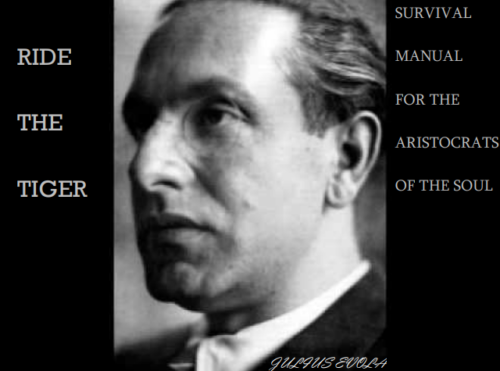
Part II of Ride the Tiger is called ‘In the World Where God is Dead’, and deals with the ever-present problem of the nihilism that arises when one abandons traditional values. This part consists of nine essays.

The first of these (the third essay in the book), ‘European Nihilism – the Dissolution of Morals’, sets the tone for this section. The subject matter will be familiar to any reader of Nietzsche, and indeed Nietzsche is mentioned in the first paragraph. This essay also mentions Doestoevsky, in the context of “If God is dead, everything is permitted.” It promises to be heavy stuff!

“Rational”, or atheistic morality, has no firm basis, Evola contends. Without an appeal to a higher power, any moral philosophy will eventually be chipped away at by critics until it disintegrates. Moral taboos cannot be justified, and therefore we can’t move past “everything is permitted”.

Perhaps more worryingly, it’s possible that, even if God did exist and inform us all, nothing would really change.

The fourth essay is ‘From the Precursors of Nihilism to the “Lost Youth” and the Protest Movement’. Existence has become absurd, Evola contends, because there are no longer any restraints. Here he traces the advancement of nihilism in the years post-Nietzsche. As Nietzsche predicted, the problem of nihilism only intensified as we entered the 20th century.

Movements such as punks and beatniks are drawn under the wider rubric of nihilists. The counter-culture becomes, for Evola, a “destructive, voiceless rage”. It’s isn’t necessarily that things are bad in and of themselves, but that a quiet, peaceful, mediocre life evokes this rage. Natural man feels little difference between the modern cornucopia of manufactured goods and slavery.

Citing Paul van den Bosch when he wrote that “When we were born, the gold was already transmuted into lead,” Evola makes another appeal to the perennial philosophy and its esoteric nature. This is necessary because the left-wing revolution has “betrayed its origins” with “a new conformism” – a statement that echoes in 2018.

The fifth essay is ‘Disguises of European Nihilism – The Socioeconomic Myth and the Protest Movement’. To Evola’s mind, there are two great socioeconomic myths of our time: the myth of Western prosperity, and the Marxist-communist myth of oppressor versus oppressed. Both myths are predicated on the same falsehood, namely that the signs and markers of the dissolution of society represent “progress”.

One severe problem exists with both of these myths: neither has any room for any conception of a higher world – the realm of gold in alchemism – and so both myths, while they solve the problem of nihilism, introduce unacceptable problems of their own. Both ideologies are predicated on a gross, fundamental error: that solving questions of material suffering will also solve questions of existential suffering.

Perhaps the last words here are “there is no correlation between material and spiritual misery.” This lays out the futility of trying to find absolution through materialist avenues. One is left with the impression, in Evola’s words, that “The time is near of the most despicable οf men, who can nο longer despise himself.”

Are we now in the time of the Man of Clay?

*

If you enjoyed reading this essay, you can get a compilation of the Best VJMP Essays and Articles of 2017 from Amazon for Kindle or Amazon for CreateSpace (for international readers), or TradeMe (for Kiwis).
Understanding New Zealand: Turnout Rate in 2017

The turnout rate in the 2014 General Election was 77.9%, and at the time of the 2017 General Election this had climbed to 79.3%. This is not a huge change, but care must be taken not to be misled. Just because the overall turnout rate was about the same does not mean that the turnout rates of the various demographics within New Zealand society all remained the same. This article examines the deeper trends.

The most striking thing about the turnout rates in the 2017 General Election is that, despite the alarm about the huge numbers of immigrants New Zealand has absorbed in recent years, the election marked a sharp increase in turnout rate among the New Zealand-born.

The correlation between being New Zealand-born and turnout rate became much more positive from 2014 to 2017, from a significantly negative -0.24 to -0.10. This is arguably the story of the election and explains how we ended up with a nationalist party holding the balance of power.

Among the four major parties, the correlation with turnout rate and voting for a particular party remained very similar from 2014 to 2017 for National (0.76 to 0.75), Labour (-0.70 to -0.72) and the Greens (0.28 to 0.27). These slight falls were balanced by a fairly strong increase for New Zealand First (-0.09 to -0.02).

This doesn’t necessarily mean that there was a swing towards New Zealand First – it just means that the sort of person who is a New Zealand First supporter was more likely to vote this time around. Who they actually voted for requires further analysis.

If we look at the ethnic demographics, we can see that the correlation between being of a certain race and turnout rate between 2014 and 2017 strengthened for Kiwis of European descent (from 0.71 to 0.81) and for Maoris (from -0.75 to -0.68). These are the two ethnic groups most likely to support New Zealand First.

Pacific Islanders and Asians, who were more likely to be born overseas, were less likely to turn out to vote. The correlation between being a Pacific Islander and turnout rate was -0.58 in 2017, out from -0.44 in 2014, which makes them now almost as disenfranchised as Maoris. The correlation between being Asian and turnout rate was -0.22 in 2017, out from -0.10.

One reason for this is that even though large numbers of immigrants have turned up in New Zealand recently, many of these newcomers don’t seem to feel much of a connection with the country and so are not motivated to vote.

Where it gets complicated is that the correlation between median age and turnout rate increased from 2014 to 2017, from 0.77 to 0.79. This means that the people who voted this time around were older, and older people tend to vote National – but these voters did not vote National.

The correlation between being aged 20-29 and turnout rate became a lot more negative from 2014 to 2017, from -0.21 to -0.26. The correlation between being aged 30-49 and turnout rate followed a similar pattern, weakening from 0.21 to 0.13. The predictable result of this is older people voting more, and indeed we can see that the correlation between being aged 50-64 and turnout rate increased from 0.70 in 2014 to 0.73 in 2017, while the correlation between being aged 65+ and turnout rate increased from 0.64 in 2014 to 0.67 in 2017.

Unsurprisingly, then, the correlation between being on the pension and turnout rate increased from 2014 to 2017 (from 0.50 to 0.56). In fact, all of the benefit types apart from the student allowance also strengthened. The correlation between being on the invalid’s benefit and turnout rate strengthened from -0.53 in 2014 to -0.43 in 2017, and the correlation between being on the unemployment benefit and turnout rate strengthened from -0.76 in 2014 to -0.72 in 2017.

This is supported by the fact that voters were more likely to be New Zealand-born in 2017, because there is a significant correlation between being New Zealand-born and being on a benefit.

More information comes from noting that several correlations between belonging to privileged demographic categories and turnout rate decreased from 2014 to 2017. This applied to people working in information media and telecommunications (0.06 to -0.01), financial and insurance services (0.08 to 0.01) and professional and scientific services (0.28 to 0.23). Also, the correlation between having never smoked tobacco and turnout rate fell from 0.35 in 2014 to 0.25 in 2017.

On the other hand, the correlations between more working-class occupations and turnout rate increased, most strikingly so in the occupations that involved the most personal contact. The correlation between working in a particular occupation and turnout rate increased from 2014 to 2017 in the case of education and training (-0.10 to -0.03), healthcare and social assistance (-0.04 to 0.05), arts and recreation services (0.04 to 0.09) and hospitality (-0.09 to -0.01).

A poorer cross-section of the population turned out to vote in 2017, which is another clue as to where Labour won. All of the correlations between being in an income band below $70K and turnout rate strengthened from 2014 to 2017, and all of the correlations between being in an income band above $100K and turnout rate weakened from 2014 to 2017. The correlation between being in the $70-100K income bracket and turnout rate remained exactly the same, at 0.38.

Another striking correlation is that between being part-time employed and turnout rate, which rose sharply from 0.45 to 0.58 between 2014 and 2017. This, coupled with what we know about income brackets and turnout rate, suggests that it was the people on the margins between doing well and doing poorly who shifted from National to Labour. It may be that these people saw the promise of the country being lost, or felt that they missed out on all the loot of the last nine years.

Perhaps the clearest sign of where National lost the election comes from the correlations with the flag referendum. The correlation between voting National in 2017 and voting to change the flag in the second flag referendum was an extremely strong 0.93, which tells us that it was pretty much only National voters to wanted to change the flag to the National Party version.

These National Party supporters, being generally well enfranchised, have very high turnout rates. The correlation between turnout rate in 2014 and voting to change the flag was 0.75, exactly the same as the one between turnout rate in 2017 and voting to change the flag. However, the correlation between turnout rate in the second flag referendum and turnout rate in the general election increased from 2014 (0.86) to 2017 (0.92).

This suggests that many of the new people who voted in the 2017 General Election but did not vote in the 2014 one were Labour supporters who came from generally National-supporting demographics (i.e. wealthy but not too wealthy, old but not quite a pensioner, white, employed and part-time employed, male). Had they been National supporters, the correlation between turnout rate and voting to change the flag would have increased from 2014 to 2017, because the vast bulk of people who wanted to change the flag were National supporters.

We can say that it was here that the centre, and thereby the 2017 General Election, was lost by the National Party.

*

The second edition of Understanding New Zealand, by Dan McGlashan, was published by VJM Publishing in the summer of 2017/18. It contains all the analysis of Kiwi voting patterns and demographics you could ever want!

There is Only One Issue of Social Justice, and It’s One of Class

As long as the left acts as if the white working class man is the enemy, it will fail

The mass consciousness is full of social justice issues at the moment, with social justice warriors in the media and in the public both screaming to get attention to their issue of choice. What few realise is that all of these shrieking SJWs distract from the one and only real social justice issue, which is that the rich have all the power and the poor just get fucked. In a word – class.

Privilege does not come from race, or gender, or sexual orientation – it comes from wealth. All of these other categories are merely correlates with wealth. Being white, male and heterosexual are all qualities correlated with wealth – but none of them are wealth per se. The left has made its most grievous error by confusing genuine privilege with the correlates of privilege – and in doing so it has lost the white working class.

The whole concept of racism is a distraction – but it’s a well-chosen one. In fact, the decision to impose a taboo on so much as mentioning any racial differences was a stroke of genius (from the point of view of suppressing the peasantry). It has had a devastating impact on the ability of the working class to organise itself to resist class injustices. Like an axe through an enemy skull, it has cleaved them neatly in two.

For one thing, the simple fact that there are obvious racial differences in behaviour means that, if racism is the ultimate taboo, then honest people will be ostracised by the herd when they inevitably point them out.

This is not to argue that some ethnic groups are subhuman and should be exterminated – it’s merely to point out that the reason why different ethnic groups exist is because people have adapted to different environments, and those different environments reward various behaviours differently.

It will be centuries before black people in the West become as wealthy as whites (if it ever happens), for the simple reason that Western society has been set up to reflect the hardworking values that naturally evolve in the cultures of people who live in the cold environments that produce white people. So as long as a gap in economic performance exists, the ruling class can always browbeat the white working class about creating this state of affairs with their “racism”.

The second major reason is that it allows the ruling class to give the white working class – their number one enemies – another kick in the guts. If privilege is reduced to a matter of skin colour, instead of a matter of whether a child’s parents had the surplus time and money to properly invest in its education and raise it to be a functioning being, then the white working class can be blamed for their own poverty.

They can be given an extra kick in the guts with the justification that their white skin gave them great advantages that they only failed to take because of their own moral weakness.

The truth – that privilege is almost entirely a function of the quality of one’s upbringing – is ignored because it reveals that people are usually wealthy only if their own parents were themselves wealthy enough to have the spare time and energy to teach them how to behave in ways that capture wealth. In other words, all privilege is class privilege.

This makes the distraction effective because it immediately causes the left to eat itself. The left only has moral authority insofar as it represents the labouring classes that produce wealth instead of the capital-owning class that captures it. When it ceases to represent the labouring classes and instead becomes a disparate horde of disaffected misfits with grievances, it cedes that authority.

Other distractions such as the gender pay gap, gay adoption, funding gender reassignment surgery etc. (i.e. issues that are either entirely fictitious or which affect a very small number of people) all serve a similar purpose, but no method of distracting a Western population from its class issues has proven as effective as race.

These distractions are brought to us by the same people that have brought us all the other distractions – i.e. the very same people who currently occupy the top positions in the class hierarchy and who wish to remain there. This is the reason why wages have stagnated for 30 years and homelessness is on the increase, despite several decades of supposedly continuous economic growth.

The mainstream media won’t tell you this because its journalists work on the direction of the shareholders, who are themselves members of the plutocracy.

The solution to it all is for the left to accept, as it once did, that working class white people are not members of an oppressive enemy class simply because they have white skin. The class status of poor whites, and the financial and cultural poverty that frequently accompany it, is sufficient to mark them as unprivileged.

*

If you enjoyed reading this essay, you can get a compilation of the Best VJMP Essays and Articles of 2017 from Amazon for Kindle or Amazon for CreateSpace (for international readers), or TradeMe (for Kiwis).
The Palestinian Paradox

The more a person knows about certain political issues, the less likely they are to present information about those issues in an honest manner

When listening to people talk about the Israel-Palestine Conflict, it’s possible to observe the following pattern. The more knowledge a person has about the conflict, they less likely they are to present that knowledge objectively to a listener. This presents us with a curious paradox that makes it necessary to unlearn some of our educational conditioning.

In the educational system, it’s rare that a student considers the possibility that their teacher is lying to them. In the vast majority of cases they don’t need to do so, and paranoia about the teacher is not optimal from the perspective of learning efficiency, because the most efficient learning method is to accept everything unquestioningly.

The political world, however, is infinitely more cutthroat than any educational system could ever be, and one result of this is people constantly lying. The average politician will lie about absolutely anything if they perceive that it is somehow to their advantage to do so. Truth is not a goal in the way it is for an academic. To the average politician, honesty is a slave morality, fit only for simple-minded suckers.

In the political world, people don’t become experts, because that implies an honest effort to communicate truth. Politicians merely become effective manipulators of truth-like statements. Information is not learned because it has truth value; information is learned because data can be used to manipulate listeners into obeying one’s directives and working for one’s agendas.

The Palestianian Paradox arises in the case of the Israel-Palestine conflict, where there are rarely neutral observers for the reason that almost everyone hates at least one of either Jews or Arabs. The result of this is that people are usually only interested in learning about the history of the conflict in the first place if they have already committed to one side or the other.

Many people hate Jews and this leads to them learning about the conflict from a perspective that emphasises Palestinian rhetoric; many people hate Muslims and this leads to them learning about the conflict from a perspective that emphasises Israeli rhetoric. Indeed, the very choice of descriptor for the disputed area in question gives away a bias (I have chosen “Palestinian Paradox” for the sake of alliteration).

The paradox, then, is the more a person knows about the Israel-Palestine conflict the less likely they are to be motivated to tell the truth about it, because only a person with an established bias would be motivated to learn about the conflict in the first place.

If a person knows a lot about the history of the conflict and the major names involved, they are more likely to selectively omit some of this information when telling you about the conflict for the sake of supporting the objectives of their side. Finding a truly neutral observer is extremely difficult, which makes learning about the conflict difficult, because the more someone is an expert the more likely they are to be biased.

This is also true of many (if not most) other conflicts throughout the history of the world.

In terms of elementalism, the distinction described here corresponds to the distinction between the realm of gold and the realm of silver. In the realm of gold, truth is appreciated for its own value and is recognised as valuable in its own right. In the realm of silver, it is the appearance of truth that matters. The actual truth is hidden away behind the glare of the appearance of truth.

This reflects the distinction between the gold of honest truth-seeking for its own ideal reasons and the silver of educating oneself so that one might use one’s knowledge as a weapon to further material objectives.

*

If you enjoyed reading this essay, you can get a compilation of the Best VJMP Essays and Articles of 2017 from Amazon for Kindle or Amazon for CreateSpace (for international readers), or TradeMe (for Kiwis).