Writing Post Traumatic Stress Disorder

Post Traumatic Stress Disorder (PTSD) is an unusual condition in that almost everyone has it to a greater or lesser degree, but few realise the impact that it has had on their lives. As the name implies, the condition describes when a person’s stress levels or reactions don’t go back to normal after a major traumatic experience. This article looks at how to write believable characters and situations involving PTSD.

PTSD is caused by exposure to a traumatic event, usually one in which a person thinks they are going to die. The classic examples are exposure to warfare, traffic accidents, sexual assault or physical assault. Experiences like these cause the brain to flood with fear, which can form long-term associations with the other stimuli present. This means that future exposure to those stimuli can trigger that deep fear again.

The classic symptom of PTSD is becoming full of adrenaline and going into combat mode when exposed to a loud noise or a touch to the head. In the former case, the loud noise might remind a character of the explosions of grenades and shellfire in combat; in the latter case, the touch to the head might remind of early childhood abuse at the hands of a parent. In either case, powerful memories of immense fear can quickly come flooding back.

The effects of PTSD are what could be expected from a close brush with gruesome physical death: adrenaline and cortisol prime the character for either combat or running. A character with the condition might easily become stirred into fight-or-flight mode as a response to the trauma. Here it can be seen that PTSD has considerable overlap with other psychiatric disorders, in particular Panic Disorder, Avoidant Personality Disorder and Generalised Anxiety Disorder.

Other effects are an increased propensity for self-harm. After all, one of the natural consequences of having a massively traumatic experience is that a person comes to realise that the world is much nastier or more dangerous than they thought it was. Some people with PTSD might decide that this world is actually pretty shit and not worth living in, given the horrors it contains.

In the case of violent crime or rape, a person might also come to lose all trust in a major societal demographic, which entails everyday difficulties. If a woman comes to distrust all men or a robbery victim comes to distrust all blacks, their life might become a lot harder and quickly, for no real fault of their own. Like children who have had bad experiences with dogs, a person with PTSD might come to dislike anything associated with their initial trauma.

Because PTSD is frequently portrayed in dramatic fiction, care must be taken not to write in cliches. The example of a nightmare leading to someone waking up in the middle of the night screaming, only to realise that the object of their terror is no longer present, is a striking one but also very heavily used. So too is the man staring into the distance, reliving a traumatic experience, not hearing someone calling to them.

A protagonist who suffers from PTSD might be aware of their condition or unaware.

If they are aware that they have PTSD, they might be a deep and sensitive character. They could be directly aware that a particular early life event has damaged them irreparably. This might be the reason for their unusual levels of compassion – the character knows what it feels like to be scared to death and commiserates with others who also do.

A story featuring such a character might be one about how they overcame their psychic damage and managed to find a way to engage joyfully with life. Often this involves healing oneself, the shamanic path. An extremely wise character may have attained their insight through having overcome an equally extreme trauma earlier in their life. Perhaps this experience caused them to understand what another character is going through.

It’s common to have PTSD and to be unaware of it. This is especially plausible on account of that people who incur severe psychological trauma might not show signs of it until many years later. A person might grow into early adulthood with a particularly surly or nasty character because of some heavy trauma incurred while a child. They might also show other signs of being strongly emotional, reckless or impulsive.

Just because a character with PTSD is not aware that they have PTSD, doesn’t mean that other characters will not be aware. In some cases it will be very obvious, because they will observe the first character go into kill mode for what seems like an insufficiently grave provocation. The character with PTSD might soon find that their condition is part of their reputation – they seem “damaged” in the eyes of others.

A combination of the two can also tell a story, such as the case of a protagonist who gradually becomes aware that they have PTSD or something like it. Perhaps they are perceptive enough to realise that a prior event has damaged their psyche – for example, they observe that they feel intense anxiety when presented with a stimulus that reminds them of a particular traumatic event.

If your protagonist encounters a character with PTSD, how that protagonist behaves might depend on their naivety and openness. A naive character might think that simply by being nice to someone with PTSD they can get them to behave normally. Although this is sometimes true up to a point, the reality is that PTSD often carries with it sinister undertones of bitterness and resentment.

It’s common for people who have PTSD for similar reasons to bond strongly over the fact. This is especially true in the case of soldiers, emergency personnel and survivors of abusive relationships. For one thing, misery loves company, but for another, severe trauma is often the kind of experience that deeply shapes a person and their conception of life and reality, so people who share the trauma often share an entire worldview that’s based on it.

C-PTSD (Complex Post Traumatic Stress Disorder) isn’t actually in the DSM-V, but it’s worth covering here for the sake of completeness. Essentially it’s a similar condition, only brought about by repeated exposure to a traumatic person or stimulus, as opposed to one single, horrifying event as is usually the case with regular PTSD.

The major difference with C-PTSD is the loss of a sense of self. One’s boundaries are violated with such consistency that it becomes hard to say where one ends and the outside world begins. This can be related to Depersonalisation Disorder and frequently coincides with a deep sense of distrust about other people.

*

This article is an excerpt from Writing With The DSM-V (Writing With Psychology Book 5), edited by Vince McLeod and due for release by VJM Publishing in the summer of 2018/19.

Writing Narcolepsy

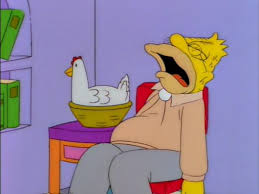
Best known as the condition that causes Grandpa Simpson to fall asleep at a moment’s notice, narcolepsy is an uncommon disorder linked to sleep patterns. This article looks at how to write believable characters with narcolepsy.

Narcolepsy is a decreased ability to regulate sleep-wake cycles. The overwhelming problem with narcolepsy, and its most characteristic feature, is that people with it can feel extremely tired during the day. The most notable symptom is recurring bouts of extreme daytime sleepiness, which can result in falling asleep in unexpected and inappropriate places.

Because being properly awake during the day is virtually a necessity for normal life function, narcolepsy can be a crippling condition for those afflicted. If it’s bad enough, driving a car will be impossible because of the risk of crashing (similar to epileptics). Taking public transport might not be possible either, which means that the life of the a narcoleptic character in your story might have to be a restricted one.

The author should pay close heed to what’s known as the “tetrad of narcolepsy”: cataplexy, sleep paralysis, hypnagogic hallucinations and being extremely tired during the day.

Cataplexy is a strange condition that involves the sudden weakening of large muscle groups. A bout of cataplexy can involve a weakening at the knees, or in the neck and head (similar to nodding off to sleep). This is one symptom that can truly wreck the life of a narcoleptic. It isn’t just that the physical debilitation is a problem, it’s that the narcolepsy sufferer learns to fear the social occasions that pose a risk of provoking one.

Sleep paralysis is the experience, often terrifying, of not being able to move one’s body when awakening or falling asleep. The experience of a character undergoing sleep paralysis might be similar to one undergoing night terrors. They may feel as if they have died.

Hypnagogic hallucinations are felt by narcoleptics when falling asleep. These are intense, vivid and dreamlike experiences that usually manifest as sights and sounds. These experiences can feel much like salvia divinorum experiences in that they are surreal and cause one to feel like one is present in another world. These hypnagogic experiences are sometimes disturbing enough to cause a person to get out of bed again.

The excessive daytime sleepiness is probably the most striking and obvious symptom. This manifests as powerful “sleepiness attacks” that overcome the narcoleptic, no matter how much sleep they have had the previous night. These attacks may be irresistible, so much so that the narcoleptic can literally fall on the ground asleep.

Narcolepsy might be more useful as a plot device than as something to afflict a character with. It could be that someone’s narcolepsy in the past led to a car accident, which then had far-reaching consequences for the protagonist of your story. Or it could be that, as a small minority of narcoleptics are “supertasters” with heightened olfactory awareness, your protagonist has a special use in forensic science or perfumery.

It might even be that a character’s narcolepsy has led to them waking up and rearranging their environment during the night. This could be combined with more interesting sleep disorders, like somnambulism.

Another curious point about narcolepsy is that it’s easy to confuse with an addiction to heroin or some other drugs. After all, it need not be immediately obvious to a close observer if a given person nodding off is doing so because of narcolepsy or heroin, drunkenness or something else. A character with narcolepsy might then feel that they are hard done by on account of being treated like something they’re not.

Unlike most of the other psychiatric conditions in this book, narcolepsy is not caused by early childhood abuse or neglect. So a character with it is unlikely to demonstrate signs of being damaged. Possibly they are an entirely normal person by most apparent measures apart from the narcolepsy.

Many stories about mental illnesses are tragedies because of the exposure to violence, neglect or abuse that caused the trauma underlying the illness. In this sense, a story about narcolepsy is probably different. The trauma might be ongoing, on account of that the coming of narcolepsy can ruin the life of an otherwise entirely normal person who had previously given no indication that they might be mentally unusual.

Alternatively, the narcoleptic could be a good choice of character to place at the centre of a comedy. A problem with suddenly falling asleep all the time could make it very hard to get things done. If a band of characters had to achieve some set goal, and one of their number was a narcoleptic, that character might constantly be letting the others down by falling asleep at inopportune times.

Likewise, a narcoleptic guard, surgeon or helicopter pilot might be considered inherently funny, on account of that their condition makes them exceptionally unsuited for that particular job, in a fish out of water sense. The author will have to take care to find the right balance between comic and ridiculous here.

*

This article is an excerpt from Writing With The DSM (Writing With Psychology Book 5), edited by Vince McLeod and due for release by VJM Publishing in the summer of 2018/19.

We’ve Had the Great Financial Depression, Now We Have the Great Spiritual Depression

We’ve got all the money and stuff we ever wanted – but it’s not making us happier

Tyler Durden in Fight Club told Generation X that “Our Great War is a spiritual war.” This is the truth, and we have been too slow to see it. The narrative has changed since our parents’ and grandparents’ time: the major struggle of human life is no longer physical survival, but making sense of our lives.

Durden was speaking directly to Generation X because ours is a different story. The Great Depression that our elders endured, while terrible, was ultimately a financial one, and we were guaranteed to get out of it once the markets reset. What we have to endure is also worthy of the epithet Great Depression, only what we have to endure is spiritual.

This Great Spiritual Depression has been caused by a perfect storm of factors.

The first major factor is the rottenness of what passes for spiritual tradition in our culture. It’s obvious to any outside observer that the Christian rituals are empty and meaningless – this can be determined simply by speaking to the average Christian and hearing his hatred of other religions, of homosexuals, and of drug users. It’s apparent from that that Christians do not have any privileged access to understanding the mind of God.

A person who enters a Christian church to hear a sermon from a learned man is far more likely to hear something political about the need to obstruct progress on gay rights or drug law reform. If that person stays to talk to those who think they understand the nature of God, those people will say that a women’s place is subordination, and that anyone who doesn’t worship the Magic Jew will be condemned to an eternity of hellfire.

If there was ever anything spiritual in the Abrahamic tradition it has rotted away centuries ago.

The second major factor is that all of our cultural and political narratives are entirely materialistic. It’s materialist capitalists versus materialist socialists. Whichever side wins, we get materialism. Neither side has a solution to the problems of human existence that goes beyond accumulating more physical resources or power.

This materialism has arisen as a reaction to the fact that religion, in the guise of Christianity, retarded progress in the West for over 1,000 years. Because of this, the people and societies that developed an interest in discovering the truth naturally came to distrust anyone who spoke about non-materialist concepts. Moreover, most of the advances in alleviating human suffering made in recent centuries have come through materialist sciences such as medicine, engineering, biology, chemistry and physics.

The problem with this materialism is that people have been thinking in these terms so so long that most of us have forgotten that any other terms are possible, or even sometimes necessary. Emotional, intellectual and spiritual paradigms have all been forgotten in favour of who controls the most stuff. Even psychiatrists – supposedly doctors tasked with healing the soul – can only think in terms of chemical imbalances and pharmaceuticals.

As Terence McKenna was fond of saying, “the way out is back”. Westerners have historically shown themselves capable of exceptionally sophisticated metaphysical thought – one only need read Plato for ample proof of this. The solution is the revival of the perennial philosophy and the perennial, universal, cosmic religion, in a form that suits the world of today.

This will have two major benefits.

The first will be the return to each human being of their birthright to be initiated into the spiritual truths. Instead of being brainwashed from birth with some horseshit story about being specially chosen by God, virgin births or last prophets, and how God’s love is conditional upon obeying the moral dictates laid down by the political authorities of the time, people shall be instructed truthfully from the beginning.

This means that something like the Eleusinian Mysteries will have to be reinstated, and the ceremonial mass public consumption of psychedelics encouraged, but in a highly ritualistic and orderly manner. This will mean that the public at large will once again be connected with God, and all will know the truth. This will lead to our spiritual elders transmitting useful information to the youth instead of old Middle-Eastern stories that justify genital mutilation and slavery.

Because the spiritual elders will no longer be lying, there will no longer be cause for the men and women of silver to respond by going in the other direction. Thus, being a freethinker will no longer correlate highly with being a materialist (as it has for the past three or four centuries). People will be free to discuss metaphysical subjects without the assumption that they are dangerous fanatics.

The second major benefit will be to cause the coming of new political ideologies that are not based on materialism. These will transcend the ancient capitalist-communist paradigm. In other words, they will not be grounded in settling arguments about who gets what stuff, and who can extort what labour, taxes and rent out of who. These ideologies will be much better suited to meet the challenges we face because they will reflect reality more accurately and faithfully.

What exact form they do take is not clear, but it is likely that they will be grounded in reducing the amount of suffering in the world rather than the redistribution of resources. This specifically means reducing the suffering of sentient beings, through all of their thwarted desires.

It’s certain that cognitive liberty will play a central role here, as it has been the lack of cognitive liberty that caused this Dark Age in the first place. We can guess from this that the social sharing of consciousness-altering sacraments will flourish – not merely alcohol and cannabis, but psychoactives that are capable of a wide range of desirable effects.

*

If you enjoyed reading this essay, you can get a compilation of the Best VJMP Essays and Articles of 2017 from Amazon for Kindle or Amazon for CreateSpace (for international readers), or TradeMe (for Kiwis).