
Author: vjmp
Cannabis Use is Spiritual Hygiene
There’s no way to avoid accumulating physical filth if one has a body. The basic demands of thermostasis require an intake of energy in the form of food, which necessitates both moving around and sweating as well as excreting waste products – both of which tend to make you smell bad. Basic hygiene, then, is to wash one’s body before the smell becomes offensive to others.
More offensive than a bad smell is a rotten spirit.
Unfortunately we live in a spiritually degenerate age and spiritual hygiene is not well practiced. The majority of people are unaware of the influence their rotten spirit has on others and have difficulty understanding how this works to their ultimate detriment.
In everyday life, our basic choices are twofold: you can meditate if you want the equivalent of a long, relaxing bath in perfumed water, or you can smoke cannabis if you want to equivalent of a quick shower under a strong blast of water.
The reason why cannabis has a spiritually cleansing effect is this. In the course of one’s everyday life, one inevitably encounters things that cause one to suffer, because life is suffering. The act of suffering causes one’s ego to develop, as the ego naturally develops to protect oneself in response to pain.
Possibly the most common kind of mental problem in the world is that caused by ego arising in response to pain and then not properly dissipating again when the pain is gone. Usually this is because the memory of the pain causes depression or dread about it happening again, or because a stimulus associated with the pain (such as a person) is still present in the environment.
This is where cannabis is so great. Using cannabis regularly has the effect of releasing the user from unconscious anxieties and neuroses brought on by too much worry. The warm, comforting and relaxing feeling brought on by the anandamide reminds one that everything is fundamentally alright, and that there is likely to be much joy in one’s future.
Rastas know this. This is why they get together in “reasoning sessions” to smoke cannabis and to discuss the nature of reality. This is done explicitly to heighten feelings of community and spirituality.
It’s sadly obvious that making cannabis illegal is evidence that we are living in a spiritually degenerate age. This could be by design, as the easiest way to enslave a people is to separate them from spiritual truth and thus incite fear in their hearts. it could be by accident, as the cumulative magnitude of our egos distracts us from facing up to the truth.
Cannabis use is spiritual because it frees people from fear, and in doing so liberates them from powerful instinctual and conditioned impulses to harm and exploit one another.
Its prohibition is a crime against the human spirit.
Reefer Makes Darkies Think They’re as Good as White Men
When the propaganda push to make cannabis illegal began in earnest in the West during the 1930s, some utterly ludicrous things were spoken. The public’s fear of everything – murder, sexual permissiveness, black people – was associated with cannabis in an effort to condition them to think about the plant as negatively as possible.
One of the major tactics used in this propaganda war was to create the perception in the public mind that cannabis use was the rightful province only of the lesser races. Even the name ‘marijuana’ was chosen specifically so that the public would associate it with Mexican labourers and thus as the habit of a foreign culture.
Racism was so deeply entrenched in the America of the 1930s that prohibitionists knew that if they could convince the booze-soaked white masses that cannabis was a black man’s drug then the public would come to support its prohibition.
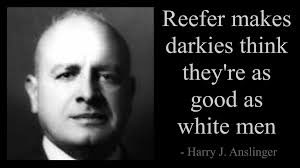
Arch-prohibitionist Harry Anslinger even said, when speaking to powerful figures who he wanted to convince to support prohibition, that “Reefer makes darkies think they’re as good as white men.”
Perhaps the really crazy thing, however, is that Anslinger was, in an inadvertent way, right: cannabis does make black people think they’re as good as white people. The explanation for why this is appears simple once you ask yourself why black people didn’t already think they were as good as white people.
Black people are conditioned to thinking of themselves as lower value, because this conditioning is reinforced so frequently that it cannot be escaped unless shattered at once. It’s enforced every day by small displays of social contempt, by news about the deaths of black men in Police shootings, by seeing the neglected state of black neighbourhoods.
Cannabis has the effect of breaking a person out of their psychological conditioning. Cannabis is like a lunar caustic to all the ways a person is programmed (without their consent and usually even without their knowledge) to behave in ways detrimental to themselves (or, more to the point, in ways beneficial to their programmers).
Note that a person enslaved by their psychological conditioning is worth hard money to their programmer. The more brutalised a person is, the lower the wages they will accept working for, generally speaking. As cannabis heals psychological damage, it can easily lead to workers asking for more money. Thus, the widespread use of cannabis is a threat to the capital value of the mind controllers.
The psychological conditioning that has gone into inducing black people to accept such a poor place in society is as brutal and as overwhelming as anything the Nazis thought up. It requires thousands of what are at least small displays of contempt and disrespect, enough so that black people regularly internalise much of this hatred and start to believe themselves worthy of it.
There are multiple problems with cannabis then, from the point of the view of the ruling class.
A less obvious one is that the deconditioning effect of cannabis will make white people stop thinking they’re better than black people as well, because much white supremacy is based on the same conditioned responses to thousands of social cues that contempt for other races is.
This possibility is so frightening to the modern control freaks that they dare not so much as utter the possibility of it.
The Solution to Low Voter Turnout is to Have Politicians that Aren’t Cheating, Lying Pieces of Shit
There were local body elections in New Zealand last week. You probably didn’t know because no-one gives a fuck except for the control freaks that are fighting for power. They care so much about the low turnout that some of them want to make it illegal to not vote.
This means that if you choose not to vote you must either pay a fine or the Police will put you in a cage (and kill you if you resist). This seems extremely aggressive to those of us who do not benefit in any way from voting.
Take, for instance, my personal situation with medicinal cannabis. John Key will not change the cannabis laws and Andrew Little believes that cannabis use causes brain damage. So, no matter who I vote for, I will have a Prime Minister who thinks it’s fair for the Police to come and smash my head in and put me in a cage for using a medicinal plant they don’t approve of.
It’s much better to not vote and, by doing so, withdraw my consent to be governed by a political system that conducts a War on Drugs against its own people. Especially when the only people who have a chance of taking power under this system have already promised to continue this war to destroy people like me.
This I do not only for myself but out of solidarity with all of the people dispossessed by the current New Zealand political system. If my only choices are to give my power to a cheating, lying piece of shit waving a blue flag or a cheating, lying piece of shit waving a red flag, then I will keep my power for myself!
Dr Bryce Edwards, a Massey University politics lecturer and a heavily indoctrinated and brainwashed man, says “[low voter turnout] is a terrible thing. I don’t think there’s really anyone saying lower voter turnout is a good thing”.
Meanwhile, outside of the ivory tower, paedophiles get lighter sentences from the New Zealand “Justice” System than medicinal cannabis growers.
I’m saying that low voter turnout is a good thing, because it is a sign that the population does not consent to the abuses committed against it by the ruling class.
Is it any wonder we’ve lost faith in a political system that gives lighter sentences to paedophiles than it does medicinal cannabis growers? Why should we continue to vote and give our power to the same political system, and to the same clueless old narcissists that brought this atrocious state of injustice about?
Much better to not vote, and in doing so delegitimise the entire system. This is why the control freaks are ultimately afraid of – a population that does not fall for the illusion heavily enough to give away their power to the control freaks.
Not voting doesn’t just mean not voting – it means having the gumption to solve the social problems that politicians exploit to swindle power before that power is swindled. This means looking after vulnerable members of your community before the control freaks start making laws to ban everything that they have not explicitly given permission for.
It means mowing an old person’s lawn. It means smiling at the crazy guy with the haunted look. It means making a donation of time or money to the RSPCA. It means talking honestly with people you know about what’s really going on in the world.
If we all stopped falling for the lies, we could have a world in which the control freaks would dissipate into the gutter like the filth they are.