The 10 Most Uncorrelated Pairs of Things in New Zealand Society

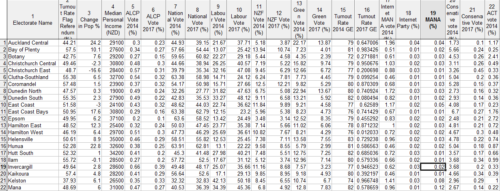
The third part of Dan McGlashan’s Understanding New Zealand contains an index of all the 11,628 correlations considered in the writing of the first two parts of the book. There are so many of these that the index has to go to three decimal places in order to properly distinguish them from each other. Even then, there are some pairs of variables that are so perfectly uncorrelated that they go down to weaker than 0.000 – as this article examines.

This data was collected from the Electorate Profiles that can be found on the Parliamentary Library website, and then entered into a Statistica database from which a correlation matrix was calculated. These ten pairs of variables represent the least correlated things in New Zealand society.

9=. 0.0007, Voting New Zealand First in 2014 and Being of European descent

New Zealand First gets much more support from Maori electorates than most people realise. Their level of support among Maoris declined in 2017 but in 2014 it was strong enough that there was no correlation between voting New Zealand First and being white.

9=. -0.0007, Voting Internet MANA in 2014 and Having an income between $60-70K

Internet MANA voters were a fair bit poorer than average, and so there is no correlation between voting for them in 2014 and having a slightly higher than average income.

8. -0.0006, Having NZQA Level 2 as a highest academic qualification and Working as a sales worker

Leaving school at the end of Sixth Form is a middling sort of academic achievement, and being a sales worker is an extremely common line of employment.

7. 0.0005, Being a Brethren and Working in public administration and safety

Brethrens are indifferent to working for the Government.

6. -0.0004, Voting Internet Party in 2017 and Being a Spiritualist or New Ager

Internet Party voters are young and mostly live in Auckland; Spiritualists and New Agers are a bit older and are distributed reasonably evenly throughout the country.

3=. 0.0003, Voting to change the flag in the second flag referendum and Being in a couple with children

Couples with children probably have more important things to think about than a flag referendum, which was only ever a vanity project for the elderly elite with leisure time.

3=. -0.0003, Being a Christian (not further defined) and Being a sales worker

Christians, when not further defined, are generally a bit poorer than average, and sales workers are moderately wealthy, hence no correlation.

3=. -0.0003, Being a Pacific Islander and Being on the invalid’s benefit

Pacific Islanders are stereotyped as being on the benefit a lot, but the truth is that the sort of Pacific Islander who wanted to go on the invalid’s benefit probably wouldn’t be motivated to immigrate to New Zealand in the first place.

1=. -0.0001, Voting Internet MANA in 2014 and Taking a bus to work

Internet MANA voters in 2014 tended to live in the Far North, and those who lived in Auckland often took a bus to work, the others not so much.

1=. -0.0001, Being a regular tobacco smoker and Being a sales worker

There are no more middle-of-the-road variables than being a regular tobacco smoker and being a sales worker. Both traits point to a very normal, standard sort of person, hence no correlation.

Jacinda Ardern Lied To Us About Changing The Medicinal Cannabis Laws

The Clark Government lied to us about cannabis, the Key Government lied to us about cannabis and the English Government lied to us about cannabis. Today the Ardern Government went back on their word to legalise medicinal cannabis in the first 100 days of taking power

They promised that they would make medicinal cannabis legal in the first 100 days of a new Government. They lied. That’s the long and the short of the medicinal cannabis “reforms” announced by David Clark and Jacinda Ardern today. No doubt it will be spun as a great victory for compassion and justice, but it isn’t.

Home growers will be the most disappointed, because the “reforms” offer absolutely nothing to them. If you grow cannabis at home because you have found it alleviates your suffering – as tens of millions of Americans are legally allowed to do – you will still have to live in permanent fear of the Police knocking on your door and dragging you away to go in a cage.

Basically, under the proposed legislation, home growers are invited to go and fuck themselves. There is no word of any reduction in penalties for home growers, only for those who have less than 12 months left to live, and even they aren’t allowed to grow cannabis. If you have a terminal illness (this being defined as an illness likely to kill you in the next 12 months), then you now have a defence against prosecution.

You can still be arrested, thrown in a jail cell with rapists and murderers and treated like a subhuman piece of shit by the justice system, but should you decide to protest, you will now be permitted to have a defence.

The Bill also “establishes a regulation-making power to set quality standards for domestically manufactured and imported cannabis products.” In other words, the Labour Party intends to give full control of the New Zealand medicinal cannabis supply (if we ever get one) to the same pharmaceutical industry that has lobbied for decades to keep medicinal cannabis illegal. This is further underlined when the Bill declares “Most cannabis products produced internationally do not meet the quality and efficacy requirements of therapeutic product regulators such as Medsafe.”

It sounds like the best result is that medicinal cannabis will become available through a pharmacy, at some indeterminate point in the future, once a Byzantine process of bureaucracy has first been established and secondly navigated. In other words, medicinal cannabis is still not legal, and there is no sign of home grow ever becoming legal.

Most worryingly of all, the Bill states that “no pure cannabidiol product made to reliable quality standards is currently available.” This means that, according the quality standards enforced by this Bill, none of the medicinal products produced by the $20 billion cannabis industry in America are good enough, a clear sign that the “quality standards” demanded are not necessary or reasonable.

Clearly, this is another Psychoactive Substances Act – a piece of legislation intended to keep something fully illegal while giving politicians a plausible reason to claim that they are trying to make it legal. Peter Dunne successfully blocked cannabis law reform, while evading media heat, for over a decade using this method.

In summary, Jacinda Ardern is nothing but another vacuous corporate whore, exactly like John Key. She is lipstick on a pig. Just a pretty face on the same disgusting corporate agenda that has engorged itself on the New Zealand people for the past 30 years. Labour lied about signing the TPPA, and now they’ve also lied about reforming the medicinal cannabis laws.

Hierarchies of Silver Versus Hierarchies of Gold

There is a lot of discussion about power dynamics, and whether the people who end up at the top of them have got there through competence or by machination. A person’s position on this question will correlate extremely strongly with their level of revolutionary zeal. This essay seeks to illuminate the subject from an esoteric perspective.

There are three ways for a person to dominate another one. They can do so physically, in a manner akin to the effect iron has on clay; they can do so with trickery, in a manner akin to the effect silver has on clay; they can do so by offering up an example of behaviour that ought to be emulated and allow the clay to imitate it, in a manner akin to the effect gold has on clay.

For the most part, people can generally agree that hierarchies of iron are illegitimate, except for the odd occasion when they are entered into legitimately, such as an army volunteer or a consensual BDSM participant. In nature, the effect of iron upon the clay is necessarily coercive and non-consensual, and the majority of people find this sort of thing unpleasant, so hierarchies of iron are generally discouraged.

Everyone generally agrees that hierarchies of gold are ideal. The ideal form of hierarchy is for an excellent person to behave excellently and for people who aspire to a similar excellence to support that first person on account of their great deeds. This is identical to the philosopher-king model proposed by Plato in The Republic and most people can immediately see the merits in it.

The difficulty arises when a hierarchy of silver is formed in imitation of the hierarchy of gold. To some extent this is unavoidable because almost all hierarchies of silver are – in the human world at least – imitations of the hierarchy of gold.

For example, a man might arise who is crafty enough to swindle the people around him into believing whatever he said. He might then, as many men have previously chosen to do, take advantage of this opportunity and tell them all that he’s a living god and that his every word is infallible and that his will cannot be questioned.

This is an ancient trick – it worked 10,000 years ago and the Pope is still running it now. It works because the hierarchy of silver built by the swindler is sufficiently close to the ideal hierarchy (assuming a sufficient level of stupidity among the peasantry) that the dull cannot tell the difference, and those who do can be silenced by swift application of sharp iron.

Hierarchies of silver have a multitude of forms, as numerous as there are opportunities to cheat others. They all have in common, however, the property of illegitimately acquiring and concentrating power.

Either they put the power into the wrong hands or they put it in the right hands but in the wrong amounts. The hierarchies of silver share this quality with the hierarchies of iron, but unlike the iron they do not do so by acquiring powerful weapons, but rather by controlling the minds of the men who control the weapons.

In other words, a hierarchy of silver will misdirect the men of iron. This means that the men of silver will make laws that are unjust, such as levying unfair taxes, or banning certain luxuries that should remain freely available. The men of silver will not be able to adjust their system to reflect accurate criticism because, not being of gold, their hierarchy is not intended to represent correct rule.

Hierarchies of gold are when the right people have the power in the right amounts, and usually result in Golden Ages for the people within them. However, they are more fragile than the others, in the same way that gold is the softest of all metals. The proximate challenge for the philosopher-king is usually keeping the men of silver from hatching some plot to steal the loyalty of the men of iron.

VJMP Reads: The Interregnum: Rethinking New Zealand VIII

This reading carries on from here.

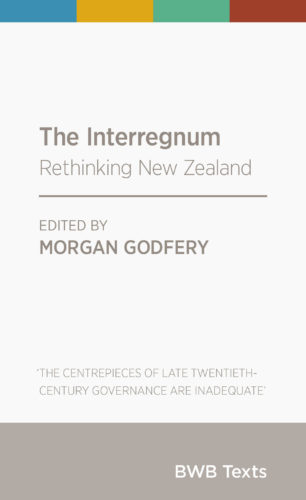
The eighth essay in The Interregnum is ‘Feminism and Silence’, by Holly Walker. Feminism belongs, to most people’s minds, to the sort of thing the left was occupied with before it went crazy. So I’m almost expecting this essay to be relatively conservative compared to the Marxist insanity in much of the rest of the book.

Happily, the basis of this essay is the real-life challenges of a Green MP who found it difficult to combine the demands of her job with the demands of raising a child. This makes a refreshing turn back towards the real world, and the hardships Walker faced in her short time in Parliament are relatable.

Unusually for the essays in this book, Walker’s effort here is honest and disarmingly humble. She writes that “most MPs knew very little about the bills they were speaking on,” and laments that the further she got sucked into the party Parliamentary system, “my ability to share my true thoughts diminished.”

Unfortunately, from there the essay degenerates into the same Marxist politics of antagonism as most of the rest of the book. Walker complains about the proportion of female MPs being too low at 29 percent, not stopping for even a second to question whether it needs to be any higher. The equality dogma has choked all other lines of thought out of Walker’s mind.

Indeed, she even goes as far as asking why Parliament can’t just shut down sooner for the sake of making it easier to combine being an MP with being a mother, as if having mothers in Parliament was so important that it was worth sacrificing a major part of the Government’s efficiency and effectiveness for. The cynic will note that MPs taking a pay cut to reflect the drastic reduction in work hours is not proposed here.

Walker hits the right note when she writes “Let’s unstitch the neoliberal, individualistic mindset we’ve all internalised,” but it’s not easy to see how this essay, or this book, ultimately contributes to that. Neoliberalism and Cultural Marxism work hand-in-hand in that they both serve to divide and conquer the people and to set them against each other to be more readily exploited by an international ruling class, so it’s not credible to argue against neoliberalism from a Marxist perspective.

The essay ends with the author declaring that she spent an entire year reading only words written by women. From the perspective of the eternal victimhood of the female this is no doubt a victory; from the perspective of a working-class man watching his university opportunities dwindle ever-further, as women are assisted to take his place despite already being a clear majority of university students, it seems obscene.

In summary, this piece is very similar to most of the other efforts in the book. It’s clearly written from a privileged, middle-class perspective, despite claiming to speak for the disadvantaged, and it furthers the divide-and-conquer narrative of globalism while claiming to oppose it.