

A Closer Look at the Four Masculine Elements

The masculine is to go upwards, outwards and onwards; to shine without burning

Previous essays here have discussed the difference between the four feminine elements and the four masculine elements, and the four elementary perceptions. This essay looks more closely at the four masculine elements and, more specifically, how awareness of them arises in perceptual space.

According to one manner of thinking, masculinity is judgment in the place where femininity is perception. Where feminine divides into light and dark (where both have equal value), masculine divides into good and bad, where one is prized and the other despised.

Thought of in terms of elements, the basic masculine division is into precious and base. This means that applying the simplest possible masculine lens to the world will divide it into things that are valuable and things that are not valuable. Those things that are already valuable don’t need to be (or ought not to be) acted upon, because they are good as they are. That which does not have value can be freely acted upon, because such actions do not (or ought not) destroy value.

The elementary masculine action is to impose order upon chaos. This means to impose order upon the world. Before this can be done, the masculine perception must be adopted, so that the world can be divided into precious and base. The precious does not need to have order put to it; it has value inherently. The base, however, can freely be worked because in doing so one cannot damage anything valuable, and can in fact improve the value of it if the correct order is imposed.

Regarding the base, the natural masculine question is to ask: can some of this be shaped into a tool? If a blob of clay – which is simply an ordinary part of the natural world – can be shaped into an object that is useful as a tool, then the crafter has performed an act of basic alchemy: through an application of will he has turned clay into iron. This he has done by imposing a useful order upon it.

Imposing useful order upon clay makes it more valuable than mere clay, because it is possible for information to have value, and if that information is encoded into the shape of an object then that object also has value. A worthless blob of clay can be thrown into a pot, and a pot has value as a tool because it can be used to store things. A stick can be fashioned into a spear; rocks can be melted to produce copper and iron, which can themselves be formed into tools.

The two precious elements – those which are perceived to be good and valuable instead of otherwise – are silver and gold. Both of these are very bright in comparison to the base elements, which is how their essential masculinity manifests – as light. Because these elements manifest themselves as light, and because light is associated with valuable things (like warmth, the Sun, daytime etc.), these elements have inherent value.

Ultimately, the reason why gold is more valuable than silver is because it is richer. Gold is shiny like silver, but where silver is colourless, gold is a vibrant kind of yellow. In this sense, gold contains all of the range of colours that clay does – all the colours of life. Thus, it is easier to distinguish gold from iron than it is to distinguish silver from iron, which means that the gold is more obviously valuable.

Metaphysically speaking, this arrangement of the world into four elements of increasing rarity and value tells an entirely different creation story to the seemingly random appearance of the feminine elements of earth, water, air and fire. It tells a story of order emerging out of an ocean of chaos by means of an act of will, first hardening itself, then polishing itself, then finally refining itself to become something immensely valuable that somehow stood as an avatar for all of life – a God.

*

If you enjoyed reading this essay, you can get a compilation of the Best VJMP Essays and Articles of 2017 from Amazon for Kindle or Amazon for CreateSpace (for international readers), or TradeMe (for Kiwis).
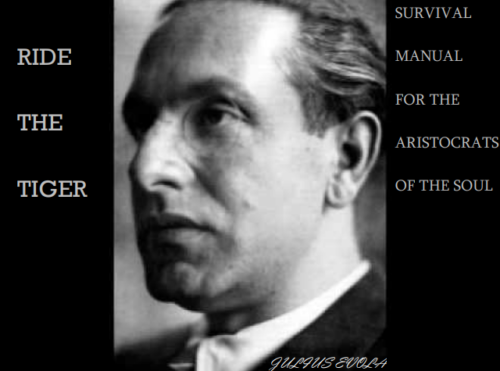
VJMP Reads: Julius Evola’s Ride the Tiger X

This reading continues on from here.

The 27th essay in Ride the Tiger is called ‘Relations Between the Sexes’ and seeks to cover a different range to the essay about marriage. When the order of the world is dissolving, men and women are naturally separated. Our sexual prejudices have contaminated our ethics. Nowhere is this more evident that in the idea of sexual revolution.

Processes have worked towards a freeing of sex, but not a freeing from sex. The sexual revolution has not liberated us from the suffering caused by sexual desire; to the contrary, we are now intoxicated by it. This is contributing to the collapse of society, but we can use the space afforded by the chaos to assert higher values. Bourgeoisie values, being materialistic, cannot conceive of woman in anything more than her anatomical capacity as instrument of reproduction – in reality, she has a spiritual value.

Sexual liberty therefore leads to materialism, and thereby away from spirituality. Incredibly for the 1960s, Evola is already able to anticipate how widespread pornography has affected the “polarity” between men and women. Nowadays a naked woman doesn’t stir much more interest than the sight of a cat. This is a tragedy because the sexual union is capable of acting as a bridge to higher consciousness via “an existential rupture of planes”. Making love can be Dionysian.

Part Eight of Ride the Tiger is where Evola finally gets to the spiritual side of things. This final section is titled ‘The Spiritual Problem’, and consists of two essays. The first of these is called ‘The “Second Religiosity”‘.

In this essay Evola decries what he calls “neospiritualism”, which he describes as an attempt to lead people beyond the material without giving any credence to the old, dogmatic religious movements. He has no time for the “movements, cults, sects, lodges, and conventicles” of the modern day, and considers them also a phenomenon of dissolution. In fact, things have gone so far that we are now in the rigor mortis stage, and all that awaits is the decomposition of the corpse.

When man closed himself off to the higher, transcendent world in the 19th century, this did not liberate him from superstition but merely opened him up to the lower, primitive emotional world in the 20th. We are now in the “soulless, collectivistic and materialistic phase corresponding to the closing of a cycle of civilisation”. All of these neospiritual movements thus represent an excess of the feminine. Evola is highly cynical and dismissive of these movements.

It’s difficult to correctly discriminate between all the garbage thrown up by neospirituality and the wisdom of genuine value. The emphasis ought to go on the deconditioning of the spirit. Here, Evola is at pains to emphasise that a person cannot achieve initiation by themselves, in contrast to the belief espoused by many. One is either born initiated, or one achieves initiation by way of spiritual emergency or ordeal, or one is initiated deliberately by someone who is part of a tradition and who knows what they’re doing. This is hard to achieve because the organisations that do so hardly exist any more.

The 30th and final essay is titled ‘Death – The Right Over Life’. Evola begins here by talking about the common belief, held by Heidegger (as well as by Socrates) that life is in some way a preparation for death. Death appears to be the end of the “person”, and atheism and materialism have made this simpler to deal with. Contemplation of death is a noble endeavour, as it can lead to a heightened state of appreciation of one’s life.

The traditional doctrines had the correct approach to death. The truly differentiated man cannot believe that his being began with the beginning of his physical body. He must solve the problem of nihilism by “displacing the I towards the centre of ‘being'”. Here Evola is talking about consciousness: “the human condition οf earthly existence is only a restricted section in a continuum, in a current that traverses many other states.” This eternal truth is not easy to grasp in an age of dissolution like ours, but it is much better than the lies of theistic creation myths.

A truly differentiated man, much like the Stoics and the Pythagoreans, could never take his own life, no matter how poor his conditions. This is because to do so would acknowledge that he was not strong enough to overcome the irrational part of his being. However, one always has the moral right to exit the world, should one decide that remaining ordeals are not meaningful. The differentiated man would be extremely disinclined to take this option in any case, right or otherwise. This is because of the possibility that one has chosen and said yes to – whether before or beyond this life – all of the ordeals in it.

In the final analysis, one can say that, no matter how degenerate and dissolute the world, it can still have value. It might be that, in order to achieve the highest state of being, consciousness must challenge itself as intensely as possible. To that end, there’s little more challenging than existing in a world where everything is contrary to one’s nature.

*

If you enjoyed reading this essay, you can get a compilation of the Best VJMP Essays and Articles of 2017 from Amazon for Kindle or Amazon for CreateSpace (for international readers), or TradeMe (for Kiwis).

Are You Suffering From Retard Fatigue?

There are a variety of explanations for the general sense of depression and malaise in the Western world today. Some are saying it’s future shock, some are saying it’s climate change, some are saying it’s borne of economic despair, some are saying it’s the alienating effect of technology. This essay proposes a simple but outrageous explanation: we’re all suffering from retard fatigue.

The simple truth is that there are more retards around now than ever.

As technology and medical care have continued to advance over the past 200 years, a large number of people who were not intelligent enough to overcome the survival pressures of the biological past are now able to thrive. Because the extra population is filling the most marginal niches, the average quality of people is declining, and because the human animal has won its niche with its intelligence, that decline is most sharply felt upstairs.

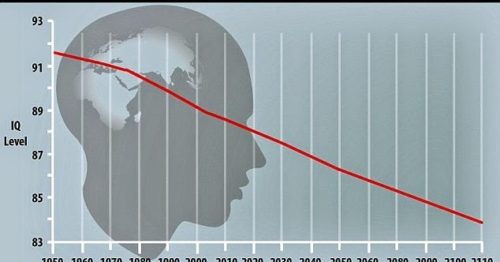
Worse, these marginal individuals are procreating at greater rates. Because intelligent people have better things to do than mindlessly rutting, the vast majority of the children being born nowadays are being born to halfwits. Naturally, they carry on the halfwit genes, as can be clearly seen from the graph at the top of this article.

The average IQ of a person on this planet was already an unpromising 92 in 1950. By now it has fallen to 88, and looks set to fall below 85 (i.e. fall into the literal clinical retardation zone) in a few more decades. But not only are there more retards, they’re also harder to get away from.

The mass media of 2018 brings retards and retardation into our awareness 24/7. All manner of politically-inspired retards kill people every day, whether they’re motivated by Islam, Nazism, Communism or some other hate ideology, and it’s all beamed directly into our homes. The Kardashians and their ilk, for their part, may not be violent, but they still make a large contribution to the retardification of the airwaves, as do all the other reality-tv bobbleheads.

Social media has had the effect of reducing communication to the lowest common denominator, which means that the escape from mass media that existed a decade ago on the Internet has now also yielded to the pressure of the retard horde. Where it used to be possible to find intelligent conversation everywhere in cyberspace, nowadays that conversation only exists in specially curated communities that have sealed themselves off like monks awaiting the wrath of God.

As our culture continues to degenerate, it becomes ever harder to talk about non-retarded things. The vast majority of the population are now only capable of talking about things that appeal to the average or the below average.

This has created what we can call retard fatigue, characterised by a lethargy that is brought on by repeated exposure to low-IQ people without any means of escape. Although retard fatigue has long been a phenomenon in service industries such as hospitality, it’s only in recent years that society has suffered widespread hopelessness in the minds of individuals who despair of ever finding a switched-on person who can talk to them like a human being.

Part of the problem is that the usual avenues for escaping retard fatigue are gradually being closed off to us. Going into the university system was once the default life avenue for anyone too intelligent to handle the peasantry, but now even this is full of retards. The qualifications to study at university have been loosened so far that the system is now little more than a few years extra high school, only with no parental supervision. The hordes have swarmed in.

Even worse, university culture has now fallen victim to the same phenomenon that destroyed intelligent conversation in the mass media: political correctness. People have become so deeply conditioned to feel shame whenever someone accuses them of any immorality or prejudice that they just keep their mouths shut rather than risk it. Of course, this doesn’t stop the retards, who then have no rivals in conversational space.

People have forgotten how to unplug from the machine and take time for themselves, which means that dealing with the hordes of tards can get extremely tiring. It’s also depressing. As mentioned above, the average world IQ is steadily decreasing as the retards keep breeding. This means that, unless drastic measures are taken, retard fatigue is only going to intensify in coming decades.

The only truly effective treatment for retard fatigue is to cultivate quality relationships with non-retards. It’s best if this is done pre-emptively, as part of the practice of good social hygiene, but if the reader has already fallen into a deep state of fatigue they may have to do so as a method of treatment. Speaking with someone who isn’t retarded is often all that is needed to restore a will to live, as well as faith in humanity and in natural selection.

Of course, this means you have to not be a retard yourself. Psychological science tells us that the majority of retard fatigue will be caused by people who are not aware that they are retards – and this potentially means you. It’s wise to have something interesting to talk about that hasn’t been dictated to you by the television. Demonstrating that you are capable of original, self-directed learning will both attract intelligent people and repel retards.

*

If you enjoyed reading this essay, you can get a compilation of the Best VJMP Essays and Articles of 2017 from Amazon for Kindle or Amazon for CreateSpace (for international readers), or TradeMe (for Kiwis).

Why the 2018 Labour Budget Was so Underwhelming

The 2018 Budget, like the 2000 one, was extremely tight; the 2020 Budget will be a lolly scramble, as the 2002 one was

“Yet, for all the hype, [the Finance Minister and the Prime Minister] were at pains to reassure big business and employer groups that this was above all a ‘fiscally responsible’ budget. Its commitments to social spending would not jeopardise Labour’s intention to maintain a surplus, they emphasised…” The two Labour Party politicians mentioned here are Grant Robertson and Jacinda Ardern, speaking in 2018 right? Wrong – they are Michael Cullen and Helen Clark, speaking 18 years ago in the year 2000.

The quote in the opening paragraph comes from this article from 2000, discussing the first Budget of the new Fifth Labour Government. Other quotes of interest from the same source are: “the increases fall far short of what is required to address the acute levels of social and economic inequality now embedded deep within the social structure”, “The majority of families forced to rent from private landlords will be no better off than before” and “Labour and the Alliance have done nothing to restore the vicious cuts to unemployment benefits and welfare that were implemented by the National Party”.

So if you’ve been listening to the Sixth Labour Government explain why this year’s Budget helps almost no-one and you’re starting to realise that you’ve heard this exact same bullshit story before, sit tight while we explain why – and what’s going to happen next.

After nine of years of neglect, including closing down rape crisis centres and overseeing the world’s highest youth suicide rate, the Fifth National Government was finally – although narrowly – voted out of power. The Sixth Labour Government came to power with a strong commitment and mandate to do something about the rape and pillage of the New Zealand populace by the plutocrats.

So the 2018 Budget surprised many commentators with how weak it was. The consensus described it as “National-lite”, and, indeed, it did almost nothing to help anyone. Many asked themselves why it was that an incoming Labour Government would deliver such a weak Budget. Didn’t they want to create the impression that they were doing something to help? Why miss this golden opportunity to set things right?

The answer to this conundrum comes from examining the 2002 Budget, which was released a few months before the General Election that year. That year’s Budget sent the New Zealand business community into paroxysms of rage.

The Employers & Manufacturers Association complained that “The huge $3.31 billion increase in new spending in the Budget for the next financial year is more than double the increase in new spending for the past two years combined”, and then National Party leader Bill English was enraged by “Labour and their higher operating balances, as well as higher taxes, increasing debt and billions of taxpayers’ dollars invested overseas”. There was even money for pure luxury items like refugee resettlement.

These increases impressed the population, as they were the first real relief Kiwis had been given in 18 years of relentless neoliberalism, and they duly returned the Labour Party to power. Kiwis contrasted this big spend-up with the cruelty of the National Party Budgets under Ruth Richardson, and the Nats were duly slaughtered, falling to 21% of the votes, their lowest result in 100 years.

It was a lesson for all, not least the Labour Party.

So the reason why the Sixth Labour Government did next to nothing to fix the nine years of neglect that the Fifth National Government put us through is simple: they’re saving the lolly scramble until just before the 2020 General Election. You can almost guarantee that, when the 2020 Budget rolls around, the grip of the New Zealand ruling class around the throat of the population will be loosened just enough to enable us to express our gratitude by returning Jacinda Ardern’s Government to power for a second term.

This is not a nefarious new trick, dreamed up by a crack team of political consultants – it’s straight out of the Helen Clark playbook. We can confidently predict another weak Budget in 2019 before the conspicuous generosity of the 2020 one, and we can also almost guarantee that if Labour wins a second term this would see us having two more weak Budgets in 2021 and 2022 before another lolly scramble in time for the 2023 General Election. Then, if they win a third, there will be weak Budgets in 2024 and 2025 before yet another lolly scramble in 2026.

This pattern is no less predictable than the General Electoral Cycle itself is, and could even be said to be part of it. Plus ça change, plus c’est la même chose.

*

If you enjoyed reading this essay, you can get a compilation of the Best VJMP Essays and Articles of 2017 from Amazon for Kindle or Amazon for CreateSpace (for international readers), or TradeMe (for Kiwis).