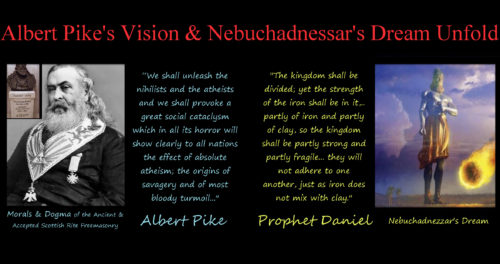
If you’ve moved in conspiracy circles for long enough you will have heard the name of Albert Pike, and his prophecy of three future great wars, one which would see the old empires of Europe mutually annihilate each other, another that would see extreme nationalism and extreme communism mutually annihilate each other, and a third that would see Judaism and Islam mutually annihilate each other. This essay reveals a few truths about these prophecies.
In Pike’s time, freethinkers faced the problem of not being allowed to discuss intellectual subjects freely because of the paranoia of the ruling classes. This necessitated that free thinkers met behind closed doors, and that those who sought entry were heavily vetted. Recognising that these efforts to suppress the truth were grossly immoral, some schemers got together and hatched a scheme that would destroy all opposition to free inquiry and free speech.
Their plan was to use the principle of coincidentia oppositorum to destroy all of the corrupt institutional forces that made it impossible to honestly study and discuss the natural world and the things in it. This involved setting those institutional forces against each other in a series of wars, in blocs of equal power that would bleed each other dry. The kings would be first to go, then the dictators and finally the priests.
All of this is a great work of alchemy. As followers of this newspaper are aware, there are three masculine elements of iron, silver and gold, and each of them has a corrupted form that must be dissolved for the truth to shine through.
The corrupt form of iron was destroyed in World War One when the great European Empires that had developed from the military caste (i.e. the men of iron) destroyed each other. The corrupt form of silver was destroyed in World War Two when the great political falsehoods (i.e. the products of silver) in the form of national socialism and communism destroyed each other. The corrupt form of gold is destined to be destroyed in World War Three, when the great religious falsehoods (Judaism and Islam) destroy each other.
This is the great secret that you’re not privy to. Once you are privy to it, the rest of it all makes sense.
This is the reason why the Western world, whose politicians are beholden to the schemes of the great schemers, moved so certainly after the conclusion of World War Two to secure the position of Israel. The relentless pushing of the Holocaust religion ties into this as well – it has come to be considered extremely immoral to oppose a Jewish homeland in the Middle East.
The ceaseless propagandising on behalf of Israel serves two purposes.
First, it flushes out Jews from among Western populations and induces them to emigrate to Israel. Concentrating all of the world’s remaining Jews in one spot is an important precursor to exterminating Judaism – after all, if they were all in Israel it could be done with a handful of nuclear missiles.
Second, it primes the Western World for the massive retaliation against the Muslim World that we are intended to engage in once Israel is destroyed. The Illuminati scheme calls for the West, insane with rage and fear after Israel’s annihilation, to itself annihilate the Muslim world in revenge for their unthinkable crime against Israel. To this end, we are artificially being induced, by ceaseless media bombardment, to pay attention to the impending Middle Eastern cataclysm.
On the surface of it, allowing mass Muslim immigration to the West seems like absolute insanity. It has long been known that those who live among Muslims come to hate them, and for good reason, since Islam is an ideology of hate. Too many Muslims genuinely believe, as Christians once did, that their superstition is destined to rule over the whole world by the Will of God, and that violent acts that hasten this end are justified.
But stoking this hate is part of the plan. The people of the West have to be conditioned to despise Muslims so that we are motivated to provide the righteous flames of revenge to them after they destroy Israel. We become conditioned to despise them as a result of their presence and behaviour in the West. Therefore, opening the borders to them now causes Westerners to become ready to play their role in the third part of this great scheme.
Male infant genital mutilation is another part of it. Abrahamists would have you believe that the practice of male infant genital mutilation is not harmful and does not cause any trauma to the infant boy. To the contrary, it causes a massive amount of trauma, proportionate to having one’s earlobes sliced off, but this is desired and is intentional, because of the psychological malleability it produces.
This trauma makes the victim exceptionally receptive to certain suggestions, in particular suggestions to do violence against others. This is why the vast majority of the world’s terrorists, mass murderers and serial killers are mutilated. Revenge-fuelled outbursts of violence are natural for innocent beings who have been forced to undergo such a severe trauma for no good reason.
The three most notable areas of male infant genital mutilation are the Muslim world, America and Israel. The reasons for this are simple: these are the people who have been selected to play the starring roles in World War Three. Therefore, they have to be mutilated so that they’re submissive and malicious enough to follow the orders to destroy huge numbers of people when they are given them.
How this will come about has long been foreshadowed: Israel has been claiming for over two decades that Iran is close to developing nuclear weapons. Iran might be, Iran might not be, but the point is that it is part of the plan for them to develop nuclear weapons, and it’s part of the plan for them to use those weapons on Israel.
When this happens, the world will be so shocked, horrified and traumatised that we will be in a prime state to accept the introduction of a New World Order that promises to keep humanity permanently free from the great corruptions. This will involve the introduction of a world religion based on the perennial philosophy, and a world political system based on what we have learned scientifically from psychology and evolutionary biology about how the human species actually functions.
When this day comes, borders (iron) politics (silver) and religion (gold) will all be obsolete, because all humans will have been reunited with their birthright to know the truth. This will signify the end of the Kali Yuga and the start of a new Golden Age.
Of course, none of this really is a secret – you can find all these plans on the Internet if you have the patience to collate them. The real secret is whether or not what I’m saying is true. Is it truth, or it is bullshit dreamed up by some schizophrenic cannabis addict larping as a publisher while living at his mother’s house? You don’t know, you can’t know, unless and until you do the research, and in any case there’s nothing you can do about it. So enjoy the ride.
*
If you enjoyed reading this essay, you can get a compilation of the Best VJMP Essays and Articles of 2017 from Amazon for Kindle or Amazon for CreateSpace (for international readers), or TradeMe (for Kiwis).