
The Ultimate Evil Is To Continue To Exist

To live is to destroy

You! You are an aggressor! There is no way that you can exist on this planet otherwise. All of us have to carve a niche out of Nature, with violence or treachery, for there is simply no other way to survive. So malicious are you that you commit the ultimate evil – to continue to exist!

Every living creature has a need to metabolise in order to stay warm. This metabolisation requires energy, which means food, which means a need to eat, which means a need to kill. In order to live, you have to kill!

Every bit of food you have ever eaten was a living being that had to be killed so that you could eat it! What right do you have to assert the primacy of your own existence over that of another being, over a fellow creation of God? The morally correct thing to do, in order to avoid bringing suffering into the world, is to lie down and starve to death!

Worse, as a mostly hairless ape, you also have a need for shelter – and there’s no other way to build a house than by carving a space out of Nature for yourself. This means destroying the habitats of other creatures.

150 square metres of floor space means 150 square metres of land on which no forests can grow, and through which no streams can run. It’s 150 square metres worth of trees that had to be chopped down, with all the bird and insect life supported by it destroyed.

Neither can you escape your own energy needs. Driving a car around consumes oil – a finite energy source, and one that has to be extracted at the price of more environmental damage. Reading this website requires electricity, which requires energy. All the goods in your house were shipped to you by transportation methods that required energy.

Collectively, these demands meant even more coal mines put down, even more oil wells sunk, even more valleys wiped out by hydroelectric dams. To use energy is to render parts of the Earth to chaos!

There’s nothing you can do about any of these things! To continue to exist is to destroy – for only through destruction can one continue to exist!

To reproduce causes even more damage. The facts are stark: the single most ecologically destructive move a person can make is to bring another human being into the world – a human who will have to eat, to shelter themselves and to use energy, and at ever-increasing appetites!

Worst of all, merely to keep existing means you run the risk of bringing more conscious life into the world to suffer. Even if you don’t intend to breed, you might meet a certain person who causes a massive dump of some hormone to be released by your brain and then you fall in love and nek minnit you have eight children, all of whom must find their own way to come to terms with the fact that they are mortal creatures in a world of ceaseless slaughter!

If you should stop existing, on the other hand, not only does it become impossible to bring more conscious suffering into the world in the form of human offspring, but one also vacates a niche within the biosphere that can (and will) be occupied by gentler, kinder forms of life.

Think of the biomass of the worms that would eat your corpse!

You should be killed!

*

If you enjoyed reading this essay, you can get a compilation of the Best VJMP Essays and Articles of 2017 from Amazon for Kindle or Amazon for CreateSpace (for international readers), or TradeMe (for Kiwis).
Writing the Depressive

All of us know what it feels like to be sad, but few truly appreciate how it is to be clinically depressed. There’s something about wandering ghost-like through an ashen world of dead feelings that is a challenge to express to those who are full of healthy, natural vigour. This article shares some tips for writing realistic characters who suffer from depression.

Depression (in the sense of a mental illness) is otherwise known as major depressive disorder. To be diagnosed with it, a patient has to meet certain criteria. 21% of the French population have been diagnosed with the condition at some point in their lives, which speaks to its prevalence in the modern world.

There are two obvious approaches here.

The first is to use thoughts. Conveying the innermost thoughts of a character is, in many ways, the ultimate power of the literary medium.

The kind of thoughts that go through the mind of a depressed person tend to be anxiety, sadness and fear. Life not only seems to have no meaning, but seems completely hollow and empty. Even thirty seconds is a sufficiently long time in which to experience some genuine psychological torment, and it seems all-pervasive and never ending.

It’s important to distinguish depression from sadness. Depression is a mental illness, and as such it causes irrational thinking. A bereaved person can tell you that they expect to feel happy again at some point in the future once the shock has worn off; no such expectation exists for the depressive. It seems like it’s going to last forever.

Of those people who have never been depressed, few understand the ways that guilt can eat away at the minds of someone who is. Depression is not like a physical ailment in the sense that one can easily justify taking time off from regular duties to recover. It’s rare that a depressed person has the ability to think clearly enough about their condition to realise that they need a break.

It’s far more common for a depression sufferer to end up consumed by guilt in their every waking moment, thinking about the things they should be doing in the time they are convalescing, and how they are letting people down by being weak. This reveals one of the worst things about depression: the way in which it feels like one is persecuting oneself.

The second obvious approach is to use the reactions of other characters to the depressed one. All mental illnesses have a marked social impact, and depression is no exception.

Depression is a sinister, insidious illness. In many cases, a person with it will not realise that they have it. The protagonist of your story might end up arguing and fighting with people all day because of sourness or irritability caused by the condition, all the while assuming that the fractiousness that caused it was natural and normal.

Some well-meaning friend might tell them that they have depression only to be told to piss off. To a depressed person, a friendly suggestion to “Cheer up” might well be taken as an insult. Constant irritability is as much a part of depression as sadness is, and a story might be best able to evoke this through the social side.

In other cases a person can’t avoid realising they have depression, because other people will continually remind them of that fact. The protagonist of your story might be smarting from constantly being called a “miserable prick”, and this might make them even more depressed. It might cause them to withdraw and plot revenge (or even to seek help – who knows?).

The fear of the loss of social bonds can be evoked here. This is a very powerful, primal instinct that almost everyone can relate to. People don’t enjoy interacting with depressed people, and after a while the rejection may lead to the depressed person deciding that those others would be better off without them.

Note that stories featuring depressed characters don’t need to themselves be depressing. In a way, every story about a depressive is a happy one, because any depressive who is still alive must have been able to find some reason to keep going.

This might be the most interesting part of the entire character. After all, it’s objectively not clear why any of us should keep living, given the uncertain prospects for any happiness in front of us. A depressed person might exhibit a stronger will to live or a more beautiful nature than any other person who did not need to struggle through the condition.

Despite this, the reality of the depression experience is that it is one of the most terrifying and deadly of all illnesses, mental or otherwise. The temptation to take the ultimate step to end the suffering is always present, which makes the experience worse than a horror story in several regards.

*

This article is an excerpt from Writing With The DSM (Writing With Psychology Book 5), edited by Vince McLeod and due for release by VJM Publishing in the summer of 2017/18.

How To Fix All of Cricket’s Problems At Once: Introducing the T0 (T-Zero) Format

Taking thirty overs out of the middle of ODIs has been such a success, we need to consider removing a further twenty

T20s were invented to fill a specific niche in the cricket market. It was believed by some great, visionary minds that cricket fans were turning away from ODIs because of the “boring” middle overs between ten and 40. Apparently these 30 overs had too many balls that resulted in neither a wicket nor a boundary, causing viewers to switch off from a lack of action. This essay proposes that we reduce limited overs cricket by a further 20 overs.

There have been experiments with reducing cricket matches to less than 20 overs, such as the recent T10 tournament in Sharjah. Some brave souls have talked about T5 cricket, but what is being proposed here is the advent of zero-over cricket, hereby dubbed the T0 (pronounced “tee-zero”) format. It’s technically a form of limited-overs cricket in the sense that overs are, indeed, acutely limited.

Many people say that Tests are boring because the result is often a foregone conclusion. Over five days, it’s as likely as anything ever is in sport that the most skilled side wins. This contrasts sharply with soccer, and with T20 cricket, because these sports have a much greater luck component. This luck component means that weaker teams can upset stronger ones more often, making for a much more engaging spectacle.

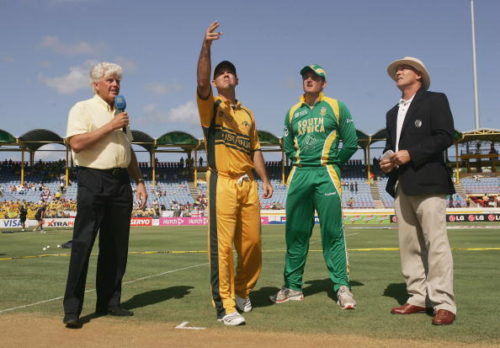
Why not maximise the thrill of potential upsets by deciding the match at the coin toss?

Purists will likely dismiss the idea at this stage, pointing out that reducing the contest to zero overs also reduces the batting, bowling and fielding components of the game. While this is a fair criticism, it needs to be balanced against the fact that the boring aspects of the game would also be reduced. T0 cricket completely does away with the notion that the players are just going through the motions; every moment of every game would be crucial to the outcome.

In all, there are at least three major reasons to support the expansion of T0 cricket. Each of these reasons solves a major problem with the current state of the longer formats of world cricket.

One of the foremost is that it would enable cricket to be expanded into markets where people have not been able to play because of the expense. Cricket is a fairly expensive sport to play, especially when compared to rugby or soccer, and this puts an upper limit on its market appeal to the poorer demographics of the world. Many interested people just don’t have the spare cash for several bats, balls, a set of pads, box, helmet, thighguard etc.

In T0 cricket teams don’t need anywhere near as much equipment as they need in the longer formats – for some players a uniform would suffice. Moreover, maintenance of that equipment is also reduced to a minimum on account of being used less often than in the longer formats of the game. Limiting the equipment factor will also have the effect of reducing gear envy among teammates.

The effect on wear and tear on the players’ bodies is another problem solved by T0 cricket. England head coach Trevor Bayliss was in the news recently for saying that T20 internationals should be dropped from the schedule to help with player burnout. Bayliss contends that the cricket schedule is so jam-packed nowadays there is no time for players to rest.

T0 cricket takes away the physical exhaustion factor. By minimising the incidence rate of high-risk physical exertions, T0 cricket also minimises the chances of injury or burnout. Also, with awareness growing about the long-term dangers of concussions, mothers of young keen-on-cricket children will be relieved to hear that T0 cricket offers very little risk of players getting hit in the head by a hard, rapidly moving ball. The biggest risk is getting a coin in the eye.

Modern life has a peculiar obsession with equalising conduct between the sexes, and T0 cricket can proudly claim to have solved the gender problem. At the moment, men and women can’t really play cricket together because of the fact that men are much taller and stronger, which provides immense advantages when it comes to bowling a ball fast or swinging a bat hard. The differences are so vast that leagues currently have to be separated by gender.

Many would argue that these gender differences, like the personal differences in height and muscle mass, make the game of cricket inherently unfair. Instead of everyone having a reasonable expectation of being able to pull off a win, the longer forms of cricket reduce batting to a mere contest of strength, timing and hand-eye co-ordination, and bowling to a simple process of repeating a single action with maximum shoulder leverage.

T0 cricket would provide a truly level playing field, as all players would be limited to their own ability to pick which side the coin was going to land on – a tricky skill to master even for the most dedicated or gifted athlete.

In summary, there are a number of reasons to think that this revolutionary proposal could rejuvenate the public’s appreciation for the sport. T0 cricket offers the perfect solution for busy people in our modern world who don’t have copious amounts of time to set aside to watch a match, and is surely the future of our beloved game.

*

If you enjoyed reading this essay, you can get a compilation of the Best VJMP Essays and Articles of 2017 from Amazon for Kindle or Amazon for CreateSpace (for international readers), or TradeMe (for Kiwis).

The Left Are the New Christians – For Better or Worse

The essence of Jesus Christ, as he appears to the modern Left, can be summed up in the word ‘nice’

In the West, most of us associate Christianity with the political right. It’s the right – especially in America – that makes the most overt appeals to the Bible and to Jesus. But if one looks past these appeals to the Christian religion, it seems that the political left is more interested in virtue signalling in general. Have they become the new Christians?

People profess Christian beliefs in order to virtue signal. The idea is that Jesus Christ was the perfect man and without blame, and therefore the more Christ-like a person appears to be the more perfect they are.

The problem with this mentality is that a people’s perception of what Jesus was like – and therefore, their conception of what entails moral perfection – is an artifact of the time and place they live in. Even worse, the popular perception of what Jesus was like is usually fabricated wholesale to suit the needs of the ruling classes.

It has now become fashionable to associate Jesus with socialism. Pope Francis, when not covering up for the numerous child abusers within his institution, makes a concerted effort to link his church with progressive attitudes to refugees, homosexuals and climate change. These are all trendy, left-wing issues that promote globalist solutions – which is what Francis really wants.

The idea is to recast Jesus as the “Lord of Nice,” and since it would be really nice to open your borders to anyone who wanted to wander in and claim welfare for the next 50 years, it’s presumed to be the sort of thing Jesus would have done. Jesus wouldn’t let refugees into his actual home, of course, or even his neighbourhood, because of the imperative to keep house prices up, and he definitely wouldn’t have opened the doors of his church to them, but he surely would have at least dumped them in poor neighbourhoods and offered to pay some tax to go towards their upkeep.

When Jesus was cast as the Lord of morally upstanding and wholesome, then it was the right wing that virtue signalled about how much they were like this. Now, the Baby Boomers that comprise the right don’t care about anything other than money, and Generation X don’t even care about that, so it’s left to the Millennials to virtue signal about how much they are like Christ.

In much the same way that the Biblical Christ taught people to give up concerns for pleasure in this material life, so does 21st-Century Jesus teach that we give up concern for maintaining basic law and order in our societies and protecting our women from rape and our vulnerable youth from physical abuse.

These are mere physical, material concerns, and will naturally dissipate. So it doesn’t matter if Muslims and Africans flood into the country in their millions and rape and destroy everything in sight – the fools simply don’t understand that the real pleasures are in the afterlife!

Of course, this is the reason why the Romans threw Christians to the lions in the Colosseum – the presence of any Abrahamic cult will inevitably cause the society that hosts it to rot from within unless action is taken. The left do not realise that they are controlled by whoever controls their perception of what Jesus Christ was like – and these people tend to be the major moneyed interests who control the mass media.

In other words, their sworn enemies.

The purity spiral of the neo-Christian Left has led to them breathlessly supporting the importation of rapists and religious fanatics into the West, in the hope that this masochistic niceness will be seen and appreciated as Christ-like and rewarded. In this sense, they are much like the original Christians who were too concerned with moral posturing to do anything about the hordes of Germanic invaders that ended up destroying the Roman Empire.

*

If you enjoyed reading this essay, you can get a compilation of the Best VJMP Essays and Articles of 2017 from Amazon for Kindle or Amazon for CreateSpace (for international readers), or TradeMe (for Kiwis).