
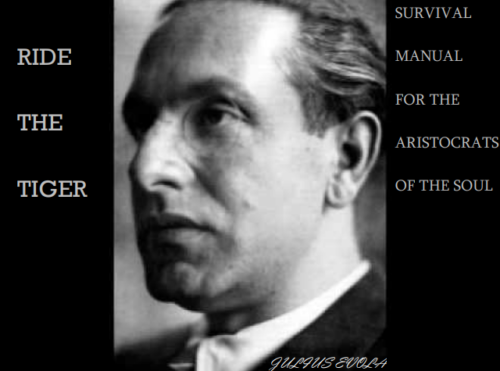
VJMP Reads: Julius Evola’s Ride the Tiger VI

This reading continues on from here.

Part Four of Ride The Tiger is called ‘Dissolution of the Individual’ and is comprised of three essays. The first of these, the sixteenth in the book, is called ‘The Dual Aspect of Anonymity’. Railing against the “collectivism, mechanization, standardization, and soullessness οf modern existence,” here Evola attempts to find an answer to the question of what is worth saving.

It’s at this point that Evola finally gets to the esotericism. Individualism is part of the problem facing us, he contends, because it has led to the atomisation of society. Worse, it has no spiritual basis. What is taken by Westerners to be the individual is not what a person really, fundamentally is.

In esoteric terms, Evola is here talking about the difference between silver and gold. Here the men of silver are decried for their pomposity and hypocrisy, for this has obscured the light of spiritual truth and made it more difficult for the men of gold to play their part. The false self must be transcended and the true self reconnected with, otherwise we will continue to flounder.

The seventeenth essay is called ‘Destructions and Liberations in the New Realism’. Here, Evola gives us for the first time a specific sense of what it might mean to “ride the tiger”. For him it is a life lived at the limit, in a way that actualises the “absolute person”. Most people who discover this do so through warfare, for it is here that an extreme lucidity stripping away all extraneous concerns can be achieved.

Evola makes vague hints at a gross feminising process that, he warns, will make any individualisation impossible. Crucially, however, this feminisation is necessary, to destroy the corruption of the old order. He continues to emphasise that any true revaluation of values must come from that “minority” who retain a sense of the transcendental. Anyone else will merely make the same mistakes that the other non-spiritual people have made.

What is necessary to move forwards from here is “a clear, detached, objective vision οf existence” and “a positive, existential incapacity to submit to ‘myths’ οf any kind whatsoever”. The new mythologies (such as Marxism) are not only doomed to fail, they are in fact signs of systemic failure.

The eighteenth essay is called ‘The “Animal Ideal” – the Sentiment of Nature’. Here Evola talks about the two fundamental spiritual orientations – the first being the hermit who lives without company and the second the wanderer who lives without fixed abode. Incredibly for an essay published in 1961, here Evola talks about the isolation and detachment that can be caused by modern communication technology and city life, foreshadowing contemporary sentiments about the Internet and smartphones.

Anticipating – and pre-emptively decrying – the hippie movement as a bourgeoisie failure, Evola rejects a return to primitivism as being merely a naked form of materialism. Conceding that athletics and sports may be useful (although he decries professional sport), Evola once again asserts that spiritual needs must come first. The true aristocrat of the soul must feel as comfortable among dams and skyscrapers as among trees and streams, for the former is an expression of human nature and thereby of Nature itself.

Fundamentally, a person needs to accept that “nothing extraordinary exists in the beyond”. Only the real exists and only the real can be said to exist. To this end, there is a lot of wisdom in ancient traditions, especially Zen. These allow us to cultivate an appreciation of how reality consists of both the immanent making itself transcendent and the transcendent making itself immanent.

*

If you enjoyed reading this essay, you can get a compilation of the Best VJMP Essays and Articles of 2017 from Amazon for Kindle or Amazon for CreateSpace (for international readers), or TradeMe (for Kiwis).
VJMP Reads: Julius Evola’s Ride the Tiger V

This reading continues on from here.

The 13th essay in Ride The Tiger is called ‘Sartre: Prisoner Without Walls’. This essay is very short – only three pages – and concerns itself with the attitude that one ought to take towards inherent freedom. Criticising Sartre’s conception of man as “condemned to be free”, Evola decries the idea that ultimate freedom is any kind of curse, describing this attitude as characteristic of the deep nihilism of the 20th century.

Sartre’s conception of life is, in Evola’s estimation, a fundamentally negative one in that one considers the human experience akin to being a prisoner without walls. For Evola, this maudlin attitude is not appropriate, for it brings with it suffering. Something more is needed.

The 14th essay is called ‘Existence, “Α Project Flung into the World”‘. Here Evola continues to outline his misgivings with existentialism, despite giving it credit for accurately describing the dilemma of the human condition. Existentialism also gets credit for moving beyond primitive solutions like religion and scientific materialism.

As mentioned previously, Evola’s main problem with existentialism is metaphysical. The varieties of existentialism that do not give a satisfactory answer to metaphysical questions are no better than nihilisms. For this reason, the maxim “existence precedes essence” must be rejected. A person is that which transcends the mere physical form; if not, existence is nothing more than morphing randomly into various shapes. Transcendence cannot and will not be found outside the self.

The idea of anxiety over lost choices, opportunities and paths is, for Evola, ridiculous – and materialistic. The transcendent principle ought to exclude such thoughts. The nature of things cannot usefully be said to be sinful in and of itself. Much better to adopt the ancient Greek view of cultivating appreciation of the beauty of limits and form.

The 15th essay is called ‘Heidegger: “Retreating Forwards” and “Being-for-Death” – Collapse οf Existentialism’. The problem with Heidegger, Evola contends, is that his philosophy is motivated principally by a fear of death, in particular the death of the false self, or I. It’s better to disavow identification with the I, and to choose instead to identify with the transcendent, than to march to the drumbeat of death.

Here Evola continues with his criticisms of existentialist philosophy, accusing it of promoting a bleak, sombre and submissive attitude towards the world, one of resignation. Jaspers offers no other solution but faith. In fact, none of the existentialists have offered a satisfactory solution to the problems of nihilism as outlined by Nietzsche. “Existentialism is a projection of modern man in crisis”.

Neither is faith satisfactory, for that is essentially no different from the “Catholic existentialism” that has already been rejected on account of positing the transcendent outside oneself. It must be accepted that God is dead. Transcendence ought not be conceived of as the ‘other’; rather one should begin from the point of transcendence and consider the world from that perspective.

In any case, all of these men, religious and existentialist alike, are written off as petit bourgeoisie, writing about petit bourgeoisie concerns. The real philosophy comes from the men who have survived the “storms of steel and fire” of the early 20th century: those who have been tested. These are the men who understand the true nature of things; they understand “being able to be destroyed, even, without thereby being wounded”.

*

If you enjoyed reading this essay, you can get a compilation of the Best VJMP Essays and Articles of 2017 from Amazon for Kindle or Amazon for CreateSpace (for international readers), or TradeMe (for Kiwis).

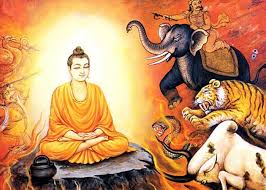
Buddhism is Incompatible With Abrahamism, But Fully Compatible With Luciferianism

The apotheosis of Buddha came not through grovelling, sadomasochism and superstitious entreaties, but from lucid, rational and brave introspection

The fashionable talk today is about interfaith dialogue. All of sudden, everyone’s trying to emphasise what the world’s various religious traditions have in common. Some even go as far as to say that all religions worship the same God. Despite the absurdity of most of this fashionable lip-flapping, this essay will argue that, at least, Buddhism is compatible with Luciferianism.

Some say the reason for this interfaith dialogue is that talking leads to fewer misunderstandings, which leads to less violence. Leaving aside the fact that Abrahamism causes 99%+ of the world’s religious violence anyway, the problem with Abrahamism is that the more one learns about it, the less one respects it. Even worse, the more time one spends around its followers, the less one respects it.

On the face of it, there are several major ways that Buddhism appears utterly incompatible with Abrahamism. On the other hand, although Buddhism could never find peaceful co-existence with Abrahamism, it could find it with Luciferianism.

The major tenet of Buddhism is that one acts in a way that minimises the suffering of other sentient beings. The principle behind this is compassion, in that the suffering of those other beings is an important thing that ought to be taken into consideration. A related teaching is the interdependence of all things, which cultivates an appreciation of the effects that one’s actions have on the well-being of other creatures.

There are no such concepts in Abrahamism. Working to reduce suffering is incidental to following the directives of God – if homosexuals are to be put to death then so be it. God says so. It matters not whether this action reduces or increases the suffering in the world. Likewise, women have to be put in their place, and non-believers persecuted. Compassion doesn’t come into it; all that matters is submission.

Luciferianism doesn’t really have set instructions for what to do about the suffering of other conscious beings. Cruelty, however, is seen as petty, small-minded, even bestial. The Abrahamic insistence on male infant genital mutilation appalls the Luciferian, who tends to see it as a gross violation of power with superstitious origins.

This attitude of submission (and of forcing submission) is another way in which Buddhism is not compatible with Abrahamism. For example, Buddha said:

“Don’t blindly believe what I say. Don’t believe me because others convince you of my words. Don’t believe anything you see, read, or hear from others, whether of authority, religious teachers or texts. Don’t rely on logic alone, nor speculation. Don’t infer or be deceived by appearances. Find out for yourself what is true and virtuous.”

This is an extremely Luciferian attitude. Here, Buddha appears to be saying explicitly not to worship him, not to see him as something higher. A Luciferian would understand that one cannot take another person for an authority on how we all got here or what we’re doing, while a Buddhist might contend that the nature of God is irrelevant.

By contrast, Abrahamism preaches submission to dogma. Questioning the priest is not the done thing, because he speaks with the authority of God. Whereas a Buddhist teacher will sit at the front of a class and take questions, which are answered honestly, the Abrahamist preaches from a raised pulpit, and takes no questions. Questions imply free-thinking, which is a sin because it correlates negatively with submission.

Buddhism doesn’t demand that anyone bow down to anyone else. There is no self-appointed “God’s Representative on Earth”. A Buddhist would not give any credence to anyone claiming to speak for God, for any reason – the Pope has no more spiritual authority than a schizophrenic street prophet. The shiny silver that high priests are bedecked with will not convince a Buddhist that they know what they’re talking about.

What matters to the Luciferian, like the Buddhist, is a methodology by which truth might be discerned. Abrahamism is not a methodology – it is a dogma. Where the Luciferian and the Buddhist might meet on equal terms to discuss strategies and tactics of mutual interest, the Abrahamist presumes to dictate the truth, and the right to enforce submission to this truth with violence.

It seems like Buddhism appeals to the same sort of people as Luciferianism. It may be that both traditions arose to meet the challenges of their time and place: Buddhism with immense physical poverty, and Luciferianism with suffocating environments of spiritual lies, misdirections and untruths.

Buddhism deals with the lies of the senses and the mind, and Luciferianism with the lies of the Abrahamists. They are both master moralities, in contrast to the slave philosophies of the desert.

*

If you enjoyed reading this essay, you can get a compilation of the Best VJMP Essays and Articles of 2017 from Amazon for Kindle or Amazon for CreateSpace (for international readers), or TradeMe (for Kiwis).

VJMP Reads: Julius Evola’s Ride the Tiger IV

This reading continues on from here.

The tenth essay in Ride The Tiger is called ‘Invulnerability – Apollo and Dionysus’. Here Evola further describes his conception of an aristocrat of the soul as someone who feels very deeply and who is very moved by things. The modern man (the man of clay, essentially), only feels very shallow emotions, and quickly moves from one such shallow impression to the next.

In this essay, Evola touches on the truly aristocratic topic of deliberately exposing oneself to great trials and tribulations, for the sake of learning one’s true nature. Alchemists will recognise this mentality as the one necessary to burn away everything but the gold so as to learn to distinguish Spirit from Nature. The purifying fire is that which burns away body and mind and leaves one with one’s true nature – it is necessary because it burns away everything shallow, leaving only actions which arise from the depths.

A person who has done this may find themselves gifted with a “transcendent confidence” that is characteristic of the aristocrat of the soul. This is important because in purifying oneself down to the gold one also strips away all of the conditioned belief in life’s meaning. To proceed past this stage, the alchemist must find within themselves the will to assert a meaning to life independent of any outside source. Then one is invulnerable.

To open oneself without falling apart is not easy in an age of dissolution. Here Evola takes care to point out that it’s very easy to fall at the second hurdle. Just because mainstream religion is bullshit doesn’t mean that we should abandon it for wild paganism and barbarianism. There is more.

The eleventh essay is called ‘Acting Without Desire – The Causal Law’. Once a person discovers their true nature, they should also learn the ability to act without desire. This entails taking the correct action at any given time instead of becoming distracted by profit or loss, or by what other people might think of you. Doing what needs to be done.

This needs to be qualified, however. There are naturalistic desires, that arise from the biology of the human animal. These are generally to be avoided. There are also, however, heroic desires, that arise from something greater than the merely physical, from something transcendent. These may be acted upon.

An aristocratic person, then, thinks not in terms of sin but in terms of error. The concept of sin is impossible because God has long been repudiated; all that remains is adherence to standards that one sets from within as an expression of one’s true nature.

One ought to act with a mind to what is effectively a law of karma, in that actions have consequences, regardless of whether those actions conform to any conception of good or evil. Those consequences are real and should be regarded as such. This is fine because the real man of gold doesn’t just live, but rather manifests himself and his true nature in the world.

This is the end of the second part of the book. The next part is called ‘The Dead End of Existentialism’, and the first essay here is the book’s twelfth: ‘Being and Inauthentic Existence’. This deals with the two types of existentialism (as Evola sees it): the philosophical, academic tradition and the practical tradition exemplified by Jean-Paul Sartre.

Evola dismisses existentialism almost entirely, for the reason that the existentialist philosophers are too much a product of their times, and because they are not themselves interested in the world beyond. The existentialists are very materialistic and this disqualifies existentialism from being a philosophy that an aristocrat might be concerned with.

Despite this, existentialism can be credited with some things. For one, the idea that “existence precedes essence” serves to keep the existentialist in touch with the metaphysical and transcendent. It also helps to highlight the dual nature of the aristocratic soul, which, as described earlier, is much deeper than that of the pleb.

*

If you enjoyed reading this essay, you can get a compilation of the Best VJMP Essays and Articles of 2017 from Amazon for Kindle or Amazon for CreateSpace (for international readers), or TradeMe (for Kiwis).