If You Want the Young to Avoid Smoking, Properly Fund a Mental Health System

The way to lower rates of tobacco use is not by raising taxes on the substance but by curing the mental illnesses that lead to people finding solace in smoking

Decades of government propaganda has convinced most people that tobacco smoking is a harmful addiction with absolutely no benefits whatsoever. Unfortunately, this brutalist approach to what is really a complicated issue neglects the very real psychiatric benefits of smoking tobacco. This essay proposes that the only realistic way to get young people to avoid smoking is to properly fund a mental health system.

Because our culture is going backwards in many ways, we are losing a lot of wisdom that used to be common. A lot of old folk remedies have been forgotten because a large pharmaceutical company was able to make profits selling an alternative. Cannabis is the most obvious of these, but tobacco risks becoming another.

Tobacco has been used in the West for its anti-anxiolytic and antidepressant qualities for hundreds of years, beginning with its discovery by Europeans in South America. The substance has a long history of shamanic use in South America, where some traditions seemed to believe that the exhaled smoke carried one’s wishes up to God.

Unfortunately, knowledge about how to use this substance wisely has been lost, and most people have drifted to either the extreme of smoking a pack a day or the extreme of thinking that tobacco has no benefits at all. Subtlety has been forgotten.

The first public government campaign against tobacco smoking was carried out by Nazi Germany. The authoritarian nature of the National Socialists made them well suited for ignoring the mental health benefits of the substance. Despite that, the Nazis were unwilling to go quite as far as the New Zealand Government and try to have the substance banned.

The truth is that people smoke tobacco because it feels good, and that tobacco feels good not because it gives an instant rush of pleasure that makes you addicted but because it alleviates suffering that already existed in the smoker’s mind.

If it was true that it gave people a rush of instant pleasure then everyone should become addicted, but this is not at all the case. People who are suffering psychologically are far more likely to become addicted, for the simple reason that smoking tobacco temporarily takes the suffering away. This appears to be especially true of people suffering from schizophrenia, depression or anxiety.

Some will say that these people have “addictive personalities”, but that is rubbish. The simple fact is that people who are suffering are more likely to take a substance that alleviates that suffering than people who are not suffering – this is obvious if one considers the balance of incentives.

And so they smoke tobacco because it helps them deal with stress, anxiety, rage, depression, and a range of neurotic and psychotic disorders.

The correct approach here is not to brutally force the citizenry into abstinence by taxing the mentally ill into poverty like a 20th century authoritarian hellhole would, but to cure the mental illnesses that cause people to smoke tobacco before they start smoking it.

Fundamentally, this means two interrelated things have to change. The first is for the Government to acknowledge that mental illness are legitimate health problems in the same way that physical illnesses are, and to properly fund a mental health system. With a properly funded mental health system psychiatrists will be able to keep up to date in their field instead of parroting 30-year old drug war propaganda because they have no time to research.

For this to be possible depends on the second thing, which is that New Zealand makes a cultural change in which it acknowledges that mental illnesses are legitimate problems in the same way that physical illnesses are, and that “hardening up” when you are suffering from depression makes as much sense as hardening up when you have a broken leg, and is equally as likely to kill you if you try to go on with your life without getting help.

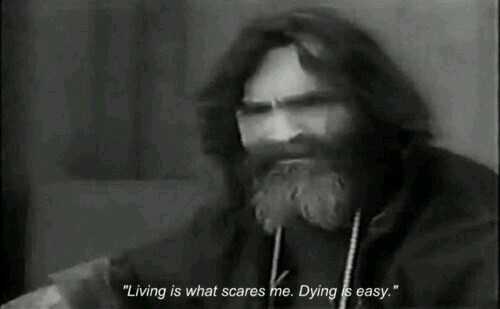
Charlie Manson: So Close And Yet So Far

Charles Manson: got a lot right, got a lot wrong

Charles Manson: thought by some to be a genius, thought by many to be a maniac. Only a select few realised that he was both. In his actions relating to the infamous Family killings, Manson almost showed humanity a new way of relating to power, but a poor choice of target disqualify his actions from being considered anarcho-homicidalism.

Much like Adolf Hitler, Manson kept a coterie of devoted followers on account of an extraordinary level of charisma and penchant for giving lectures about the degeneracy into which the outside world had fallen. Also much like Adolf Hitler, Manson had a lot of excellent ideas that lacked execution, with consequences that the world would not forget.

One of the excellent ideas that Manson had was that people ought to rise up and challenge the control system, on account of its incredible corruption and the lies and destruction that it has wrought upon the Earth. Rising up against liars and thieves who have wormed themselves into positions of authority is the basis of anarcho-homicidalism, and no doubt Manson played on natural anarcho-homicidalist sentiments when he persuaded Watson et al. to do what they did.

Nobody can stand in judgement, they can play like they’re standing in judgement. They can play like they stand in judgement and take you off and control the masses, with your human body. They can lock you up in penitentiaries and cages and put you in crosses like they did in the past, but it doesn’t amount to anything. What they’re doing is, they’re only persecuting a reflection of themselves. They’re persecuting what they can’t stand to look at in themselves, the truth. – Charles Manson

Some might argue that Manson was an anarcho-homicidalist, on account of that much of his stated ideology was anarchic, and so the homicidal actions of the Family were also anarchism. It could indeed be argued that the Family actions were anarchic, because behaving in that manner is demonstrating very clearly that one has no rulers, but actions only constitute legitimate anarcho-homicidalism if they are conducted against someone making an attempt to enslave another.

It’s not really fair to target members of the cultural elite on that basis alone, for the reason that they are not the ones holding the reins of power. Sharon Tate was an actress – an influential position admittedly – but no-one took orders from her. She didn’t threaten anyone into coercion; she didn’t try to enslave anyone. She was just a pretty face that people paid money to look at for a few hours.

There was perhaps an element of jealousy in Manson’s selection of target, in that he had found it difficult to break into Los Angeles cultural circles, and so chose to target those who had. Such motivations cannot be considered anarcho-homicidal in any real sense, because they didn’t target anyone who held real coercive power, and were not motivated by the ideal of liberation.

This absence of coercive power meant that the people the Manson Family killed were not aggressors in any real sense, and therefore killing them could not be justified in self defence.

If Manson had targeted politicians instead, things would be very different. America was embroiled in the Vietnam War in 1969, and the Government was drafting young men to fight it without their consent, on pain of imprisonment. Killing any prominent warhawk or supporter of the Vietnam War would have been a legitimate act of anarcho-homicidalism, and would have been much more effective than abusing the draftees when they returned.

Charles Manson and his Family had more or less the right idea; their major error lay in the selection of a target that was not directly trying to enslave them.

The Future of Empathy

Empathy has probably evolved to facilitate social interaction in the human species, which is why an absence of it tends to have antisocial consequences

By most measures, the world seems to have become a more empathetic place since the Stone Age. The average person’s chances of meeting a violent end are far lower today than back then, and one’s exposure to grossly traumatic events are also far lower. This has had some interesting effects for a species that may have adapted to a certain level of environmental violence.

In many ways, this increasing empathy is becoming standardised and expected. We are more empathetic than ever before by a number of measures: we share more of our wealth than ever, we commit fewer crimes against each other than ever, we have a much better understanding of mental illness than ever. We debate social issues – like bringing refugees into the country to be supported out of general taxation – that would have been unthinkable even a century ago.

The question arises: where does this process end? In my upcoming cyberpunk novel, The Man With A Thousand Fathers, I explore this point in some detail. It is set in the 2080s, when the science of psychology is much more advanced than what it is today and when the confluence of virtual reality and psychoactive research chemicals has meant that the world on the flipside is often realer than this one.

In the Thailand of the story world, children who are discovered to have defective levels of empathy are put into a virtual reality environment instead of being allowed to go into real life, and then raised with exposure to a set of stimuli specifically calculated to condition them to be more civil. One of the story’s characters, an orphan named Suwat, spends over a decade in such a virtual environment before being released.

It’s entirely possible that such a thing may eventuate, for utilitarian reasons. It’s not difficult to predict the kinds of children who are going to grow up to be criminals. They’re simply the kids that lack empathy for other kids. Any schoolteacher could tell you with high accuracy which children in their class are likely to grow up to cause problems and which children are not.

It’s also not difficult to predict why these kids lack empathy. The vast majority of the time it’s because they themselves aren’t shown empathy at home. Children are not born knowing what’s what; they learn to base their behaviour and moral values on what is demonstrated to them as normal. If a child’s parents don’t show empathy to each other or to that child, that child might well grow up to learn that not showing empathy is normal.

A child who has been exposed to really bad things might even come to learn that empathy is weakness that makes a person vulnerable. They might learn that showing empathy is a signal that one is soft, and that one dare not show it in case it invites aggression and exploitation.

With advancing virtual reality technology, we’re almost at the point where using a virtual environment for therapeutic purposes becomes mainstream. Virtual reality therapy has already shown promise in treating soldiers suffering from PTSD.

Extrapolating from this, it might become possible, if a virtual environment was engineered accurately enough, to use VR therapy to cure a wide range of psychiatric illnesses and disorders.

On the darker side, advancing technology might also make it possible for psychotechnicians to use machines to measure aspects of brain activity that the owner of the brain might not themselves be aware of. It has been possible to detect homosexuality in a subject for decades by exposing them to graphic homosexual images and measuring whether certain parts of the brain spark into life or not, and who knows where this sort of technology might lead.

It might happen that young children are exposed, en masse, to virtual reality examinations in which their brains are tricked into thinking that they’re in situations where empathy is required, and then their levels of empathy are measured. Anyone with too low a level is shipped off to VR therapy in the hope that they can learn to become more co-operative.

*

Vince McLeod is the author of ANZAC cyberpunk novel The Verity Key.

If Charles Manson Was a Serial Killer, What Was George W Bush?

Charles Manson: responsible for 999,991 fewer deaths than George W Bush

News media are reporting that one of the world’s most “notorious serial killers”, Charles Manson, has died in prison. Described as a “mass murderer” by many, including Wikipedia, Manson was found guilty for a string of murders committed by followers of his Family cult, even though it was only ever alleged that he ordered the killings. But if Manson was a serial killer for ordering the deaths of nine people, then what is George W Bush, who ordered the deaths of a million?

It’s well known that Charles Manson never killed anyone himself (at least he was never tried of a murder that he committed himself). At his famous trial, where he faced several counts of murder, it was never even alleged that he killed anyone. From the beginning it was asserted that the Family members had killed on his authority, and so Manson was as good as guilty even if he hadn’t literally murdered.

One obvious question arises from this. If being the leader of a hippie cult that killed nine people is enough to get a man put in prison for life, how has George W Bush got away with being the leader of a statist cult that killed over a million people? Surely, according to the same logic that was used to imprison Manson, George W Bush ought to stand trial for several hundreds of thousands of counts of murder and up to a million counts of manslaughter?

All of the US soldiers that killed people in Iraq from 2003 onward justify what they did because they had vowed to follow orders. They had sworn to do whatever they were told by their superior officers (unless it was illegal), and their superior officers had done the same, all the way up to the first link in the chain of command, which is the President. It was the President’s word that got the invasion started, and the President’s authority that justified it.

So if the actions of Manson’s followers made him guilty of murder, then the actions of George W Bush’s followers have also made him guilty of murder.

Even worse, Charles Manson had very little in the way of guidance that he could have drawn on to make a better decision. He was the son of an alcoholic teenage prostitute, and so wasn’t raised to learn how to make good judgments. What’s George W Bush’s excuse for so callously ordering a military action that killed over a million people? He was the son of a president himself, so should have learned better judgment than anyone else.

Moreover, the people of the world demonstrated in no uncertain terms that they thought the invasion was a bad idea. Over a million people protested in London, and three million in Rome – still the largest protest in world history. The whole planet told George W Bush that what he proposed to do was going to be a humanitarian catastrophe – so he can’t say that he wasn’t warned by the world that he was making an error.

So if Charles Manson was worthy of all the hatred he endured because he was guilty of possessing a monstrously arrogant disregard to the value of human life, then George W Bush is worthy of a hundred thousand times more.