
A Person’s Politics Follow From Their Conception of Human Nature

People who believe that humans are more like bonobos than chimpanzees tend to be left-wing, and vice-versa

Most people with strong political opinions like to think that their opinions are perfectly logical, and derive directly from natural principles. Although most people are correct and reasonable in that their political opinions follow logically from their perception of human nature, the problem is that people have an extremely varied range of beliefs when it comes to their perceptions of human nature. In some cases, there’s no way of knowing who’s right.

Take, for example, the question of nature versus nurture. This is another way of asking: how much of a person’s behaviour can be attributed to natural causes that they were born with, such as genes, and how much can be attributed to environmental causes, such as how they were raised?

All positions on this extremely important question fall somewhere between 100% nature and 100% nurture, the former being known as “genetic determinism” and the latter being known as the “tabula rasa” (“blank slate”) theory. This sounds objective and scientific, but it really isn’t, because one’s attitude here will reflect one’s political opinions.

Take the question of Third World immigration and refugees, for example. A person who believes in genetic determinism might be extremely reluctant to open the borders to African or Muslim refugees, because they will tend to believe that these people will never and can never learn to behave in a civilised manner.

A person who believes in the tabula rasa theory, by contrast, will tend to believe that the wealth of Western nations is because of cultural reasons, and therefore African and Muslim refugees will acclimatise to the Western way of doing things, and therefore over time their crime rates and income levels will equalise with the native population.

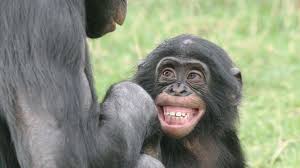
Another area in which this occurs is with regard to bonobos and chimpanzees. Here we can also see that a person’s belief about the scientific, biological reality of the human species has a profound effect on their political beliefs.

Bonobos and chimpanzees are the two generally accepted chimpanzee species, and some (such as Jared Diamond) have argued that humans are so similar to them that we belong in the same group as them as a third chimpanzee. But from which of the two can we draw more accurate inferences about the true nature of behaviour in the human animal?

The bonobo is a creature of peace, the chimpanzee is a creature of war. This is evident from observing the two species in their natural habitat. The chimpanzee is violent, cruel, loves fighting and tends to cure anxiety by bashing a weaker chimp. The bonobo is hypersexual, loves bonding and grooming and tends to cure anxiety by having sex.

If a person believes that humans are more like the bonobo they will tend towards pacifism and polyamory, and will be left-wing. If a person believes that humans are more like the chimp they will tend towards violence and monogamy, and will be right-wing. This is true even if the person in question knows nothing at all about the ethology of the two species.

A third is whether or not people are naturally lazy. This one is especially difficult because attitudes to industriousness are biological to a major extent.

Few appreciate this, but in a cold environment people evolve to be active because physical activity keeps you warm, and this confers a survival advantage by staving off colds and hypothermia-related conditions. In a warm environment people evolve to be inactive because physical activity gives you heatstroke.

This is why pale-skinned people tend to work hard and dark-skinned people don’t – it’s not because of any moral failure on the part of the latter.

Consider this information in the context of whether or not we should bring in a universal basic income. The fear on the conservative side is that a universal basic income would cause certain demographic groups to become lazy and shiftless, and they would all stop working immediately and live the parasitic lifestyle natural to their kind.

If a person’s conception of human nature is not that people are lazy but rather that people are industrious, they will be much more likely to support a universal basic income out of the hope that it will free people from drudgery and therefore enable them to put their energies into creative endeavours of more benefit to human happiness.

In summary, it’s usually possible to surmise a person’s political opinions from their belief in human nature. Political opinions are not formed in a vacuum – they are informed by many factors, one of which is a person’s belief in how other people naturally behave given a certain schedule of reinforcements and punishments.

*

If you enjoyed reading this essay, you can get a compilation of the Best VJMP Essays and Articles of 2017 from Amazon for Kindle or Amazon for CreateSpace (for international readers), or TradeMe (for Kiwis).

The Four Kinds of Warfare

When a person hears the word ‘warfare’, it usually conjures up images of fire and explosions, bombs, tanks, blood, death, bayonets and bullets. This is what most people mean by ‘warfare’. As this essay will examine, there are four different elementalist perspectives that we can take towards the subject of war, depending on the realm of reality that we are in.

The element of iron corresponds to the kind of warfare that we are used to. In the natural world, iron represents the strength that came to dominate over the clay. It is the strength of muscle, claws and fangs, and later bone clubs and spears, and then swords, axes and knives and then firearms.

When we talk about warfare we’re usually talking about warfare on this level. Here the goal of the warfare is to reduce one’s opponent to chaos by destroying the coherence of (and therefore the order in) their physical body. The element of iron is especially useful here because it can be hammered into a tool that can pierce or slice through an opponent’s body of clay.

Much of modern warfare in this sense is really a logistical challenge that seeks to optimise how quickly iron can be moved from one part of the battlefield to another. Hence, bullets move as fast as possible and tanks move as fast as cars despite weighing several tons. The apogee of this process might be the aircraft carrier, many of which can carry dozens of strike fighter jets plus other armaments.

The element of silver corresponds to economic warfare. This means that it is a warfare of primarily unseen things: debt and interest rates being the foremost of them. In the same way that a man with an iron instrument can reap a field of wheat, a man with a silver instrument (such as a bank charter) can reap a field of men.

The nature of this economic warfare is silvery like the gossamer of a spider’s web. Its power does not come from crushing and slicing, like the iron, but from dazzling and entangling. It has been used ever since Babylon and bases itself on things that people with ordinary intellects have trouble understanding, like fractional reserve banking.

So people with low levels of financial literacy find themselves bedazzled by the promise of, for example, an instant loan no-questions-asked-right-now, and this leads to them becoming entangled in scams like payday loans that they take out to blow on something like a holiday, and then getting bled for a small amount every week forever to service the interest.

The element of clay corresponds to demographic and biological warfare. This does not mean biological in the sense of nerve agents and genetically engineered viruses, but in the sense that the most powerful weapons of any group of people over the long term are the wombs of their women.

Most refuse to acknowledge it, but Europe is in the process of being conquered by an r-selected, equatorial enemy that primarily wages war by reproducing at a high rate and ensuring that the children produced are brainwashed into willingly serving as soldiers for the furtherance of the meme complex. This is warfare of clay because it’s the same way that plants and insects outcompete each other: by spitting out as many offspring as possible.

It has been said that “demography is destiny”, and this is clearly true if one looks back over history and notes how high birth rates inevitably lead to the surviving offspring seeking out new territories (and usually killing the existing occupants of them). The British Empire was also founded on high birth rates and it has been the same for every previous empire in history.

The element of gold corresponds to spiritual warfare. This is the hardest perspective to understand, and it is the perspective that is the most valuable.

The reason why it is the most valuable is the battlefield in question here is the human will, absent which, no force can triumph in any of the other three areas of warfare, no matter how vigorous, strong or smart.

It isn’t a simple matter to describe how warfare is conducted on this level, but it’s enough to say that the spiritual birthright of every human being is to understand that their core essence is pure consciousness, and that this consciousness is immortal, invulnerable and eternal and is the same as God.

*

If you enjoyed reading this essay, you can get a compilation of the Best VJMP Essays and Articles of 2017 from Amazon for Kindle or Amazon for CreateSpace (for international readers), or TradeMe (for Kiwis).

Humanity’s Greatest Conceit

Many people are happy to hold the belief that other creatures have a “lesser” or “lower” form of consciousness to themselves, despite the absence of a logical basis for it

The single greatest conceit of the human animal is that humans like it are somehow more conscious or self-aware than the beings who make up the rest of the animal kingdom. This belief is not only insane and irrational, but it has had devastating consequences for the rest of the Earth.

When it comes down to it, no-one has any fucking idea who or what else is conscious. This follows simple logic. After all, how could we possibly know? Each one of us can assert with absolute certainty that, as an individual, they are conscious, because being conscious of your own consciousness is sufficient evidence that it exists. But this gets taken to illogical conclusions.

The vast majority of humans labour under the erroneous assumption that other creatures are only conscious to the degree that they are like those humans. A chimpanzee is considered to be very similar to us relative to the rest of the animal kingdom (and it is if the comparison is made in physical and anatomical terms), but this has no relevance to whether or not the chimpanzee is conscious.

If we can’t observe or measure consciousness in other humans, then we can’t measure it in other creatures either. So if consciousness has never and can never be either observed or measured in other creatures, then any belief about the consciousness of another creature must of necessity be an article of faith.

Simple enough, but the difficulty arises when this iron-clad logic meets the infinite human capacity for self-delusion. The vast majority of people make the erroneous assumption that their brain generates consciousness and therefore that other creatures are similar to the extent that their brains are believed to be similar.

But this is pure superstition, and not logical.

Even worse, despite being a majority, are those who assume that they are superior to all creatures of “lesser” consciousness, and that the supposed lower consciousness of other creatures give us a green light to abuse and exploit them.

It’s common for humans to look at a cat and think we see an animal that is uncomprehending of the greater existential questions, but how can we rule out that the cat has long since solved all these questions and is now blase about them, to the point that any human wondering about them merely appears sophomoric?

How can we know that the cat, who sleeps 15 hours a day, isn’t meditating for most of this time? Cats might all be spiritual masters on the order of Buddha.

How do we know that the ant that appears to go forward mindlessly, isn’t at perfect peace with its role in the world and accepts it without reservation?

The logical flaw is also evident if one observes that many people are willing to assume that these creatures have less consciousness on account of that they didn’t evolve as much of it as we did – but they aren’t willing to make the same assumptions of different races, even though the logic is the same.

The argument that differing selection pressures could account for differences in consciousness between humans and the other mammals, but could not also account for differences in consciousness between white people and black people, is a contradiction on its face.

Humanity’s greatest conceit is that our consciousness is somehow more special or worthy of not suffering than the consciousness of other creatures, and this line of reasoning is what has enabled the rape of the planet that has occurred over the last century.

*

If you enjoyed reading this essay, you can get a compilation of the Best VJMP Essays and Articles of 2017 from Amazon for Kindle or Amazon for CreateSpace (for international readers), or TradeMe (for Kiwis).

Sweden Met With Catastrophe Because of Arrogance

I arrived in Sweden for the first time in December of 2001. Within weeks, before I even had the chance to adjust my sleep schedule to the 11-hour time difference, the country was rocked by the murder of Fadime Sahindal. I didn’t understand it at the time, but this incident – and Swedes’ reaction to it – could explain the disaster that has now befallen the nation a generation later.

Sahindal was a Turkish refugee, and had moved to Sweden with her family at the age of seven. She was evidently a high-spirited woman because she refused to accede to her father’s demands that she abstain from dating any Swedish men. This refusal, to to horrified astonishment of the Swedish population, was enough to provoke her own father into shooting her in the head to absolve the perceived shame Fadime had brought upon the family – a so called honour killing.

I had never, ever heard of such a thing as an honour killing in New Zealand, because our Muslim population is too low. So I had to look to Swedish people, as fellow Westerners, to suggest a reasonable reaction. The reaction to this was, at first, utter shock, mostly because murders were shocking enough by themselves in the Sweden of 2002, and to my surprise people got over it very quickly, appearing to reason that the problem would be sorted out soon enough.

But on the fringes on Swedish society, a plaintive voice sounded in the dark forests. It said, calmly and logically, that if women are being murdered for going out with young Swedish men, then the nation’s efforts to integrate these people – now arriving in their tens of thousands – were going to be extremely difficult. If the immigrants hate us so badly that they’d rather kill their own children than have them go out with ours, how will they ever have the will to integrate?

Many Swedish people appeared to have followed that line of reasoning to the obvious, and unremarkable conclusion that if they hate us that badly then we ought not to let them into the country, at least not in any large number. These people had learned, however, that they could not articulate these thoughts without being socially executed, because the consensus was that Sweden would do an excellent job of integrating these immigrants, and anyone going against this consensus was ostracised without mercy.

The intellectual class of Sweden appeared to be obsessed with becoming an “ideologiskt stormakt” (ideological superpower). The reasoning was that Sweden was too small to be a superpower in any military or economic sense, so she could only find satisfaction for her ambitions to be recognised as the best in the world through ideology. She would have to set some kind of Christ-like moral example for the world to follow.

Swedes strongly disagreed with me when I claimed that this desire, borne of a self-righteous and narcissistic need to be recognised as the best in the world at everything, was likely to backfire. Sweden had proven itself the best in world at solving any and all social issues – this was the constant refrain that I could not escape during my time here. Vi är stolt men inte nojd – we are proud but not satisfied – was the campaign slogan.

Therefore, Sweden would inevitably prove itself better than every other country in the world at solving the issue of how to integrate masses of angry, psychologically crippled men of fighting age from cultures rotten with hatred for outsiders. I realised this from talking to a Swedish friend of mine who was a member of the ruling Social Democrat party.

I tried to explain the mathematics of open borders to him. I used the metaphor of two bank accounts, one containing $100 and growing at 5% interest, the other containing $1,000 and growing at 2% interest. No matter how small the initial principal in the first bank account, as long as it grew at a higher percentage it would eventually become the larger of the two.

Therefore, I explained, if you allow mass and unending chain migration from a foreign population into your country, and those foreigners breed at higher rates than you, those foreigners will eventually outnumber you in your own country. Then you are forced to either get rid of democracy or be ruled by them.

He shrugged his shoulders. It was evidently not considered a big deal. “Dom försvenskar sig” (they will become/make themselves Swedish) was heard everywhere. The underlying belief appeared to be that, out of sheer gratitude, the refugees would cast aside all of their previous culture and immediately adopt Swedish norms, having finally come to the conclusion (self-evident to Swedes) that Swedish culture is the best in the world.

None of this is to disparage Swedish culture – to the contrary. Aside from the problems mentioned in this essay, I was deeply impressed with the national character of the Swedish people. In all regards I found them exceptionally competent, thoughtful, industrious, honest, organised and compassionate. They had clearly succeeded in building a society with very few problems.

Unfortunately for them, this success also contained the seed for their demise.

A foreign visitor to Sweden (at least 16 years ago) quickly noticed that it was an unusually high-trust society. People generally believed what you told them. This high trust allowed for an exceptional level of efficiency, because it meant that business could be conducted with very little suspicion.

It also led to Swedish people forgetting, over time, that not everyone else in the world was like that. The level of trust in Swedish society at the turn of the century was so high, and so taken for granted, that it was assumed that everyone else in the world was capable of behaving like that if they were just given a chance.

And so, the failure of other countries to successfully integrate large numbers of Africans or Muslims and turn them into productive members of society was blamed on the moral failings of those countries – those populations were simply too racist or unwilling to pay the high levels of welfare necessary. Sweden would be different because of the unique foresight and generosity of these people.

The psychological origin of the disaster currently befalling Sweden is nothing more than the very same hubris that great writers and playwrights have been warning us about since the time of Homer. It lies in the narcissistic, arrogant belief that Sweden is the best in the world as if by God’s Will and therefore can effortlessly solve the social problems that other nations had struggled with.

Sweden has to accept that it’s impossible to make gold out of shit, no matter how skilled and intelligent one is.

*

If you enjoyed reading this essay, you can get a compilation of the Best VJMP Essays and Articles of 2017 from Amazon for Kindle or Amazon for CreateSpace (for international readers), or TradeMe (for Kiwis).