

Writing Obsessive-Compulsive Disorder

Frequent handwashing can be a sign of a person who is struggling with OCD

Obsessive-Compulsive Disorder (OCD) is characterised by the compulsive and repetitive performing of ritualistic behaviours intended to reduce anxiety. It’s a relatively common condition, and may not be as distressing as some of the others in this book, but a character with it will still be a striking one. This article looks at how to write believable and engaging characters with this condition.

An obsession is a pattern of thoughts that persists despite a conscious effort to get rid of it. These obsessions frequently cause anxiety, especially when they relate to lurid sexual or violent content, as they often do. Some other obsessions can border on the schizophrenic. God and the Devil are frequent subjects for obsessions, especially as pertains to future punishment for some misdeed.

These sort of thoughts can become highly intrusive and maddening in their persistence and the degree they distract from a normal life. If your protagonist has OCD, they might have a distressing interior monologue where anxiety and thoughts of decay and contamination are commonplace. Intrusive thoughts can be just as unpleasant as physical intrusions, especially when they come into the head when you’re trying to sleep or relax.

Compulsions are similar, only they relate to behaviours instead of thoughts. The classic example is compulsive hand washing. Others are compulsively checking that a door is locked, or that a stove is turned off. The person with OCD tends to worry about whether or not something is in correct order and this anxiety increases until that thing can be checked.

A person with OCD will usually be aware that they have a problem. This makes them different to psychotics, narcissists and psychopaths. A character with OCD might not necessarily be an outcast (or at least, not a true outcast), in contrast to the vast majority of characters inspired by this book.

Psychologists talk about a four-factor theory for understanding people with OCD. Essentially this is based on four groups of behaviours. There is a “symmetry” factor, a “forbidden thoughts” factor, a “cleaning” factor and a “hoarding” factor. If the protagonist of your story is or encounters a character with OCD, they will quickly notice one of these groups of behaviours.

The symmetry factor relates to an anxiety-driven compulsion to make everything balance in terms of symmetry. For instance, they might make sure that they take exactly the same number of steps to cross each segment of a repeating pattern of cobblestones. They might also be very fussy about books on a shelf or paintings on the wall lining up perfectly. Every left needs a right and vice-versa.

The forbidden thoughts factor relates to compulsively thinking about things only because one knows one isn’t supposed to. A character with OCD might start having frequently, intrusive, obsessive thoughts about a particular sexual fetish or situation, despite not finding it arousing (more the contrary). Thoughts of incest, pedophilia and homosexuality are all very common here.

Cleaning is probably the best-known of the common symptoms of OCD. The cleaning factor refers to how people with OCD are prone to quickly decide that something is contaminated and needs to be cleaned. For instance, just touching the ground might cause immense anxiety until the OCD sufferer washes their hands. Because there are thousands of potential contamination vectors, people with OCD often end up washing their hands dozens of times a day.

Hoarding is common but not often understood to be a symptom of OCD. Underlying this is often an anxiety about information being lost, and so the hoarder might hoard, for instance, a daily newspaper. The really clinical OCD comes into play when that person doesn’t want to get rid of what they’ve hoarded, even when it becomes a hygiene or fire risk.

It will be easy, if desired, to write sympathetically about a character with OCD. Usually people with the condition are regarded as eccentric rather than malicious. People with OCD don’t tend to take their suffering out on other people, although they can do if those other people prevent them from acting out their compulsions. Hoarding can, of course, lead to malicious behaviour, especially if the space in which the hoarding occurs is contested.

OCD can certainly feel malicious to a person with it, however, especially if the impulsive thoughts don’t give the person any peace. It’s common for impulsive thoughts to come at times that feel especially intrusive, like when trying to sleep or when making love. When this happens for long enough it’s possible to consider that a malevolent demon or entity might be causing them, although this is uncommon.

In contrast to most of the conditions in this book, OCD is not believed to be caused by trauma. The most generally accepted belief is that people with OCD have likely inherited an unusually high genetic propensity towards certain behaviours that were associated with survival in the past, such as checking for dangers and being meticulous about hygiene. A person with OCD is, by this reckoning, usually just hyper-vigilant.

For this reason, a character with OCD is likely to be doing considerably better than the a character with most other conditions described in the book. They might even be in a form of gainful employment where an extremely unusual level of meticulousness and cleanliness were advantages, such as surgeon. Certainly it is more likely that they will have a circle of compassionate friends than people with most other psychiatric conditions.

*

This article is an excerpt from Writing With The DSM (Writing With Psychology Book 5), edited by Vince McLeod and due for release by VJM Publishing in the summer of 2018/19.

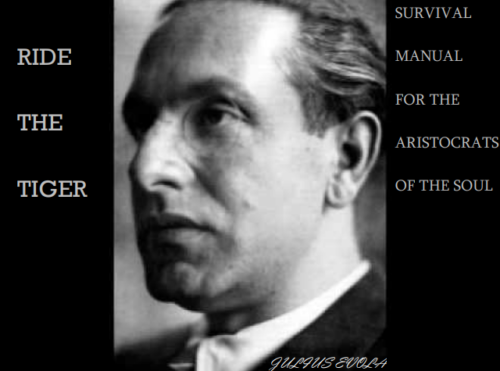
VJMP Reads: Julius Evola’s Ride the Tiger VII

This reading continues on from here.

Part Five of Ride The Tiger is called ‘Dissolution of Consciousness and Relativism’ and is comprised of two essays.

The first of these is called ‘The Procedures of Modern Science’. Here Evola begins by describing how the Western idea of Western supremacy upholds itself by appeal to its achievements in materialist science. Evola thinks that this is a gross error, and goes as far as to say that “None οf modern science has the slightest value as knowledge.” It is concerned with statistics and probability rather than truth.

The cult of scientific objectivity that Evola decries is all too willing to discard currently-held theories in favour of ones that, if adopted, provide temporary gains in terms of political power. This supposed objectivity, instead of leading to ever-refining truth, has merely caused science to lose itself chasing shadows. Einstein’s theory of relativity comes in for special criticism, being notable only for producing the bomb.

Scientism has only led to a kind of cult of quantity, which has made people obsessed with numbers and formulas and abstractions, so that we have forgotten what reality actually is and what it’s about. It’s a false logic, and it’s grossly unsuitable for anyone with spiritual pretensions.

The twentieth essay is called ‘Covering Up Nature – Phenomenology’ and continues the theme of the inadequacy of the scientific culture. Science hasn’t really got us any closer to the nature of reality, and each new “advance” merely takes us further away. After all, the world of our actual experience is still made up of fire, air, earth and water, and mathematical abstractions tell us nothing about how to deal with these.

Modern man is destructive because scientism has conditioned him to see everything as soulless. Our compulsory education system brainwashes children with this perspective from when they are very small. Even worse is the popular delusion that science can replace religion in the sense that it might give humanity a promised path to future happiness. This delusion has caused much misery.

Alchemically, this essay continues the theme of decrying the men of silver, whose preoccupations have not and can not lead to spiritual absolution. Evola gives credit to the concerns of the men of silver in so far as the discipline of mathematics cultivates clarity of thought, but all of these intellectualisms ignore the spiritual. Once one has seen the “great illusion” it’s apparent that science cannot be sufficient to solve human needs.

The twenty-first essay is called ‘Sickness and the European Culture’ and comes back to the subject of European decadence. This essay is very short, at only three pages.

Here Evola reinforces the contention that European culture has become sick because it has lost its spiritual centre. With no shared sense of spiritual tradition, the forces holding society together have weakened, and some parts of it have broken away. The tragedy of World War II is considered a natural consequence of this process of technical and scientific advancement at the expense of spiritual knowledge.

Part of the problem, Evola holds, is that politics has become separated from an intellectual and cultural class that, in its conceit, has decided it’s above the political. This is not the fault of that class so much as it is a symptom of the collapse of the unifying, transcendent and spiritual ideas that lie underneath cultural expressions such as politics and the arts.

*

If you enjoyed reading this essay, you can get a compilation of the Best VJMP Essays and Articles of 2017 from Amazon for Kindle or Amazon for CreateSpace (for international readers), or TradeMe (for Kiwis).


Moral Outrage is a Crude Thrill But an Addictive One

It’s evident from the body language of virtue signallers that they exult in the feelings of moral superiority provided by their aggression

It’s possible to become addicted to a wide range of different thrills. Adrenaline, oxytocin, endorphins, dopamine and a slew of other neurotransmitters all create a very specific kind of pleasurable buzz that a person can easily become hooked on. This essay examines the most fashionable addiction in current year: the addiction to moral outrage.

Moral outrage belongs to the class of ego thrills. Within this class are all actions that lead to pleasure on account of letting you think, even if only for a short moment, that you’re better than other people. Belonging to this class are a large number of activities relating to competition and domination.

Alchemically speaking, there are three ways that one person can dominate another person, and these correspond to the three orientations of bravery. One can dominate physically, one can dominate mentally, or one can dominate morally.

Dominating physically is generally looked down upon as an activity befitting children and thugs. Dominating mentally is the obsession of the young adult learning to be a man of silver, and incredible amounts of energy are expended to this end at universities, but most people soon grow out of that.

Dominating morally is where the real self-aggrandisement comes into play, because if this can be achieved then the other forms can be dismissed as less worthy or meaningful. It doesn’t matter if someone dominates you physically or mentally, because you can claim that the act of domination is itself immoral by virtue of being aggressive, and that therefore you, in fact, dominated them where it counts – morally!

As it happens, the modern world gives us plenty of opportunity to get a kick out of moral outrage. So much so that some people may have become clinically addicted to the thrill. Much like smoking cigarettes or snorting cocaine, working oneself into a towering moral fury has a near-immediately gratifying payoff and is therefore more likely to become habitual.

Signs of addiction can be seen in the compulsive bleating of “Racist!” whenever someone criticises a group of people that contains some black or brown individuals. Here, the person getting a buzz off moral outrage doesn’t bother to wait to make sure that the person they’re attacking really is a racist, because that might mean that they don’t get to accuse anyone and so don’t get the buzz.

Other signs include getting outraged at things that are entirely natural, such as the gender pay gap. Taking something that’s clearly the result of female choice and spinning it to make out like there’s a massive anti-female conspiracy to drive down wages is the kind of thing that could get someone a diagnosis of paranoia in other contexts, but when politics are involved no pile of bullshit is too high.

In truth, moral outrage is a form of bullying. It’s a way of running another person down because of their perceived lack of virtue, and this moral shaming is little different to shaming someone for being fat, poor or slovenly. The main distinction is that it is more passive-aggressive than physical bullying.

The driving force behind moral outrage is a combination of slave morality and mob mentality. The slave morality is always a feature because people susceptible to moral outrage have inevitably been told what their morals are, and usually told early enough in life that, by adulthood, they’re convinced their behaviour is natural. The mob mentality, likewise, is always a feature because people need to whip each other up into a frenzy to generate the self-righteousness necessary for a truly gratifying state of moral outrage.

The question then arises: should crude expressions of moral outrage be banned, or at least socially discouraged? It’s possible to combat them by making the virtue signaller look bad themselves.

For instance, virtue signallers shrieking “Racist!” when they hear criticism of Islam could be discouraged by being told how stupid they are for not being able to see the difference between dislike of a religion and dislike of a race. After all, the two concepts are radically different – the first is a meme complex, the second is a gene complex. It could fairly be pointed out that someone unable to tell the difference is pretty thick.

Even better, when someone is aggressively expressing their moral outrage at you, is to ask that person if they think they’re better than you on account of their beliefs. Of course they think they are, which is why they’re outraged in the first place – but if they admit that, they immediately lose their moral high ground on account of confessing to egotism.

*

If you enjoyed reading this essay, you can get a compilation of the Best VJMP Essays and Articles of 2017 from Amazon for Kindle or Amazon for CreateSpace (for international readers), or TradeMe (for Kiwis).
Writing Depersonalisation Disorder

Depersonalisation Disorder is a brutally surreal experience. Also known as Derealisation Disorder, this condition is characterised by feeling like an outside observer of one’s own body despite being in it, and feeling like one isn’t actually in control of that body’s actions. Also common are feelings about reality being vague, dream-like, or less real than usual. This article gives some hints for how writers can handle characters with Depersonalisation Disorder.

This condition is almost always the result of stress, but a distinction needs to be made between a person who is temporarily dissociating in the moment because of an intensely traumatic event that has just happened, a person who has an established pattern of dissociating when exposed to certain stimuli that should not themselves be distressing, and a person who has a tendency to dissociate under small amounts of stress owing to psychological damage from past trauma.

It has to be made clear that Depersonalisation Disorder is not the same thing as psychosis. A person in a dissociated state will be aware that their perceptions are altered (or, at the very least, that something is wrong). In other words, they will not have lost touch with reality, which is a necessary quality of a psychotic experience. They will just have dissociation.

Dissociation is when one starts to feel emotions and sensations that aren’t usually associated with the environment that one is in. For example, one might be in an extremely stressful situation but not actually feel any stress: one simply watches everything from the perspective of consciousness, as if floating outside the body. Things feel unreal, surreal, so that sometimes one feels as if one is watching a film with one’s life on it instead of actually living it.

This lack of connection with the body is the strangest and most difficult thing about the condition. A person with depersonalisation can look at their own hand and not feel like they’re looking at their own body, which is a highly disconcerting experience. It’s also disconcerting to look at yourself in the mirror and not really understand who it is or that it’s you, or to recall a past memory and feel as if it really happened to someone else.

If written from a first person perspective, and written well, the experience of a character with Depersonalisation Disorder might be terrifying to the reader. Dissociation is often terrifying to experience personally, especially for the first time, and may be difficult to distinguish from a panic attack. However, often it is more weird than frightening, especially when the alternative is genuine suffering.

If the dissociation is occurring in a character being observed by the protagonist, that character might seem distant, vacant and “spaced-out”. The protagonist might get emotionless, zombie-like responses from the character undergoing dissociation, which might be a problem if there is something that has to be done quickly. It’s very possible that the protagonist mistakes the person dissociating for being under the influence of a psychoactive substance.

Most readers don’t do a lot of drugs. If they do, they might find the experience amusing to read about. After all, dissociation is a common effect of many recreational drugs. For such an audience, a character’s bout of dissociation might come across as highly comical, and doubly so when paired with another character who is perfectly straight in all regards.

Like most psychiatric conditions, Depersonalisation Disorder is believed to have an origin in psychological trauma. It’s very possible that a character with the condition will have experienced repeated trauma in childhood (usually emotional) that was so relentless it caused the mind to dissociate with reality in order to protect itself. This could be abuse, or a witnessed tragedy, or even simply a realisation about the true nature of things.

The case of Depersonalisation Disorder might then be an ego protection response to extreme trauma so that the person suffering the trauma doesn’t become cruel as a consequence of the suffering. Essentially one goes mad, when under inhumane stresses, in preference to becoming evil. This might be a way of showing the inherent goodness of a character, or their inherent naivety, depending on one’s approach.

Writing about a character who has dissociation might not be very interesting if the story revolves around the dissociation itself. The story might be more interesting if your character is an otherwise mentally healthy person who becomes dissociated as a result of extreme circumstances. This might be a one-time event or it could be part of a pattern.

If it’s a one-time event, it might be a reaction to a grisly sight like a car accident or something seen on a battlefield. This need not, then, be the central role in the story, but might rather be something that befalls the protagonist at a particular juncture, possibly transforming them or causing them to grow.

If part of a pattern, it might play a more central role in the story. It may be that the sight of a certain thing triggers an episode of dissociation on account of being associated with what caused the initial trauma, or it could be that relatively small amounts of stress or uncertainty are enough to tip a character over the edge.

*

This article is an excerpt from Writing With The DSM (Writing With Psychology Book 5), edited by Vince McLeod and due for release by VJM Publishing in the summer of 2018/19.