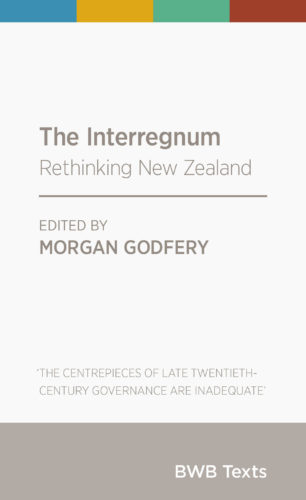
VJMP Reads: The Interregnum: Rethinking New Zealand IV

This reading carries on from here.

The fourth essay in The Interregnum is ‘Climate Change and Just Transition’ by Edward Miller. Keeping with the theme of the book so far, Miller describes himself as “a political activist with a keen interest in global justice,” and declares the enemy as “the deeply held commitment of large businesses and governments to maintaining economic growth at all costs.”

Miller laments that neoliberalism has made conditions worse for the “most vulnerable of society,” and it is for them who Miller claims to speak. There is already a problem with this, as anyone who has spent time around the most vulnerable of society would know, and it’s that people with pressing, immediate problems couldn’t care less about things like “global justice”.

Writing of the need to sacrifice economic growth for the sake of lowering our carbon emissions, Miller suggests that he is completely engrossed in the bubble of middle-class privilege, like many Green supporters. The practical reality is that sacrificed economic growth means workers getting fired, hours being cut, health care being postponed or cancelled, and children going hungry – considerations often lost on the young and carefree.

Action on climate change is described as something “we so desperately need” – further evidence that Miller lives in an echo chamber. What we need are better wages, better houses, and better attitudes to mental healthcare and to child abuse. Problems with proximate causes and clear solutions. Focusing on problems with clear solutions will all us to ensure that our energies are not wasted from virtue signalling about issues we cannot affect.

Much like other commentators in this book so far, Miller attacks neoliberalism as if it was an evil that sprang from nowhere upon an unsuspecting world in the mid 1980s. This is perhaps to be expected of young writers who are yet to comprehend that history and the world existed before they were born, and were not things discovered by them.

But it’s difficult to take seriously a work that does not place neoliberalism in its context of the complete collapse of the Soviet Union and the West’s increasing awareness that Communism had directly led to the starvation of tens of millions of people. In the 1980s and early 1990s, Communism appeared to the world as a monstrous evil that had, after almost half a century, finally been defeated. It was natural that things move in the direction away from it.

Almost certainly, this movement away from Communism went too far, as political movements tend to do, and so neoliberalism does need to be balanced. But we don’t need to balance it with economic and social policies that have established historical precedents of failure.

The idea of returning the means of production to the masses via an unelected ideological elite that purports to speak for those masses is known to be suicidal, but Miller avoids this easy fantasy, making a successful point when he promotes the idea of a universal basic income by means of the Government printing money.

Unfortunately, the fate of those other men who have proposed debt-free Government-backed money (McKinley, Lincoln, Hitler, Kennedy, Gadaffi) is ignored here. Perhaps this book is not thick enough for the kind of investigation necessary for such a thing.

Charlie Manson: So Close And Yet So Far

Charles Manson: got a lot right, got a lot wrong

Charles Manson: thought by some to be a genius, thought by many to be a maniac. Only a select few realised that he was both. In his actions relating to the infamous Family killings, Manson almost showed humanity a new way of relating to power, but a poor choice of target disqualify his actions from being considered anarcho-homicidalism.

Much like Adolf Hitler, Manson kept a coterie of devoted followers on account of an extraordinary level of charisma and penchant for giving lectures about the degeneracy into which the outside world had fallen. Also much like Adolf Hitler, Manson had a lot of excellent ideas that lacked execution, with consequences that the world would not forget.

One of the excellent ideas that Manson had was that people ought to rise up and challenge the control system, on account of its incredible corruption and the lies and destruction that it has wrought upon the Earth. Rising up against liars and thieves who have wormed themselves into positions of authority is the basis of anarcho-homicidalism, and no doubt Manson played on natural anarcho-homicidalist sentiments when he persuaded Watson et al. to do what they did.

Nobody can stand in judgement, they can play like they’re standing in judgement. They can play like they stand in judgement and take you off and control the masses, with your human body. They can lock you up in penitentiaries and cages and put you in crosses like they did in the past, but it doesn’t amount to anything. What they’re doing is, they’re only persecuting a reflection of themselves. They’re persecuting what they can’t stand to look at in themselves, the truth. – Charles Manson

Some might argue that Manson was an anarcho-homicidalist, on account of that much of his stated ideology was anarchic, and so the homicidal actions of the Family were also anarchism. It could indeed be argued that the Family actions were anarchic, because behaving in that manner is demonstrating very clearly that one has no rulers, but actions only constitute legitimate anarcho-homicidalism if they are conducted against someone making an attempt to enslave another.

It’s not really fair to target members of the cultural elite on that basis alone, for the reason that they are not the ones holding the reins of power. Sharon Tate was an actress – an influential position admittedly – but no-one took orders from her. She didn’t threaten anyone into coercion; she didn’t try to enslave anyone. She was just a pretty face that people paid money to look at for a few hours.

There was perhaps an element of jealousy in Manson’s selection of target, in that he had found it difficult to break into Los Angeles cultural circles, and so chose to target those who had. Such motivations cannot be considered anarcho-homicidal in any real sense, because they didn’t target anyone who held real coercive power, and were not motivated by the ideal of liberation.

This absence of coercive power meant that the people the Manson Family killed were not aggressors in any real sense, and therefore killing them could not be justified in self defence.

If Manson had targeted politicians instead, things would be very different. America was embroiled in the Vietnam War in 1969, and the Government was drafting young men to fight it without their consent, on pain of imprisonment. Killing any prominent warhawk or supporter of the Vietnam War would have been a legitimate act of anarcho-homicidalism, and would have been much more effective than abusing the draftees when they returned.

Charles Manson and his Family had more or less the right idea; their major error lay in the selection of a target that was not directly trying to enslave them.

VJMP Reads: The Interregnum: Rethinking New Zealand II

This reading carries on from here.

The second essay in The Interregnum is called ‘Speech and Silence in the Public Sphere’ by Andrew Dean. It recounts the story of the abuse copped by Eleanor Catton in the wake of her criticism of the direction the county was taking in 2015, and how this is indicative of deteriorating levels of public discourse.

Although most of the essay is devoted to quoting Philip Catton, which makes one wonder why Professor Catton didn’t write the essay himself, it aptly summarises the state of the cultural wars in New Zealand and in the West. The narrative of neoliberalism is triumphant; its victims are marginalised because their suffering goes against this narrative.

I was in Philip Catton’s History of Science class at the University of Canterbury in the year 2000. It’s curious to think about what the professor teaching that class 100 years from now will say about our time, and about the quality of our public discourse. Dean is right: our public discourse has degenerated to a shameful level, even as the Internet has theoretically made it easier than ever to share science, knowledge and truth.

Catton and Dean both have a point when they say that inequality has made the level of discourse more degenerate. The greater the inequality in a society, the more criticism of it is dismissed as “whinging” by those at the top and their lackeys in the mainstream media. Furthermore, the greater the inequality the more society becomes stratified into subgroups that speak their own dialect, so that it becomes difficult to communicate between different positions on the hierarchy.

The worse any one group of people is doing, the less their voices fit the neoliberal narrative that “Everything is better than ever, so spend spend spend!” And so, the more their voices are silenced by a mainstream media that is beholden to the same capitalist interests who support neoliberalism.

Dean refers to the same pattern that Dan McGlashan calls the “general disenfranchisement rule” in the demographic analysis Understanding New Zealand. It’s a feedback loop in which increasing inequality causes the people in the lower socioeconomic demographics to lose faith in the belief that the system represents them at all, which leads to a decreased turnout rate in elections, which leads to a system that represents them even less, leading to a further decreased rate and so on.

He also mentions the effect that neoliberalism had has on the discourse at our universities. Instead of acting as the conscience of the nation, our universities have to compete for students in order to get funding, which means that they have to present a certain image. In the case of New Zealand universities, which get a lot of international students from Asia, it is almost impossible to have a public discussion about the need for cannabis law reform.

All in all, this essay is pleasingly accurate and concise, and ends by pointing out that not only it is necessary to point out the failings of neoliberalism it is also getting harder to do because of the silencing of dissenting voices to the mainstream narrative.

If Charles Manson Was a Serial Killer, What Was George W Bush?

Charles Manson: responsible for 999,991 fewer deaths than George W Bush

News media are reporting that one of the world’s most “notorious serial killers”, Charles Manson, has died in prison. Described as a “mass murderer” by many, including Wikipedia, Manson was found guilty for a string of murders committed by followers of his Family cult, even though it was only ever alleged that he ordered the killings. But if Manson was a serial killer for ordering the deaths of nine people, then what is George W Bush, who ordered the deaths of a million?

It’s well known that Charles Manson never killed anyone himself (at least he was never tried of a murder that he committed himself). At his famous trial, where he faced several counts of murder, it was never even alleged that he killed anyone. From the beginning it was asserted that the Family members had killed on his authority, and so Manson was as good as guilty even if he hadn’t literally murdered.

One obvious question arises from this. If being the leader of a hippie cult that killed nine people is enough to get a man put in prison for life, how has George W Bush got away with being the leader of a statist cult that killed over a million people? Surely, according to the same logic that was used to imprison Manson, George W Bush ought to stand trial for several hundreds of thousands of counts of murder and up to a million counts of manslaughter?

All of the US soldiers that killed people in Iraq from 2003 onward justify what they did because they had vowed to follow orders. They had sworn to do whatever they were told by their superior officers (unless it was illegal), and their superior officers had done the same, all the way up to the first link in the chain of command, which is the President. It was the President’s word that got the invasion started, and the President’s authority that justified it.

So if the actions of Manson’s followers made him guilty of murder, then the actions of George W Bush’s followers have also made him guilty of murder.

Even worse, Charles Manson had very little in the way of guidance that he could have drawn on to make a better decision. He was the son of an alcoholic teenage prostitute, and so wasn’t raised to learn how to make good judgments. What’s George W Bush’s excuse for so callously ordering a military action that killed over a million people? He was the son of a president himself, so should have learned better judgment than anyone else.

Moreover, the people of the world demonstrated in no uncertain terms that they thought the invasion was a bad idea. Over a million people protested in London, and three million in Rome – still the largest protest in world history. The whole planet told George W Bush that what he proposed to do was going to be a humanitarian catastrophe – so he can’t say that he wasn’t warned by the world that he was making an error.

So if Charles Manson was worthy of all the hatred he endured because he was guilty of possessing a monstrously arrogant disregard to the value of human life, then George W Bush is worthy of a hundred thousand times more.