
Understanding New Zealand: Turnout Rate in 2017

The turnout rate in the 2014 General Election was 77.9%, and at the time of the 2017 General Election this had climbed to 79.3%. This is not a huge change, but care must be taken not to be misled. Just because the overall turnout rate was about the same does not mean that the turnout rates of the various demographics within New Zealand society all remained the same. This article examines the deeper trends.

The most striking thing about the turnout rates in the 2017 General Election is that, despite the alarm about the huge numbers of immigrants New Zealand has absorbed in recent years, the election marked a sharp increase in turnout rate among the New Zealand-born.

The correlation between being New Zealand-born and turnout rate became much more positive from 2014 to 2017, from a significantly negative -0.24 to -0.10. This is arguably the story of the election and explains how we ended up with a nationalist party holding the balance of power.

Among the four major parties, the correlation with turnout rate and voting for a particular party remained very similar from 2014 to 2017 for National (0.76 to 0.75), Labour (-0.70 to -0.72) and the Greens (0.28 to 0.27). These slight falls were balanced by a fairly strong increase for New Zealand First (-0.09 to -0.02).

This doesn’t necessarily mean that there was a swing towards New Zealand First – it just means that the sort of person who is a New Zealand First supporter was more likely to vote this time around. Who they actually voted for requires further analysis.

If we look at the ethnic demographics, we can see that the correlation between being of a certain race and turnout rate between 2014 and 2017 strengthened for Kiwis of European descent (from 0.71 to 0.81) and for Maoris (from -0.75 to -0.68). These are the two ethnic groups most likely to support New Zealand First.

Pacific Islanders and Asians, who were more likely to be born overseas, were less likely to turn out to vote. The correlation between being a Pacific Islander and turnout rate was -0.58 in 2017, out from -0.44 in 2014, which makes them now almost as disenfranchised as Maoris. The correlation between being Asian and turnout rate was -0.22 in 2017, out from -0.10.

One reason for this is that even though large numbers of immigrants have turned up in New Zealand recently, many of these newcomers don’t seem to feel much of a connection with the country and so are not motivated to vote.

Where it gets complicated is that the correlation between median age and turnout rate increased from 2014 to 2017, from 0.77 to 0.79. This means that the people who voted this time around were older, and older people tend to vote National – but these voters did not vote National.

The correlation between being aged 20-29 and turnout rate became a lot more negative from 2014 to 2017, from -0.21 to -0.26. The correlation between being aged 30-49 and turnout rate followed a similar pattern, weakening from 0.21 to 0.13. The predictable result of this is older people voting more, and indeed we can see that the correlation between being aged 50-64 and turnout rate increased from 0.70 in 2014 to 0.73 in 2017, while the correlation between being aged 65+ and turnout rate increased from 0.64 in 2014 to 0.67 in 2017.

Unsurprisingly, then, the correlation between being on the pension and turnout rate increased from 2014 to 2017 (from 0.50 to 0.56). In fact, all of the benefit types apart from the student allowance also strengthened. The correlation between being on the invalid’s benefit and turnout rate strengthened from -0.53 in 2014 to -0.43 in 2017, and the correlation between being on the unemployment benefit and turnout rate strengthened from -0.76 in 2014 to -0.72 in 2017.

This is supported by the fact that voters were more likely to be New Zealand-born in 2017, because there is a significant correlation between being New Zealand-born and being on a benefit.

More information comes from noting that several correlations between belonging to privileged demographic categories and turnout rate decreased from 2014 to 2017. This applied to people working in information media and telecommunications (0.06 to -0.01), financial and insurance services (0.08 to 0.01) and professional and scientific services (0.28 to 0.23). Also, the correlation between having never smoked tobacco and turnout rate fell from 0.35 in 2014 to 0.25 in 2017.

On the other hand, the correlations between more working-class occupations and turnout rate increased, most strikingly so in the occupations that involved the most personal contact. The correlation between working in a particular occupation and turnout rate increased from 2014 to 2017 in the case of education and training (-0.10 to -0.03), healthcare and social assistance (-0.04 to 0.05), arts and recreation services (0.04 to 0.09) and hospitality (-0.09 to -0.01).

A poorer cross-section of the population turned out to vote in 2017, which is another clue as to where Labour won. All of the correlations between being in an income band below $70K and turnout rate strengthened from 2014 to 2017, and all of the correlations between being in an income band above $100K and turnout rate weakened from 2014 to 2017. The correlation between being in the $70-100K income bracket and turnout rate remained exactly the same, at 0.38.

Another striking correlation is that between being part-time employed and turnout rate, which rose sharply from 0.45 to 0.58 between 2014 and 2017. This, coupled with what we know about income brackets and turnout rate, suggests that it was the people on the margins between doing well and doing poorly who shifted from National to Labour. It may be that these people saw the promise of the country being lost, or felt that they missed out on all the loot of the last nine years.

Perhaps the clearest sign of where National lost the election comes from the correlations with the flag referendum. The correlation between voting National in 2017 and voting to change the flag in the second flag referendum was an extremely strong 0.93, which tells us that it was pretty much only National voters to wanted to change the flag to the National Party version.

These National Party supporters, being generally well enfranchised, have very high turnout rates. The correlation between turnout rate in 2014 and voting to change the flag was 0.75, exactly the same as the one between turnout rate in 2017 and voting to change the flag. However, the correlation between turnout rate in the second flag referendum and turnout rate in the general election increased from 2014 (0.86) to 2017 (0.92).

This suggests that many of the new people who voted in the 2017 General Election but did not vote in the 2014 one were Labour supporters who came from generally National-supporting demographics (i.e. wealthy but not too wealthy, old but not quite a pensioner, white, employed and part-time employed, male). Had they been National supporters, the correlation between turnout rate and voting to change the flag would have increased from 2014 to 2017, because the vast bulk of people who wanted to change the flag were National supporters.

We can say that it was here that the centre, and thereby the 2017 General Election, was lost by the National Party.

*

The second edition of Understanding New Zealand, by Dan McGlashan, was published by VJM Publishing in the summer of 2017/18. It contains all the analysis of Kiwi voting patterns and demographics you could ever want!

There is Only One Issue of Social Justice, and It’s One of Class

As long as the left acts as if the white working class man is the enemy, it will fail

The mass consciousness is full of social justice issues at the moment, with social justice warriors in the media and in the public both screaming to get attention to their issue of choice. What few realise is that all of these shrieking SJWs distract from the one and only real social justice issue, which is that the rich have all the power and the poor just get fucked. In a word – class.

Privilege does not come from race, or gender, or sexual orientation – it comes from wealth. All of these other categories are merely correlates with wealth. Being white, male and heterosexual are all qualities correlated with wealth – but none of them are wealth per se. The left has made its most grievous error by confusing genuine privilege with the correlates of privilege – and in doing so it has lost the white working class.

The whole concept of racism is a distraction – but it’s a well-chosen one. In fact, the decision to impose a taboo on so much as mentioning any racial differences was a stroke of genius (from the point of view of suppressing the peasantry). It has had a devastating impact on the ability of the working class to organise itself to resist class injustices. Like an axe through an enemy skull, it has cleaved them neatly in two.

For one thing, the simple fact that there are obvious racial differences in behaviour means that, if racism is the ultimate taboo, then honest people will be ostracised by the herd when they inevitably point them out.

This is not to argue that some ethnic groups are subhuman and should be exterminated – it’s merely to point out that the reason why different ethnic groups exist is because people have adapted to different environments, and those different environments reward various behaviours differently.

It will be centuries before black people in the West become as wealthy as whites (if it ever happens), for the simple reason that Western society has been set up to reflect the hardworking values that naturally evolve in the cultures of people who live in the cold environments that produce white people. So as long as a gap in economic performance exists, the ruling class can always browbeat the white working class about creating this state of affairs with their “racism”.

The second major reason is that it allows the ruling class to give the white working class – their number one enemies – another kick in the guts. If privilege is reduced to a matter of skin colour, instead of a matter of whether a child’s parents had the surplus time and money to properly invest in its education and raise it to be a functioning being, then the white working class can be blamed for their own poverty.

They can be given an extra kick in the guts with the justification that their white skin gave them great advantages that they only failed to take because of their own moral weakness.

The truth – that privilege is almost entirely a function of the quality of one’s upbringing – is ignored because it reveals that people are usually wealthy only if their own parents were themselves wealthy enough to have the spare time and energy to teach them how to behave in ways that capture wealth. In other words, all privilege is class privilege.

This makes the distraction effective because it immediately causes the left to eat itself. The left only has moral authority insofar as it represents the labouring classes that produce wealth instead of the capital-owning class that captures it. When it ceases to represent the labouring classes and instead becomes a disparate horde of disaffected misfits with grievances, it cedes that authority.

Other distractions such as the gender pay gap, gay adoption, funding gender reassignment surgery etc. (i.e. issues that are either entirely fictitious or which affect a very small number of people) all serve a similar purpose, but no method of distracting a Western population from its class issues has proven as effective as race.

These distractions are brought to us by the same people that have brought us all the other distractions – i.e. the very same people who currently occupy the top positions in the class hierarchy and who wish to remain there. This is the reason why wages have stagnated for 30 years and homelessness is on the increase, despite several decades of supposedly continuous economic growth.

The mainstream media won’t tell you this because its journalists work on the direction of the shareholders, who are themselves members of the plutocracy.

The solution to it all is for the left to accept, as it once did, that working class white people are not members of an oppressive enemy class simply because they have white skin. The class status of poor whites, and the financial and cultural poverty that frequently accompany it, is sufficient to mark them as unprivileged.

*

If you enjoyed reading this essay, you can get a compilation of the Best VJMP Essays and Articles of 2017 from Amazon for Kindle or Amazon for CreateSpace (for international readers), or TradeMe (for Kiwis).
VJMP Reads: Julius Evola’s Ride the Tiger I

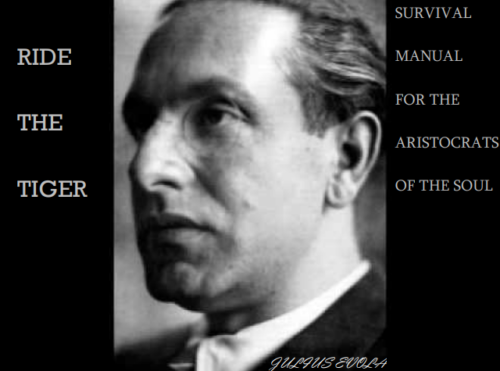
Having chosen a left-wing work (The Interregnum) for our previous reading, we now go to the right again and have a look at Julius Evola’s Ride the Tiger. Subtitled “A Survival Manual for the Aristocrats of the Soul”, it’s based on the premise that the fight against modernity has been lost and the only thing a thinking man can do is ride the tiger of modernity until it’s time to rebuild on the other side.

Part I of the eight parts of this book is called “Orientations” and divides into two essays.

The first of these is called ‘The Modern World and Traditional Man’. This opens outright with a declaration that this text isn’t for everyone. Like The Satanic Bible, Evola is explicit in that his book is only for a particular kind of person. Ride the Tiger is written for the outsider.

Evola’s style seems timeless in the sense that his complaints about the nature of society apply just as well to 2018 as they did to his time, and probably apply well to many times in the past. Things are collapsing, certainly in social terms if not yet physical ones, and so Evola advocates a return to traditional values.

These traditional values are not bourgeoisie ones, Evola is at pains to point out, but in fact “the very antithesis of them.” Indeed, he hints at evoking the perennial philosophy, such as when he writes “It is good to sever every link with all that which is destined sooner or later to collapse. The problem will then be to maintain one’s essential direction without leaning οn any given or transmitted form.”

Psychonauts such as the readership of VJM Publishing will commiserate with this feeling, as it’s a handy description of the ego death experience that comes with the peak of a psychedelic trip. One loses all touch with and memory of the fleeting forms of energy that make up the material world, and resides solely in pure consciousness, and thereby reunites with God.

Fittingly, then, Evola states that the Tradition that inspires him has “the character of an esoteric doctrine.”

The second essay, ‘The End of a Cycle – “Ride the Tiger”‘, continues in the same vein. Evola explains that the expression “to ride the tiger” is from the Far East and refers to the idea that it’s safer to ride on the tiger’s back than to try and flee and get pounced on, for the tiger will eventually tire out and then one can make an escape.

Essentially, the idea expressed here is this: great and terrible changes are sweeping the world, and will continue to do so. They will destroy much, if not all, of the existing order, regardless of whether this order is good or bad. There is no hope of resisting this process.

All of this sounds terribly pessimistic and nihilistic on the surface, but it’s clear that, like Nietzsche before him, Evola has anticipated the nihilism that follows the destruction of the incumbent value system, and is speaking of what must come beyond that. He writes of the “Four Ages” system famililar to readers of Plato’s Republic as well as to Hindus.

The warning of this chapter is that the forces of destruction and degeneracy are too powerful to be overcome; resisting them is as futile as resisting the tide. But in this there is still a message of hope: those destructive forces are too mindless, stupid and disorderly to hold sway for very long and so, like the storm, they will pass, and leave an opportunity to rebuild order in their wake.

And so, Evola mocks the “progressive” and “advanced” thinking of the West as little more than symptoms of a disease of the soul. This is apparently the context in which the book ought to be read.

The object of the book is summed up in the final paragraph of this essay: “defining the attitude to be taken toward certain experiences and processes of today”. In other words, how do we deal with the fact that everything’s falling to bits?

*

If you enjoyed reading this essay, you can get a compilation of the Best VJMP Essays and Articles of 2017 from Amazon for Kindle or Amazon for CreateSpace (for international readers), or TradeMe (for Kiwis).
The Political Paradox at the Heart of Cyberpunk

Science fiction has generally been considered a left-wing preoccupation. Not only is the readership of science fiction stories younger than average, but the nature of science fiction lends itself towards progressivism. Female characters such as Lieutenant Ripley of Alien had great appeal among the generation that had cast off the moral strictures of the 1950s, but a right-wing yang has always existed within the dark yin of the milieu.

The political atmosphere of science fiction reflects an old-school leftism that’s almost entirely different to the identity politics of the social justice warriors who dominate the media of today. The leftism of science fiction was always more libertarian than today’s culture would prefer, and was written without the need to shoehorn a moral lecture into the story.

Philip K Dick wrote his science fiction works, to a large extent, out of inspiration drawn from his hatred of authoritarianism and authoritarian systems. This is why his protagonists, like Bob Childan in Man in The High Castle, were usually everymen who lacked any aristocratic pretenses. Joe Haldeman’s The Forever War depicted a future world in which hedonistic homosexuality was standard practice and a kind of communism had taken over the resource distribution of the planet.

Realistically, it’s hard to imagine a high-tech society that hadn’t also managed to solve the vast majority of its social problems, for the simple reason that if a society has the resources to be high-tech it also has the resources to feed, clothe and house everyone. The essence of cyberpunk, however, is “high tech, low life”; Brave New World is not cyberpunk, and neither is 1984, for the reasons that these works deal with heroic and upstanding characters.

This essence lends itself to a conservative orientation for two reasons.

The first is that it suggests that “the more things change, the more they stay the same,” which is a deeply conservative sentiment. It’s a break with the easy utopias envisioned in atomic era works like Alfred Bester’s The Demolished Man or Aldous Huxley’s The Island. These works portray future societies which, although they have their problems, have generally solved all the major survival challenges (although The Demolished Man has a cyberpunk vibe in that the protagonist is also the antagonist).

In cyberpunk, by contrast, it’s common that society has either collapsed or become dystopic. The America of Neal Stephenson’s Snow Crash has disintegrated into a patchwork of city states, fiefdoms, armed enclaves and chaos zones, which goes against the common narrative of an easy ascent into becoming a space-faring civilisation common to most earlier science fiction.

Likewise in William Gibson’s Bridge trilogy, where society has rotted out from the inside, meaning that people have been forced to take on a hard edge to their personality and behaviour in order to survive. In Gibson’s stories, crime exists for the same reasons it exists in our own world; greed, fear, stupidity and cruelty cast their shadows on every chapter.

This is a conservative sentiment because it directly opposes the common leftist belief that it’s possible to build a utopia. Cyberpunk works warn us of the terrible possibilities that are likely to result from attempts to build a perfect world – Akira could be considered the modern Frankenstein.

The second reason is that “high tech, low life” reflects a cynical interpretation of human nature. The protagonist of the Altered Carbon series, Lieutenant Kovacs, never gets fooled or manipulated on account of automatically assuming the worst of everyone he encounters. He is particularly cynical, verging on paranoid, and this quality serves him well as it keeps him one step ahead of the criminals trying to kill him. Cyberpunk heroes are often like this – more antihero than good old boy.

Much like the first reason, this low-life element of cyberpunk reminds us that ideas of utopias are just dreams. Life finds a way, and so does crime. This is essentially conservative because it asserts that human nature cannot fundamentally be changed.

Humans have not been intrinsically good at any point in the past, and so there’s no reason to think they should be in the future. Therefore, we can assume that humans (especially young men) will aggressively push the boundaries just as much in times to come. As is the case today, these people will often go too far in asserting their wills, and this can lead to reprisals, and thereby the whole dark side of the human drama that cyberpunk is known for.

It is not the contention of this essay that this paradox detracts from the power of cyberpunk media. To the contrary, cyberpunk draws its power from the tension inherent in the juxtaposition between the desire for order and the desire for freedom.

Many of the protagonists in cyberpunk stories just want to be left alone to enjoy their lives, but violence and trouble finds them anyway, and they have to learn to become hard in order to cope. The protagonist of Metrophage is an everyman who could have been a protagonist in a Philip K Dick story, but instead of the mind-bending confusion of a PKD story he gets dragged into the noir of a cyberpunk one.

This sentiment of escaping an oppressive, totalitarian force is also a common sentiment for many intelligent, free-thinking people nowadays, who just want to be left alone to experiment with consciousness in the form of psychoactive substances without being attacked by law enforcement officers.

In this balance, cyberpunk appeals to a more intelligent kind of reader. The resolution of the cyberpunk paradox might be found in that punk is an expression of rebellion against those same human forces that create political dystopias and faceless corporate juggernauts. In this rebellion it is an affirmation of the human spirit, more libertarian than either left of right, and this is perhaps where cyberpunk gets most of its appeal.

*

Vince McLeod is the author of ANZAC cyberpunk work The Verity Key. If you enjoyed reading this essay, you can get a compilation of his and other VJMP essays in the Best VJMP Essays and Articles of 2017 from Amazon for Kindle or Amazon for CreateSpace (for international readers), or TradeMe (for Kiwis).