Category: society
The Ethnonationalism Spectrum
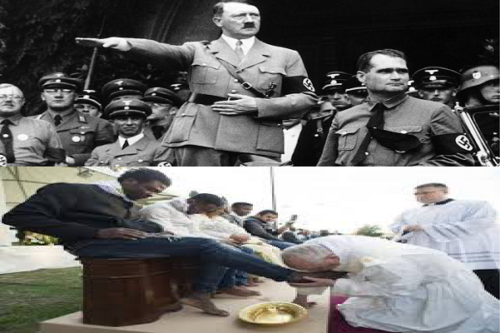
Despite being an accurate description of the way that human societies organised themselves for ten thousand years, the word ‘ethnostate’ has become taboo recently. Although the debate is usually dominated by arguments between insane Nazis and insane Marxists, there is a fascinating variety of opinions on the question of how wide and/or porous the group borders should be. This essay attempts to put them on a spectrum.
The two poles of the ethnonationalism spectrum are ethnosupremacism and ethnomasochism.
Ethnosupremacism found its apogee in the racial supremacist doctrines of Adolf Hitler’s Nazi Party in the 1940s, under which the Eastern Europeans were declared subhuman and therefore less worthy of existing in the lands of Poland and Ukraine than the German soldiers to who the land was promised. This pole of the spectrum fell out of favour, understandably, when the German “Drang nach Osten” ended up causing the deaths of over 25 million people.
There are two aspects to ethnosupremacism (see: The Three Definitions of Racism) and one is much more dangerous than the other. The first can be considered a sort of pride in the achievements of one’s kin and is little different to individual self-esteem raised to the group level, whereas the second is the belief that other ethnicities are categorically lesser and perhaps even ought to be exterminated.
The first step from ethnosupremacism towards sanity could be called ethnoconservatism. This is the “fuck you, I’ve got mine” of the ethnonationalist spectrum. This position is similar to regular conservatism on the class spectrum. Essentially it says that, because one’s own kind are doing well from the way that society is structured, there is nothing wrong with the way society is structured and it should therefore stay the same.
This is different to ethnosupremacism in the sense that the ethnosupremacist doesn’t believe that any amount of money can help the lesser races overcome their inherently base nature, whereas the ethnoconservative doesn’t care, they just don’t want to pay for it. Likewise, the ethnoconservative doesn’t despise other races, they just don’t think it’s right to mix with them, for whatever reasons.
This is a common position in the New World, on account of that the remnants of the native population are often much poorer than the descendants of the settlers. If an individual feels that the Government shouldn’t charge them taxes in order to fund social programs etc. intended to reduce income inequality, they are likely to take this position.
Ethnomasochism has found its apogee today, in the anti-white SJW culture that represents the furthest swing of the Great Pendulum away from the ethnosupremacism of the Nazis. Ethnomasochism is discussed at length here but could be summarised as a belief that one’s own kind were worthy of particular disgrace on account of some past political misdeeds. Very often, ethnomasochism is the result of a low self-esteem, whereby the individual’s self-hatred is projected onto the race as a defence mechanism.
The first step from ethnomasochism towards sanity is a realisation that individuals do not inherit sin from their forefathers, and that even if they did, it would be impossible to determine how much blame one’s forefathers had caused one to inherit. However, if one is more intelligent than the average person one might come to perceive that gross pride in one’s race is considered vulgar by most cultured people and that a modicum of racial humility ought to be adopted, on occasion, for the sake of politeness.
A white person here might not possess any self-hatred but might make a joke about how a high proportion of child sex offenders are white people. An Asian might make a joke about how he’s shit at driving, and a black person might make a joke about how he feels tempted to steal something. This is not genuine self-hatred but a kind of self-deprecation for the sake of social utility. Indeed, a person needs to have genuine self-esteem before they can joke about themselves in this manner.
This is the position most commonly associated with sanguine cosmopolitanism and could be described as ethnocurious. Many people who are university educated or who identify with the left-libertarian quadrant (of the common political model) are here, especially if they are the sort of person who does a lot of international travel. Ethnocurious people often have foreign girlfriends or boyfriends, and can prefer other races on account of that interactions with their own kind lack novelty.
In the middle of the spectrum is a point of reason. Here it is acknowledged that each person is an individual, and therefore neither responsible for the crimes of their race nor able to take credit for its accomplishments, and yet that each person has genetic characteristics that have shaped the way that their environment has treated them, and which have thereby shaped their life story.
Here one believes that the most logical thing to do, therefore, is to treat everyone else as equal partners in a grand human project to minimise the amount of suffering endured by conscious beings in this world. Other people are to be understood but their resentments are not to be encouraged.
Unfortunately for us, this point of reason conflicts with all the other positions. Ethnosupremacists will shun you for being a weakling who is unwilling to stand up for his own kind. Ethnoconservatives will shun you for being a suspected Marxist. The ethnocurious feel like this position wilfully misses out of much of the flavour that life has to offer, and ethnomasochists will despise you for not adopting their quasi-religious narrative that their particular race is guilty.
Even more unfortunately, this point of reason conflicts with neoliberal ideology (the prevailing ideology of our age), and so a combination of state and corporate power has colluded to obscure the truth about it. Neoliberal ideology demands that any desire on the part of big business for cheap labour can be met by simply opening the borders to mass Third World immigration, and so any problems that might be caused on account of mixing together people of genotypes that never previously mixed can be dismissed as racism.
The dumber a person is, the more likely they are to pick an unsophisticated position at either pole of the ethnonationalist spectrum. If they are sadistic they will choose ethnosupremacism where everyone else is subhuman, if they are masochistic they will choose ethnomasochism where everyone else is an immoral oppressor. If they are intelligent they will have a nuanced position somewhere centrist.
*
If you enjoyed reading this essay, you can get a compilation of the Best VJMP Essays and Articles of 2017 from Amazon for Kindle or Amazon for CreateSpace (for international readers), or TradeMe (for Kiwis).
Should The West Convert to Islam?
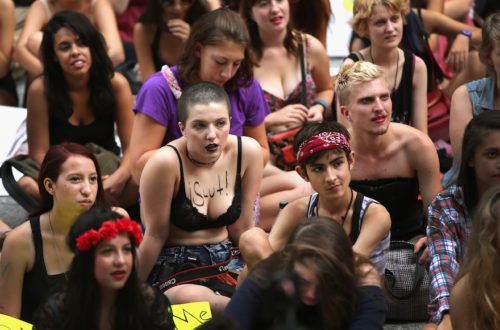
Westerners are not stirred to rage by many things – not by mass homelessness, not by declining wages, not even by the British Government covering up serial child sex abuse by Jimmy Saville and by various Asian rape gangs. Our spirits have been broken, and this had led us into a state of decline. This essay argues that the Western World could solve many of its current problems with a wholesale conversion of every country to Islam.
People can criticise what they like on social media, and people can defend what they like. Some criticisms meet with more defence that others. Nothing inspires an impassioned defence more than criticism of Islam. If a person criticises Islam on social media, hundreds of people will line up to scream all kinds of abuse at them, but they won’t do the same for any other ideology. This suggests that Islam has a special place in the heart of Westerners; it’s already holy, in a way.
If one considers that almost all of the Western World was Christian before World War One, it seems that the widespread loss of faith that resulted from that conflict could be resolved with a switch to a similar religion. Islam is also an Abrahamic cult, so it contains much of the same message as Christianity; the idea that God is male and that the feminine is inferior is an Abrahamic idea, as is the idea that homosexuals should be killed and the genitals of infant boys mutilated.
So Westerners have long been conditioned to accept the ideas of Islam, by way of accepting these same ideas in the guise of Christianity. Islam, like Christianity, considers itself a branch of the tree of revelation that began with Adam and continued through Moses and Abraham. In a sense, then, switching to it would represent a natural progression.
Already in Britain, there are more weekly mosque visits than church ones. This fact alone suggests that Islam might already be stronger than Christianity in Britain. The same is likely to also be true of other countries with large Muslim populations, such as France and The Netherlands. So Islam is arguably already stronger than Christianity, and one reason to adopt it would be to recognise this fact.
The most pressing reason for a widespread conversion to Islam would be to arrest the decline of the West.
Western birthrates have fallen to the point where we are no longer replacing our own people. The fertility rates in major Western countries like Italy, Poland and Spain is less than 1.5 children per woman. This is going to cause our populations to shrink ever-further until we are no longer capable of resisting foreign domination. Birthrates in Muslim countries, by contrast, remain high: Afghanistan 4.6, Iraq 4.4, the West Bank 4.0, Pakistan 3.5, Egypt 3.3, Algeria 2.8.
For whatever reason – perhaps the admonition to wage war against the infidel with the wombs of Muslim women – Islamic countries have maintained a much higher birthrate. A switch to Islam might rid us of the meek self-hatred of Christianity that has caused us to believe that we were no longer worthy of continued existence, and inspire our people to ensure a physical future for themselves.
Adolf Hitler once declared that:
“It’s been our misfortune to have the wrong religion. Why didn’t we have the religion of the Japanese, who regard sacrifice for the Fatherland as the highest good? The Mohammedan religion too would have been much more compatible to us than Christianity. Why did it have to be Christianity with its meekness and flabbiness?”
and that logic still holds. The meekness of Christianity has caused the West to lie down and die out of guilt and the resentment of strength; the vigour of Islam might be what is required to revitalise our people.
Some might object that Muslim culture has a number of obscene and immoral practices that ought to be resisted on account of the immense human suffering they cause. Not so.
Many of the most obscene practices of Muslims are already accepted by Westerners. Muslim cultures also practice widespread male infant genital mutilation, much like America. Although this practice results in horrific psychological damage to the victim, it’s not considered too barbaric for America (or many European countries). Moreover, like the Europeans, Muslims despise Jews and can’t wait to exterminate them for good.
Of course, a mass conversion of all Western nations to Islam would be terrible for the homosexual community. Homosexuality is illegal in the vast majority of Muslim countries, and punishable by death in South Sudan, Iran, Saudi Arabia, Yemen, Mauritania, Afghanistan, Pakistan, Qatar, the UAE, parts of Nigeria, parts of Somalia, parts of Syria and parts of Iraq. The Koran repeats the Biblical story of Sodom, and implies at several points that homosexuality ought to be punished severely.
Should the West convert to Islam, a wholesale persecution, if not outright massacre, of the homosexual community would have to be expected. However, against that, it has to be pointed out that the homosexual community is one of the strongest proponents of mass Muslim immigration. Homosexuals are on the front lines of the war against the people who oppose mass Muslim immigration, frequently attacking people for mentioning the deleterious effects of it elsewhere.
A wholesale Western conversion to Islam would also be terrible for women, whose rights are severely restricted in Islam. Women would likely have to face the daily reality of sexual assault and the impossibility of getting Police help for domestic violence or sex crimes against them. Again, however, like the homosexuals, women have been eager proponents of mass Muslim immigration and arguably would be getting what they deserve.
So maybe we should just surrender. Is it time to admit that we don’t have the willpower to resist the Islamic conquest of the West? That Muslims will keep stealing from us and raping our women as long as they see us as infidels and so we ought to join them? The conclusion of this essay is that we should jump on board while we can still get favourable terms.
*
If you enjoyed reading this essay, you can get a compilation of the Best VJMP Essays and Articles of 2017 from Amazon for Kindle or Amazon for CreateSpace (for international readers), or TradeMe (for Kiwis).
The Murderers of Free Speech in New Zealand