Where is Humanity on Maslow’s Hierarchy of Needs?

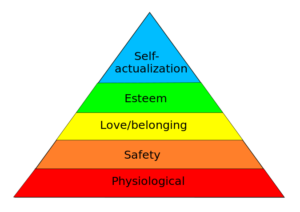
Abraham Maslow’s Hierarchy of Needs is a famous psychological theory based on the observation that people as a rule take care of their most pressing needs first, and only when those are satisfied do they develop an ambition to move to the next level.

The most common way to represent this is as a coloured pyramid – one can see an example as the title image of this essay. The ‘lower’ desires represent the more fundamental ones. The need represented by each level must be satisfied before a person is motivated to move on to the next one.

The lowest level is physiological needs. This basically means air, water and food. When the need for these are met a person moves on to safety needs, such as physical and economic security. Meeting those needs will mean a person advances to the level of love and belonging, where they try and satisfy a need for friendship, intimacy and belonging.

Above these three levels are two that are arguably not so much ‘needs’ as ‘decencies’. The first is the need for self-esteem. This relates to the human desire to be accepted and appreciated by others and by oneself. Generally the lower one’s self-regard the greater one’s need for fame or respect.

The last level is self-actualisation. This involves fulfilling one’s greatest potential; becoming the best version of oneself that it is possible to be.

It’s common for individuals to look at where they are themselves on Maslow’s hierarchy. It certainly is an interesting theory for anyone curious about how they fit into the grand scheme of things.

Some people are further than others. What we generally consider wealthy, fortunate, or “doing good” correlates pretty strongly with where a person is on the hierarchy of needs. If we take a look at humanity, though, we can see that as a whole we have not come very far.

According to the World Food Programme, 842 million people go to bed hungry on any given night. This represents about one in every eight people, all of whom have fallen at the first hurdle when it comes to the hierarchy of needs.

If one thinks about what that means in practice, it is one in every eight people who have no realistic chance of ever making progress in any of the other needs. After all, someone who goes to bed hungry will hardly be concerned with their bank account, because if they had any money they would have bought food with it.

It’s worth thinking that one in every eight people are that desperate – possibly that means one in every eight people are desperate enough to have a strong incentive to do serious harm to another human being, should an opportunity for a robbery arise.

After all, the major incentive a person has for not robbing someone is their desire for physical security, in the form of not going to jail, and their desire for social esteem, in the form of not being thought to be a robber.

As both of those needs are less fundamental than the need for food, a hungry person is unlikely to care about them very much. The desire for food is even more fundamental than the desire for peace, and so one in every eight of us is too hungry to care at all about all the war in the world.

A global universal basic income would raise us up the hierarchy, as it would take care of most basic physiological needs. It is the inability to fulfill the need for these that causes the vast majority of human suffering in the world.

It does, however, raise the spectre of overpopulation, at least in the minds of those who believe that some of the tropical peoples are incapable of keeping their breeding in check. If a person believes this, then it is natural to also believe that a global basic income will lead to ecological collapse.

Maybe humankind is doomed to remain at a reasonably low level because of the belief that if we co-operate too closely, factions within humanity will take advantage of this peace to wage war against other factions, perhaps even without those factions knowing about it.

Australia in New Zealand 2017 ODI Series Preview

Missing an explosively terrifying opening batsman and a first drop with the hand-eye co-ordination of a god, the Australian cricket team came to New Zealand and got beaten 3-0. Prediction for this week? No, that was what happened the last time we were in that situation, in February 2007.

Building up for a later triumphant Cricket World Cup campaign, Australia rested both Adam Gilchrist and Ricky Ponting for the 2007 Hadlee-Chappell series in New Zealand, and got beaten 3-0.

Absent the usual steel up top, Australia disintegrated in the first ODI to Shane Bond, who took 5-23 from 9.3 overs, and they lost by ten wickets. Chasing 337 in the second ODI, New Zealand won after a brilliant Ross Taylor century and some dogged lower-order batting. Again chasing in the third, only that time 347, the Black Caps won in the last over with the last wicket after a 165-run 6th wicket stand between Craig McMillan and Brendon McCullum.

The 2017 edition of the Hadlee-Chappell will be absent David Warner – who recently took AB de Villiers’s crown as No. 1 ranked ODI batsman, and Steve Smith, who averages 51.90 since the start of 2015.

In the 2016 edition in New Zealand, the Black Caps took the series 2-1: Australia won a close game and was thumped twice. Something similar might be on the cards for this week.

Like 2007, the Australia of 2017 will possess some fearsome bowling. Mitchell Starc, Josh Hazlewood and Pat Cummins make up what must be close to the most dangerous trio ever seen in ODI history. Both Starc and Hazlewood are ranked in the top 5, and although Cummins is only ranked 27th that is a reflection of bad luck with injuries and not an absence of talent.

The Black Caps, for their part, have their own heavy artillery. Trent Boult is today the No. 1 ranked ODI bowler in the world, and Matt Henry is at No. 7. These two bowlers demolished the Australia top order in the first ODI of the 2016 series, leaving them at one stage 6/41.

Tim Southee might only be ranked 26th but he is dangerous with a bit of assistance, and Mitchell Santner is fast becoming like another Daniel Vettori in terms of miserly economy. This series will surely also feature more of Lockie Ferguson, who rocked the speed radar in Australia with a string of 150kph+ deliveries, but whose pace was often to the batsman’s advantage on the hard pitches.

The major difference between the two sides is in the batting. Australia’s best batsman in this series is arguably Glenn Maxwell, ranked 18th.

Because Australia is absent Warner at the top and Steve Smith ranked 8th, New Zealand have the top-ranked three batsmen in this match, with Kane Williamson at 5, Martin Guptill at 9 and Ross Taylor at 16. These three batsmen would all be in a Black Caps all-time ODI top 5.

Tom Latham may only average 33 in ODIs but appears to have now adjusted very well to the white ball game, and he is now averaging 40 in his last 25 ODI matches. As he is still only 24 and improving so rapidly in all forms of the game he is on a trajectory to become as good as the others.

Australia has brought in the reputable Aaron Finch to bolster the batting, but none of the names in the Australian top 5 – weak by historical standards even with Warner and Smith – will stand out to the Black Caps tacticians as a particular threat.

The obvious plan for the Black Caps to win the series, then, is to repeat how they won it in 2016, namely by bowling Australia out for substandard totals.

The market seems to think that this is very likely – the Black Caps are paying only $2.12 on BetFair to take the first ODI at Eden Park tomorrow. At the TAB a 3-0 Black Caps series win is paying only $6.50, which seems minuscule considering that Australia has won five Cricket World Cups.

Considering that the Hadlee-Chappell is fast becoming the ODI cricket equivalent of a marquee series like the Ashes or the Bledisloe Cup, probably the best strategy would be to save your betting money for chips and weed and just kick back to enjoy the degree of skill on display.

The Peter Pan Generation

The Peter Pan Generation believes that whatever it wishes to be true is true. Whatever would be the most personally gratifying interpretation of reality is the natural one to, not only believe in, but to insist upon, as if the rest of us had a duty of care towards them akin to that of their biological mother.

This has led to many adopting the attitude that they can believe whatever they like with no obligation to pay any regard to consensual reality. If reality disagrees with me, it is wrong, and therefore has the obligation to change.

We can observe the consequences of this in the form of delayed adulthood, in particular a child-like total failure to accurately appraise the degree of danger in the world and to respond accordingly.

For this reason, some call them the ‘Special Snowflake Generation’. This was to distinguish them from their predecessors in Generation X, for whom Fight Club was a seminal influence on the collective identity, and who were told in which “You are not a special and unique snowflake. You are the all-singing, all-dancing crap of the world.”

The generation who came after X, who weren’t latchkey kids, who were brought up with technology rather than catching the wave of the disruption it caused, who were bathed in hysteria about Islamists rather than the very real threat of the USSR and who, crucially, didn’t hear the message of Fight Club – they are the snowflakes, so named for their striking fragility.

wtf
The Peter Pan Generation doesn’t like being told no

If there is an overarching narrative in one’s social circles that rich white men are the devil and everyone opposed to The Man is on the same side and knows they’re on the same side and feels solidarity with each other, then one might be horribly surprised to find some of these people on your side want to throw gays off buildings.

Yet this is the natural consequence of the unnatural degree of naivety and unprecedented delayed infancy that is due, in a large part, to the absence of war or belief in the need for war or to prepare, either physically or mentally, for it.

Those of us in Generation X may not have had World War II or Vietnam to contend with, but we did grow up hearing the death throes of the Soviet Union and, with it, an entire paradigm that had until then given the world meaning. We were still brought up under the very real possibility that we might end up going to war one day.

Not so the snowflakes. War – like Hillary Clinton losing the last election – is unthinkable simply because they do not want it. There is no concept of war coming to them. After all, the Muslims blowing up Western targets are opposed to the same Man that is oppressing us!

And because those Muslims are opposed to the same patriarchal capitalist interests as the young and trendy there couldn’t possibly be any problem with letting in a couple of dozen million of them – they’re just like us, right?

As any regular reader of this column knows, all things comes in time, and the yin always turns into yang.

A sense of entitlement, in an indifferent world where you’re going to die, is like the potential kinetic energy created by raising a heavy object against gravity. Sooner or later, it is going to fall back to its natural starting point, and the further away it was before it fell the more noise and violence it will make on the way down.

It’s too early to tell what will slap the Peter Pan Generation awake in the way that 9/11 slapped awake Generation X, that Vietnam slapped awake the Boomers, that World War II slapped awake the Silent Generation, and the Great Depression slapped awake the Greatest Generation.

But what we do know is that nature will out, and that nature loves to punish stupidity with violence.

The Solution to Nelson Drunkenness is Cannabis Cafes on Bridge Street

Nelson does exceptionally well as a tourist town over the summer. We get thousands for the Abel Tasman alone and the Black Caps played here twice this season. It means big money for Sun City – but it won’t continue if we continue to get a reputation for mindless violence.

Retail group Uniquely Nelson is especially concerned by what they see as a spike in antisocial activity, in particular “drunkenness, violence, abuse, theft, rubbish and broken glass.” But as anyone who has lived in Nelson for any length of time knows, violence, abuse, theft rubbish and even broken glass are natural consequences of the first problem named – drunkenness.

Neither can we glibly blame everything on ‘North Islanders’ as if Nelsonians are not subject to the same loss of inhibition as everyone else on the planet who drinks booze. Drunk people in Nelson do the same things in Nelson that drunk people in any low-wage area get up to.

The problem with the drinking culture of Nelson is this – most of the intelligent people who have lived here for long enough have secured cannabis hookups and use that instead. Cannabis has driven out alcohol among the sort of consumer that is most sensitive to being turned away by dickheads, and this has left the drinking to the lowest common denominator.

Anyone new to Nelson looking for a good time will quickly encounter this lowest common denominator, and the results are usually as described in the examples given in the opening paragraph.

The sad thing is, there is plenty of opportunity for people to come here and have a good time. Being the oldest of Kiwis, we Nelsonians naturally represent what is the best of us, in particular a sunny nature, a social attitude and a genuine joy of life.

But we’d rather smoke weed at home than come into town to get our heads kicked in.

So the solution is obvious.

We ought to demolish the dive bars of Bridge Street and replace them with a handful of cannabis cafes, so that Nelsonians and our many visitors can relax in public without fear of being attacked by some drunken animal.

As it is, if I’m driving East on Bridge Street late on a weekend night and I see some young backpackers heading the other way for a night on the town, I feel sorry for them, knowing that they will not get to see the best of my city or of its people.

Cannabis cafes on Bridge Street would provide the revitalisation that Sun City needs. It would bring the young people back out of their homes and life back into the streets of the CBD. It would also create a festive atmosphere in the city centre to replace the fighting, vomiting and vandalism.

Not least, the local retailers of Nelson stand to make a packet from the idea. The wider Nelson region is already, along with Coromandel, the most popular destination in New Zealand for underground cannabis tourism owing to our widespread local embrace of the plant medicine. International visitors know that they can come to this region for some of the world’s best natural cannabis.

If Nelson could get it together to take advantage of the impending repeal of cannabis prohibition we could position ourselves first in the queue for the hordes of young tourists that would flock here to escape from the drunken shitheadery that plagues most other Kiwi towns and cities.

If we did it right, many of those tourists would be other Kiwis. These people should leave Nelson with a sense of being impressed by our forward-thinking, gregarious and positive attitude, not with relief at getting out before they were glassed by some pisshead.