Black Caps vs. Bangladesh, Champions Trophy Pool Match Preview

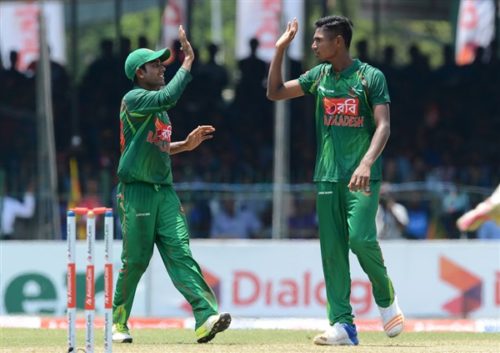
Mustafizur Rahman, with a strike rate of 22.7 in ODIs, would fancy himself against the Black Caps middle order if he gets a chance against them in tonight’s do-or-die encounter in Cardiff

This Champions Trophy has been one of upsets. The Black Caps got themselves into a position of control before the rain set in against the slightly favoured world champion Australia side, then Pakistan defeated the moderately favoured South Africa side, and last night Sri Lanka defeated the massively favoured India side.

An even worse omen for the Black Caps is the fact that they lost their previous encounter with Bangladesh in the Ireland tri-series a few short weeks ago.

This will give the Bangladeshis confidence before their crucial Group A encounter with the Black Caps in Cardiff tonight. They will, however, have to contend with facing a very different Black Caps side to the one they beat in Dublin.

Most notably, the Black Caps will now have the presence of all of their four genuinely world-class players, with Martin Guptill, Kane Williamson and Trent Boult, all of whom missed the Ireland tri-series for IPL duty, rejoining Ross Taylor in the side.

This explains why the Black Caps are still the favourites to win the encounter on BetFair. They are only paying $1.33 compared to Bangladesh’s $3.90, making them heavy favourites.

Martin Guptill has looked very good in his two starts this tournament, but has been unable to go on and play a punishing innings. With Luke Ronchi likely to continue partnering him at the top, Bangladesh will be forced to take early wickets or risk getting hit out of the game.

With Kane Williamson and Ross Taylor completing the top order, the most likely outcome of the match appears to be the Black Caps top four batting the Bangladeshi bowlers – a class weaker than the English and Australian batteries – out of the game.

If they don’t, Bangladesh will feel confident of rolling the rest of the order. The Black Caps lost 7 for 37 against Australia and 8 for 65 against England, and Bangladesh know that if they can get Williamson in early and then out early, they will be in a very strong position.

The Black Caps might be tempted to fiddle with their middle order a bit, knowing that this has been their soft underbelly for a long time.

Neil Broom’s returns have been poor this tournament – only 11 and 14 – but he has averaged 43.53 since coming back into the Black Caps side last December. His position should be okay for now.

The real question is how to fit both of Jimmy Neesham and Corey Anderson in the team. It may be that one of them comes out for Colin de Grandhomme, who has shown the ability to come to the crease and start hitting straight away.

It may also necessary to drop Mitchell Santner below Adam Milne in the batting order, as Santner has had great struggles with the bat recently.

Another option is bringing Latham in to open and moving Ronchi back down the order.

Bangladesh may find it much more difficult to chase down scores like 271, as they managed to do in Dublin, because they will have to do it against Boult, Tim Southee and Adam Milne.

However, their batting down to 7 is much stronger than it has ever previously been in Bangladesh cricket history.

Tamim Iqbal is their strongest bat on recent form. In 30 matches since the last Cricket World Cup he averages 59.53 with the bat, and has scored over 200 runs in two innings so far this tournament.

Around him there are a number of very talented batsmen, in particular Sabbir Rahman, Soumya Sarkar, Mushfiqur Rahim and the allrounder Shakib al Hasan.

If they can keep Boult, Milne and Southee out with the new ball, as England managed to do, then it will be possible for them to milk a plethora of runs in the middle stages.

A major danger for Bangladesh is that if they fail to bowl New Zealand out, they may lack the hitting power to match them across 50 overs. Despite the talent in the Bangladeshi side it’s hard to see them chasing 300 or more, even in the most favourable circumstances.

All of this could be moot in the very real circumstances of rain, as a washout would see the Black Caps eliminated and Bangladesh with only a mathematical chance of progress.

For the winner, however, an Australian loss in their matchup against the bookies’ favourites England, or a washout in the same encounter, would see them progress to the semi-finals.

Considering the chaos in the other group, there’s every chance that they would then play a relatively soft team like Pakistan or Sri Lanka in the semifinal.

So there’s all to play for tonight.

Black Caps vs. England, Champions Trophy Pool Match Preview

The Black Caps demolished England the last time these two sides met in a major competition, with Tim Southee taking 7/33. The England team of today, however, is an entirely different beast

The washout against Australia a few nights ago gave Black Caps fans a lesson in expectation akin to being given a lesson in orgasm denial from a professional dominatrix. With Australia reduced to 53/3 in the tenth over of their chase, all signs were pointing towards an opening round upset as shocking as the Black Caps’ win over Australia in the 1992 Cricket World Cup.

Instead, the rain came in to deny us a fair finish to the contest. So the Black Caps will be champing at the bit to have a go at England tonight (9:30 p.m. NZT) in Cardiff, in a match that they almost have to win in order to advance to the semifinals.

The English side has been heralded as prospective champions from all corners, and this is reflected in the short odds offered on BetFair for England to win this contest: $1.52, compared to $2.90 for the Black Caps.

Looking at the achievements of the England batting unit it’s not hard to see why.

Joe Root looks unstoppable at the moment, with an ODI batting average of 49.68 and just coming off 133* against Bangladesh. Around him are three batsmen who are ranked just behind Ross Taylor on the ODI charts right now: Alex Hales, Eoin Morgan and Jos Buttler.

All of these batsmen, including Root, are capable of batting at a very fast clip, and so are opener Jason Roy and allrounder Ben Stokes.

So the Black Caps will go into the match knowing that a failure to take early wickets will likely leave them chasing a gigantic score. They need to at least get Joe Root out early if they want to have a real chance of bowling England out.

But if English batting stocks are strong, the bowling stocks are another question.

Chris Woakes has been ruled out of this match through injury and Ben Stokes may not be able to bowl his full quota of 10 overs on account of a minor knee injury.

On top of this, Jake Ball has been very expensive in recent games and neither David Willey, Mark Wood nor Steven Finn have shown a particular talent for taking wickets. This means that Liam Plunkett – at 16th – is likely to be the highest-ranked English bowler on display.

The weak English bowling is where, if anywhere, the match is most likely to be decided. They will have to get Kane Williamson and Taylor out cheapish, and avoid being hit out of the game by Martin Guptill or Luke Ronchi at the top, to have any realistic chance of winning.

If they can, then they will be into the currently misfiring Black Caps middle order. The Black Caps lost 7 for 37 at the end of their innings against Australia, mostly thanks to their middle order finding Australian fielders with most of their lofted shots.

The New Zealand middle order had already been identified as a point of weakness before this tournament, so the English bowlers should feel confident of restricting the Black Caps to a small total if they can get into it before the death overs.

However, if they can’t, then they will not be able to defend anything less than 350, because otherwise the Black Caps will hit them out of the game.

Adam Milne was extremely impressive against Australia, despite only bowling a few overs. This will make him, alongside Trent Boult and Mitchell Santner, the likely choices for bowlers.

They will be partnered by either Tim Southee or Jeetan Patel, depending on which of the two appear best suited for the conditions, and a combination of Corey Anderson and Jimmy Neesham as the fifth bowler.

All of Milne, Boult and Santner are more impressive than any bowler England is fielding – for reasons of pace, skill and economy respectively – so it is most likely to be here that the Black Caps win the match.

Black Caps vs. Australia, Champions Trophy Pool Match Preview

Trent Boult demolished the Australian lower order the last time these two sides met in an ODI, taking 6-33. The Black Caps will need something similar to concede less than 350 against this strong Australian side

The Black Caps had mixed fortunes in the Champions Trophy warm-up matches, but that will all be forgotten when their first pool match starts, against World Cup final opponents Australia, this Friday at 9:30p.m. (NZT).

Australia is a solid favourite on BetFair to win this encounter in Birmingham. They are only paying $1.53 compared to $2.84 for the Black Caps.

The main reason for this is their superb bowling. Mitchell Starc and Josh Hazlewood are both ranked in the top 5 of ODI bowlers at the moment, and they will have both Pat Cummins and James Pattinson backing them up.

Because Starc is capable of batting 8, Australia might be tempted to go with all four of them in the same side – which would make for an exceptionally fearsome ODI pace battery, one of the strongest ever. There would be no respite.

The Black Caps may have three of their best ever ODI batsmen in the top 4 – Martin Guptill, captain Kane Williamson and Ross Taylor, but question marks remain over Guptill’s opening partner and the middle order.

A number of players were tried in these positions in the warm-up matches and in the preceding tri-series against Ireland and Bangladesh. The difficulty is that there were no performances that will have forced the hand of the selectors.

Guptill will open with either Luke Ronchi or Tom Latham. The desire from the brains trust might be to favour the big-hitting Ronchi, because English surfaces in recent years have tended towards very big scores.

A variety of players have been recently tried in the Black Caps middle order. Neil Broom, Corey Anderson, Jimmy Neesham, Mitchell Santner and Colin de Grandhomme are all possibilities for the middle order and allrounder slots.

The Black Caps bowling unit, however, is easy to select. The tried and true combination of Trent Boult (ranked 6th in the world for ODIs) and Tim Southee will no doubt share the new ball, and it’s likely that Mitchell McClenaghan will be in as third seamer.

McClenaghan’s T20 experience will help to lend him skills that are useful in death bowling, and he has been talked about in that role in particular. This should see him take the spot ahead of Adam Milne, who is improving rapidly but still lacks the knockout punch of the more established seamers.

The three seamers will be complimented by Mitchell Santner, whose relentless accuracy and subtle variations have seen him rise into the top 10 of ODI bowlers for the first time.

The Black Caps bowling strategy will be to take two or three poles early with the moving ball, and then to at least restrict the scoring in the middle overs with Santner and the variations of either McClenaghan or Milne.

This will lessen the potential impact of the Australians’ big middle order hitters like Chris Lynn, Travis Head, Glenn Maxwell, Marcus Stoinis and Matthew Wade.

The Australian batting lineup appears to be following the general ODI zeitgeist at the moment by being packed with hitters. Any of David Warner, Aaron Finch, Lynn, Head, Maxwell or Stoinis is capable of striking at well over 100 for as long as they can stay in.

Their strategy will probably be to use Steve Smith at 3 as the fulcrum around which the other batsmen can hit. If Smith can stay in long enough then the others around him can throw the bat and Australia will post a colossal score.

Considering that 300 has been a par score in England recently even for average sides, this match between the two World Cup finalists has the potential to see 700+ runs scored.

The winner of it will have the box seat in qualifying from this group, as they will probably then only have to beat Bangladesh in order to advance to the semifinals.

Did Richie McCaw Destroy International Rugby?

The Sydney Bledisloe Cup match of 2000 was a high water mark in international rugby. In front of 109,000 people, the world champion Australia team and the desperate, wounded All Blacks fought to the death like Ali and Frazier. Many who saw it said at the time it was the most extraordinary rugby match ever played, with an iconic match-winning performance from none other than Jonah Lomu.

The All Blacks prevailed on that night, 39-35, but the Wallabies would win by one point three weeks later to retain the Bledisloe Cup, and at the time it seemed like the advent of professional rugby was about to make for a titanic era of contests for this trophy.

Professional rugby seemed like it was going to bring a lot of razzamatazz to the Southern Hemisphere circuit – Super Rugby was also huge that year. The ACT Brumbies topped the table at the end of the pool stages, and ended up losing the final at home against the Canterbury Crusaders by one point.

The next year, 2001, marked the Super Rugby debut, also for the Crusaders, of one Richie Hugh McCaw. As it turned out, McCaw was not so much a rugby player as a genius that played rugby.

He only played eight minutes of Super Rugby that year, but he did play a full NPC season, and was good enough to win selection to the All Blacks’ end of year tour, where he was handed a debut against Ireland, and promptly won Man of the Match.

The next year, 2002, McCaw became a Crusaders regular. In an odd echo of the future, the Crusaders won every single match that year, taking the Super Rugby title undefeated – something never achieved before or since.

2003 might have been the end of the golden summer for Australian rugby. They lost the Bledisloe Cup, but managed to knock the All Blacks out of the World Cup, going on to take an all-conquering England team to extra time in the final.

Come 2017, and Australia has not won the Bledisloe Cup since. Richie McCaw may have retired two years ago, but in the same way that Mansa Musa’s pilgrimage to Mecca depressed the price of gold in the Middle East for decades afterwards, McCaw’s decade of almost total dominance still depresses Australian rugby.

This year’s Super Rugby table makes for confusing reading. The current leaders of the Australian conference, the Brumbies, have fewer tournament points than the current wooden spooners of the New Zealand conference, the Blues.

New Zealand rugby is so dominant that the 4th-ranked Kiwi team, the Highlanders, has only lost three games all season. Despite this, they can’t climb any higher than 4th because the Hurricanes have only lost two, the Chiefs one and the Crusaders zero.

Even worse is the effect this dominance has had on the Internet rhetoric. At the turn of the century, trans-Tasman rugby banter was between equals. In recent years, however, it has taken a darker turn: the prison rape metaphor, once only applied to descriptions of All Blacks matches against the hapless Celts, crept into summaries of Bledisloe matches.

At its nadir, the Internet rhetoric was entirely based on the degree of sexual impotence the Australian players and fans would suffer as a consequence of the losses and for how many years afterwards. The jokes were that the children of Australian players would be too ashamed to admit their paternity to their classmates.

So the question is this: was Richie McCaw so good at rugby that he actually destroyed the international game? Did he set standards so high that all other nations just gave up on hoping to ever match them?

Probably not. After all, Australia made it to the World Cup final in 2015, and they did about as well there as any other side could have hoped to have done – namely, a loss by a two-try margin.

Alexander the Great died at age 33, and within months of the same age Richie McCaw retired from international rugby. The struggle for a successor to Alexander saw his empire shatter into four pieces and then to further disintegrate.

Kieran Read now leads the All Blacks, and his side might play the role of the Seleucid Empire, the early favourites to recreate the total world domination that McCaw once achieved.

However, no order can exist indefinitely, and it is in the nature of peaks to erode into valleys. The standards set by McCaw are unlikely to be maintained for the simple reason that the men tasked with doing so will not possess McCaw’s genius.

This column believes that it is in the Australian nature, despite a decade of denial, to recognise the smell of blood at the first opportunity and to take advantage of it. Therefore, it predicts that the current sorry state of Australian rugby will not last for much longer.

And as long as one side can stand up to the All Blacks the others will always believe themselves to have a hope.