

Generation X and the Wisdom of Robert Anton Wilson

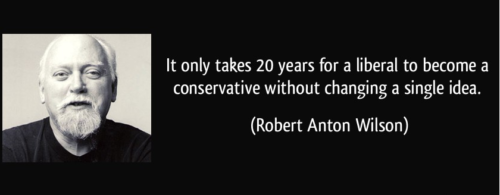
The great philosopher Robert Anton Wilson liked to say “It only takes twenty years for a liberal to change into a conservative without changing a single idea.” As it happens, I first heard this statement almost 20 years ago, when I was just about to begin studying at university. How did RAW’s observation stack up for those of us born at the arse end of Generation X? Let’s have a look.

In 1999, when I first went to university, I was more or less a liberal. I had grown up in a welfare family that had been strongly adversely affected by the 1991 Budget of the conservative National Party. A consequence of this budget was that sometimes my brother and I had to go hungry, and the effect of this would often reduce my mother to tears. This gave me a very deep and powerful sense of contempt for conservative politics.

Twenty years later, things have changed immensely, although I haven’t. RAW’s observation holds just as true this century as it did in his time.

In 1999, race was a major issue, as it had already been for centuries, but the tone of it was different. The liberal belief in 1999 was that, although there had been a lot of inter-racial violence in the past, people of all races were capable of coming together in shared humanity. Although biological reasons could clearly explain much of the racial differences in intelligence and behaviour, segregation was an example of the utmost evil.

All that has been flipped. In 2018, the white race stands alone as the singular cause of all the suffering in the world. Now, I’m a conservative because I don’t support the outright destruction of the white race and of Western culture. Even believing in borders is seen as conservative in some quarters, merely an impediment to the neoliberal objective of maximally efficient allocation of labour resources.

Although it’s true that no two things in Nature are identical, it’s no longer permissible to assert that racial differences in intelligence have a biological component. Although this was accepted without question 20 years ago, now one must blame everything on economic and social reasons or be considered right-wing, if not actually fascist. All races are perfectly equal in intelligence, not only when measured in general terms but also when it comes to specific behaviour. Evolution stops at the neck.

Neither has gender escaped this miserable phenomenon. In 1999, I considered myself a strong believer in women’s rights. I considered men filth if they abused or harassed women, and was glad that New Zealand had its first elected female Prime Minister later that year.

Now, a man is sexist if he does not support a system that actively undermines and destroys him. It’s not enough to support scholarships for women to study at university – now that women heavily outnumber men among university students, the agenda has moved on to boardroom quotas and the “gender gap”. MPs like Julie Ann Genter attack white men on account of being white and male, even when there is already a suicide epidemic among those some young men.

Anyone who mentions that men commit suicide at 300% the rate of women is considered a bigot, or dismissed as an incel men’s right’s activist. It’s not enough for men and women to be equal – men have to be made to suffer for the historical crimes of their gender. Many people, like New Zealand’s Poto Williams, want to remove the right to presumption of innocence from men accused of rape.

Religion is no different. Some say that religion is supposed to represent the timeless and eternal, but public attitudes to religion have not remained the same over the past 20 years. In 1999, it was widely understood that Islam was an extremely conservative religion that treated women and homosexuals appallingly. For these reasons, it was obvious that Islam was a right-wing ideology and therefore the enemy of liberals such as myself.

Twenty years later, it’s all different. In 2018, Muslims are – bizarrely – seen as victims, despite a 1400-year world tour of slaughter, mayhem and conquest. I’m a racist if I don’t like people who choose to worship a murderous warlord paedophile. If I oppose the mass immigration of Muslims to my country, I am equated with Hitler, despite being able to point to dozens of historical examples of local populations suffering immensely after mass Muslim immigration.

Believing in history is now conservative, because it supposedly normalises a white male way of thinking. The liberal approach to history nowadays is just to make up whatever needs to be made up in order to further one’s political aims. Lebanon was always a Muslim country, and no natives ever benefitted from colonialism.

Last of all, a similar thing has happened with homosexuality. In 1999, I was a fervent supporter of gay rights. Not only did I think it was appalling that our government had taken until the mid-80s to decriminalise homosexual activity, but I fully supported gay marriage. Gay adoption was clearly a step too far, however, as society was made up of men and women, mostly in breeding pairs, and it would be best for a child to be exposed to this and to both genders.

Now, 20 years later, I’m a conservative for believing that a gay couple is different, in any way, from a heterosexual one. A man can just say he’s a woman now, and if I continue to insist that he’s different to a woman – in any way – then I’m a bigot. I’m not even allowed to find homosexual activity odd, or disgusting, no matter how fervently I support someone’s right to engage in it. Fucking a 16-year old boy in the arse is as natural as anything else in the world.

Even worse, those same homosexuals I defended for many years against hissing, hateful Christians are now attacking me because of my criticism of Islam. They call my criticism of Islam ‘racism’, even though it’s motivated by an appreciation for gay rights – precisely the same sentiments that motivated my criticism of Christianity!

If you are also young and reading this, don’t think it won’t happen to you too. When I first heard RAW predict that I would be a conservative in 20 years if I didn’t change any ideas, I refused to believe him. RAW was old, and didn’t understand that we had now made everything right after centuries of misrule, and that we didn’t need to go any further.

But RAW was right, and much wiser and more perceptive than me. If you are a liberal now, and young, just know that in 20 years those who call themselves liberal will be pushing all manner of absolutely insane shit, and if you don’t go along with it then you’ll be considered a conservative.

*

If you enjoyed reading this essay, you can get a compilation of the Best VJMP Essays and Articles of 2017 from Amazon for Kindle or Amazon for CreateSpace (for international readers), or TradeMe (for Kiwis).

VJMP Reads: Julius Evola’s Ride the Tiger IX

This reading continues on from here.

Part Seven of Ride the Tiger is called ‘Dissolution in the Social Realm’. This consists of four essays. The first of these is called ‘States and Societies – Apoliteia’. In this essay, Evola contends that the sociopolitical environment has essentially collapsed, and that the right sort of person must learn to govern themselves in the absence of social guidance. This is because there are no longer any legitimate nation-states.

True leaders, Evola states, do not exist today. Neither does any movement exist that offers itself as a defender of higher ideas. The petty politicians of today are just figureheads “at the service of financial, industrial,
or corporate interests” – essentially prostitutes. Even if a party that reflected a higher truth appeared, the people are simply too base to voted for one. The only realms left for political action are the irrational and the subintellectual.

Apoliteia means detachment from the political. Evola notes that the great conflict between Western democratic capitalism and Eastern socialism requires no appeal to any higher ideal. The West is equally as destructive and nihilistic as the Marxists. However, the West does at least offer the freedom from where an assault can be mounted. The really difficult thing is to defend one’s dignity when one feels that one belongs to a different humanity.

Essay 26 is called ‘Society – the Crisis of Patriotic Feeling’. Evola immediately lays out the problem – “eνery organic unity has been dissolνed or is dissolν­ing: caste, stock, nation, homeland, and eνen the family”. The associations of today are not built on blood or ideals or anything meaningful – people only come together temporarily for economic advantage. Spiritual superiority counts for nothing. The problem can be summed up by Nietzsche: a great struggle just to win nothing. Modern states are so bloated and overreaching that they have destroyed all remaining organic bonds.

Curiously, even for writing in the 1960s, Evola can already criticise an “economy of excess” that no longer serves to meet necessities. Evola is able to deduce that overproduction has become normalised – people’s wants simply increased to meet the increase in production. Moreover, the desperate need to employ everyone has people working to produce things that no-one needs.

The modern world is absurd. Our massively increasing population is an insanity, and serves as proof that man, for all of the impulses he has overcome in his conquest of the Earth, cannot control his sexual urges. This population growth has led to the need to condition people more and more in order to force them into the workplace. The overall effect is much like a cancer. No really aristocratic soul could possibly identify with a modern world so base.

Men of our age respond even less to the old appeals for action. Appeals to religion died with World War I; appeals to the nation died with World War II. The traditional state won its power through appeals to order. It was a matter of unification from above, not below. The void can be filled if the ancient principles returned. What is needed is an invisible unity of individuals associated by their nature.

The 27th essay is called ‘Marriage and the Family’. Here Evola contends that we have to face up to the fact that the family no longer has the same meaning and importance as it once did. The essential thing is the transmission of spiritual truth from generation to generation, not merely passing on the bloodline. This loss of meaning in the idea of family combines with the trend of materialism to create misery.

Marriage is now “little more than a puritanical veneer for a regime of high prostitution”. The marriage rites that supposedly made the profane into something sacred have merely served to do the opposite. Part of the problem is that sex is seen as something sinful, which means that marriage itself is something that one only chooses to participate in because one does not want to be an ascetic.

As it is, there is no longer anything worth defending or preserving. Therefore the differentiated man cannot ready form social bonds such as marriage. He must have his own self. Part of the reason for this is, again, that if a true leader arose in today’s time, he would be the last of men to be followed. More important than ensuring a succession of blood is ensuring a succession of spiritual knowledge.

*

If you enjoyed reading this essay, you can get a compilation of the Best VJMP Essays and Articles of 2017 from Amazon for Kindle or Amazon for CreateSpace (for international readers), or TradeMe (for Kiwis).
The Greater Electoral Cycle

If you’re in your mid-30s, and start feeling like you’ve seen it all before, it’s because you have

Many commentators like to talk about what they call the electoral cycle. This refers to the fact that, in the vast majority of modern liberal democracies, a party coming to power inevitably soon hits a high point and then steadily loses support over time until they are ousted. This essay looks at a broader phenomenon that we will call the Greater Electoral Cycle.

The Lesser Electoral Cycle is the one that most people, by now, are well familiar with. A party or President comes to power, immediately makes the changes that the previous regime had neglected to make, then rides a wave of popular support, until inevitably their own lust to cling onto power at all costs causes them to make poor moral decisions and the voters throw them out in disgust.

In the old days, this expulsion of the previous rulers could lead to any kind of new philosophy or ideology taking its place. If the previous rulers weren’t good enough, try fascism, try democracy, try republicanism, try anarchy. So there was no real greater cycle beyond this. It was just come to power and cling to power for as long as possible.

In recent decades, now that the ruling classes have refined and perfected their strategies for dividing and brainwashing us, all we get is neoliberalism with a red mask or neoliberalism with a blue one. The Greater Electoral Cycle, then, is from the start of one government to the start of another government of that kind (i.e centre-right or centre-left).

New greater cycles begin all the time. One has just now begun after 16 years in America, and one has begun after 18 years in New Zealand. Because of this, anyone with a memory that goes back 20 years or so has by now heard all the arguments and excuses already, and is starting to hear them again. Political arguments, like fashions and the Teenage Mutant Ninja Turtles, are simply repackaged every generation for a new audience not exposed to them yet.

For example, Internet commentators often make reference to Trump Derangement Syndrome. This is a joke referring to the reactions of people on the left to the election of Donald Trump as American President. The idea is that many leftists have reacted so badly to the news of Trump’s ascendancy that they have essentially become clinically deranged.

Those who have been around a bit longer remember that this as Obama Derangement Syndrome, which is essentially the same thing but triggered by the sight of Barack Obama as President. Those of us as old as Generation X might even remember everyone talking about Bush Derangement Syndrome, and there might have been a Clinton Derangement Syndrome before that.

A lot of Millennials have now observed that Trump is little different from George W Bush in a lot of ways, and the Democrats’ reactions to him are very similar to their reactions to Dubya. Trump, like Dubya, uses certain patterns of speech to appeal to people who aren’t particularly well educated. His concern is that he might cause resentment and alienation by speaking to them in long sentences with multiple clauses and ten-dollar words. So he’s painted as dumb – when he really isn’t dumb.

Likewise, in New Zealand, Jacinda Ardern tells many of the same lies as her Labour predecessor Helen Clark, from whose playbook Ardern appears to be reading. Claiming that the previous Government left the books in a terrible state, and so there’s much less money available than anyone supposedly thought, Ardern’s Labour has gone back on almost all of its spending promises. Typically, they will suggest in 2020 that we will have to vote them in again if we actually want all those goodies, because we sure won’t get them from National.

If we want to know what’s happening next in the Greater Electoral Cycle, we just need to look at what happened at this point last time. The Democrats in America will probably run a weak candidate because incumbent Presidents are rarely prevented from winning a second term (not even George W Bush failed to do so). Trump will probably easily defeat them, as he will be in the high point of the centre-right part of the cycle.

The National Party of New Zealand has already handed the poisoned chalice to Simon Bridges, who is unimpressive even by the low standards of New Zealand politicians. He will probably lead National to a crushing defeat akin to that suffered by Bill English in 2002.

The West will keep going around and around in these greater cycles until the charade of democracy finally ends. At that point, either a tyrant arises to take us all to hell or a new movement of philosopher-kings arises and initiates a new Golden Age.

*

If you enjoyed reading this essay, you can get a compilation of the Best VJMP Essays and Articles of 2017 from Amazon for Kindle or Amazon for CreateSpace (for international readers), or TradeMe (for Kiwis).

Medicinal Cannabis Advances in 2017 – A Review

This literature review was conducted using Google Scholar, which was used to find citations of academic papers that referenced “cannabis medicine”, “cannabis psychosis”, “cannabis schizophrenia” and “medicinal cannabis”.

The strands of research that interest us here include: research undermining cannabis prohibition, with reference to psychiatric concerns; research supporting use of cannabis medicine, with reference to psychiatric conditions; evidence for cannabis as a substitute for opioids; other evidence supporting the use of cannabis medicine.

Research undermining cannabis prohibition, with reference to psychiatric concerns

This paper in the Biological Psychiatry Journal was notable for containing the sentence “Meta-analyses suggest that individuals with schizophrenia who use cannabis show better cognitive functioning compared to those who are non-users.”

Another paper in the Schizophrenia Bulletin makes a point of distinguishing between the effects of CBD and the effects of THC, noting that “THC is responsible for the psychotogenic effects of cannabis.” This directly contradicts the received psychiatric wisdom that “cannabis” causes psychosis.

This paper even notes that “independent evidence that CBD has antipsychotic and anxiolytic properties in patients with mental health disorders has been accumulating.” Indeed, doctors in California have been advising people for at least 10 years now that high-CBD strains (such as Northern Lights) were better suited for calming and sleeping purposes than high-THC skunk.

Although this paper is not titled with a journal of publication, it is worthwhile for at least conceding that many of the negative symptoms of schizophrenia are ameliorated by cannabis use.

This paper in the Acta Psychopathologica argues against the prohibition of cannabis on the basis of the Precautionary Principle. According to this paper, almost everyone tempted to smoke cannabis already has, regardless of the law. Moreover, prohibition prevents very few cases of schizophrenia, even assuming a direct causal link. Therefore, the deterrent effect of prohibition is outweighed by the positive effects of making it legal.

Research supporting use of cannabis medicine, with reference to psychiatric conditions

This paper in the the Clinical Psychology Review performed a meta-analysis of recent discoveries about the relationship between medicinal cannabis use and positive mental health outcomes. Perhaps the foremost result of this analysis was “Cannabis has potential for the treatment of PTSD and substance use disorders.” Among cannabis users this is well-known to be one of the main reasons why people smoke it in the first place. It was also noted that “Cannabis use does not appear to increase risk of harm to self or others.”

What is striking about this paper is the absence of Drug War rhetoric. Cannabis use, instead of being described as cannabis abuse (as in the majority of prohibitionist papers), is here given the acronym CTP (cannabis for therapeutic purposes). In the past, a paper that referred to cannabis in this manner would not have been funded or published, so the appearance of the phrase suggests that attitudes are changing.

A comprehensive overview of recent advances in medicinal cannabis science can be found in the Handbook of Cannabis and Related Pathologies Chapters 90 and 91, ‘The Use of Medical Marijuana in the Treatment of Psychiatric Disorders’ and ‘Beneficial Effects of Cannabis and Related Compounds on Sleep’.

Unfortunately, much of the literature continues to make the fundamental error of confusing cannabis extracts and pharamceutical preparations with the actual cannabis plant itself (as seen here). The authors of these papers frequently draw the conclusion that cannabis is not helpful for treating certain conditions because some extract was found to not be helpful. Others (as seen here) fail to make any distinction between THC and CBD, lumping all 100+ cannabinoids under the rubric of “marijuana”.

This paper notes that anxiety is one of the top five reasons given by patients in North America for using medicinal cannabis. It doesn’t go into why, but it’s likely that the calming effects of CBD are involved, as they may also be in the case of schizophrenia. Other papers also support the notion that cannabis has use for treating certain mental conditions, such as social anxiety.

Evidence for cannabis as a substitute for opioids

One of the most promising directions of future medicinal cannabis research appears to be in the direction of using cannabis as a substitute for a variety of other medicines that might have worse side-effects or addictive potential.

One of the most astonishing pieces of research was a study of how usage of pain, anxiety and sleep medication decreased when medicinal cannabis was available. In a survey of New England dispensary members, “among respondents that regularly used opioids, over three-quarters (76.7%) indicated that they reduced their use since they started [medicinal cannabis]…” and “…Approximately two-thirds of patients decreased their use of anti-anxiety (71.8%), migraine (66.7%), and sleep (65.2%) medications following [medicinal cannabis]…”.

Another example can be found here. The linked study is a literature review of 2897 medicinal cannabis patients that found “Respondents overwhelmingly reported that cannabis provided relief on par with their other medications, but without the unwanted side effects.”

In particular there seems to be special promise for cannabis to help with the opioid addiction crisis. Several papers suggest promise for cannabis to help here, as well as act as a substitute for sleep medications.

Other evidence supporting the use of cannabis medicine

Soporific uses appear to be one of the most promising avenues for future research into the benefits of medicinal cannabis. This study found reason to support the idea that cannabis heavy in CBDs is better suited for sleep management than cannabis heavy in THCs.

This review in Clinical Psychopharmacology and Medicine suggested that there might be promise in using cannabis to treat Alzheimers’s, Huntington’s and Parkinson’s diseases, among other neurodegenerative conditions.

Other studies suggest that there is promise for cannabis medicine in alleviating suffering associated with multiple sclerosis.

This study suggested that the savings from prescriptions that don’t get filled in legal cannabis states (because legal medicinal cannabis acts as a substitute for the prescribed medicine) could run into the billions.

What many of these studies have in common is a mention of the need for more research into the potential for cannabis to alleviate suffering, and a lament for the fact that this research has been hamstrung by cannabis prohibition. It’s clear that awareness of the benefits of cannabis medicine is spreading rapidly among the medical community, and that there is much excitement about future applications.

*

Vince McLeod is a former Membership Secretary of the Aotearoa Legalise Cannabis Party and author of the Cannabis Activist’s Handbook.