
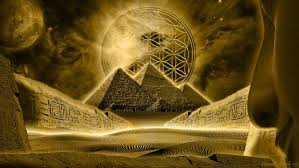
Why Spirituality is Represented Elementally by Gold

In terms of elementalism, it can be said that clay represents health, iron represents courage, silver represents intelligence and gold represents spirituality. But why should spirituality be equated with gold in particular? This essay examines the question.

Gold is the cornerstone of the economy, because it’s ultimately what backs debt (even if that’s no longer as apparent as it was when we were on the gold standard). Everyone knows, intuitively or otherwise, that other people will always accept gold as payment for goods and services, and therefore that the substance always has value. This means that material things can be valued in terms of gold.

In alchemism, gold represents spirituality, for the reason that spiritual treasures are the most valuable of all. The universal appeal of gold is similar to the universal appeal of a genuine connection with God. Much as the value of gold is obvious to anyone who can sense it in the material plane, so is the possession of metaphysical gold obvious to those tuned into it.

Gold is the rarest in physical terms, and its the hardest to create in alchemical terms. Like genuine spiritual wisdom, there simply isn’t very much of it. Although clay is everywhere and iron can easily be found, silver and gold require more effort, and gold twenty times more so than silver.

The intellectual traditions that give value to silver might be hard-won, but it’s possible to develop them in a formulaic manner through the education system. There is no such thing as formulaic development of spirituality. Every consciousness takes its own path back to God.

Without spirituality, people are terrified of their own deaths, because they tend to drift into materialism, and therefore the belief that the brain generates consciousness, and therefore the belief that the death of the physical body means the extermination of this consciousness.

This reasoning causes them to think more short-term. After all, if long-term thinking means having to face up to fact that one will die, it’s best to avoid it entirely. Best just to live for immediate gratification, and the less guilt the better.

This has repercussions, many of which are denied by the men of silver and iron. The men of silver delude themselves into thinking that the spiritual side of life is childish nonsense, in contrast to the hard, adult sobriety of their scientific materialism. The men of iron, for their part, consider gold to be soft and therefore a weak element, not particularly more valuable than clay on account of its lack of immediate application to warfare.

Both are grievously wrong, and wrong in a way that causes immense suffering. The men of silver find that, no matter how many books they read, they cannot solve existential questions without an understanding of the true nature of God. Absent this, the pin is pulled from history and it no longer has any meaning. The men of iron don’t even know what they’re missing out on.

Another way in which gold represents spirituality is that it cannot degrade. Clay can rot, iron can rust and silver can tarnish – but there is no such equivalent for gold. One can leave a gold coin out in the elements for ten years and it will be as shiny as the day one left it there. Like spirituality, gold is not temporal in this sense.

Metaphysical gold works in a similar fashion. The health and strength of every person fades early in their life, and their mental powers fade late, but all of these temporal powers must fade. Spirituality relates to that which endures beyond the death of the physical body, and value earned early in life tends to endure.

A final way is that gold is extremely malleable: one gram of it can be hammered out into a sheet one square metre in area.

Spirituality, too, is extremely malleable. It is useful everywhere. Whereas big muscles are seldom useful and big brains are only useful where there is information to be processed, an appreciation of the fact that this is it will pay off in all domains of life.

*

If you enjoyed reading this essay, you can get a compilation of the Best VJMP Essays and Articles of 2017 from Amazon for Kindle or Amazon for CreateSpace (for international readers), or TradeMe (for Kiwis).
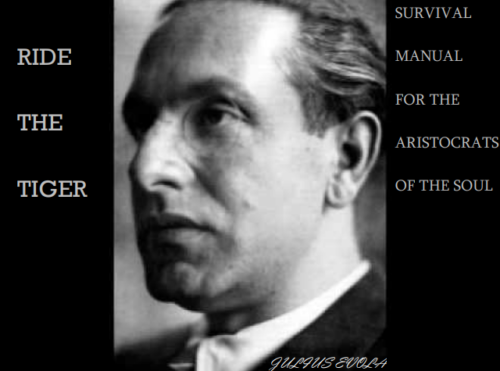

VJMP Reads: Julius Evola’s Ride the Tiger I

Having chosen a left-wing work (The Interregnum) for our previous reading, we now go to the right again and have a look at Julius Evola’s Ride the Tiger. Subtitled “A Survival Manual for the Aristocrats of the Soul”, it’s based on the premise that the fight against modernity has been lost and the only thing a thinking man can do is ride the tiger of modernity until it’s time to rebuild on the other side.

Part I of the eight parts of this book is called “Orientations” and divides into two essays.

The first of these is called ‘The Modern World and Traditional Man’. This opens outright with a declaration that this text isn’t for everyone. Like The Satanic Bible, Evola is explicit in that his book is only for a particular kind of person. Ride the Tiger is written for the outsider.

Evola’s style seems timeless in the sense that his complaints about the nature of society apply just as well to 2018 as they did to his time, and probably apply well to many times in the past. Things are collapsing, certainly in social terms if not yet physical ones, and so Evola advocates a return to traditional values.

These traditional values are not bourgeoisie ones, Evola is at pains to point out, but in fact “the very antithesis of them.” Indeed, he hints at evoking the perennial philosophy, such as when he writes “It is good to sever every link with all that which is destined sooner or later to collapse. The problem will then be to maintain one’s essential direction without leaning οn any given or transmitted form.”

Psychonauts such as the readership of VJM Publishing will commiserate with this feeling, as it’s a handy description of the ego death experience that comes with the peak of a psychedelic trip. One loses all touch with and memory of the fleeting forms of energy that make up the material world, and resides solely in pure consciousness, and thereby reunites with God.

Fittingly, then, Evola states that the Tradition that inspires him has “the character of an esoteric doctrine.”

The second essay, ‘The End of a Cycle – “Ride the Tiger”‘, continues in the same vein. Evola explains that the expression “to ride the tiger” is from the Far East and refers to the idea that it’s safer to ride on the tiger’s back than to try and flee and get pounced on, for the tiger will eventually tire out and then one can make an escape.

Essentially, the idea expressed here is this: great and terrible changes are sweeping the world, and will continue to do so. They will destroy much, if not all, of the existing order, regardless of whether this order is good or bad. There is no hope of resisting this process.

All of this sounds terribly pessimistic and nihilistic on the surface, but it’s clear that, like Nietzsche before him, Evola has anticipated the nihilism that follows the destruction of the incumbent value system, and is speaking of what must come beyond that. He writes of the “Four Ages” system famililar to readers of Plato’s Republic as well as to Hindus.

The warning of this chapter is that the forces of destruction and degeneracy are too powerful to be overcome; resisting them is as futile as resisting the tide. But in this there is still a message of hope: those destructive forces are too mindless, stupid and disorderly to hold sway for very long and so, like the storm, they will pass, and leave an opportunity to rebuild order in their wake.

And so, Evola mocks the “progressive” and “advanced” thinking of the West as little more than symptoms of a disease of the soul. This is apparently the context in which the book ought to be read.

The object of the book is summed up in the final paragraph of this essay: “defining the attitude to be taken toward certain experiences and processes of today”. In other words, how do we deal with the fact that everything’s falling to bits?

*

If you enjoyed reading this essay, you can get a compilation of the Best VJMP Essays and Articles of 2017 from Amazon for Kindle or Amazon for CreateSpace (for international readers), or TradeMe (for Kiwis).
The Yin-Yang of History

Traditionally speaking, when men like this start appearing among your youth, it’s the beginning of the end

The postwar period was a good one for the West. The major Anglo powers had seen all the challengers and potential challengers to their world hegemony bombed flat – partially by them, mostly by each other. With Nazism and Communism both falling to their knees, the liberal democratic order ushered in some good times for the people of the world. Peace and prosperity reigned… but the yin-yang of history tells us that nothing lasts.

The 1990s might be seen, from the vantagepoint of history, as the apogee of these good times. The Soviet Union had fallen, and China and India were yet to rise. Those of us who knew the course of history, however, knew this: good times create weak men. Weak mean create hard times. Hard times create strong men. Strong men create good times.

This is the yin-yang of history.

Good times are the equivalent of summer. Here, people don’t have to think very hard about how to survive and thrive. In the same way that it’s warm and sunny in summertime and so people don’t have to think very hard about what clothing to put on before they go outside, political conditions are favourable in the sense that the ruling class doesn’t have to think very hard about security without and solidarity within.

In the summertime of history, wealth abounds from the increased energy in the atmosphere. To most, these good times seem like they’re going to last forever. The more perceptive of people, however, even if they don’t know about the yin-yang of history, can often see the signs of collapse coming in advance.

The problem with good times, as Plato observed in The Republic, is that they create weak men. When times are good, the tendency is to let minor infractions slide, and although this can lead to an atmosphere of joy it also leads to indiscipline. This indiscipline is why the weak men are weak, and it’s this indiscipline that leads to the hard times.

It might be argued that this is the stage that the West finds itself in 2018 A.D. Our Baby Boomer leaders, who were raised with all the laxness of a generation that had got its fill of violence in World War II and had decided to bring up the Boomers with as little harshness as possible, clearly do not possess the mental discipline to educate themselves properly about the matters of the world.

In our age, it’s entirely possible to find a Western minister or higher who doesn’t know the basics about history or science. There is ample opportunity to learn about such things, of course, but our leaders would rather drink alcohol and watch television. Some, like the Belgian Minister of Health, have lost control of their weight entirely.

These weak men cast a shadow on their nations: the same as the shadows of autumn, who they represent. Their enemies observe this absence of intellectual power, and they move to take advantage.

Because the leaders have no discipline to educate themselves properly, they don’t understand what’s really happening in the world. This results in decisions getting made on the basis of how things used to be a long time ago (but no longer are), or how things might be in some idealised future world (instead of how they now are).

These poor decisions lead naturally to hard times. This stage in the cycle of history corresponds to the wintertime. Leaders lead the people in the wrong direction, causing them to dissipate their energies on follies or to spill them on battlefields for no reward. Here there is poverty – in fact, there is never enough of anything, and people learn to live with want.

Hard times can lead to bitterness, but in the same way that the bitterest cold of winter leads to a hardening in the form of ice, so too do the bitterest lows of life lead to a hardening of the heart. These hard men do not, at first, bode well for the people who they live among. To the contrary – the pitiless, ruthless nature of hard men make them natural criminals and killers.

But the hardness of hard men leads to discipline in those who come after them. This discipline – true iron discipline – is a matter of Will and therefore it is ultimately generated from within. These disciplined men are the opposite of the men we have in 2018 A.D. These disciplined men impose order upon their minds by devoting themselves to the correct course of study and behaviour.

Disciplined people who study hard represent the springtime of a people. It is for these people that VJM Publishing exists. These are the people who will rise up and make good decisions. They will come to occupy positions of leadership not because their backers paid for the best advertising, but because they are asked by their peers to occupy these positions on the basis of demonstrated wisdom.

Because of this wisdom, these leaders are not afraid to shy away from the knowledge necessary to make the correct decisions. This leads to increasing wealth and prosperity. So when the men of gold are recognised as such and are placed into positions of leadership on account of this, then the people will enter another golden age, or another age of summer.

*

If you enjoyed reading this essay, you can get a compilation of the Best VJMP Essays and Articles of 2017 from Amazon for Kindle or Amazon for CreateSpace (for international readers), or TradeMe (for Kiwis).

The Four Kinds of Warfare

When a person hears the word ‘warfare’, it usually conjures up images of fire and explosions, bombs, tanks, blood, death, bayonets and bullets. This is what most people mean by ‘warfare’. As this essay will examine, there are four different elementalist perspectives that we can take towards the subject of war, depending on the realm of reality that we are in.

The element of iron corresponds to the kind of warfare that we are used to. In the natural world, iron represents the strength that came to dominate over the clay. It is the strength of muscle, claws and fangs, and later bone clubs and spears, and then swords, axes and knives and then firearms.

When we talk about warfare we’re usually talking about warfare on this level. Here the goal of the warfare is to reduce one’s opponent to chaos by destroying the coherence of (and therefore the order in) their physical body. The element of iron is especially useful here because it can be hammered into a tool that can pierce or slice through an opponent’s body of clay.

Much of modern warfare in this sense is really a logistical challenge that seeks to optimise how quickly iron can be moved from one part of the battlefield to another. Hence, bullets move as fast as possible and tanks move as fast as cars despite weighing several tons. The apogee of this process might be the aircraft carrier, many of which can carry dozens of strike fighter jets plus other armaments.

The element of silver corresponds to economic warfare. This means that it is a warfare of primarily unseen things: debt and interest rates being the foremost of them. In the same way that a man with an iron instrument can reap a field of wheat, a man with a silver instrument (such as a bank charter) can reap a field of men.

The nature of this economic warfare is silvery like the gossamer of a spider’s web. Its power does not come from crushing and slicing, like the iron, but from dazzling and entangling. It has been used ever since Babylon and bases itself on things that people with ordinary intellects have trouble understanding, like fractional reserve banking.

So people with low levels of financial literacy find themselves bedazzled by the promise of, for example, an instant loan no-questions-asked-right-now, and this leads to them becoming entangled in scams like payday loans that they take out to blow on something like a holiday, and then getting bled for a small amount every week forever to service the interest.

The element of clay corresponds to demographic and biological warfare. This does not mean biological in the sense of nerve agents and genetically engineered viruses, but in the sense that the most powerful weapons of any group of people over the long term are the wombs of their women.

Most refuse to acknowledge it, but Europe is in the process of being conquered by an r-selected, equatorial enemy that primarily wages war by reproducing at a high rate and ensuring that the children produced are brainwashed into willingly serving as soldiers for the furtherance of the meme complex. This is warfare of clay because it’s the same way that plants and insects outcompete each other: by spitting out as many offspring as possible.

It has been said that “demography is destiny”, and this is clearly true if one looks back over history and notes how high birth rates inevitably lead to the surviving offspring seeking out new territories (and usually killing the existing occupants of them). The British Empire was also founded on high birth rates and it has been the same for every previous empire in history.

The element of gold corresponds to spiritual warfare. This is the hardest perspective to understand, and it is the perspective that is the most valuable.

The reason why it is the most valuable is the battlefield in question here is the human will, absent which, no force can triumph in any of the other three areas of warfare, no matter how vigorous, strong or smart.

It isn’t a simple matter to describe how warfare is conducted on this level, but it’s enough to say that the spiritual birthright of every human being is to understand that their core essence is pure consciousness, and that this consciousness is immortal, invulnerable and eternal and is the same as God.

*

If you enjoyed reading this essay, you can get a compilation of the Best VJMP Essays and Articles of 2017 from Amazon for Kindle or Amazon for CreateSpace (for international readers), or TradeMe (for Kiwis).