
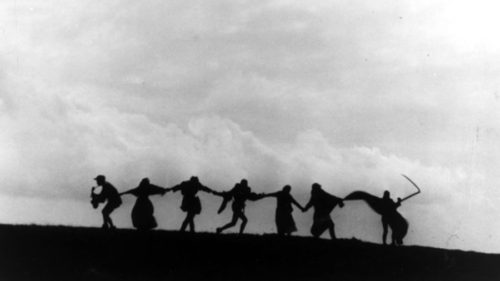
The Ultimate Power is to Make Peace With Death

Socrates was not wrong when he said “those who really apply themselves in the right way to philosophy are directly and of their own accord preparing themselves for dying and death.” The best thing a person can ever do is to accustom themselves to the fact that they are mortal and therefore that time on this planet is limited. To the extent that this can be achieved, a person can be liberated from a tremendous range of miseries.

All fear ultimately comes from a fear of death. The reason why pain is frightening is because we have evolved an instinctual appreciation that pain is a harbinger of death. When you are in pain, it means that Death has you in its sights. Pain gives us energy because we can instinctively appreciate the seriousness of the threat.

When kids fight each other in the playground, and they learn to force each other’s wills through violence, the natural fear of death possessed by each child makes this easy. A little bit of pain from a twisted arm, in the mind of someone young and inexperienced, is tantamount to a near-death experience, and so compliance is easily given. A little bit of social disapproval in the form of a stern teacher likewise.

It’s expected that adults will be a bit braver and harder to manipulate. Adults have had longer to come to terms with death, and in that time they might have overcome their fear of it. Failing that, they might have learned to behave in ways that hide their fear of it. Failing that, they might at least have found a way to trick themselves into going forward with some semblance of dignity.

The less fear of death any given adult has, the more powerful they will be. This is fundamentally a spiritual power, but it works its magic by way of its gradual effect on the people around its possessor (much like gold does). Someone unafraid of death will have charisma, they will inspire confidence, people will follow them, and people will respect them for having found existential solace. It’s a power more subtle than silver, but at the same time one with a much greater reach.

On the other hand, no-one is expected to make peace with death, or at least not entirely, for there is no public consensus of any kind as to what befalls consciousness upon the expiration of the physical body. Conviction in the matter of what does befall consciousness is reserved for a very few, most of whom are readily and fairly dismissed as some kind of religious fanatic who is merely parroting what they have been brainwashed with.

The gnosis of those who have seen beyond and know what lies beyond death is almost never accepted by the masses, and for good reason: the vast bulk of the people claiming to know are patently scammers, and so distrust is necessary and natural. Selling tickets to an afterlife in exchange for worldly goods has always been the default con job of the black priesthood, and one that may even have been practised in prehistory.

The Tao teaches us that, even in the time of the total triumph of yin, there is invariably a tiny speck of yang that will grow to impose a new order upon things. In a similar manner, all of these religious scammers have, in common, certain insights about the nature of life as a material being that remain true despite the horseshit layered on top of them. We all die, and we’re all afraid of it, and we’re all willing to take action to ameliorate that fear.

This column is willing to give you gold for free: once you make peace with death you are invincible, for all psychological weakness flows directly from the fear of it. Without a fear of death one cannot be threatened with torture, because death would simply mean a sweet release from such, and no other physical threat is as bad as torture. Without a fear of death, one cannot be intimidated in any way, for there is no reason to bow the knee to an oppressor if they are not able to materially hurt you.

A person who has made peace with their mortality will stand, on the metaphysical plane, like a great boulder of granite, which cannot be moved or damaged. The winds and waves of fear and dread will not impact such a person; they will barely change the expression on the face of one. A person who has made peace with death knows that there’s nothing more but to sit back and watch as the wave breaks upon the shore. The dissolution of the wave is something to be experienced, not feared.

However, there’s a risk.

The more you look into the face of death, the deeper you look into the void. What happens then is not necessarily up to you, not even with all the will in the world. As Nietzsche warned us, the void will also look into you. When it does, you might come to decide that life itself is evil on account of the inevitable suffering it promises and that death is to be welcomed and encouraged as a release from same and as a reunion with God.

And at that point it’s extremely easy to make a terrible mistake.

Do you have the courage to look into the very back of the void, with nothing more than a hope that one will be rewarded? This column can give no assurance that any person who does look will be the better off for it. Madness is an ever-present threat for those who do, for one might find that one’s will disintegrates under the weight of this hidden knowledge. All we can say is that one ought to prepare oneself thoroughly, for one is staking a claim to godhood and ought to expect that it will be commensurately challenging.

*

If you enjoyed reading this essay, you can get a compilation of the Best VJMP Essays and Articles of 2017 from Amazon for Kindle or Amazon for CreateSpace (for international readers), or TradeMe (for Kiwis).
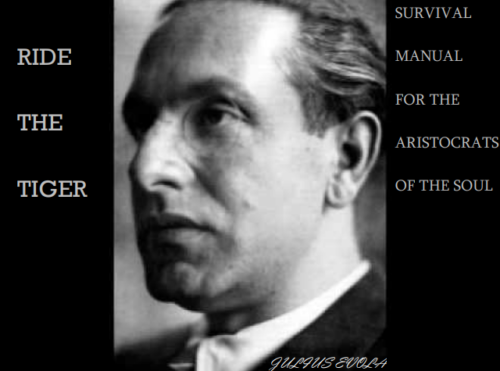
VJMP Reads: Julius Evola’s Ride the Tiger VI

This reading continues on from here.

Part Four of Ride The Tiger is called ‘Dissolution of the Individual’ and is comprised of three essays. The first of these, the sixteenth in the book, is called ‘The Dual Aspect of Anonymity’. Railing against the “collectivism, mechanization, standardization, and soullessness οf modern existence,” here Evola attempts to find an answer to the question of what is worth saving.

It’s at this point that Evola finally gets to the esotericism. Individualism is part of the problem facing us, he contends, because it has led to the atomisation of society. Worse, it has no spiritual basis. What is taken by Westerners to be the individual is not what a person really, fundamentally is.

In esoteric terms, Evola is here talking about the difference between silver and gold. Here the men of silver are decried for their pomposity and hypocrisy, for this has obscured the light of spiritual truth and made it more difficult for the men of gold to play their part. The false self must be transcended and the true self reconnected with, otherwise we will continue to flounder.

The seventeenth essay is called ‘Destructions and Liberations in the New Realism’. Here, Evola gives us for the first time a specific sense of what it might mean to “ride the tiger”. For him it is a life lived at the limit, in a way that actualises the “absolute person”. Most people who discover this do so through warfare, for it is here that an extreme lucidity stripping away all extraneous concerns can be achieved.

Evola makes vague hints at a gross feminising process that, he warns, will make any individualisation impossible. Crucially, however, this feminisation is necessary, to destroy the corruption of the old order. He continues to emphasise that any true revaluation of values must come from that “minority” who retain a sense of the transcendental. Anyone else will merely make the same mistakes that the other non-spiritual people have made.

What is necessary to move forwards from here is “a clear, detached, objective vision οf existence” and “a positive, existential incapacity to submit to ‘myths’ οf any kind whatsoever”. The new mythologies (such as Marxism) are not only doomed to fail, they are in fact signs of systemic failure.

The eighteenth essay is called ‘The “Animal Ideal” – the Sentiment of Nature’. Here Evola talks about the two fundamental spiritual orientations – the first being the hermit who lives without company and the second the wanderer who lives without fixed abode. Incredibly for an essay published in 1961, here Evola talks about the isolation and detachment that can be caused by modern communication technology and city life, foreshadowing contemporary sentiments about the Internet and smartphones.

Anticipating – and pre-emptively decrying – the hippie movement as a bourgeoisie failure, Evola rejects a return to primitivism as being merely a naked form of materialism. Conceding that athletics and sports may be useful (although he decries professional sport), Evola once again asserts that spiritual needs must come first. The true aristocrat of the soul must feel as comfortable among dams and skyscrapers as among trees and streams, for the former is an expression of human nature and thereby of Nature itself.

Fundamentally, a person needs to accept that “nothing extraordinary exists in the beyond”. Only the real exists and only the real can be said to exist. To this end, there is a lot of wisdom in ancient traditions, especially Zen. These allow us to cultivate an appreciation of how reality consists of both the immanent making itself transcendent and the transcendent making itself immanent.

*

If you enjoyed reading this essay, you can get a compilation of the Best VJMP Essays and Articles of 2017 from Amazon for Kindle or Amazon for CreateSpace (for international readers), or TradeMe (for Kiwis).

Buddhism is Incompatible With Abrahamism, But Fully Compatible With Luciferianism

The apotheosis of Buddha came not through grovelling, sadomasochism and superstitious entreaties, but from lucid, rational and brave introspection

The fashionable talk today is about interfaith dialogue. All of sudden, everyone’s trying to emphasise what the world’s various religious traditions have in common. Some even go as far as to say that all religions worship the same God. Despite the absurdity of most of this fashionable lip-flapping, this essay will argue that, at least, Buddhism is compatible with Luciferianism.

Some say the reason for this interfaith dialogue is that talking leads to fewer misunderstandings, which leads to less violence. Leaving aside the fact that Abrahamism causes 99%+ of the world’s religious violence anyway, the problem with Abrahamism is that the more one learns about it, the less one respects it. Even worse, the more time one spends around its followers, the less one respects it.

On the face of it, there are several major ways that Buddhism appears utterly incompatible with Abrahamism. On the other hand, although Buddhism could never find peaceful co-existence with Abrahamism, it could find it with Luciferianism.

The major tenet of Buddhism is that one acts in a way that minimises the suffering of other sentient beings. The principle behind this is compassion, in that the suffering of those other beings is an important thing that ought to be taken into consideration. A related teaching is the interdependence of all things, which cultivates an appreciation of the effects that one’s actions have on the well-being of other creatures.

There are no such concepts in Abrahamism. Working to reduce suffering is incidental to following the directives of God – if homosexuals are to be put to death then so be it. God says so. It matters not whether this action reduces or increases the suffering in the world. Likewise, women have to be put in their place, and non-believers persecuted. Compassion doesn’t come into it; all that matters is submission.

Luciferianism doesn’t really have set instructions for what to do about the suffering of other conscious beings. Cruelty, however, is seen as petty, small-minded, even bestial. The Abrahamic insistence on male infant genital mutilation appalls the Luciferian, who tends to see it as a gross violation of power with superstitious origins.

This attitude of submission (and of forcing submission) is another way in which Buddhism is not compatible with Abrahamism. For example, Buddha said:

“Don’t blindly believe what I say. Don’t believe me because others convince you of my words. Don’t believe anything you see, read, or hear from others, whether of authority, religious teachers or texts. Don’t rely on logic alone, nor speculation. Don’t infer or be deceived by appearances. Find out for yourself what is true and virtuous.”

This is an extremely Luciferian attitude. Here, Buddha appears to be saying explicitly not to worship him, not to see him as something higher. A Luciferian would understand that one cannot take another person for an authority on how we all got here or what we’re doing, while a Buddhist might contend that the nature of God is irrelevant.

By contrast, Abrahamism preaches submission to dogma. Questioning the priest is not the done thing, because he speaks with the authority of God. Whereas a Buddhist teacher will sit at the front of a class and take questions, which are answered honestly, the Abrahamist preaches from a raised pulpit, and takes no questions. Questions imply free-thinking, which is a sin because it correlates negatively with submission.

Buddhism doesn’t demand that anyone bow down to anyone else. There is no self-appointed “God’s Representative on Earth”. A Buddhist would not give any credence to anyone claiming to speak for God, for any reason – the Pope has no more spiritual authority than a schizophrenic street prophet. The shiny silver that high priests are bedecked with will not convince a Buddhist that they know what they’re talking about.

What matters to the Luciferian, like the Buddhist, is a methodology by which truth might be discerned. Abrahamism is not a methodology – it is a dogma. Where the Luciferian and the Buddhist might meet on equal terms to discuss strategies and tactics of mutual interest, the Abrahamist presumes to dictate the truth, and the right to enforce submission to this truth with violence.

It seems like Buddhism appeals to the same sort of people as Luciferianism. It may be that both traditions arose to meet the challenges of their time and place: Buddhism with immense physical poverty, and Luciferianism with suffocating environments of spiritual lies, misdirections and untruths.

Buddhism deals with the lies of the senses and the mind, and Luciferianism with the lies of the Abrahamists. They are both master moralities, in contrast to the slave philosophies of the desert.

*

If you enjoyed reading this essay, you can get a compilation of the Best VJMP Essays and Articles of 2017 from Amazon for Kindle or Amazon for CreateSpace (for international readers), or TradeMe (for Kiwis).

VJMP Reads: Julius Evola’s Ride the Tiger IV

This reading continues on from here.

The tenth essay in Ride The Tiger is called ‘Invulnerability – Apollo and Dionysus’. Here Evola further describes his conception of an aristocrat of the soul as someone who feels very deeply and who is very moved by things. The modern man (the man of clay, essentially), only feels very shallow emotions, and quickly moves from one such shallow impression to the next.

In this essay, Evola touches on the truly aristocratic topic of deliberately exposing oneself to great trials and tribulations, for the sake of learning one’s true nature. Alchemists will recognise this mentality as the one necessary to burn away everything but the gold so as to learn to distinguish Spirit from Nature. The purifying fire is that which burns away body and mind and leaves one with one’s true nature – it is necessary because it burns away everything shallow, leaving only actions which arise from the depths.

A person who has done this may find themselves gifted with a “transcendent confidence” that is characteristic of the aristocrat of the soul. This is important because in purifying oneself down to the gold one also strips away all of the conditioned belief in life’s meaning. To proceed past this stage, the alchemist must find within themselves the will to assert a meaning to life independent of any outside source. Then one is invulnerable.

To open oneself without falling apart is not easy in an age of dissolution. Here Evola takes care to point out that it’s very easy to fall at the second hurdle. Just because mainstream religion is bullshit doesn’t mean that we should abandon it for wild paganism and barbarianism. There is more.

The eleventh essay is called ‘Acting Without Desire – The Causal Law’. Once a person discovers their true nature, they should also learn the ability to act without desire. This entails taking the correct action at any given time instead of becoming distracted by profit or loss, or by what other people might think of you. Doing what needs to be done.

This needs to be qualified, however. There are naturalistic desires, that arise from the biology of the human animal. These are generally to be avoided. There are also, however, heroic desires, that arise from something greater than the merely physical, from something transcendent. These may be acted upon.

An aristocratic person, then, thinks not in terms of sin but in terms of error. The concept of sin is impossible because God has long been repudiated; all that remains is adherence to standards that one sets from within as an expression of one’s true nature.

One ought to act with a mind to what is effectively a law of karma, in that actions have consequences, regardless of whether those actions conform to any conception of good or evil. Those consequences are real and should be regarded as such. This is fine because the real man of gold doesn’t just live, but rather manifests himself and his true nature in the world.

This is the end of the second part of the book. The next part is called ‘The Dead End of Existentialism’, and the first essay here is the book’s twelfth: ‘Being and Inauthentic Existence’. This deals with the two types of existentialism (as Evola sees it): the philosophical, academic tradition and the practical tradition exemplified by Jean-Paul Sartre.

Evola dismisses existentialism almost entirely, for the reason that the existentialist philosophers are too much a product of their times, and because they are not themselves interested in the world beyond. The existentialists are very materialistic and this disqualifies existentialism from being a philosophy that an aristocrat might be concerned with.

Despite this, existentialism can be credited with some things. For one, the idea that “existence precedes essence” serves to keep the existentialist in touch with the metaphysical and transcendent. It also helps to highlight the dual nature of the aristocratic soul, which, as described earlier, is much deeper than that of the pleb.

*

If you enjoyed reading this essay, you can get a compilation of the Best VJMP Essays and Articles of 2017 from Amazon for Kindle or Amazon for CreateSpace (for international readers), or TradeMe (for Kiwis).