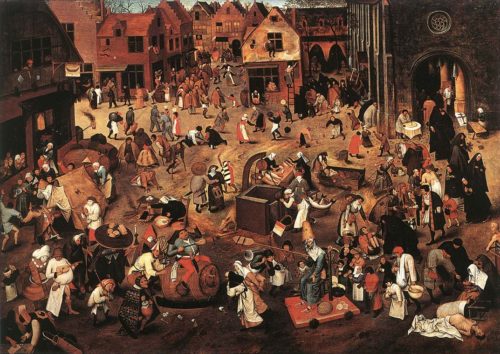
The World That Sober People Built

Sober minds built the atomic bomb that fell on Hiroshima; sober minds gave the orders to drop that bomb; sober minds followed those orders

“That person must have been on drugs” is a common response to observing all kinds of wacked-out behaviour, as if taking a psychoactive drug inevitably brings about false kinds of thinking – a cognitive bias this column has previously described as Sobriety Bias Syndrome. But if we look around the world that sober people built, and the moral values agreed upon by sober people, things really didn’t turn out that great.

It was pious and sober people who decided, a few thousand years ago, that mutilating the genitals of baby boys was a legitimate expression of God’s will. It was sober people who decided to adopt this tradition from the foreigners who practiced it, and people are sober when they argue for the “health benefits” of the mutilation.

George W. Bush, completely sober, decided that sending the firepower of the US military after Saddam Hussein’s Iraq was a great idea, even though it led directly to the deaths of over a million people. The US Congress, elected to represent the American people, also soberly decided that this was a great idea.

In the 1930s we created and watched “documentaries” such as Reefer Madness, which exhorted us to tell our children that smoking cannabis will turn them into murderers; a dozen years later, with god-fearing sobriety, we built nuclear weapons and dropped them on Japanese civilians, killing hundreds of thousands in one hit.

These are the actions of sober minds. So clearly a person doesn’t have to be intoxicated in order to do terrible things to someone else.

Far from it. In many ways, sobriety can be seen as a kind of virus. Its presence in a person’s mind tends to work to drive out periods of non-sobriety, usually because of egoistic religious delusions about achieving purity of thought. The sober mind tends to have thoughts repeating in it over and over again, and this repetition can lead to a powerful commitment to some ideas.

This is a fact long understood by television programmers, who appreciate how repeated exposure to a short, powerful stimulus is more likely to induce purchasing behaviour in a potential consumer than a single exposure to e.g. a lecture about the qualities of a product.

Because novel psychoactive experiences tend to destroy this conditioning by allowing the conditioned person to see things from new perspectives, if you want to get everyone marching in lockstep then these psychoactive experiences need to be either discouraged or made illegal.

Consequently, entirely sober people have decided, presumably using sober logic, that putting another human being in a cage is a fair punishment for being caught growing a medicinal plant without permission.

Maybe there’s an argument that too much sobriety makes an individual mean from a lack of levity, and a society dumb from a lack of questioning?

After all, the mass shooters making the front pages recently are definitely not smoking weed, taking ecstasy or tripping on mushrooms or LSD, and neither are the genital mutilators, military warhawks and brainwashers that are responsible for most of the world’s evil.

The truth is that the world needs a diversity of ideas if humans are to survive the challenges of coming years. Never mind a diversity of skin colour – such superficial qualities do not constitute real diversity. Real diversity is diversity of ideas, even outlandish ones, even crazy ones, because that is the kind of diversity that saves us from groupthink and prevents us from making the kind of error that arises from self-righteous conviction about one’s correctness.

To that end, sobriety is our enemy and getting wasted is our friend.

The Big Lie of Our Age

Many pseudoscientific writings speak of the parts of the brain that give rise to consciousness, as if the question of whether the brain does generate consciousness had already been answered in the affirmative

The Big Lie of our age is that the brain generates consciousness. It’s a lie characteristic of our exceptionally materialistic age, because in most other times in human history people have retained their intuitive awareness of the primacy of consciousness. In the modern West, however, it’s simply taken for granted that the brain generates consciousness, and the deleterious consequences of this belief are denied or explained away.

This Big Lie has come about as a result of a reasoning error that became fashionable in the wake of the Enlightenment. The idea was that religion had held humanity back during the Dark Ages by making scientific research impractical, and therefore religious dogma had to be discarded from the scientific reasoning process, and therefore all talk of a world beyond the material had to be abandoned, and therefore consciousness simply had to be a material property.

From this Big Lie a number of falsehoods arise. Many of these falsehoods are encouraged by the ruling classes because they make the plebs easier to rule.

For instance, the belief that the brain generates consciousness leads immediately to the belief that the death of the brain (alongside the inevitable death of the physical body) must inevitably mean the “end” of consciousness. Because if the body dies, and the brain dies with it, then the brain must logically lose its capacity for ‘generating’ or ‘maintaining’ consciousness and thus that consciousness must disappear.

This belief, while predicated entirely on a falsehood, leads to a number of other beliefs.

The most powerful of these is the belief that this life is all that there is. If the death of this physical body means the death of consciousness, then I cannot be held responsible for anything I do while in this place (i.e. Earth, more or less). Therefore, if I take money now in exchange for attacking another person, or if I murder, rob or rape, then I only have to get away with it for as long as this physical life endures.

Another odd idea that follows naturally from the Big Lie is that only creatures with brain structures similar to that which knows itself to be conscious can also be conscious. If the brain generates consciousness by means of some property inherent to it (such as a critical mass of complexity) then other creatures can only be considered conscious to the degree that they share these brain structures with the person thinking up the consciousness theory (after all, that person knows themselves 100% to be conscious).

One delusion is that mortal terror is an appropriately dignified response to mortal threats for a civilised human. It is if you believe that the brain generates consciousness, but if you don’t believe this it becomes possible to be genuinely courageous. After all, why subject yourself to mortal terror if you know that the contents of consciousness are ephemeral and transient?

Of course, the ruling classes are generally happy to have people believe that this life is all there is, for a variety of reasons. Not least of these reasons are because it discourages anarcho-homicidalist action by making people afraid of execution, and because it makes people greedy, aggressive and acquisitive as they try to cram an eternity’s worth of pleasures into one mortal incarnation.

It is ultimately because of this Big Lie that cannabis and the psychedelics are illegal. These drugs modify behaviour by making the user aware, however fleetingly, of a world beyond the material. In this world beyond are immutable moral principles, and it’s harder to pull the strings of people who are aware of these principles and believe in them. Such people tend to make their own decisions.

A common experience on psychedelics is to feel the material world slipping out of consciousness and to become aware of an entirely different world as seen through an entirely different set of eyes, but which is ultimately comprehended by the same consciousness. This often results in the tripper learning the lesson of the primacy of consciousness and how conceptions of time and space are illusions brought about by temporary separation from God.

It is because of the Big Lie that people who become privy to such revelations about the true nature of reality – whether by taking psychedelic drugs or through other means – are seen as having gone insane, and their revelations seen as chaotic nonsense of no value. After all, if a psychonaut comes to realise that the Big Lie is a big lie, then that psychonaut must be dismissed as a space cadet or schizophrenic lest this realisation catch on.

Could Amelia Kerr Play For the Black Caps?

Cricket is a game of skill, not strength, and Amelia Kerr has bags of that. Could she compete with the men?

The main reason for dividing sports teams into men and women is because this reflects the basic division of labour that has occurred in nature: into male fighters and female reproducers. This is the same logic as dividing boxers into weight divisions – that the categories are so different that to pit them against each other is not a fair competition. As this essay will examine, one niche within sports where the female body has an advantage over the male one is that of legspinner.

The chance of a female competing with men in heavyweight boxing, absent some wicked cybernetic arms or computer targeting systems in bionic eyes, is practically zero, and the same could be said of Greco-Roman wrestling or rugby. These sports are too similar to actual fighting for women to compete with men, who are the result of millions of years of natural and sexual selection of fighting skills.

Cricket is, like other sports, a metaphor for combat, but it is not like other sports. It’s not primarily a contest of strength, speed, size, height or aggression. Cricket is a contest of skill, guile, concentration and nerve – qualities that might be of immense value in the conduct of warfare, but not so much in actual fighting.

This is why the sportsmen who become the world’s top cricketers are very seldom in top fighting shape. Kane Williamson, Steve Smith, Joe Root and Virat Kohli are far from musclemen; Rangana Herath, who just moved past 400 Test wickets, is known as “Fatty” for his distinctive pot belly and the less said about Dwayne Leverock the better.

There’s a lot of skill in fast bowling, but physical attributes are crucial. Although the most skilled fast bowlers – like Dale Steyn, Trent Boult and Jimmy Anderson – are not particularly tall, they are all far from short. Moreover, any player lacking those skill levels almost has to be tall in order to make it.

In either case, women can’t compete with men in fast bowling because so much of the action of slinging a weight (like a ball) is a function of shoulder strength, and shoulder strength is one of the ways in which men are stronger than women by the greatest amount.

There’s a lot of skill in batting, but there’s also a lot of strength. Williamson and Kohli might trade on skill but they are far from weaklings. No woman could realistically compete with either player, much less the heavy hitters like Martin Guptill, Chris Gayle, David Warner or Brendon McCullum.

As in the two categories of cricketer above, there’s a lot of skill in spin bowling, but in this regard there is no benefit at all to being strong.

In fact, having big muscles might be a disadvantage. Muttiah Muralitharan, the single most successful spin bowler in the history of cricket, had famously rubbery wrists, extremely flexible, which enabled him to sling the ball with a whipping action that imparted incredible turn.

It’s known that women are more flexible in the wrists, elbows and shoulders than men, which is partially a function of having less muscle mass. This flexibility ought to make it possible for female bowlers, like legspinner Amelia Kerr (see video), to put more spin on the ball for the same reasons that Muralitharan could.

However, the big thing when it comes to spin bowling is smarts. The bowler is trying to deceive the batsman, trying to make them play down the wrong line or put their feet in the wrong place anticipating spin in, for example, the other direction.

To this end they need a lot of variations. It seems like Kerr already has most of the variations – and speaking of variations, very few international men’s cricket sides will have faced a bowler as short as Kerr, and therefore they will not be used to the trajectory her deliveries come from.

All this raises a question. Kerr currently has 20 wickets in women’s ODI cricket at an average of 22, and it might be that the coaches of the Black Caps decide that her cunning, guile, variations and unpredictability make her more dangerous against the Black Caps’ next opponent than the best legspinning male. Should Kerr then be eligible for the Black Caps?

Some might argue that the Black Caps are specifically a male representative team and so it doesn’t make sense to pick a woman to play in it, in same way that no-one would select a man to play in the Silver Ferns.

Others would argue that the sport of cricket was only gender-segregated in the first place because of the unlikelihood that any given woman could compete with men, so if a woman is good enough to compete with the best men there is no reason to enforce segregation.

In any case, this column predicts that if Kerr would get the chance to bowl in a net with the Black Caps, the men would learn a thing or two from her.

The Alchemy of the Evolutionary History of Hominids

The invention and refinement of the spear was one of the first significant applications of human intelligence

All regular readers of this column will be familiar with four temperaments theory, which is the idea that humans fall into four psychological groups that correspond to the four feminine elements of earth, water, air and fire. As a previous essay discussed, these four elements could be considered to be the four feminine elements of equal value, in contrast to the four masculine elements of varying value. This essay looks at the four temperaments according to the four masculine elements.

The most elementary sort of person is the one that exists in the state of nature. This corresponds to the man of clay. This is how people are when we’re not significantly distinguished from the rest of the animal kingdom – in other words, when we’re just a third chimpanzee.

In esoteric terms, this is a person with no divine inspiration. Such a person will not feel any reason to question the various animal impulses that come through their mind, and consequently they will behave much like an animal. They will be aggressive, vicious, spiteful, brutal, jealous and envious.

Divine inspiration manifests in the man of iron as someone with a concept of discipline. At the most primitive level, this means someone who is able to overcome their fear of physical suffering in order to hold fast and resist an enemy, usually in the form of another man or a predatory animal.

At the most primitive level of humanity, this is how people came to distinguish themselves from the ordinary ape-man, and this is therefore how humanity began to evolve into something higher. Tuning into this frequency of iron meant learning the virtues of bravery and courage which, when applied to death, allow a person to act as something more than just a fear, hunger and sex-based animal.

After a certain critical mass of iron was reached, some of it began, like fusion in the heart of a star, to brighten into silver. This was when people came to learn that intelligent application of discipline was better than discipline for the sake of discipline.

This was also the point at which humans started to use their brains and intellects to secure survival and reproductive advantages. A crucial stage in this process was the invention of the spear. The application of intellect necessary to first realise that a spear is a more effective weapon than a club, and second to improve it by hardening the tip in fire, catapulted humanity forward.

The value of silver is in that it is softer than iron and can therefore be used to direct iron in subtler ways. When humanity started to appreciate this value, then iron was consciously polished into silver for the first time.

This led to a third type of person, one who was neither animal nor knight but somewhere in between. This person carved a niche for themselves out of reality primarily through their minds, i.e. through the application of intelligence. On an alchemical level, this sort of person corresponds to the element of silver.

Music began to develop at this point, as did language more complicated than the growls and hisses that we shared with other mammals like cats and monkeys. Evidently, people decided that they naturally liked that sort of thing because all cultures developed a musical tradition and a tradition of singing.

The real development of silver, however, wasn’t in levity but in lying and cheating and scheming and plotting, either against other people or other animals in hunting or nature itself in agriculture. Silver is not gold, and intelligence is entirely separate from morality.

Most humans don’t develop much past this stage of silver, if they even get that far. But for those who did, the next step was the advent of philosophy, and alongside that came the ritual use of psychoactive drugs.

The first of these drugs to be used ritually was probably psilocybin mushrooms or amanita muscaria, followed by ayahuasca, alcohol and then cannabis. Mushrooms are the obvious choice for ritual use because they require no real preparation (although ought to be dried for reasons of palatability) and because they spring up at at a regular and predictable point in the seasonal cycle.

Once this started to happen, humans started to develop a sense of spirituality. The broader perspectives offered by the altered states of consciousness that were deliberately entered into, often enough for a shaman to learn to navigate in them, allowed for an appreciation of something much greater than oneself, an insight into higher levels of the Great Fractal.

Once insights like this were reached, it became possible for consciousness to affect reality on the level of gold, which is to say, the level of correct conduct.

This led to a fourth sort of person, one who is capable of guiding and influencing all of the other elements despite being soft like the clay. This person was able to lead by example, and therefore did not need to be strong like iron or quick-thinking like silver. This sort of person is rare enough that they are like the gold.

This sort of person took the role of the shaman in ancient society, in that they were a person who experimented with altered states of consciousness for the sake of maximising the breadth of their perspective on reality. This path requires both the courage of iron and the cunning of silver, and in this manner is like a synthesis of the two.